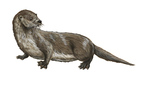
Lutra lutraEuropean otter


Geographic Range
Lutra lutra inhabits most of Eurasia south of the tundra line and North Africa. (MacDonald, 1984)
- Biogeographic Regions
- palearctic
Habitat
Lutra lutra forage in water and nest on land. They inhabit rivers, lakes, streams, freshwater and peat swamp forests, ricefields, ocean shores, fjords, caves, and terrestrial habitats adjacent to waterways. Covered dens and dry resting sites are found in earth tunnnels, tree roots, boulder piles, shrubs, and banks. In its territory of 1 to 4 miles, each river otter has fixed locations for getting into and out of the water, rolling, sunbathing, and sliding on "otter stairways". (Grzimek 1990, Sivasothi 1994)
- Aquatic Biomes
- lakes and ponds
- rivers and streams
- coastal
Physical Description
- Other Physical Features
- endothermic
- bilateral symmetry
Reproduction
Lutra lutra has a continuous breeding cycle and female otters have a continuous estrus cycle. Mating can take place either in water or on land. The main mating season is from February to March and July. Gestation lasts 60 to 70 days and weaning occurs at 3 months. Each female river otter usually gives birth to 2 or 3 cubs which are 99 to 122gm at birth. The cubs' eyes open after one month and they begin to leave the nest after two months. The young stay with their mothers for up to 14 months and reach sexual maturity after 2 or 3 years. (Heggberget 1994, Grzimek 1990)
- Key Reproductive Features
- gonochoric/gonochoristic/dioecious (sexes separate)
- sexual
Lifespan/Longevity
-
- Average lifespan
Status: captivity - 22.0 years
- Max Planck Institute for Demographic Research
- Average lifespan
Behavior
River otters can dive for up to two minutes underwater and are most active at dusk and during the night.
Lutra lutra are basically solitary animals with only temporary pairing of mates or mothers with their young, although they are sometimes found in loosely knit groups of up to six animals.
Otters are often described as playful and have been observed sliding down mudbanks or snowdrifts on their bellies. Both juvenile and adult L. lutra play, trot, gallop, slide, and chase each other in water. This behavior is thought to help young otters perfect their hunting techniques.
Lutra lutra are vocal, with basic calls of alarm, greeting, and mating as well as up to 12 other calls. The voice of L.lutra consists of short, shrill whistling, yelps, whimpers, and high pitched screams of distress.
River otters have paired scent glands at the base of their tail which give off a heavy, musky smell. Scent marking is a form of communication between otters about the territorial boundaries, identity, and sexual state of each otter. Otters not only mark vegetation and logs with their scent but cover their fur as well. (MacDonald 1984, Sivasothi 1994)
- Key Behaviors
- motile
Communication and Perception
Food Habits
Lutra lutra individuals eat fish, crustaceans, clams, small mammals and amphibians, birds, eggs, insects, worms, and a small amount of vegetation. They use their vibrissae (whiskers) as sensing organs underwater to monitor the movements of fishes and other prey. River otters hunt and feed several times a day, consuming about 1kg of food daily. (Grzimek 1990, MacDonald 1984, Heggberget 1994)
Economic Importance for Humans: Positive
The pelts of river otters are considered to be valuable to humans. (Grzimek 1990)
Economic Importance for Humans: Negative
In the past river otters were considered to be the main competition of fishermen and a bounty was paid by the Swiss goverment for each otter killed. (Sivasothi 1994)
Conservation Status
-
- IUCN Red List
-
Near Threatened
More information
Contributors
Susan Kennedy (author), University of Michigan-Ann Arbor.
Glossary
- Palearctic
-
living in the northern part of the Old World. In otherwords, Europe and Asia and northern Africa.

- bilateral symmetry
-
having body symmetry such that the animal can be divided in one plane into two mirror-image halves. Animals with bilateral symmetry have dorsal and ventral sides, as well as anterior and posterior ends. Synapomorphy of the Bilateria.
- chemical
-
uses smells or other chemicals to communicate
- coastal
-
the nearshore aquatic habitats near a coast, or shoreline.
- endothermic
-
animals that use metabolically generated heat to regulate body temperature independently of ambient temperature. Endothermy is a synapomorphy of the Mammalia, although it may have arisen in a (now extinct) synapsid ancestor; the fossil record does not distinguish these possibilities. Convergent in birds.
- motile
-
having the capacity to move from one place to another.
- native range
-
the area in which the animal is naturally found, the region in which it is endemic.
- sexual
-
reproduction that includes combining the genetic contribution of two individuals, a male and a female
- tactile
-
uses touch to communicate
References
Corbet, G. and J. Hill. 1992. The Mammals of the Indomalayan Region. Oxford University Press, NY.
Grzimek's Encyclopedia of Mammals. Vol 3. 1990. McGraw-Hill Publishing Company, NY.
Heggberget, T. and H. Christensen. 1994. Reproductive timing in Eurasian otters on the coast of Norway. Ecography 17: 339-348.
Heggberget, T. and K. Moseid. 1994. Prey selection in coastal Eurasian otters Lutra lutra. Ecography 17: 331-338.
MacDonald, D. 1984. Encyclopedia of Mammals. Facts on File Publications, NY.
Sivasothi, N. and B. Nor. 1994. A review of otters (Carnivora: Mustelidae: Lutrinae) in Malaysia and Singapore. Hydrobiologia 285: 151-170.
Tate, G. 1947. Mammals of Eastern Asia. The Macmillan Company, NY.