Leptailurus servalserval
Geographic Range
Leptailurus serval (formerly classified as Felis serval) is a member of the family Felidae. African servals, originally found throughout Africa, now predominantly reside in southern Africa, especially in Zimbabwe and the province of Natal. Small populations are located in the Atlas Mountains, where distributions were greater prior to 1980. African servals have also been found in Algeria, Morocco, Ethiopia, and south of the Sahara. Due to relocation efforts, members of this species can now be found in northern Tanzania. (Alderton, 1993; Geertsema, 1991; Livingston, 2009; Perrin, 2001)
Habitat
African servals are most commonly found in reed beds and grasslands, which primarily consist of Themeda triandra. They also spend time in forest brush, bamboo thickets, marshes, and streams within their home range. The average annual temperature within the geographic range of African servals is 13.7 °C and the average rainfall 826 mm/year. Members of this species in the Ngorongoro Crater in Tanzania are found at elevations between 1400 and 2200 m where winters are mild and there is occasional snowfall. (Geertsema, 1991; Perrin, 2001)
- Habitat Regions
- temperate
- tropical
- terrestrial
- Terrestrial Biomes
- savanna or grassland
-
- Range elevation
- 1400 to 2200 m
- 4593.18 to 7217.85 ft
Physical Description
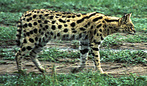
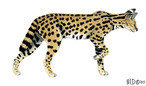
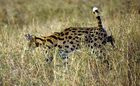
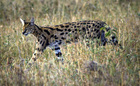
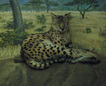
Adult African servals are slender, agile, and approximately 60 cm in length from shoulder to tail. Males weigh about 9 to 18 kg and females 9 to 13 kg. Their legs and ears are long and considered the largest in the cat family relative to their size. African servals have a coat with copper hue. Their ventral side and some of their facial features are white. They have black spots and stripes, which vary among each individual in size and placement. Individuals that originated from grasslands tend to have larger spots than those found in forests. Markings run from the top of the head between the ears and continue down the back breaking into four distinct lines. Upon reaching the shoulders, the lines break and scatter into spots along the same path of the stripes. Eventually reaching the rear of the animal, the spots elongate perpendicularly and merge to form the rings of the tail. The tip of the tail is black. The back of the ears are black with a white line between them. Occasionally, melanistic servals have been observed. (Alderton, 1993; Breitenmoser-Würsten and Breitenmoser, 1996; Geertsema, 1991; Livingston, 2009; Perrin, 2001; Sunquist, 1996)
- Other Physical Features
- endothermic
- bilateral symmetry
- Sexual Dimorphism
- sexes alike
- male larger
-
- Range mass
- 9 to 18 kg
- 19.82 to 39.65 lb
-
- Average mass
- 14 kg
- 30.84 lb
-
- Average length
- 60 cm
- 23.62 in
-
- Average basal metabolic rate
- 1.44 W
- AnAge
Reproduction
African servals are solitary animals except when breeding. They are polygynous, and the territories of males overlap with those of as many females as possible for optimal reproduction. Although there is no set breeding interval, mating occurs more often in the spring. A female nearly ready to breed will hunt and court the male over several days, just before coming into oestrus. Oestrus can last as little as 1 day. (Geertsema, 1991; Livingston, 2009)
- Mating System
- polygynous
After a gestation period of 10 to 11 weeks, female African servals give birth to 2 to 3 kittens. These young, about 250 g at birth, double in size in their first 11 days. They are weaned in 5 months, and their permanent canines are developed by 6 months of age. Young African servals stay for up to a year with their mother until kicked out to find their own territory. Males take 1 to 2 years to establish a new territory. Sexual maturity occurs about the time kittens are independent, between 18 and 24 months. (Geertsema, 1991; Livingston, 2009)
- Key Reproductive Features
- year-round breeding
- gonochoric/gonochoristic/dioecious (sexes separate)
- sexual
- fertilization
- viviparous
-
- Breeding interval
- African servals have no set breeding season, though increased mating occurs in spring.
-
- Range number of offspring
- 2 to 3
-
- Average number of offspring
- 2.5
- AnAge
-
- Range gestation period
- 65 to 75 days
-
- Range weaning age
- 3 to 5 months
-
- Range time to independence
- 1 to 1.5 years
-
- Average age at sexual or reproductive maturity (female)
Sex: female - 821 days
- AnAge
- Average age at sexual or reproductive maturity (female)
After mating, female African servals likely look for suitable dens in which to raise their young. Dens vary from dense shrubs to holes under rocks or abandoned burrows. The behavior of a mother changes to accommodate her young as she must forage for them as well as herself. Constantly hunting, she must deter her kittens from following her. In the late afternoons she rests before hunting for the next meal. Males provide no parental care for the kittens. (Breitenmoser-Würsten and Breitenmoser, 1996; Geertsema, 1991; Livingston, 2009)
- Parental Investment
- female parental care
-
pre-hatching/birth
-
provisioning
- female
-
protecting
- female
-
provisioning
-
pre-weaning/fledging
-
provisioning
- female
-
protecting
- female
-
provisioning
-
pre-independence
-
provisioning
- female
-
protecting
- female
-
provisioning
Lifespan/Longevity
African servals are estimated to live 10 years in the wild. The longest lived African serval in the wild was estimated to be 23 years of age. Servals in captivity live on average 22.4 years. One female at the Basel Zoo in Switzerland had her last litter at age 14 and lived 19.5 years. (Grzimek, 1990; Livingston, 2009; Walker, et al., 1964; Weigl, 2005)
-
- Average lifespan
Status: wild - 23 years
- Average lifespan
-
- Average lifespan
Status: captivity - 22.4 years
- Average lifespan
-
- Average lifespan
Status: wild - 10 years
- Average lifespan
-
- Average lifespan
Status: wild - 23.0 years
- Max Planck Institute for Demographic Research
- Average lifespan
-
- Average lifespan
Sex: female
Status: captivity - 19.8 years
- Max Planck Institute for Demographic Research
- Average lifespan
Behavior
African servals hunt during early morning and late afternoon and rest at mid-day and occasionally at night. Hunting movements range about 2.4 km per day and about half that distance per night. During the dry season, hunting movements decrease. Best concealed in the tall grass, African servals slink in open areas until cover is found again. Territory is marked in several ways, all of which increase when another serval is present or detected. Methods of marking include spraying urine, rubbing the side of the face (which contain scent glands) on the ground or brush, defecation, and marking/scratching the ground. Servals are not social, but in some cases, when a male and female encounter each other, they may travel, hunt, and rest together for short periods. Females tend to be more active than males. (Alderton, 1993; Geertsema, 1984; Geertsema, 1991)
- Key Behaviors
- terricolous
- crepuscular
- motile
- sedentary
- solitary
- territorial
-
- Range territory size
- 11.6 to 20 km^2
Home Range
Minimum territory size of African servals is 11.6 sq km. Factors that affect the size of home range include availability of prey, resources, and cover. Female ranges do not overlap with other females, but may overlap with males. A male moves up to 9.6 km from thier natal range to establish a territory. Reintroduced servals have an average range of 6.2 square km which is significantly less than those of wild individuals. (Alderton, 1993; Geertsema, 1984; Geertsema, 1991; Perrin, 2001)
Communication and Perception
Being a solitary animal, African servals only interact with other members of their species when mating, caring for young, or fighting for territory. Of all the sightings in Geertsema's (1984) 4-year study, 7.8% of observations were of social interactions, most of which was parental care. Chemical communication of adults is limited to scent markings emitted from urine and glands in the cheeks. The highest recorded number of markings was by a male when he was following a female, in which he marked 566 times in a 4 hour period. (Geertsema, 1984; Geertsema, 1991)
- Other Communication Modes
- pheromones
- scent marks
Food Habits
African servals are crepuscular, hunting several times a night and early morning. If human habitation is close, servals may become nocturnal when hunting. Their diet consists of 93.5% small mammals (rats, mice, and shrews) and 5% birds with the remainder including occasional insects, frogs, lizards, and very rarely carrion. They have a hunting success rate of 48%, higher than other members of the family Felidae. This success rate was observed in successfully reintroduced and wild servals. Hunts early in the morning have a lower rate of success yet have higher yield of prey (about 10) than in the evening (about 6). (Bowland and Perrin, 1993; Breitenmoser-Würsten and Breitenmoser, 1996; Geertsema, 1984; Geertsema, 1991; Livingston, 2009; Sunquist, 1996)
To begin hunting, Afircan servals first scan the surrounding area. Ideal hunting spots are located along roads or trails, where there is good audibility on all sides and less noise is made when walking. Along their survey, African servals periodically stop and remain motionless for as long as 15 min. If a meal is detected, their ears prick up and rotate to pinpoint their prey. Once the location of prey has been established, servals slink forward. They pounce a distance of 1 to 4 m, with their front feet landing atop their prey. If prey is heard beneath the soil, African servals rummage, dig, and sniff to either reach or flush the critter out. African servals have more difficulty catching birds and insects. They have been recorded jumping as high as 1.5 m attempting to catch lesser flamingos, spoonbills, ducks, and other waterfowl. These animals are plucked before consumption. (Bowland and Perrin, 1993; Breitenmoser-Würsten and Breitenmoser, 1996; Geertsema, 1984; Geertsema, 1991; Livingston, 2009; Sunquist, 1996)
Serval kittens and sometimes adult African servals “play with” their food if prey are not immediately killed. Rats, mice, and birds are tossed in the air while snakes are allowed to scurry some distance away before caught again and bitten. Prey are generally eaten where they caught or along the roadside when undisturbed. Kittens suckle from their mother until weaned at about five months, when they attempt to venture out with her to hunt. (Bowland and Perrin, 1993; Breitenmoser-Würsten and Breitenmoser, 1996; Geertsema, 1984; Geertsema, 1991; Livingston, 2009; Sunquist, 1996)
- Primary Diet
-
carnivore
- eats terrestrial vertebrates
- Animal Foods
- birds
- mammals
- amphibians
- reptiles
- carrion
- insects
Predation
African servals have no major predators other than humans. Leopards and hyenas are the most probable competitors for food and territory. When African servals discover they are close to an individual of a rival species, they run away in confusing darting leaps. (Geertsema, 1991)
-
- Known Predators
-
- humans Homo sapiens
Ecosystem Roles
As a predator, African servals may limit growth of their prey (small mammals). Fecal matter deposition and meal remains may also act as fertilizer. African servals are host to a parasitic protozoan Toxoplasma gondii, and antibodies to the parasite have been found in the blood of servals. (Geertsema, 1984; Silva, et al., 2001)
- Protozoan Toxoplasma gondii
Economic Importance for Humans: Positive
African servals are part of the exotic pet trade. One domestic cat breed, savannah, is a mix between tabbys and servals. The pelt of servals is valuable and used to make mantles worn by chiefs in native tribes. Servals may also encourage ecotourism, which is common in Tanzania where most servals reside. (Bowland and Perrin, 1993; Geertsema, 1984; Walker, et al., 1964)
- Positive Impacts
- pet trade
- body parts are source of valuable material
- ecotourism
- research and education
Economic Importance for Humans: Negative
African servals have become accustomed to people and motor vehicles due to tourism, farming, and relocation. Servals prey on rare occasions on dogs and livestock (poultry). (Geertsema, 1991; Perrin, 2001)
Conservation Status
Increasing human populations and agricutural developement have reduced habitat for both African servals and their prey. This may lead to hunting of livestock, as it is an easy and highly nutritious meal. Though the impact of servals on agriculture is minimal, they are regularly shot on site by farmers. Reintroduction of captive-raised servals has been attempted, but there has been difficulty introducing them too close to human habitations. Studies have used radio transmitters to show that most effective releases are at least 10 km from humans at a site with sufficient prey. Although African servals are listed as a species of least concern by the IUCN, the subspecies Leptailurus serval constantina is listed as endangered by the US Fish and Wildlife Service. (Alderton, 1993)
-
- IUCN Red List
-
Least Concern
More information
-
- IUCN Red List
-
Least Concern
More information
-
- US Federal List
- Endangered
-
- CITES
- No special status
-
- State of Michigan List
- No special status
Other Comments
Orphaned young African servals at the Impendle Nature Reserve in Natal were hand raised and released into the wild. They were first fed a Darasol solution and water to maintain hydration. Once a little older, a supplement of 60:40 milk and water with Calsup (a calcium supplement) and vitamin drops were given. In time of weaning, minced chicken was fed gradually scaling up to dead, then live, mice. (Perrin, 2001)
Contributors
Tessa Canniff (author), Radford University, Karen Powers (editor), Radford University, Gail McCormick (editor), Animal Diversity Web Staff.
Glossary
- Ethiopian
-
living in sub-Saharan Africa (south of 30 degrees north) and Madagascar.

- acoustic
-
uses sound to communicate
- bilateral symmetry
-
having body symmetry such that the animal can be divided in one plane into two mirror-image halves. Animals with bilateral symmetry have dorsal and ventral sides, as well as anterior and posterior ends. Synapomorphy of the Bilateria.
- carnivore
-
an animal that mainly eats meat
- carrion
-
flesh of dead animals.
- chemical
-
uses smells or other chemicals to communicate
- crepuscular
-
active at dawn and dusk
- ecotourism
-
humans benefit economically by promoting tourism that focuses on the appreciation of natural areas or animals. Ecotourism implies that there are existing programs that profit from the appreciation of natural areas or animals.
- endothermic
-
animals that use metabolically generated heat to regulate body temperature independently of ambient temperature. Endothermy is a synapomorphy of the Mammalia, although it may have arisen in a (now extinct) synapsid ancestor; the fossil record does not distinguish these possibilities. Convergent in birds.
- female parental care
-
parental care is carried out by females
- fertilization
-
union of egg and spermatozoan
- motile
-
having the capacity to move from one place to another.
- native range
-
the area in which the animal is naturally found, the region in which it is endemic.
- pet trade
-
the business of buying and selling animals for people to keep in their homes as pets.
- pheromones
-
chemicals released into air or water that are detected by and responded to by other animals of the same species
- polygynous
-
having more than one female as a mate at one time
- scent marks
-
communicates by producing scents from special gland(s) and placing them on a surface whether others can smell or taste them
- sedentary
-
remains in the same area
- sexual
-
reproduction that includes combining the genetic contribution of two individuals, a male and a female
- solitary
-
lives alone
- tactile
-
uses touch to communicate
- temperate
-
that region of the Earth between 23.5 degrees North and 60 degrees North (between the Tropic of Cancer and the Arctic Circle) and between 23.5 degrees South and 60 degrees South (between the Tropic of Capricorn and the Antarctic Circle).
- terrestrial
-
Living on the ground.
- territorial
-
defends an area within the home range, occupied by a single animals or group of animals of the same species and held through overt defense, display, or advertisement
- tropical
-
the region of the earth that surrounds the equator, from 23.5 degrees north to 23.5 degrees south.
- tropical savanna and grassland
-
A terrestrial biome. Savannas are grasslands with scattered individual trees that do not form a closed canopy. Extensive savannas are found in parts of subtropical and tropical Africa and South America, and in Australia.
- savanna
-
A grassland with scattered trees or scattered clumps of trees, a type of community intermediate between grassland and forest. See also Tropical savanna and grassland biome.
- temperate grassland
-
A terrestrial biome found in temperate latitudes (>23.5° N or S latitude). Vegetation is made up mostly of grasses, the height and species diversity of which depend largely on the amount of moisture available. Fire and grazing are important in the long-term maintenance of grasslands.
- visual
-
uses sight to communicate
- viviparous
-
reproduction in which fertilization and development take place within the female body and the developing embryo derives nourishment from the female.
- year-round breeding
-
breeding takes place throughout the year
References
Alderton, D. 1993. Wild Cats of the World. New York: Facts on File.
Beebe, B. 1969. African Lions and Cats. New York: D. McKay Co.
Bowland, J., M. Perrin. 1993. Diet of serval Felis serval in a highland region of Natal. South African Journal of Zoology, 28/3: 132-135.
Breitenmoser-Würsten, C., U. Breitenmoser. 1996. "IUCN/SSC Cat Specialist Group" (On-line). leptailurus serval. Accessed December 01, 2010 at http://www.catsg.org/catsgportal/cat-website/20_cat-website/home/index_en.htm.
Eltringham, S. 1979. The Ecology and Conservation of Large African Mammals. London: Macmillan.
Geertsema, A. 1984. Aspects of the Ecology of the Serval Leptailurus Serval in the Ngorongoro Crater, Tanzania. Netherlands Journal of Zoology, 35/4: 527-610.
Geertsema, A. 1991. The Servals of Gorigor. Natural History, 100/2: 52-32.
Grzimek, B. 1990. Grzimek's Encyclopedia of Mammals. New York: McGraw-Hill.
Herrmann, E., J. Kamler, N. Avenant. 2008. New records of servals (Leptailurus serval) in central South Africa. South African Journal of Wildlife Research, 38/2: 185-188.
Jarman, P. 1991. Something New Out of Africa. Natural History, 100/11: 76-79.
Livingston, S. 2009. The nutrition and natural history of the serval (Felis serval) and caracal (Caracal caracal). The Veterinary Clinics of North America., 12/2: 327-334.
Nowak, R. 1999. Walker's Mammals of the World. Baltimore, Maryland: The John Hopkins Press.
Osthoff, G., A. Hugo, M. de Wit. 2007. The composition of serval (Felis serval) milk during mid-lactation. Comparative Biochemistry & Physiology Part B, 147/2: 237-241.
Perrin, M. 2001. Space use by a reintroduced serval in Mount Currie Nature Reserve. South African Journal of Wildlife Research, 32/1: 79-86.
Silva, J., S. Ogassawara, M. Marvulo, J. Ferreira-Neto, J. Dubey. 2001. Toxoplasma gondii Antibodies in Exotic Wild Felids from Brazilian Zoos. Journal of Zoo and Wildlife Medicine, 32/3: 349-351.
Stuart, C. 1985. The status of two endangered carnivores occuring in the Cape Province, South Africa, Felis serval and Lutra maculicollis. Biological Conservation, 32/4: 375-382.
Sunquist, F. 1996. Two Species, One Design. International Wildlife, 26/5: 28-34.
Walker, E., F. Warnick, K. Lange, H. Uible, S. Hamlet, M. Davis, P. Wright. 1964. Mammals of the World. Baltimore, Maryland: The John Hopkins Press.
Weigl, R. 2005. Longevity of Mammals in Captivity; from the Living Collections of the World. Stuttgart: Kleine Senckenberg-Reihe 48.