Lasiurus borealisred bat

Geographic Range
Lasiurus borealis, or red bats, are widely distributed in forested regions, occurring from southern Canada through Central America and into Chile and Argentina. Red bats migrate to warmer regions during winter.
- Biogeographic Regions
- nearctic
- neotropical
Habitat
Lasiurus borealis are fast flying bats that live throughout the Americas. They tend to choose habitats that are sparsely to moderately populated by humans and are rare in heavily urbanized areas.
- Terrestrial Biomes
- forest
Physical Description
Red bats are medium sized bats having a total length of 93 to 117 mm. Body length is approximately 40 to 50 mm and weight ranges between 7 to 13 g. The hindfoot length is 6 to 11 mm. Height of the ear from the notch is 8 to 13 mm. Length of the forearm varies between 36 and 46 mm.
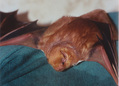
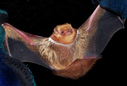
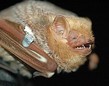
Pelage varies in color from a brick red to a yellowish red. The fur is white at the tips giving these bats a frosted appearance. In general, female bats appear more frosted compared to males, and males have a redder color than females. There is no documented sexual dimorphism in size. The uropatagium is thickly furred on the dorsal side and helps to keep these bats warm in cold weather.
Lasiurus borealis have small and heavily constructed skulls. The arrangement of the 32 teeth is distinctive and shared with other Lasiurus species. Red bats have a tiny cone shaped upper premolar that is located at the inner junction of the upper canine and the second premolar.
Red bats have been called by Allen Kurta, author of "Mammals of the Great Lakes," one of the "most handsome mammals in the Great Lakes region."
- Other Physical Features
- endothermic
- bilateral symmetry
- Sexual Dimorphism
- sexes colored or patterned differently
-
- Range mass
- 7 to 13 g
- 0.25 to 0.46 oz
-
- Range length
- 93 to 117 mm
- 3.66 to 4.61 in
Reproduction
An incomplete account of a red bat mating in flight was made in 1947. A bat biologist was fly fishing and watched as he saw what looked like a single bat tumble onto the bank. The biologist inspected with his flashlight, and saw what he originally thought was a female bat with young clinging to her. Under closer inspection the biologist saw that a male had clasped itself to the back of the female therefore making it impossible for either to fly. It seemed as if the male red bat had attached itself to the female in mid-flight. The male bat seemed to hold his position by hooking his claw over the female's wing.
Mating takes place in flight and copulation usually occurs in August or September. The sperm is stored until the spring, usually March or April. Female red bats possess four mammary glands while most other chiropterans have two. Female red bats give birth to one litter of twins each year, unlike most bats which give birth to single young. Newborn bats are hairless and weigh approximately 1.5 g. The young learn to fly at about five weeks old.
- Key Reproductive Features
- iteroparous
- seasonal breeding
- gonochoric/gonochoristic/dioecious (sexes separate)
- sexual
- viviparous
- sperm-storing
- delayed fertilization
-
- Breeding interval
- Red bats breed once each year.
-
- Breeding season
- Mating occurs in August or September.
-
- Range number of offspring
- 1 to 4
-
- Average number of offspring
- 2
-
- Range gestation period
- 80 to 90 days
-
- Average weaning age
- 38 days
-
- Average time to independence
- 5 weeks
Like all mammals, female red bats nurse their young until the young are able to fend for themselves. It takes young red bats about five weeks to learn how to fly and forage on their own.
- Parental Investment
-
pre-fertilization
-
protecting
- female
-
protecting
-
pre-hatching/birth
-
provisioning
- female
-
protecting
- female
-
provisioning
-
pre-weaning/fledging
-
provisioning
- female
-
protecting
- female
-
provisioning
-
pre-independence
-
provisioning
- female
-
protecting
- female
-
provisioning
Behavior
Red bats are migratory, arriving in the northern climates in mid-April and leaving in late October. There are records of bats hibernating in the northern parts of their range, but they typically migrate to warmer regions. When red bats hibernate they choose hollow trees. They maintain body temperatures just above freezing and cannot withstand prolonged periods of below freezing temperatures. They may lose up to 25% of their pre-hibernation weight by spring, severely depleting fat reserves (Fenton, 1985).
Lasiurus borealis choose roosting sites in dense foliage. They may be visible hanging from branches or leaves but their coloration helps to camouflage them from predators. Their red coat is particularly helpful at camouflaging them in sycamore, oaks, elm, and box elder trees and they seem to prefer these trees as roost sites (Constantine, 1996). Sites that have been used as roosting areas range from 2 to 40 feet off the ground. The roosting sites of solitary bats have not been as well studied as those of more gregarious bats. Some field workers believe that red bats defend feeding territories. (Constantine, 1966; Fenton, 1985)
- Key Behaviors
- flies
- nocturnal
- motile
- migratory
- hibernation
- solitary
Communication and Perception
Red bats use echolocation to locate prey. They use both broadband and narrow band calls. Search phases of calls use long calls with low pulse repetition of narrow band frequencies.
- Perception Channels
- tactile
- acoustic
- echolocation
- chemical
Food Habits
Red bats are insectivorous. They capture insects while flying like many other insectivorous bats.
Red bats have been found in insect light traps. The activity of these bats around lights reflects overall flight and feeding patterns. Hunting for food begins at dusk and the bat proceeds to hunt within 500 m of a light source (Hickey et al 1996). Foraging activies of this bat are generally concentrated into one feeding bout, but there are records of these bats foraging throughout the night. Their food consists of different kinds of insects: moths, beetles, plant-hoppers, ants, flies, and others.
Red bats make one pass through a concentration of potential prey, fixing on a target within 5 to 10 m. They attack insects, on average, every thirty seconds and are successful fourty percent of the time. If a bat is stalking a moth using echolocation the moth can hear this and will try to flee the attack by diving. The bat will follow the moth into a steep dive and often will pull away within inches of the ground. Humans observing this predator-prey interaction only see the bat and not the fleeing moth and may believe that the bat is acting aggressively towards them.
There is a distinct body and head posturing change in this bat when in pursuit of prey. It has been said that if you observe a rural street light and see a bat dipping and diving, that you are most likely viewing a red bat. (Hickey, et al., May 1996)
- Primary Diet
- carnivore
- Animal Foods
- insects
Predation
Predators of red bats include birds of prey and opossums. Humans and human constructions have also taken their toll on red bats. "There have been documented cases of these bats being impaled by barbed wire, . . . entrapped on road surface oil . . ., flying into lighthouses . . ., and radiator grills of automobiles . . ." (Baker, 1983, pg. 123).
Red bats avoid predators through the use of camouflage. (Baker, 1983)
- Anti-predator Adaptations
- cryptic
-
- Known Predators
-
- birds of prey
- opossums
- birds of prey (Falconiformes)
- opossums (Didelphis virginiana)
Ecosystem Roles
Red bats play an important ecosystem role as insect consumers.
Economic Importance for Humans: Positive
Red bats rarely invade homes. Red bats keep insect populations down.
- Positive Impacts
- controls pest population
Economic Importance for Humans: Negative
Unfortunately some people view red bats, along with all other bats, as vermin. However, red bats do not negatively affect humans.
Conservation Status
Red bats are secure over most of their range and are not considered threatened.
Temperate North American bats are now threatened by a fungal disease called “white-nose syndrome.” This disease has devastated eastern North American bat populations at hibernation sites since 2007. The fungus, Geomyces destructans, grows best in cold, humid conditions that are typical of many bat hibernacula. The fungus grows on, and in some cases invades, the bodies of hibernating bats and seems to result in disturbance from hibernation, causing a debilitating loss of important metabolic resources and mass deaths. Mortality rates at some hibernation sites have been as high as 90%. While there are currently no reports of Lasiurus borealis mortalities as a result of white-nose syndrome, the disease continues to expand its range in North America. (Cryan, 2010; National Park Service, Wildlife Health Center, 2010)
-
- IUCN Red List
-
Least Concern
More information
-
- IUCN Red List
-
Least Concern
More information
-
- US Federal List
- No special status
-
- CITES
- No special status
-
- State of Michigan List
- No special status
Contributors
Allison Poor (editor), University of Michigan-Ann Arbor.
Phil Myers (author), Museum of Zoology, University of Michigan-Ann Arbor, Jani Hatchett (author), University of Michigan-Ann Arbor, Phil Myers (editor), Museum of Zoology, University of Michigan-Ann Arbor.
Glossary
- Nearctic
-
living in the Nearctic biogeographic province, the northern part of the New World. This includes Greenland, the Canadian Arctic islands, and all of the North American as far south as the highlands of central Mexico.

- Neotropical
-
living in the southern part of the New World. In other words, Central and South America.
- acoustic
-
uses sound to communicate
- bilateral symmetry
-
having body symmetry such that the animal can be divided in one plane into two mirror-image halves. Animals with bilateral symmetry have dorsal and ventral sides, as well as anterior and posterior ends. Synapomorphy of the Bilateria.
- carnivore
-
an animal that mainly eats meat
- chemical
-
uses smells or other chemicals to communicate
- cryptic
-
having markings, coloration, shapes, or other features that cause an animal to be camouflaged in its natural environment; being difficult to see or otherwise detect.
- delayed fertilization
-
a substantial delay (longer than the minimum time required for sperm to travel to the egg) takes place between copulation and fertilization, used to describe female sperm storage.
- echolocation
-
The process by which an animal locates itself with respect to other animals and objects by emitting sound waves and sensing the pattern of the reflected sound waves.
- endothermic
-
animals that use metabolically generated heat to regulate body temperature independently of ambient temperature. Endothermy is a synapomorphy of the Mammalia, although it may have arisen in a (now extinct) synapsid ancestor; the fossil record does not distinguish these possibilities. Convergent in birds.
- forest
-
forest biomes are dominated by trees, otherwise forest biomes can vary widely in amount of precipitation and seasonality.
- hibernation
-
the state that some animals enter during winter in which normal physiological processes are significantly reduced, thus lowering the animal's energy requirements. The act or condition of passing winter in a torpid or resting state, typically involving the abandonment of homoiothermy in mammals.
- insectivore
-
An animal that eats mainly insects or spiders.
- iteroparous
-
offspring are produced in more than one group (litters, clutches, etc.) and across multiple seasons (or other periods hospitable to reproduction). Iteroparous animals must, by definition, survive over multiple seasons (or periodic condition changes).
- migratory
-
makes seasonal movements between breeding and wintering grounds
- motile
-
having the capacity to move from one place to another.
- native range
-
the area in which the animal is naturally found, the region in which it is endemic.
- nocturnal
-
active during the night
- seasonal breeding
-
breeding is confined to a particular season
- sexual
-
reproduction that includes combining the genetic contribution of two individuals, a male and a female
- solitary
-
lives alone
- sperm-storing
-
mature spermatozoa are stored by females following copulation. Male sperm storage also occurs, as sperm are retained in the male epididymes (in mammals) for a period that can, in some cases, extend over several weeks or more, but here we use the term to refer only to sperm storage by females.
- tactile
-
uses touch to communicate
- temperate
-
that region of the Earth between 23.5 degrees North and 60 degrees North (between the Tropic of Cancer and the Arctic Circle) and between 23.5 degrees South and 60 degrees South (between the Tropic of Capricorn and the Antarctic Circle).
- tropical
-
the region of the earth that surrounds the equator, from 23.5 degrees north to 23.5 degrees south.
- viviparous
-
reproduction in which fertilization and development take place within the female body and the developing embryo derives nourishment from the female.
References
Altringham, J. 1996. Bats biology and behaviour. Oxford: Oxford University Press.
Baker, `. 1983. Michigan Mammals. Lansing: Michigan State University Press.
Constantine, D. 1966. Ecological observation of lasiurine bats in Iowa. Journal of Mammalogy, 47: 34-41.
Cryan, P. 2010. "White-nose syndrome threatens the survival of hibernating bats in North America" (On-line). U.S. Geological Survey, Fort Collins Science Center. Accessed September 16, 2010 at http://www.fort.usgs.gov/WNS/.
Davis, W., W. Lidicker. May 1956. Winter range of the red bat, Lasiurus borealis. Journal of Mammalogy, 37: 280-281.
Fenton, B. 1985. Communication in the Chiroptera. Bloomington: Indiana University Press.
Fenton, B. 1983. Just Bats. Toronto: University of Toronto Press.
Hickey, B., L. Acharya, S. Pennington. May 1996. Resource partitioning by two species of vespertilionis bats (Laiurus cinereus and Lasiurus borealis) feeding around street light. Journal of Mammology, 77: 325-334.
Hickey, B., A. Neilson. 1995. Relative activity and occurence of bats in Southwesten Ontario as determined by monitoring with bat detectors. The Canadia Field-Naturalist, 109: 413-417.
National Park Service, Wildlife Health Center, 2010. "White-nose syndrome" (On-line). National Park Service, Wildlife Health. Accessed September 16, 2010 at http://www.nature.nps.gov/biology/wildlifehealth/White_Nose_Syndrome.cfm.
Perston, R. 1964. Silently, By Night. New York: McGraw and Hill.
Schober, W., E. Grimmberger. 1997. The bats of Europe and North America. Dallas: T.F.H. Publicaitons, Inc. 1997.
Slaughter, B., D. Walton. 1970. About Bats a Chiropteran biology synposium. Dallas: Southwestern Methodist University Press.
Stuewer, F. 1948. A record of red bats mating. Journal of Mammalogy, 29 (2): 180-181.
Wilson, N. 1965. Red bats attracted to insect light traps. Journal of Mammalogy, 46 (4): 704-705.