Larus ridibundusblack-headed gull(Also: common black-headed gull)
Geographic Range
The breeding range of Larus ridibundus is very broad, extending from the southern tip of Greenland and all of Iceland down through the majority of Europe and Central Asia. The Kamchatka Peninsula forms this species' eastern range; Ussuriland in Russia and Heilongjiang in northeast China lie at the extreme southeastern part of this range. Larus ridibundus is uncommon in northeastern North America.
The northern population of this species is migratory. Birds residing at lower latitudes, however, tend to be non-migratory. Most birds in the western Palearctic breed in central and north European wetlands and migrate to their winter grounds in the Mediterranean basin. Birds that breed in Scandinavia migrate to the Brittish Isles, and the majority migrate farther, flying along the Atlantic Coast to West Africa. Birds from Central Asia migrate south to India, Malaysia, and Philippines. North Africa, particularly Egypt, is a common destination for L. ridibundus (Howard and Moore, 1991; Cantos et al., 1994). (Cantos, et al., 1994; Howard and Moore, 1991)
Habitat
Larus ridibundus inhabits the temperate zone to the rim of the Palearctic boreal forests. It is found mostly at low attitudes and in or around placid, shallow coastal or inland water bodies, including rivers and their estuaries. In some areas, such as Scandinavia, it has adapted to settle in salt marshes, clay pits, and coastal dunes and offshore islands. The distribution of this highly adaptable species has increased to encompass areas near canals or sewage treatment facilities (Howard and Moore, 1991; Cantos et al., 1994). (Cantos, et al., 1994; Howard and Moore, 1991)
- Habitat Regions
- temperate
- terrestrial
- Aquatic Biomes
- lakes and ponds
- rivers and streams
- coastal
- Wetlands
- marsh
Physical Description
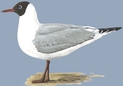
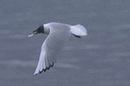
In accordance with its common name, L. ridibundus is distinguished by its dark brown or grayish-black frontal hood. Its eye crescents (primarily behind the eye), neck, and underparts are all white as is the tail. The upper wing coverts, secondaries, inner primaries, and back are gray. The secondaries are tipped with white; the white outer primaries have black tips and edges. Other identifying characteristics of L. ridibundus include its red legs and bill, and dark brown eyes. Non-breeding adults have a white head, with only some blackish coloring on their nape. Juvenile birds are recognized by the beige to darker brown markings on their back and upper wing coverts. Also, they have a black terminal tail band. The species is sexually monomorphic. Larus ridibundus ranges from 37 to 43 cm in length and has a wingspan from 94 to 110 cm (Howard and Moore, 1991). (Howard and Moore, 1991)
- Other Physical Features
- endothermic
- bilateral symmetry
-
- Range mass
- 195 to 325 g
- 6.87 to 11.45 oz
Reproduction
Information on the mating system of these animals is not available.
After returning to its colonies between late February and late March, L. ridibundus lays its eggs in late April and May. Females lay from one to three eggs and incubate them for 22 to 26 days. Larus ridibundus is strongly inclined to nest near vegetation. At the very beginning of the breeding season, male L. ridibundus congregate in larges areas close to the nesting colony before females arrive. In these areas, termed "clubs," each bird is semi-territorial in that it does not stay in one particular area for a considerable amount of time. A male first regards visiting females as a threat, showing his aggressive oblique display and making long calls. In response, the female extends her neck upward and faces away, a display that makes her sex and potential as a mate known. The male then mitigates his response. The mating process continues when females keep coming back to a selected male, staying with him for progressively longer periods of time. The potential pair exchanges mutual displays. Their courtship culminates in the male regurgitating food for the female, an act followed by copulation.
As soon the pair of L. ridibundus settle into their colony area, they become territorial and defend their area against intruders (primarily conspecifics). They clearly mark their pairing territories, which range in size from 9 to 11 square meters. Their territorial boundaries are subject to slight changes as dictated by daily disputes with neighbors or intruders.
Colonies of L. ridibundus are made up of 11 to 100 breeding pairs; however, a few colonies reach numbers greater than 10,000 birds. These colonies are loosely divided: a breeding bird will eventually become accustomed to its neighbors, but will become very aggressive towards birds that it cannot recognize.
Research has shown that L. ridibundus is a philopatric species in which individuals are inclined to return to breed in the subcolony in which they were born. This tendency is especially evident within a large colony located in a relatively unstable habitat. Philopatry encourages the establishment of kin groups and eventually heightened cooperation among neighbors (Howard and Moore, 1991; Moynihan, 1955; Prevot-Julliard et al., 1998; Gill, 1995). (Gill, 1995; Howard and Moore, 1991; Moynihan, 1955; Prevot-Julliard, et al., 1998)
- Key Reproductive Features
- iteroparous
- seasonal breeding
- gonochoric/gonochoristic/dioecious (sexes separate)
- sexual
- fertilization
- oviparous
Lifespan/Longevity
-
- Average lifespan
Status: wild - 218 months
- Bird Banding Laboratory
- Average lifespan
Behavior
Three displays signaling agonistic behavior specific to L. ridibundus have been identified in its young: the oblique, in which an erect posture complemented by a series of loud and strident calls that decrease in length; the forward, in which the neck is extended, the head is in front of the body, and the bill is horizontal to the ground; and choking, in which the bird leans toward the ground, points its bill downward and proceeds to emit a soft call of short notes in rapid succession.
According to one study, at least six variables determined the outcome of a fight in L. ridibundus: ownership (i.e. who initiated the fight), semiterritoriality, age, body mass, food availability, and location. Scientists propose that a bird might learn to shift from obvious aggression to the aforementioned displays when it realizes that the latter are just as effective in warding off opponents. This finding may help explain why immature L. ridibundus that have not yet learned the art of display instigate and win more fights than adults, and also take more risks in interactions with other species. It has been hypothesized that fighting can be beneficial to immature birds in that it helps them to gain "self-knowledge," (i.e. become aware of their own strengths).
In order to protect itself from predators, L. ridibundus displays both aggressive and fleeing behaviors. The type of behavior depends largely on the specific predator. For instance, predators that primarily take chicks and eggs, such as crows and larger gulls, warrant aggressive behavior. Attacks on adult birds by peregrine falcons (Falco peregrinus), however, cause dense flocks to fly away. Threats to both adults and the brood, such as humans and foxes, precipitate both aggressive and fleeing behavior. Factors like colonial nesting and breeding synchronization help to keep predators at bay (Groothuis and Van Mulekom, 1991; Nuyts et al., 1996; Kruuk, 1964). (Groothuis and Van Mulekom, 1991; Kruuk, 1964; Nuyets, et al., 1996)
- Key Behaviors
- flies
- motile
- migratory
- sedentary
- territorial
- colonial
Communication and Perception
Food Habits
Aquatic and terrestrial insects, earthworms, and marine invertebrates compose the bulk of L. ridibundus diet. This species also feeds on fish and grains, although to a lesser extent. Studies have shown that adults store greater nutrient reserves (fat and protein depots) not only for migration, but for reproductive activity as well.
This species forages by swimming and snatching food from the water surface, or by submerging its head under the water surface. These birds forage along coastal areas. Adults have more efficient foraging skills than do immature birds. Due to this inefficiency, immature birds feed in areas separate from the adult sites. Immature birds also display greater aggression, often winning fights over food. Interestingly, they are also more brazen in approaching humans, thus gaining a better chance to secure food.
The gulls are also kleptoparasitic on occasion, meaning that they steal food that has already been caught by a member of the same or different species. For example, in the Netherlands, sandwich terns (Sterna sandvicensis) nearly always stake their breeding ground in close proximity to colonies of L. ridibundus. In this arrangement, the gulls help protect the terns by driving out both avian and ground predators. The gulls, though, are major predators of tern eggs and chicks, and steal fish that tern parents have procured for their chicks. Larus ridibundus prefers to eat tern chicks up to two weeks old. Several scientists have suggested that kleptoparasitism occurs more often when other food sources are scarce.
Larus ridibundus displays high flexibility in diet. In western Europe, for instance, it has come to rely on human trash as an artificial food source. Researchers have attributed the significant increase in distribution of L. ridibundus to this influx of readily available food (Howard and Moore, 1991; Cantos et al., 1994; Stienen and Brenninkmeijer, 1999; Nuyts et al., 1996). (Cantos, et al., 1994; Howard and Moore, 1991; Stienen and Brenninkmeijer, 1999)
- Animal Foods
- birds
- fish
- eggs
Conservation Status
Larus ridibundus is not globally threatened, with a population approximated at two million pairs or perhaps more. As many as 1,500,000 to 1,800,000 have been estimated in Western Europe alone. From 1950 to 1980, this species underwent an impressive increase in numbers and subsequent increase in distribution (Howard and Moore, 1991). (Howard and Moore, 1991)
-
- IUCN Red List
-
Least Concern
More information
-
- IUCN Red List
-
Least Concern
More information
-
- US Migratory Bird Act
- Protected
-
- US Federal List
- No special status
-
- CITES
- No special status
-
- State of Michigan List
- No special status
Other Comments
Although this is a Palearctic species, the numbers of L. ridibundus in eastern North America have risen from the 1950s; it first bred in eastern Canada in 1977. Today there are four known breeding sites of L. ridibundus in Canada and New England, but fewer than 20 breeding pairs (Howard and Moore, 1991). (Howard and Moore, 1991)
Contributors
Nancy Shefferly (editor), Animal Diversity Web.
Stephanie Hitztaler (author), University of Michigan-Ann Arbor, Terry Root (editor), University of Michigan-Ann Arbor.
Glossary
- Nearctic
-
living in the Nearctic biogeographic province, the northern part of the New World. This includes Greenland, the Canadian Arctic islands, and all of the North American as far south as the highlands of central Mexico.

- Palearctic
-
living in the northern part of the Old World. In otherwords, Europe and Asia and northern Africa.
- acoustic
-
uses sound to communicate
- bilateral symmetry
-
having body symmetry such that the animal can be divided in one plane into two mirror-image halves. Animals with bilateral symmetry have dorsal and ventral sides, as well as anterior and posterior ends. Synapomorphy of the Bilateria.
- carnivore
-
an animal that mainly eats meat
- chemical
-
uses smells or other chemicals to communicate
- coastal
-
the nearshore aquatic habitats near a coast, or shoreline.
- colonial
-
used loosely to describe any group of organisms living together or in close proximity to each other - for example nesting shorebirds that live in large colonies. More specifically refers to a group of organisms in which members act as specialized subunits (a continuous, modular society) - as in clonal organisms.
- endothermic
-
animals that use metabolically generated heat to regulate body temperature independently of ambient temperature. Endothermy is a synapomorphy of the Mammalia, although it may have arisen in a (now extinct) synapsid ancestor; the fossil record does not distinguish these possibilities. Convergent in birds.
- estuarine
-
an area where a freshwater river meets the ocean and tidal influences result in fluctuations in salinity.
- fertilization
-
union of egg and spermatozoan
- iteroparous
-
offspring are produced in more than one group (litters, clutches, etc.) and across multiple seasons (or other periods hospitable to reproduction). Iteroparous animals must, by definition, survive over multiple seasons (or periodic condition changes).
- marsh
-
marshes are wetland areas often dominated by grasses and reeds.
- migratory
-
makes seasonal movements between breeding and wintering grounds
- motile
-
having the capacity to move from one place to another.
- native range
-
the area in which the animal is naturally found, the region in which it is endemic.
- oriental
-
found in the oriental region of the world. In other words, India and southeast Asia.
- oviparous
-
reproduction in which eggs are released by the female; development of offspring occurs outside the mother's body.
- piscivore
-
an animal that mainly eats fish
- riparian
-
Referring to something living or located adjacent to a waterbody (usually, but not always, a river or stream).
- seasonal breeding
-
breeding is confined to a particular season
- sedentary
-
remains in the same area
- sexual
-
reproduction that includes combining the genetic contribution of two individuals, a male and a female
- tactile
-
uses touch to communicate
- temperate
-
that region of the Earth between 23.5 degrees North and 60 degrees North (between the Tropic of Cancer and the Arctic Circle) and between 23.5 degrees South and 60 degrees South (between the Tropic of Capricorn and the Antarctic Circle).
- terrestrial
-
Living on the ground.
- territorial
-
defends an area within the home range, occupied by a single animals or group of animals of the same species and held through overt defense, display, or advertisement
- visual
-
uses sight to communicate
References
Cantos, F., A. Alonso-Gomez, M. Delgado. 1994. Seasonal changes in fat and protein reserves of the black-headed gull, Larus ridibundus, in relation to migration. Comparative Biochemical Physiology, Vol. 108A, No. 1: 117-122.
Gill, F. 1995. Ornithology. Second edition.. W.H. Freeman and Company.
Groothuis, T., L. Van Mulekom. 1991. The influence of social experience on the ontogenetic change in the relation between aggression, fear and display behaviour in black-headed gulls. Animal Behaviour, 42: 873-881.
Howard, R., A. Moore. 1991. A Complete Checklist of the Birds of the World. Second edition.. London, San Diego: Academic Press.
Kruuk, H. 1964. Predators and Anti-Predators of the Black-headed Gull (Larus ridibundus L.). Leiden, The Netherlands: E.J. Brill.
Moynihan, M. 1955. Some Aspects of Reproductive Behavior in the Black-headed Gull (Larus ridibundus L.)and Related Species. Leiden, The Netherlands: E.J. Brill.
Nuyets, E., A. Buit, E. Van der Zee. 1996. The influence of age on the acquirement of a perch in the black-headed gull (Larus ridibundus L.): new data and a review of the literature. Canadian Journal of Zoology, 74: 1713-1720.
Prevot-Julliard, A., R. Pradel, J. Lebreton, F. Cezilly. 1998. Evidence for birth-site tenacity in breeding Common Black-headed Gulls, Larus ridibundus. Canadian Journal of Zoology, 76: 2295-2298.
Stienen, E., A. Brenninkmeijer. 1999. Keep the chicks moving: how Sandwich terns can minimize kleptoparasitism by black-headed gulls. Animal Behaviour, 57: 1135-1144.