Larus pipixcanFranklin's gull


Geographic Range
Commonly known as Franklin's gulls, Larus pipixcan is a migratory species that travels seasonally between North and South America. Breeding distribution is limited to a small portion of central Canada and northern United States. During the breeding season this species can be seen in central Saskatchewan, eastern Alberta, southwestern Manitoba, central Oregon, northwestern Utah and Wyoming, southern Idaho, northwestern Iowa, North and South Dakota, and Minnesota. Vagrant sightings of L. pipixcan have been recorded along the southern coast of Alaska during the spring and summer months. Western Kansas and northern California have also had record sightings of L. pipixcan.
Larus pipixcan spends the winter months of December to March along the Pacific coast of South America from Peru to Chile. Lesser numbers of L. pipixcan have been seen wintering in the Galapagos Islands, Central America, southern California, and southern region of the United States. (Burger and Gochfeld, 2009)
- Biogeographic Regions
- nearctic
- neotropical
- oceanic islands
Habitat
Throughout it's range, Larus pipixcan may be found in aquatic habitats including coastlines and inland bodies of freshwater. Prime nesting habitat for L. pipixcan is within an inland freshwater lake or marsh, in an area between open water and dense vegetation. This species utilizes aquatic, floating nests which are constructed in cattails, bulrushes, on muskrat homes, or on floating debris. Optimal migration stopover habitat includes inland lakes, estuaries, bays, pastures, flooded fields, mudflats, lagoons, river mouths, and harbors. While wintering in South America, L. pipixcan may be found on ocean beaches, bays or estuaries.
Larus pipixcan makes a nest that floats on the water this nest general ranges in depth from 30 to 60 centimeters made of collected vegetation. (Burger and Gochfeld, 2009)
- Habitat Regions
- temperate
- tropical
- saltwater or marine
- freshwater
- Aquatic Biomes
- lakes and ponds
- coastal
- Wetlands
- marsh
- Other Habitat Features
- agricultural
- estuarine
Physical Description
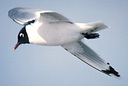
Larus pipixcan is a relatively small gull species that measures 32 to 36.1 cm in length, features a 85 to 95 cm wingspan, and weighs 221 to 335 g. Larus pipixcan is the only species of gull that goes through two complete molts in both spring and fall. In breeding plumage, L. pipixcan features an entirely black head that extends across the throat and down to the nape. It's small bill turns bright red with a thin black ring around the tip. Each eye is surrounded by broad, white eye arcs. The neck, breast, tail and undersides are unmarked white, but the belly may be tinged with pink. Legs and feet are very dark red in color. The mantle, wing coverts, and scapulars are dark-gray, which contrast with the white band along the edge of the primaries and secondaries (medial band). Wingtips feature a black subterminal band surrounded by the white medial band, and white primary tips. The pattern on the wingtips helps to distinguish this species from similar laughing gulls (Larus atricilla) which feature extensive black on the primaries and very limited white on the primary wingtips.
In non-breeding plumage, the all-black head reduces to a patchy black to gray hood that extends from the crown to the nape. The forehead and throat become white. The legs and feet turn nearly black as does the bill, which retains a reddish tip.
Juvenile and first-year adults feature duller, gray to brown plumage. These young gulls more closely resemble the non-breeding adult plumage as they display a patchy hood, and a blackish bill and legs. The nape and mantle have a brownish tinge and the white tail features a black distal band.
Like many hatchling gulls, Larus pipixcan chicks are downy and overall speckled with shades of brown and tan to aid in camouflage.
This species displays little sexual dimorphism and are identical in plumage, but males tend to be slightly larger in bill and body size. ("National Geographic Complete Birds of North America", 2006; Burger and Gochfeld, 2009; ; "Franklin's gull Larus pipixcan", 2000)
- Other Physical Features
- endothermic
- homoiothermic
- bilateral symmetry
- Sexual Dimorphism
- sexes alike
- male larger
-
- Range mass
- 221.13 to 334.53 g
- 7.79 to 11.79 oz
-
- Range length
- 32 to 36.1 cm
- 12.60 to 14.21 in
-
- Range wingspan
- 85.1 to 95 cm
- 33.50 to 37.40 in
Reproduction
Larus pipixcan is a monogamous species that exhibits an array of courtship behaviors. After males establish territories, they give calls and toss their heads to attract females that are flying by. If a female responds to a male's display she will alight in nearby vegetation. Once the female has landed the male turns his back to her so she is unable to see his black head. The feathers on his head stand straight up. The female then turns her back to the male, and they continue alternating this pattern of looking and turning their backs. During this ritual, either may take a break to peck at vegetation, preen, or drink and then return to courtship. The female may also beg to initiate courtship, and these begging behaviors include walking in front of the male over the nesting platform, head tossing and standing in a hunched position, or pecking at the male’s chin or bill. The male will ultimately regurgitate food, which the female will eat. This behavior is generally a precursor to copulation. (Burger and Gochfeld, 2009)
- Mating System
- monogamous
Larus pipixcan is a migratory species that travels hundreds of miles north to breed each spring and summer. In Minnesota and North and South Dakota, L. pipixcan arrives at the breeding grounds during April and courtship begins several days later. Nest construction occurs before, during, or after pair formation and both males and females may participate. Nests are mounds of floating vegetation that gradually sink during the nesting period. Males, females, and even older chicks will help to add vegetation to keep the nest above water. A week after the nest is complete, females lay 1 to 4 eggs that vary in color from cream to brown, blue, or green. Eggs are incubated for 23 to 26 days and incubation duties are shared by both parents. Chicks are semiprecocial at hatching, but will not leave the nest for 20 to 30 days. At this young age, chicks spend a lot of time swimming in the vicinity of the nest. Chicks develop flight feathers after 30 days and will fledge at 32 to 35 days old. After fledging, parents and their young remain together for an additional 8 to 10 days at which time the young become independent. Juveniles become reproductively mature at 2 years old. (Burger and Gochfeld, 2009)
- Key Reproductive Features
- iteroparous
- seasonal breeding
- gonochoric/gonochoristic/dioecious (sexes separate)
- sexual
- fertilization
- oviparous
-
- Breeding interval
- Larus pipixcan breeds once a year.
-
- Breeding season
- Larus pipixcan breeds from late April to July.
-
- Range eggs per season
- 1 to 4
-
- Average eggs per season
- 2
-
- Range time to hatching
- 23 to 26 days
-
- Range fledging age
- 32 to 35 days
-
- Range time to independence
- 40 to 45 days
-
- Average age at sexual or reproductive maturity (female)
- 2 years
-
- Average age at sexual or reproductive maturity (male)
- 2 years
In most pairs, both the male and female participate in building a nest of floating vegetation. Males that do not attract females after 1 to 2 weeks after establishing territory will begin to construct a nest alone. Both parents feature 3 brood patches, making both adequate incubators. Parents tend the chicks constantly after hatching, but this care gradually decreases after 8 to 10 days. Both parents gather and regurgitate food for the young. The young consume mainly earthworms but also grubs and insects. Parents actively feed the young until a week after they begin to fly. Parents will clean up after their young by removing eggshells and feces and relocating the waste 5 meters away from the nest. These sanitary duties may minimize disease within the nest or make it more difficult for predators to smell the nest. (Burger and Gochfeld, 2009)
- Parental Investment
- precocial
- male parental care
- female parental care
-
pre-fertilization
- provisioning
-
protecting
- female
-
pre-hatching/birth
-
provisioning
- male
- female
-
protecting
- male
- female
-
provisioning
-
pre-weaning/fledging
-
provisioning
- male
- female
-
protecting
- male
- female
-
provisioning
-
pre-independence
-
provisioning
- male
- female
-
protecting
- male
- female
-
provisioning
Lifespan/Longevity
Larus pipixcan has a lifespan of 9 to 9.4 years in the wild. There is no known information for lifespan in captivity. The eggs and young are most vulnerable and common causes of mortality include exposure, drowning, or predation. Little data exists on causes of adult mortality. (Burger and Gochfeld, 2009; Clapp, et al., 1982)
-
- Range lifespan
Status: wild - 9 to 9.4 years
- Range lifespan
Behavior
Larus pipixcan is a diurnal, migratory species that spends nearly all of its life on or near water. It is a social species that nests in colonies of 100 to 100,000 breeding pairs. During the non-breeding season, this species gathers in large, often mixed-species, flocks that will form dense roosting groups with only 50 to 200 cm between individuals. It's close association with water lends this species to frequent bathing, which is usually a social event done in groups of 2 to 50. These large, boisterous bathing events may last 15 to 20 minutes.
Larus pipixcan is an agile gull that is able to perch on cattail stems and take flight from the water surface in a quick manner. This species spends more time on the wing than most gulls and exhibits aerial mobbing or diving to deter predators. When defending territory on the ground Larus pipixcan will exhibit long calls, head tossing, chocking, upright oblique, escape patterns, or attacks. (Burger and Gochfeld, 2009)
- Key Behaviors
- flies
- glides
- diurnal
- motile
- migratory
- territorial
- colonial
-
- Range territory size
- 12 to 147 m^2
Home Range
During the breeding season, male Franklin's gulls establish territories and will defend a 4 to 5 m radius around the nest. Females also participate in defending the nesting territory. As the breeding season progresses, floating nests often drift and nest spacing decreases from 7 m to 2 or 3 m. During the non-breeding season, this social species often roosts in very dense groups with only 50 to 200 cm between individuals. (Burger and Gochfeld, 2009)
Communication and Perception
Compared other gull species, Larus pipixcan make significantly louder and more frequent calls. However, L. pipixcan has few distinct calls. This species gives alarm calls to alert chicks, mates, and neighbors of potential threats. The most common call given is a long call which is used to deter predators, establish territory and attract females. Other types of calls include a call signaling they will be landing or a courtship call. Larus pipixcan uses physical displays during courtship. After a male has attracted a female he turns his back to her, bows his head, and raises his white neck feathers to hide his black head. The female displays interest by reciprocating these behaviors and the two will alternate looking at each other and then turning their backs. Like most birds, Larus pipixcan perceives its environment through chemical, auditory, tactile and visual stimuli. (Burger and Gochfeld, 2009)
Food Habits
Larus pipixcan has a diet that consists of grubs, earthworms, grasshoppers, midges, mollusks, fish refuse and sometimes seeds. These gulls are largely opportunistic feeders and will eat a variety of vegetation and animal foods as they are available. Larus pipixcan has been spotted in dumps picking for food, but they are more often found in fields or wetlands. In fields, these gulls often follow tractors which disturb resting insects, making it easy for the gulls to snatch a meal in flight. Larus pipixcan obtains flying insects aerially or mollusks while wading in shallow waters. Young gulls are fed almost exclusively regurgitated earthworms, but occasionally parents will provide insects as well. ("Franklin's Gull", 2004; Burger and Gochfeld, 2009)
- Primary Diet
- carnivore
- Animal Foods
- insects
- mollusks
- terrestrial worms
- aquatic crustaceans
- Plant Foods
- leaves
- seeds, grains, and nuts
Predation
Larus pipixcan nests over the water causing much of their predators to be aquatic or aerial. Types of predators vary geographically. In Minnesota, predators include northern harriers, muskrats, or great horned owls. Predators to adult Larus pipixcan are peregrine falcons and pomarine jaegers. Other predators include black-crowned night-herons, which will eat the eggs and young. There have been reports of mink killing up to 35 chicks in one night. (Burger and Gochfeld, 2009)
-
- Known Predators
-
- northern harriers (Circus cyaneus)
- muskrats (Ondatra zibethicus)
- great horned owls (Bubo virginianus)
- peregrine falcons (Falco peregrinus)
- pomarine jaegers (Stercorarius pomarinus)
- mink (Neovison vison)
Ecosystem Roles
As both prey and predator, Larus pipixcan plays an important role within its environment. Larus pipixcan consumes large amounts of insects such as grubs and earthworms which if left unchecked, may cause significant damage to local vegetation and soil. Adults, young, and eggs are food for local terrestrial and aerial predators. (Burger and Gochfeld, 2009)
Economic Importance for Humans: Positive
Larus pipixcan is mostly insectivorous and consumes large quantities of pest species such as earthworms and grubs. If left unchecked, populations of these insects may degrade the quality of crops or lawns which would negatively impact human landowners. These gulls also consume fish refuse which may contribute to decomposition and reduce the spread of disease. (Burger and Gochfeld, 2009)
- Positive Impacts
- controls pest population
Economic Importance for Humans: Negative
There are no known negative impacts of Larus pipixcan on humans.
Conservation Status
Conservation concern for Larus pipixcan varies geographically, as recent population trends have been increasing, decreasing, or stable across its range. In Oklahoma, the Larus pipixcan population was at 3 million in 1950, dropped to 15,000 in 1990, and then increased to 60,000 in 1991. In Manitoba there is no sign of a population decrease. British Columbia has seen an increase in the number of breeding pairs. Even though Larus pipixcan is of least concern on the IUCN Red List, efforts are being made to protect wetlands across its range. Larus pipixcan only breeds in wetlands and is very sensitive to changes in water depth within these wetlands. Efforts should be made to monitor water levels and wetland quality to ensure this species has suitable breeding habitat. As a migratory species, Larus pipixcan is protected under the United States Migratory Bird Act which regulates any collection of adults, young, or eggs. (Burger and Gochfeld, 2009; "Franklin's Gull", 1998; )
-
- IUCN Red List
-
Least Concern
More information
-
- IUCN Red List
-
Least Concern
More information
-
- US Migratory Bird Act
- Protected
-
- US Federal List
- No special status
-
- CITES
- No special status
Contributors
Heidi Rudolph (author), Minnesota State University, Mankato, Robert Sorensen (editor), Minnesota State University, Mankato, Rachelle Sterling (editor), Special Projects.
Glossary
- Nearctic
-
living in the Nearctic biogeographic province, the northern part of the New World. This includes Greenland, the Canadian Arctic islands, and all of the North American as far south as the highlands of central Mexico.

- Neotropical
-
living in the southern part of the New World. In other words, Central and South America.
- acoustic
-
uses sound to communicate
- agricultural
-
living in landscapes dominated by human agriculture.
- bilateral symmetry
-
having body symmetry such that the animal can be divided in one plane into two mirror-image halves. Animals with bilateral symmetry have dorsal and ventral sides, as well as anterior and posterior ends. Synapomorphy of the Bilateria.
- carnivore
-
an animal that mainly eats meat
- chemical
-
uses smells or other chemicals to communicate
- coastal
-
the nearshore aquatic habitats near a coast, or shoreline.
- colonial
-
used loosely to describe any group of organisms living together or in close proximity to each other - for example nesting shorebirds that live in large colonies. More specifically refers to a group of organisms in which members act as specialized subunits (a continuous, modular society) - as in clonal organisms.
- diurnal
-
- active during the day, 2. lasting for one day.
- endothermic
-
animals that use metabolically generated heat to regulate body temperature independently of ambient temperature. Endothermy is a synapomorphy of the Mammalia, although it may have arisen in a (now extinct) synapsid ancestor; the fossil record does not distinguish these possibilities. Convergent in birds.
- estuarine
-
an area where a freshwater river meets the ocean and tidal influences result in fluctuations in salinity.
- female parental care
-
parental care is carried out by females
- fertilization
-
union of egg and spermatozoan
- freshwater
-
mainly lives in water that is not salty.
- insectivore
-
An animal that eats mainly insects or spiders.
- iteroparous
-
offspring are produced in more than one group (litters, clutches, etc.) and across multiple seasons (or other periods hospitable to reproduction). Iteroparous animals must, by definition, survive over multiple seasons (or periodic condition changes).
- male parental care
-
parental care is carried out by males
- marsh
-
marshes are wetland areas often dominated by grasses and reeds.
- migratory
-
makes seasonal movements between breeding and wintering grounds
- monogamous
-
Having one mate at a time.
- motile
-
having the capacity to move from one place to another.
- native range
-
the area in which the animal is naturally found, the region in which it is endemic.
- oceanic islands
-
islands that are not part of continental shelf areas, they are not, and have never been, connected to a continental land mass, most typically these are volcanic islands.
- oviparous
-
reproduction in which eggs are released by the female; development of offspring occurs outside the mother's body.
- saltwater or marine
-
mainly lives in oceans, seas, or other bodies of salt water.
- seasonal breeding
-
breeding is confined to a particular season
- sexual
-
reproduction that includes combining the genetic contribution of two individuals, a male and a female
- tactile
-
uses touch to communicate
- temperate
-
that region of the Earth between 23.5 degrees North and 60 degrees North (between the Tropic of Cancer and the Arctic Circle) and between 23.5 degrees South and 60 degrees South (between the Tropic of Capricorn and the Antarctic Circle).
- territorial
-
defends an area within the home range, occupied by a single animals or group of animals of the same species and held through overt defense, display, or advertisement
- tropical
-
the region of the earth that surrounds the equator, from 23.5 degrees north to 23.5 degrees south.
- visual
-
uses sight to communicate
- young precocial
-
young are relatively well-developed when born
References
2006. National Geographic Complete Birds of North America. Washington D.C.: The National Geographic Society.
2004. "Franklin's Gull" (On-line). Accessed March 15, 2011 at http://sdakotabirds.com/species/franklins_gull_info.htm.
Great Basin Bird Observatory. 1998. "Franklin's Gull" (On-line). Accessed April 30, 2011 at http://www.gbbo.org/pdf/bcp/41_Franklin's%20Gull.pdf.
USGS. 2000. "Franklin's gull Larus pipixcan" (On-line). Accessed April 30, 2011 at http://www.mbr-pwrc.usgs.gov/id/framlst/i0590id.html.
Burger, J., M. Gochfeld. 2009. "Birds of North America Online" (On-line). Franklin's Gull (Leucophaeus pipixcan). Accessed April 30, 2011 at : http://bna.birds.cornell.edu/bna/species/116.
Burger, J., J. Shisler. 1978. Nest site selection and competitive interactions of herring and laughing gulls in New Jersey. The Auk, 95: 252-266.
Clapp, R., M. Klimkiewicz, J. Kennard. 1982. Longevity records of North American birds: Gaviidae through Alcidae. Journal of Field Ornithology, 53: 81-124, 125-208.
Dawson, W., A. Bennett, J. Hudson. 1976. Metabolism and thermoregulation in hatchling ring-billed gulls. The Condor, 78: 49-60.