Iguana iguanaCommon Green Iguana




Geographic Range
Green iguanas, Iguana iguana, occur throughout Central and South America, from Sinaloa and Veracruz, Mexico, south to the Tropic of Capricorn in Paraguay and southeast Brazil. This large lizard also inhabits many islands throughout the Caribbean region and the coastal eastern Pacific, and has been introduced into southern Florida and in Hawaii. This is the largest known lizard to occur within the borders of the United States (Conant and Collins, 1998; Campbell, 1998). (Campbell, 1998; Conant and Collins, 1998)
- Biogeographic Regions
- nearctic
- neotropical
Habitat
Green Iguanas are arboreal lizards that live high in the tree canopy. Juveniles establish areas lower in the canopies while older mature iguanas reside higher up. This tree dwelling habit allows them to bask in the sun, rarely coming down except when females dig burrows to lay eggs. Although preferring an arboreal (forested) environment, they can adjust well to a more open area. No matter where they inhabit, they prefer to have water around as they are excellent swimmers and will dive beneath the water to avoid predators (Conant and Collins 1998). (Alberts, et al., 2004; Campbell, 1998; Conant and Collins, 1998)
- Habitat Regions
- tropical
- terrestrial
- Terrestrial Biomes
- forest
- rainforest
- Aquatic Biomes
- lakes and ponds
- rivers and streams
- temporary pools
- coastal
- brackish water
- Wetlands
- swamp
- Other Habitat Features
- suburban
- agricultural
Physical Description
Within three years, a young, 12 gram hatchling iguana can become a 1 kg adult (de Vosjoli, 1992). Upon hatching, the length of green iguanas ranges from 17 to 25 cm. Most mature iguanas weigh between 4 and 6 kg, but some in South America, with proper diet can reach up to 8 kg. These large lizards can reach head to tail lengths of around 2 m.
Although called green iguanas, these animals are actually variable in color. The adults become more uniform in color with age, whereas the young may appear more blotchy or banded between green and brown. Color of an individual may also vary based upon its mood, temperature, health, or social status. Such color alteration may aide these animals in thermoregulation. In the morning, while body temperature is low, skin color will be darker, helping the lizard to absorb heat from sunlight. However, as the hot mid-day sun radiates upon them, these animals become lighter or paler, helping to reflect the sun rays and minimizing the heat absorbed. Active dominant iguanas usually have a darker color than lower-ranked iguanas living the same environment (Frye, 1995). Most color variation seen in this species is exhibited by males, and may be attributed in part to sex steroids. Six to eight weeks prior to and during courtship, males may acquire a bright orange or gold hue, although coloration is still related to dominance status (Frye, 1995). Mature females, for the most part, retain their green coloring.
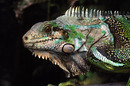
Other distinguishing features of this species include a pendulous dewlap under the throat, a dorsal crest made up of dermal spines that run from the mid neck to the tail base, and a long tapering tail. The dewlap is more developed in adult males than females. Extensions of the hyoid bones stiffen and support the leading edge of this structure, which is used in territorial defense or when the animal is frightened. This fleshy structure also serves in heat absorption and dissipation when it is extended.
The laterally situated eyes are protected mainly by a immovable eyelid and freely mobile lower eyelid (Oldham and Smith, 1975). On the dorsal midline of the skull behind the eyes is a parietal eye. This sense organ, although not a true "eye," serves as a meter for solar energy, and aids in the maturation of sex organs, thyroid gland, and endocrine glands (Frye, 1995). The visual effect of this "eye" is mostly limited to the detection of predatory shadows from above.
The scales or plates on the head are larger and more irregular than the scales on the rest of the body. Below the tympanum there is a large rounded scale called the subtympanic plate. (De Vosjoli, 1992; Frye, 1995; Oldham and Smith, 1975)
- Other Physical Features
- heterothermic
- Sexual Dimorphism
- male larger
- sexes colored or patterned differently
- male more colorful
- ornamentation
-
- Range mass
- 4 to 8 kg
- 8.81 to 17.62 lb
-
- Average mass
- 7 kg
- 15.42 lb
-
- Range length
- 2 (high) m
- 6.56 (high) ft
-
- Average length
- 1.75 m
- 5.74 ft
Development
Approximately 65 days after mating, a female is ready to lay her eggs. The size and number of eggs produced varies depending upon her size, her nutritional status, and her maturity. Eggs measure around 15.4 mm in diameter, and 35 to 40 mm in length (Frye, 1995). Over a three day period, an average of 10 to 30 leathery white or pale-cream colored eggs are deposited into a nest. Nests are located 45 cm to more than a meter deep, and may be shared with other females if nesting areas are limited. After laying the eggs, females may return to the nest several times but do not stay to guard it.
Incubation lasts from 90 to 120 days. Temperature should range from 85 to 91 degrees Fahrenheit. The hatchlings pip the egg open using a special egg tooth, called the caruncle, that falls off shortly after hatching. Absorbed yolk provides most of the nourishment for the first week or two of an iguana's life.
There are no major morphological changes in these animals as they age, except that they grow. However, diet is related to age. The young, with higher need for protein, are more likely to consume insects and eggs than are mature individuals. (Frye, 1995; Kaplan, 2002)
Reproduction
Most green iguanas reach sexual maturity between three and four years of age, although maturity can be reached earlier. Iguanas tend to breed in the dry season, ensuring that young hatch in the wet season when food is more readily available (de Vosjoli, 1992).
Mating appears to be polygynandrous. Courtship occurs within a defined territory where more than one female may be present. Conflicts between males are not uncommon. Courtship behavior of males includes head bobbing, extending and retraction of the dewlap, and nuzzling or biting a female’s neck (Frye, 1995). Dominant males may also mark rocks, branches, and females with a waxy pheromone-containing substance secreted from their femoral pores.
During mating, the male approachs the female and climbs on her back, straddling her. To restrain his mate, he grips the her shoulder skin with his teeth, sometimes causing wounds. The male then pairs his cloacal vent up with the female's and inserts one of his hemipenes into her cloaca. Copulation can last for several minutes. Female iguanas can can save sperm for several years (Frye, 1995), allowing them to fertilize eggs at a much later date. (De Vosjoli, 1992; Frye, 1995)
- Mating System
- polygynandrous (promiscuous)
Females lay their eggs about 65 days after mating (eggs take 59 to 84 days to develop before they are laid). Over the course of three days, females may up to 65 eggs, each measuring around 15.4 mm in diameter, and 35 to 40 mm in length (Frye, 1995). Eggs are deposited into nests which are located 45 cm to more than a meter deep, and may be shared with other females if nesting areas are limited.
Incubation lasts from 90 to 120 days. Temperature should range from 85 to 91 degrees Fahrenheit. The hatchlings pip the egg open using a special egg tooth, called the caruncle, that falls off shortly after hatching. Absorbed yolk provides most of the nourishment for the first week or two of an iguana's life. Young are independent from birth.
Timing of sexual maturity varies. Animals may be able to breed as early as their second year, but may not breed until as late as their fifth year. (Frye, 1995)
- Key Reproductive Features
- iteroparous
- seasonal breeding
- sexual
- fertilization
- oviparous
- sperm-storing
-
- Breeding interval
- These animals breed annually.
-
- Breeding season
- Green iguanas breed in the dry season.
-
- Range number of offspring
- 65 (high)
-
- Average number of offspring
- 10-30
-
- Range gestation period
- 59 to 84 days
-
- Average gestation period
- 65 days
-
- Range age at sexual or reproductive maturity (female)
- 2.5 to 5 years
-
- Average age at sexual or reproductive maturity (female)
- 3-4 years
-
- Range age at sexual or reproductive maturity (male)
- 3 to 5 years
Parental investment includes the risk of mating and laying eggs. Eggs are provisioned with nutrients by the mother. Females choose nesting sites, presumably as a means of caring for their offspring. However, after eggs are laid, there is no direct investment in the young. (De Vosjoli, 1992)
- Parental Investment
-
pre-fertilization
- provisioning
-
protecting
- female
-
pre-hatching/birth
-
provisioning
- female
-
protecting
- male
- female
-
provisioning
Lifespan/Longevity
Iguanas can live for more than 20 years in captivity, although wild iguanas are thought to live only about 8 years. Proper nutrition for growth is a concern for captive management of these animals. Improper housing and nutrition can shorten a captive iguana's lifespan. (De Vosjoli, 1992; Frye, 1995)
-
- Range lifespan
Status: captivity - 20 (high) years
- Range lifespan
-
- Average lifespan
Status: wild - 8 years
- Average lifespan
-
- Average lifespan
Status: captivity - 10 years
- Average lifespan
-
- Average lifespan
Sex: female
Status: captivity - 12.4 years
- Max Planck Institute for Demographic Research
- Average lifespan
Behavior
In the wild, most disputes between iguanas take place over basking sites. There is usually adequate food for these herbivorous lizards, but good perches are limited. Basking is important for increasing body temperature and aiding digestion.
During the breeding season, males become territorial and display head bobbing, dewlap extension, and color changes. They will bite at each other. Injuries in the wild are rare, as there is ample space for males to retreat when threatened. However, in captivity where space is limited, injuries are more common. Females may also display some of these behaviors when nesting sites are limited.
Green iguanas may travel considerable distances in several cases. Females migrate to the same nesting site for several years in a row, then travel back to their home territory once their eggs are laid. Hatchlings may disperse over large distances as well (Alberts et. al., 2004).
When frightened, an iguana will usually freeze or hide. If caught, twisting and rotating around or tail whipping may occur. Like many other lizards, iguanas can autotomatize, or drop of part of their tail. This gives them a chance to escape before their predator figures out what is going on. A new tail will sprout from the autotomatized spot and regrow with in a year, though not to the length it was before. (Alberts, et al., 2004)
- Key Behaviors
- arboreal
- scansorial
- diurnal
- sedentary
- solitary
- territorial
- dominance hierarchies
Communication and Perception
These animals are known to use visual signals, such as head bobbing and dewlap extension, as means of communicating with rivals. In extreme cases, physical contact is involved in altercations. In addition, males scent mark females as well as branches. Hissing, which is a form of auditory communication, sometimes occurs.
- Other Communication Modes
- mimicry
- pheromones
- scent marks
Food Habits
Green iguanas are primarily herbivorous. They occasionally eat a small amount of carrion or invertebrates. Green leafy plants or ripe fruits are their preferred foods.
Green iguanas use their tongues to help manipulate the food and bite small enough pieces to swallow, with little or no chewing. The food mixes with enzymes in the stomach before moving to the small intestine where pancreatic enzymes and bile are mixed with it. Most digestion occurs in the sacculated colon, where microflora break down the cellulose (Frye, 1995). Microflora are essential for hind-gut digestion of the hard to digest diet of this species. Hatchling iguanas are inclined to eat feces from adults, which may be an adaptation for acquiring this much need microflora (Alberts et.al., 2004). This microflora breaks the food down and makes it available for absorption.
Iguanas require a high amount of dietary protein in their first two to three years for adequately fast growth. During this time period, young iguanas may consume insects and spiders. Older iguanas that have reached close to maximum growth consume a low phosphorous, high calcium, leafy diet for their maintenance requirements.
Iguanas are ectothermic. Their body temperature is mainly dependent upon the environmental temperature. Low environmental temperatures inhibit an iguana's appetite and digestive enzymes. Active eating usually occurs when the environmental temperatures are between 77 and 95 degrees Fahrenheit (Frye, 1995). Basking is an important aid to digestion. Iguanas may cease eating prior to or during skin shedding. Females may refuse to eat during later stages of egg development. Individuals who are overly stressed or in a new environment may also refuse to eat. (Alberts, et al., 2004; Frye, 1995)
- Animal Foods
- eggs
- insects
- terrestrial worms
- Plant Foods
- leaves
- fruit
- flowers
Predation
One of the best methods for iguanas to avoid predation is their cryptic coloration. Because they look like so much of their green environment, they can remain immobile when a predator has been spotted, and go unnoticed themselves. Young iguanas may be found in small groups, and use the "selfish-herd" or "more eyes are better" strategy to avoid predators. Iguanas prefer to bask in tree limbs that over-hang water so when threatened by a predator they can dive into the water and swim swiftly away. In addition to these strategies for avoiding predation, green iguanas are able to shed a large portion of their tail, thus distracting predators and allowing the "rest" of the animal to escape.
Hawks and other large birds are potential predators of juvenile iguanas. Humans are another one of major predators of green iguanas. Humans eat both iguanas and their eggs. Humans also use these reptiles for crocodile bait, and poach them for the pet trade.
Like many other animals, green iguanas also suffer from habitat destruction.
- Anti-predator Adaptations
- cryptic
-
- Known Predators
-
- Homo sapiens
- hawks
- large birds
Ecosystem Roles
In addition to helping disperse seeds, iguanas provide a source of food for larger predatory animals, including humans. Like other amphibians and reptiles, iguanas can be indicators of environmental changes (Kaplan, 2002). Reptiles are more sensitive to environmental changes than are humans, and by watching their responses, we can be alerted to possible problems before they are large enough for us to detect with our own senses. (Kaplan, 2002; Phillips, 1990)
- Ecosystem Impact
- disperses seeds
Economic Importance for Humans: Positive
Iguanas are farmed in some countries as a source of food and leather, as well as for the pet trade. Due to their large size, iguana hides provide a source of luxury leather that can be made into boots, belts or purses. The pet industry also prizes iguanas; most are sold in the United States, Europe, and Japan. Iguanas also make an interesting tourist attraction in resort areas.
Exploitation of iguanas has resulted in marked declines in their numbers in some parts of their range. (Campbell, 1998). (Campbell, 1998)
- Positive Impacts
- pet trade
- food
- body parts are source of valuable material
- ecotourism
- research and education
Economic Importance for Humans: Negative
The most adverse effect green iguanas have on humans would be eating exotic tropical foliage in gardens. They do not pose any major problems for humans.
Conservation Status
Although some populations have suffered from poaching and collection for the pet trade, green iguanas are not considered a conservation risk at this time. All Iguana species are listed under CITES Appendix II.
-
- IUCN Red List
- No special status
-
- US Federal List
- No special status
-
- CITES
- Appendix II
Contributors
Nancy Shefferly (editor), Animal Diversity Web.
Fred Gingell (author), Michigan State University, James Harding (editor, instructor), Michigan State University.
Glossary
- Nearctic
-
living in the Nearctic biogeographic province, the northern part of the New World. This includes Greenland, the Canadian Arctic islands, and all of the North American as far south as the highlands of central Mexico.

- Neotropical
-
living in the southern part of the New World. In other words, Central and South America.
- acoustic
-
uses sound to communicate
- agricultural
-
living in landscapes dominated by human agriculture.
- arboreal
-
Referring to an animal that lives in trees; tree-climbing.
- brackish water
-
areas with salty water, usually in coastal marshes and estuaries.
- chemical
-
uses smells or other chemicals to communicate
- coastal
-
the nearshore aquatic habitats near a coast, or shoreline.
- cryptic
-
having markings, coloration, shapes, or other features that cause an animal to be camouflaged in its natural environment; being difficult to see or otherwise detect.
- diurnal
-
- active during the day, 2. lasting for one day.
- dominance hierarchies
-
ranking system or pecking order among members of a long-term social group, where dominance status affects access to resources or mates
- ecotourism
-
humans benefit economically by promoting tourism that focuses on the appreciation of natural areas or animals. Ecotourism implies that there are existing programs that profit from the appreciation of natural areas or animals.
- fertilization
-
union of egg and spermatozoan
- folivore
-
an animal that mainly eats leaves.
- food
-
A substance that provides both nutrients and energy to a living thing.
- forest
-
forest biomes are dominated by trees, otherwise forest biomes can vary widely in amount of precipitation and seasonality.
- frugivore
-
an animal that mainly eats fruit
- herbivore
-
An animal that eats mainly plants or parts of plants.
- heterothermic
-
having a body temperature that fluctuates with that of the immediate environment; having no mechanism or a poorly developed mechanism for regulating internal body temperature.
- introduced
-
referring to animal species that have been transported to and established populations in regions outside of their natural range, usually through human action.
- iteroparous
-
offspring are produced in more than one group (litters, clutches, etc.) and across multiple seasons (or other periods hospitable to reproduction). Iteroparous animals must, by definition, survive over multiple seasons (or periodic condition changes).
- mimicry
-
imitates a communication signal or appearance of another kind of organism
- native range
-
the area in which the animal is naturally found, the region in which it is endemic.
- omnivore
-
an animal that mainly eats all kinds of things, including plants and animals
- oviparous
-
reproduction in which eggs are released by the female; development of offspring occurs outside the mother's body.
- pet trade
-
the business of buying and selling animals for people to keep in their homes as pets.
- pheromones
-
chemicals released into air or water that are detected by and responded to by other animals of the same species
- polygynandrous
-
the kind of polygamy in which a female pairs with several males, each of which also pairs with several different females.
- rainforest
-
rainforests, both temperate and tropical, are dominated by trees often forming a closed canopy with little light reaching the ground. Epiphytes and climbing plants are also abundant. Precipitation is typically not limiting, but may be somewhat seasonal.
- scent marks
-
communicates by producing scents from special gland(s) and placing them on a surface whether others can smell or taste them
- seasonal breeding
-
breeding is confined to a particular season
- sedentary
-
remains in the same area
- sexual
-
reproduction that includes combining the genetic contribution of two individuals, a male and a female
- sexual ornamentation
-
one of the sexes (usually males) has special physical structures used in courting the other sex or fighting the same sex. For example: antlers, elongated tails, special spurs.
- solitary
-
lives alone
- sperm-storing
-
mature spermatozoa are stored by females following copulation. Male sperm storage also occurs, as sperm are retained in the male epididymes (in mammals) for a period that can, in some cases, extend over several weeks or more, but here we use the term to refer only to sperm storage by females.
- suburban
-
living in residential areas on the outskirts of large cities or towns.
- swamp
-
a wetland area that may be permanently or intermittently covered in water, often dominated by woody vegetation.
- tactile
-
uses touch to communicate
- terrestrial
-
Living on the ground.
- territorial
-
defends an area within the home range, occupied by a single animals or group of animals of the same species and held through overt defense, display, or advertisement
- tropical
-
the region of the earth that surrounds the equator, from 23.5 degrees north to 23.5 degrees south.
- visual
-
uses sight to communicate
References
Alberts, A., R. Carter, W. Hayes, E. Martins. 2004. Iguanas: Biology and Conservation. Berkeley and Los Angeles, Californa: University of California Press.
Campbell, J. 1998. Amphibians and Reptiles of Norther Guatemala,the Yucatan, and Belize. Oklahoma: University of Oklahoma Press.
Conant, R., J. Collins. 1998. Peterson Field Guides: Reptiles and Amphibians of Eastern & Central North America, 3rd Edition. New York: Houghton Mifflin Company.
De Vosjoli, P. 1992. The Green Iguana Mannual. Lakeside, California: Advanced Vivarium Systems.
Frye, F. 1995. Iguana Iguana, Guide for Successful Captive Care. Malabar, Florida: Krieger Publishing Company.
Kaplan, M. 2002. "Journal Abstracts: Iguana iguana Visual and Chemical Reception" (On-line). Accessed July 14, 2005 at http://www.anapsid.org/iguana/sight2.html.
Oldham, J., H. Smith. 1975. Laboratory Anatomy of the Iguana. Dubuque, Iowa: WM. C. Brown Company.
Phillips, J. 1990. Iguana iguana: a model species for studying the ontogeny of behavior/hormone interactions. Exp Zool Suppl, 4: 167-169. Accessed January 03, 2005 at http://www.anapsid.org/iguana/sight2.html.