Icterus pustulatusstreak-backed oriole
Geographic Range
Icterus pustulatus, also known as streak-backed orioles, have a range that extends along most of the Pacific coast of Central America. They occur from northwestern Mexico in northeastern Sonora and western Chihuahua south into into Sinaloa, along the coast. Streak-backed orioles are common throughout the rest of the western slope of Mexico. They are seldom observed in Guatemala, but documentation of their range resumes in El Salvador and into central Honduras and western Nicaragua. They have very rarely been seen in the southwestern United States. (Jaramillo and Burke, 1999)
In their book, "New World Blackbirds: The Icterids," Alvaro Jaramillo and Peter Burke assert that there are six subspecies of I. pustulatus, divided among three groups. (Jaramillo and Burke, 1999)
The northernmost group is the scarlet-headed oriole group. This includes I. p. pustulatus, which occurs south from Colima to Northern Oaxaca and east from Guanajuarto to Merelos, Puebla, and West Vercuz, and I. p. microstictus, which can be seen from Sonora and Chihuahua, south to Jalisco. The northern subspecies are partially migratory. While little is known of their seasonal movements (Jaramillo and Burke 1999), some I. p. microstictus have been observed wintering to the south, in the state of Guerrero (Howell and Webb 1995). (Howell and Webb, 1995; Jaramillo and Burke, 1999)
The Tres Marías oriole group consists only of I.p. graysonii. This subspecies is restricted to the Tres Marías islands which lie along the coast of Nayarit, Mexico. (Jaramillo and Burke, 1999)
Finally, the largest group, and found farthest to the south, is the streak-backed oriole group. Members of this group include I. p. alticola, found mostly in dry areas of southern Guatemala and central Honduras. Icterus pustulatus sclateri is the most southerly population and may occasionally breed with I. p. alticola, as morphologically intermediate specimens have been found. Icterus pustulatus formosus is found in the extreme south of Mexico and northwestern Guatemala. This subspecies is endemic to the vicinity of Volcán San Miguel, in southern El Salvador. Lastly, I. p. maximus is endemic to the arid Rio Negro Valley in Guatemala (Jaramillo and Burke 2000). In spite of their morphological similarity, all of these subspecies are very closely related and have diverged very recently based on mitiochondrial DNA data (Nandadevi Cortes-Rodriguez, Adolfo Navarro, UNAM Mexico; Kevin Omland, UMBC - unpublished data). (Jaramillo and Burke, 1999)
- Biogeographic Regions
- nearctic
- neotropical
- Other Geographic Terms
- island endemic
Habitat
Streak-backed orioles live in arid to semiarid areas of brushy woodland and scrub. They seem to have an affinity for thorny bushes like Mimosa in open woodlands, as well as areas of secondary growth and agriculture. To the northern end of their range, they can be found in riparian areas in deserts. (Jaramillo and Burke, 1999)
According to Howell and Webb, streak-backed orioles are seen both in solitude and in small groups. They also seem to associate with other orioles, often nesting near Altamira orioles and spot-breasted orioles. (Howell and Webb, 1995)
- Habitat Regions
- tropical
- terrestrial
- Terrestrial Biomes
- desert or dune
- forest
- scrub forest
- Other Habitat Features
- agricultural
- riparian
-
- Range elevation
- 500 to 2000 m
- 1640.42 to 6561.68 ft
Physical Description
In the northernmost group, the scarlet-headed orioles, red tones in the feathers of the heads are apparent, and there is distinct sexual dimorphism; males are much brighter in color than females. These include I. p. pustulatus and I. p. microstictus. Icterus pustulatus pustulatus are slightly larger than I. p. microstictus, and the females bear a greater resemblance to males. (Jaramillo and Burke, 1999)
Tres Marías orioles are more pale than I. p. pustulatus, and there is almost no black streaking on their backs. Females resemble males, excluding their olive colored tails (Jaramillo and Burke, 1999)
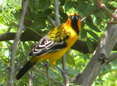
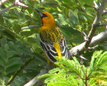
Orioles of the streak-backed group are larger, have entirely orange heads, and are almost completely monchromatic. Females can occasionally have some olive coloration. The back of I. p. alticola is the least streaked of all the subspecies and is sometimes solid black. Icterus pustulatus sclateris is often larger than other subspecies, and has a bright yellow head and broadly streaked back. Icterus pustulatus formosus has a brightly colored yellow-orange head. Icterus pustulatus pustuloides closely resembles I. p. aticola except for a reddish-orange head that is much like that of the northern populations. Icterus pustulatus maximus also resembles I. p. aticola, but is yellow, instead of orange. (Jaramillo and Burke, 1999)
- Other Physical Features
- endothermic
- heterothermic
- bilateral symmetry
- Sexual Dimorphism
- sexes alike
- male larger
- sexes colored or patterned differently
- male more colorful
-
- Range mass
- 70 to 85 g
- 2.47 to 3.00 oz
-
- Average length
- 200 mm
- 7.87 in
-
- Range wingspan
- 90 to 118 mm
- 3.54 to 4.65 in
Reproduction
Streak-backed orioles are seasonally monogamous, but one possible case of polygyny was observed. (Jaramillo and Burke, 1999)
- Mating System
- monogamous
While there is wide variation between the specific nesting times of different populations of streak-backed orioles, they generally begin nesting in the mid to late spring and continue through mid to late summer. The nest is a long, hanging basket. It is usually about 70 cm long and is woven of plant fibers. They are hung from the tips of branches, and usually remain within the shade of the tree. Their nests are very similar to those of Altamira orioles (I. gularis), but appear less sturdy. Streak-backed orioles appear to prefer thorned trees, such as Mimosa. Streak-backed orioles frequently nest next to Altamira orioles and spot breasted-orioles (I. pectoralis). (Howell and Webb, 1995; Jaramillo and Burke, 1999)
The nest is built entirely by the female, but both parents feed the young once they have hatched. Eggs are pale blue and uniformly spotted, there are 3-4 in a clutch. Hatching usually occurs after 12-14 days of incubation. Young remain in the nest for about 2 weeks before they fledge. Streak-backed orioles are sexually mature in their first breeding season. However, both sexes likely have delayed plumage maturation. This means that while they are able to breed in their first breeding season, the color of their plumage is still dull and resembles that of an immature bird. (Jaramillo and Burke, 1999)
- Key Reproductive Features
- iteroparous
- seasonal breeding
- gonochoric/gonochoristic/dioecious (sexes separate)
- sexual
- oviparous
-
- Breeding interval
- Streak-backed orioles breed once yearly.
-
- Breeding season
- Nesting begins in mid to late spring and ends in mid to late summer, there is wide variatation between populations in different areas.
-
- Range eggs per season
- 3 to 4
-
- Average time to hatching
- 12-14 days
-
- Average fledging age
- 2 weeks
-
- Average age at sexual or reproductive maturity (female)
- 1 years
-
- Average age at sexual or reproductive maturity (male)
- 1 years
Preliminary observations suggest that, like most orioles, both parents contribute to the feeding of nestlings and that the fledglings will remain in the vicinity of the parents for some time after they fledge (Liz Humphries and Kevin Omland, unpublished observations).
- Parental Investment
- altricial
-
pre-fertilization
- provisioning
-
protecting
- female
-
pre-hatching/birth
-
protecting
- male
- female
-
protecting
-
pre-weaning/fledging
-
provisioning
- male
- female
-
protecting
- male
- female
-
provisioning
-
pre-independence
-
provisioning
- male
- female
-
protecting
- male
- female
-
provisioning
Lifespan/Longevity
There is no published information on lifespan in I. pustulatus. Baltimore orioles (I. galbula) have been recorded living up to 12 years in the wild.
Behavior
Streak-backed orioles forage in pairs or as family groups, and occasionally they form larger groups. Eguiarte et al. (1987) documented that, while foraging in Pseudobombax ellipticum trees in Morelos, Mexico, streak-backed orioles behaved submissively to black-vented orioles (Icterus wagleri) during confrontations. On the other hand, streak-backed orioles consistently won confrontations with wintering Bullock's orioles (Icterus bullockii) on the same tree. Streak-backed orioles are most closely related to migratory Bullock's orioles of the western U United States (Omland et al., 1999). (Howell and Webb, 1995; Jaramillo and Burke, 1999; Omland, et al., 1999)
The northern subspecies of I. pustulatus are partially migratory. While little is known of their seasonal movements (Jaramillo and Burke 1999), some I. p. microstictus have been observed wintering to the south, in the state of Guerrero (Howell and Webb 1995). (Howell and Webb, 1995; Jaramillo and Burke, 1999)
Home Range
There is no published information on home range or territory sizes in I. pustulatus.
Communication and Perception
Stokes and Stokes (2000) describe streak-backed orioles as having a gentle "wheet" call. Howell and Webb (1995) also describe a "jerky, discordant, jangling warble," which usually ends in a raspy rattle. (Howell and Webb, 1995; Stokes and Stokes, 2000)
Food Habits
Icterus pustulatus is primarily insectivorous. However, individuals do feed on fruit, seeds, and nectar as well. (Jaramillo and Burke, 1999)
- Primary Diet
- carnivore
- Animal Foods
- insects
- Plant Foods
- seeds, grains, and nuts
- fruit
- nectar
Predation
There is little known about response to predators in streak-backed orioles. It is likely that avian predators occasionally take adults and that eggs and nestlings may be taken by arboreal predators, such as snakes and Bassariscus species. Other Icterus species respond to predators with warning calls and mobbing behavior. By building pendulant nests in trees, these orioles are avoiding predation on eggs and nestlings by many potential predators. (Jaramillo and Burke, 1999)
Ecosystem Roles
Streak-backed orioles are frugivorous and participate in the dispersal of seeds. They are also instrumental in modulating the population of various insect species, their primary prey.
While never observed to successfully fledge, a nest parasite, bronzed cowbirds (Molothrus aeneus), are known to parasitize the nests of streak-backed orioles. (Jaramillo and Burke, 1999)
- Ecosystem Impact
- disperses seeds
- bronzed cowbirds (Molothrus aeneus)
Economic Importance for Humans: Positive
Streak-backed orioles are attractive birds and attract the attention of ornithologists and bird enthusiasts. Research on their behavior, plumage, and genome will provide insights into the evolution of migration and sexual dimorphism.
- Positive Impacts
- ecotourism
- research and education
Economic Importance for Humans: Negative
As these birds sometimes eat fruit, they may cause some degree of damage to fruit crops, such as mangos.
Conservation Status
Streak-backed orioles have no special conservation status. They are widespread in agriculturally disturbed habitats. Therefore, it is unlikely that the species is threatened (Omland, personal observations).
-
- IUCN Red List
-
Least Concern
More information
-
- IUCN Red List
-
Least Concern
More information
-
- US Migratory Bird Act
- Protected
-
- US Federal List
- No special status
-
- CITES
- No special status
-
- State of Michigan List
- No special status
Other Comments
Streak-backed orioles demostrate a consistent trend within the genus Icterus. Males and females of sedentary, non-migratory populations are monomorphic, meaning their plumage characteristics are very similar. On the other hand, migratory populations are generally dimorphic, meaning the two sexes have different plumage characteristics, with males generally have more colorful plumage. Streak-backed orioles provide a novel opportunity for study, as there are populations that are both migratory-dimorphic, and sedentary-monomporphic. Dr. Kevin Omland and his post-doctoral student, Dr. Troy Murphy, are investigating this correlation between the loss of elaborate female plumage and the evolution of migration in streak-backed orioles. For more details on this research, please visit Dr. Troy Murphy's website at: http://www.umbc.edu/biosci/Faculty/OmlandLabWebpage/NewPages/Murphy_Troy/SBORresearch.html
Contributors
Tanya Dewey (editor), Animal Diversity Web.
Ryan Ihnacik (author), University of Maryland, Baltimore County, Kevin Omland (editor, instructor), University of Maryland, Baltimore County.
Glossary
- Nearctic
-
living in the Nearctic biogeographic province, the northern part of the New World. This includes Greenland, the Canadian Arctic islands, and all of the North American as far south as the highlands of central Mexico.

- Neotropical
-
living in the southern part of the New World. In other words, Central and South America.
- acoustic
-
uses sound to communicate
- agricultural
-
living in landscapes dominated by human agriculture.
- altricial
-
young are born in a relatively underdeveloped state; they are unable to feed or care for themselves or locomote independently for a period of time after birth/hatching. In birds, naked and helpless after hatching.
- bilateral symmetry
-
having body symmetry such that the animal can be divided in one plane into two mirror-image halves. Animals with bilateral symmetry have dorsal and ventral sides, as well as anterior and posterior ends. Synapomorphy of the Bilateria.
- carnivore
-
an animal that mainly eats meat
- chemical
-
uses smells or other chemicals to communicate
- desert or dunes
-
in deserts low (less than 30 cm per year) and unpredictable rainfall results in landscapes dominated by plants and animals adapted to aridity. Vegetation is typically sparse, though spectacular blooms may occur following rain. Deserts can be cold or warm and daily temperates typically fluctuate. In dune areas vegetation is also sparse and conditions are dry. This is because sand does not hold water well so little is available to plants. In dunes near seas and oceans this is compounded by the influence of salt in the air and soil. Salt limits the ability of plants to take up water through their roots.
- diurnal
-
- active during the day, 2. lasting for one day.
- dominance hierarchies
-
ranking system or pecking order among members of a long-term social group, where dominance status affects access to resources or mates
- ecotourism
-
humans benefit economically by promoting tourism that focuses on the appreciation of natural areas or animals. Ecotourism implies that there are existing programs that profit from the appreciation of natural areas or animals.
- endothermic
-
animals that use metabolically generated heat to regulate body temperature independently of ambient temperature. Endothermy is a synapomorphy of the Mammalia, although it may have arisen in a (now extinct) synapsid ancestor; the fossil record does not distinguish these possibilities. Convergent in birds.
- forest
-
forest biomes are dominated by trees, otherwise forest biomes can vary widely in amount of precipitation and seasonality.
- heterothermic
-
having a body temperature that fluctuates with that of the immediate environment; having no mechanism or a poorly developed mechanism for regulating internal body temperature.
- insectivore
-
An animal that eats mainly insects or spiders.
- island endemic
-
animals that live only on an island or set of islands.
- iteroparous
-
offspring are produced in more than one group (litters, clutches, etc.) and across multiple seasons (or other periods hospitable to reproduction). Iteroparous animals must, by definition, survive over multiple seasons (or periodic condition changes).
- migratory
-
makes seasonal movements between breeding and wintering grounds
- monogamous
-
Having one mate at a time.
- motile
-
having the capacity to move from one place to another.
- native range
-
the area in which the animal is naturally found, the region in which it is endemic.
- oviparous
-
reproduction in which eggs are released by the female; development of offspring occurs outside the mother's body.
- riparian
-
Referring to something living or located adjacent to a waterbody (usually, but not always, a river or stream).
- scrub forest
-
scrub forests develop in areas that experience dry seasons.
- seasonal breeding
-
breeding is confined to a particular season
- sedentary
-
remains in the same area
- sexual
-
reproduction that includes combining the genetic contribution of two individuals, a male and a female
- social
-
associates with others of its species; forms social groups.
- tactile
-
uses touch to communicate
- terrestrial
-
Living on the ground.
- tropical
-
the region of the earth that surrounds the equator, from 23.5 degrees north to 23.5 degrees south.
- visual
-
uses sight to communicate
References
Cortes-Rodriguez, N., A. Navarro, K. Omland. Unpublished Data.
Howell, S., S. Webb. 1995. A Guide to the Birds of Mexico and Northern Central America. Oxford: Oxford University Press.
Jaramillo, A., P. Burke. 1999. New World Blackbirds: The Icterids. Princeton, New Jersey: Princeton University Press.
Omland, K., S. Lanyon, S. Fritz. 1999. A molecular phylogeny of the New World Orioles (Icterus): the importance of dense taxon sampling. Molecular Phylogenetics and Evolution, 12: 224–239.
Stokes, D., L. Stokes. 2000. Stokes Oriole Book: The Complete Guide to Attracting, Identifying, and Enjoying Orioles. Boston, New York, London: Little, Brown and Company.