Hyla gratiosaBarking Treefrog

Geographic Range
Barking treefrogs, Hyla gratiosa, are found from southern Virginia southward through Florida and into Louisiana. This species occurs mostly in the coastal plain, but its range extends up to the southern part of Tennessee with separate colonies in southeastern Kentucky (Conant and Collins, 1998; eNature.com and Inc, 2003). Barking treefrogs have also been introduced into the southern part of New Jersey (eNature.com and Inc, 2003). (Conant and Collins, 1998; "National Wildlife Federation", 2003)
- Biogeographic Regions
- nearctic
Habitat
Barking treefrogs reside both on land and in water. They are highly arboreal, and can be found in tree tops when the weather is warm. When the weather is dry, they dig themselves into the ground around tree roots and clusters of vegetation for moisture (eNature.com, 2003). During breeding season, groups of barking treefrogs come together at streams, ponds, and bayheads, and other permanent bodies of water (VDGIF, 2005). ("National Wildlife Federation", 2003; "Virginia Department of Game and Inland Fisheries", 2005)
- Habitat Regions
- temperate
- terrestrial
- freshwater
- Terrestrial Biomes
- forest
- Aquatic Biomes
- lakes and ponds
- rivers and streams
Physical Description
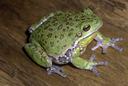
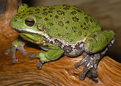
Barking treefrogs are the largest treefrog species in the southeastern United States. They have a bulky or chubby form and have a length of 5.1 to 7 centimeters (eNature.com and Inc, 2003). The skin of these frogs has a very rough, granular appearance (eNature.com and Inc, 2003; VDGIF, 2005). Barking treefrogs have the capacity to change the color of their skin, therefore coloration varies greatly (Northern Prairie Wildlife Research Center, 2002). Color ranges from a bright lime-green, to various degrees of brown. However, these frogs almost always display darker spots on their backs (eNature.com and Inc, 2003; Northern Prairie Wildlife Research Center, 2002). A lighter stripe is present, which starts at the upper jaw and runs along the length of the body (eNature.com and Inc, 2003; VDGIF, 2005). A light green or yellow throat is present in males (eNature.com and Inc, 2003; Wright and Wright, 1995). To allow for climbing, barking treefrogs have rounded pads on the end of each digit (eNature.com and Inc, 2003; The University of Georgia, 2004). (Conant and Collins, 1998; "National Wildlife Federation", 2003; "Northern Prairie Wildlife Research Center", 2002; "The University of Georgia Savannah River Ecology Laboratory", 2004; "Virginia Department of Game and Inland Fisheries", 2005; Wright and Wright, 1995)
- Other Physical Features
- ectothermic
- bilateral symmetry
- Sexual Dimorphism
- sexes colored or patterned differently
- male more colorful
-
- Range length
- 5.1 to 7 cm
- 2.01 to 2.76 in
Development
Tadpoles take about one week to hatch from the eggs once they have been deposited ("Georgia Wildlife Web", 2000). A few days after hatching, the gills of the tadpoles begin to function, and they feed on algae (AWAKE, 2004). Tadpoles are quite large, with a length of up to 5 cm, and may take up to 1.5 to 2 months to metamorphose (U. S. Geological Survey, 2003). ("Georgia Wildlife Web", 2000; "AWAKE", 2004; "Florida Integrated Science Center - Gainesville", 2003)
- Development - Life Cycle
- metamorphosis
Reproduction
Barking treefrogs mate seasonally, and they are polygynous. In one mating season, female barking treefrogs breed only once (Duellman and Trueb, 1986). On the other hand, the males of this species will mate as many as seventeen times in one season (Heatwole and Sullivan, 1995). (Duellman and Trueb, 1986; Heatwole and Sullivan, 1995)
Groups of males come together at permanent water (such as streams, ponds, and bayheads) to call for a mate (eNature.com and Inc, 2003; VDGIF, 2005). The number of males in a group is usually no more than 20 to 25 (AWAKE, 2004). Breeding choruses often form on rainy nights (The University of Georgia, 2004). Areas of breeding are very often found in pools with open canopies, and ponds dominated by grasses (VDGIF, 2005). Females choose a male from the sound of his call, but instead of choosing from the entire chorus, they select the best from a smaller group of males that are closest to them (Murphy, 2000). ("AWAKE", 2004; "National Wildlife Federation", 2003; Murphy, 2000; "The University of Georgia Savannah River Ecology Laboratory", 2004; "Virginia Department of Game and Inland Fisheries", 2005)
- Mating System
- polygynous
Mating season begins in March and continues through August (eNature.com and Inc, 2003; VDGIF, 2005). Choruses of 20 to 25 males typically form on rainy nights near streams, ponds, and bayheads (eNature.com and Inc, 2003; VDGIF, 2005; AWAKE 2004; The University of Georgia, 2004). Areas of breeding are very often found in pools with open canopies, and ponds dominated by grasses (VDGIF, 2005). Both males and females are ready to mate at about 4 years of age (AWAKE, 2004). Fertilization takes place externally through amplexus ("Georgia Wildlife Web", 2000). Following fertilization, 2000 or more eggs are deposited one at a time on the pond bottom (U. S. Geological Survey, 2003; VDGIF, 2005). Egg size ranges from 1.0 to 1.8 mm in diameter (VDGIF, 2005). The eggs take an average of one week to hatch ("Georgia Wildlife Web", 2000). ("Georgia Wildlife Web", 2000; "AWAKE", 2004; "National Wildlife Federation", 2003; Murphy, 2000; "The University of Georgia Savannah River Ecology Laboratory", 2004; "Florida Integrated Science Center - Gainesville", 2003; "Virginia Department of Game and Inland Fisheries", 2005)
- Key Reproductive Features
- iteroparous
- seasonal breeding
- gonochoric/gonochoristic/dioecious (sexes separate)
- sexual
- fertilization
- oviparous
-
- Breeding interval
- Barking treefrogs breed once every year.
-
- Breeding season
- Breeding occurs from March to August.
-
- Average number of offspring
- 2000
-
- Average time to hatching
- 1 weeks
-
- Range time to independence
- 0 (low) minutes
-
- Average age at sexual or reproductive maturity (female)
- 4 years
-
- Average age at sexual or reproductive maturity (male)
- 4 years
Females provision their eggs with nutrients which allow the tadpoles to develop and hatch. However, after the eggs are laid, male and female barking treefrogs have no parental involvement with their offspring. Care of offspring by the parent is unusual (Zug, Vitt, and Caldwell, 2001). Instead of actively caring for the young, the female deposits many more eggs than would survive in order to heighten her reproductive success. (Zug, et al., 2001)
- Parental Investment
-
pre-fertilization
- provisioning
-
protecting
- female
Lifespan/Longevity
Little is known about the lifespan of barking treefrogs in the wild, but in captivity they are fairly long-lived. An average of 7 years can be reached (Andrew Tillson Willis, 2005; Max-Planck-Gesellschaft, 2005). They have been known to live as long as 12.5 years in captivity (North Carolina Herpetological Society, 2005). ("Pollywog", 2005; "Longevity Records", 2005; "North Carolina Herpetological Society", 2005)
-
- Range lifespan
Status: captivity - 12.5 (high) years
- Range lifespan
-
- Average lifespan
Status: captivity - 7 years
- Average lifespan
-
- Average lifespan
Status: captivity - 7.2 years
- Max Planck Institute for Demographic Research
- Average lifespan
Behavior
Hyla gratiosa is a solitary species. Being nocturnal, these frogs pass the day restfully, high up in a tree ("Georgia Wildlife Web", 2000). When the weather becomes hot and dry, barking treefrogs aestivate (AWAKE, 2004; "Georgia Wildlife Web", 2000). When the weather is cold, they hibernate (AWAKE, 2004). Both aestivation and hibernation are done under the cover of roots and other vegetation (AWAKE, 2004). Because of this occasional burrowing into the ground, barking treefrogs may be considered somewhat fossorial. ("Georgia Wildlife Web", 2000; "AWAKE", 2004)
- Key Behaviors
- arboreal
- scansorial
- saltatorial
- nocturnal
- motile
- sedentary
- hibernation
- aestivation
- solitary
Home Range
The home range for these frogs is thought to be the forested areas that are right around their breeding ponds (VDGIF, 2005). When they are not breeding, they keep to this area. ("Virginia Department of Game and Inland Fisheries", 2005)
Communication and Perception
Barking treefrogs use mostly vocal communication with conspecifics. When finding a mate, no visual cues are used (Duellman and Trueb, 1986). Barking treefrogs utilize two different calls in order to communicate (U. S. Geological Survey, 2003). The first call is a very loud note that they give when they are around water and ready to mate (eNature.com and Inc, 2003). This call is reiterated every 1 or 2 seconds (U. S. Geological Survey, 2003). The other call is given when these frogs are high in the trees (eNature.com and Inc, 2003; U. S. Geological Survey, 2003). This call resembles the bark of a dog, and is a call of 9 or 10 harsh syllables (U. S. Geological Survey, 2003).
In addition to vocal communiation, tactile communication may be important during amplexus.
Aside from vocal communication, barking treefrogs use visual cues in perceiving their environment. Their span of vision is very large, and they can easily detect movement in their environment (UF/IFAS, 1994). (Duellman and Trueb, 1986; "National Wildlife Federation", 2003; "Florida Integrated Science Center - Gainesville", 2003; "EDIS", 1994)
- Other Communication Modes
- choruses
Food Habits
Barking treefrogs are greedy, opportunistic feeders (The University of Georgia, 2004). They seach for food on the ground and in treetops, eating many arboreal insects (The University of Georgia, 2004; U. S. Geological Survey, 2003; VDGIF, 2005). Barking treefrogs very often end up feeding on crickets, Gryllus rubens (U. S. Geological Survey, 2003). ("The University of Georgia Savannah River Ecology Laboratory", 2004; "Florida Integrated Science Center - Gainesville", 2003; "Virginia Department of Game and Inland Fisheries", 2005)
- Primary Diet
- carnivore
- Animal Foods
- insects
Predation
Barking treefrogs are predators on insects and in turn are prey to larger animals. The eggs and larvae of any frog are preyed upon by fish. The production of large numbers of eggs in one season may be a way of satiating aquatic predators while still having a smaller portion of offspring survive. Many birds look to frogs as an essential part of their diet (Babbitt and Tanner, 1994). These animals are also often eaten by snakes and raccoons (Congaree National Park, 2004).
One anti-predator adaptation of these frogs may be their sense of sight. The extent of their vision is quite large, and they can very easily detect movement (UF/IFAS, 1994). (Babbitt and Tanner, 1994; "National Park Service", 2004; "EDIS", 1994)
- Anti-predator Adaptations
- cryptic
-
- Known Predators
-
- fish (on larvae and eggs) (Actinopterygii)
- birds (Aves)
- snakes (Serpentes)
- raccoons (Procyon lotor)
Ecosystem Roles
As stated above, barking treefrogs are predators of many arboreal insects and prey to larger animals such as birds, snakes, and raccoons. This food web may be considered an ecosystem role. Hyla gratiosa also spends some time burying itself beneath vegetation on the ground (AWAKE, 2004; eNature.com and Inc, 2003; "Georgia Wildlife Web", 2000). This may serve as a way to aerate the soil. Beyond these relationships, little is known about their role in their environment. ("Georgia Wildlife Web", 2000; "AWAKE", 2004; "National Wildlife Federation", 2003)
- Ecosystem Impact
- soil aeration
Economic Importance for Humans: Positive
Because barking treefrogs have a diet consisting mainly of insects, they can be quite helpful in regulating pest populations (AWAKE, 2004; The University of Georgia, 2004). Another benefit for humans is that barking treefrogs are used in the pet trade. They are great terrarium pets which will easily take insects from the owners' fingers (eNature.com and Inc, 2003). ("AWAKE", 2004; "National Wildlife Federation", 2003; "The University of Georgia Savannah River Ecology Laboratory", 2004)
- Positive Impacts
- pet trade
- controls pest population
Economic Importance for Humans: Negative
There are no known adverse effects of H. gratiosa on humans.
Conservation Status
Although barking treefrogs are listed as least concern by the IUCN Red List, they may still be adversely affected by human activities. Their populations have decreased in some places due to the expansion of buildings into habitats (U. S. Geological Survey, 2003). Because barking treefrogs utilize water for mating and reproduction, pollution into ponds and other bodies of water can be detrimental (AWAKE, 2004). Populations of these frogs can be maintained by preserving wetlands and pine woods (AWAKE, 2004; "Georgia Wildlife Web", 2000). ("Georgia Wildlife Web", 2000; "AWAKE", 2004; "Florida Integrated Science Center - Gainesville", 2003)
-
- IUCN Red List
-
Least Concern
More information
-
- IUCN Red List
-
Least Concern
More information
-
- US Federal List
- No special status
-
- CITES
- No special status
Contributors
James Harding (editor, instructor), Michigan State University, Lyndsay Richards (author), Michigan State University , Nancy Shefferly (editor), Animal Diversity Web.
Glossary
- Nearctic
-
living in the Nearctic biogeographic province, the northern part of the New World. This includes Greenland, the Canadian Arctic islands, and all of the North American as far south as the highlands of central Mexico.

- acoustic
-
uses sound to communicate
- arboreal
-
Referring to an animal that lives in trees; tree-climbing.
- bilateral symmetry
-
having body symmetry such that the animal can be divided in one plane into two mirror-image halves. Animals with bilateral symmetry have dorsal and ventral sides, as well as anterior and posterior ends. Synapomorphy of the Bilateria.
- carnivore
-
an animal that mainly eats meat
- choruses
-
to jointly display, usually with sounds, at the same time as two or more other individuals of the same or different species
- cryptic
-
having markings, coloration, shapes, or other features that cause an animal to be camouflaged in its natural environment; being difficult to see or otherwise detect.
- ectothermic
-
animals which must use heat acquired from the environment and behavioral adaptations to regulate body temperature
- external fertilization
-
fertilization takes place outside the female's body
- fertilization
-
union of egg and spermatozoan
- forest
-
forest biomes are dominated by trees, otherwise forest biomes can vary widely in amount of precipitation and seasonality.
- freshwater
-
mainly lives in water that is not salty.
- hibernation
-
the state that some animals enter during winter in which normal physiological processes are significantly reduced, thus lowering the animal's energy requirements. The act or condition of passing winter in a torpid or resting state, typically involving the abandonment of homoiothermy in mammals.
- insectivore
-
An animal that eats mainly insects or spiders.
- introduced
-
referring to animal species that have been transported to and established populations in regions outside of their natural range, usually through human action.
- iteroparous
-
offspring are produced in more than one group (litters, clutches, etc.) and across multiple seasons (or other periods hospitable to reproduction). Iteroparous animals must, by definition, survive over multiple seasons (or periodic condition changes).
- metamorphosis
-
A large change in the shape or structure of an animal that happens as the animal grows. In insects, "incomplete metamorphosis" is when young animals are similar to adults and change gradually into the adult form, and "complete metamorphosis" is when there is a profound change between larval and adult forms. Butterflies have complete metamorphosis, grasshoppers have incomplete metamorphosis.
- motile
-
having the capacity to move from one place to another.
- native range
-
the area in which the animal is naturally found, the region in which it is endemic.
- nocturnal
-
active during the night
- oviparous
-
reproduction in which eggs are released by the female; development of offspring occurs outside the mother's body.
- pet trade
-
the business of buying and selling animals for people to keep in their homes as pets.
- polygynous
-
having more than one female as a mate at one time
- saltatorial
-
specialized for leaping or bounding locomotion; jumps or hops.
- seasonal breeding
-
breeding is confined to a particular season
- sedentary
-
remains in the same area
- sexual
-
reproduction that includes combining the genetic contribution of two individuals, a male and a female
- soil aeration
-
digs and breaks up soil so air and water can get in
- solitary
-
lives alone
- tactile
-
uses touch to communicate
- temperate
-
that region of the Earth between 23.5 degrees North and 60 degrees North (between the Tropic of Cancer and the Arctic Circle) and between 23.5 degrees South and 60 degrees South (between the Tropic of Capricorn and the Antarctic Circle).
- terrestrial
-
Living on the ground.
- visual
-
uses sight to communicate
References
AWAKE. 2004. "AWAKE" (On-line). Barking Treefrog. Accessed April 28, 2005 at http://www.kentuckyawake.org/plantswildlife/lifehistory.cfm?ID=255.
UF/IFAS. 1994. "EDIS" (On-line). Frogs and Toads of Florida. Accessed May 05, 2005 at http://edis.ifas.ufl.edu/UW089.
U. S. Geological Survey. 2003. "Florida Integrated Science Center - Gainesville" (On-line). Accessed April 03, 2005 at http://cars.er.usgs.gov/herps/Frogs_and_Toads/H_gratiosa/h_gratiosa.html.
2000. "Georgia Wildlife Web" (On-line). Accessed April 03, 2005 at http://museum.nhm.uga.edu/gawildlife/amphibians/anura/hylidae/hgratiosa.html.
Max-Planck-Gesellschaft. 2005. "Longevity Records" (On-line). Accessed May 04, 2005 at http://www.demogr.mpg.de/longevityrecords/.
Congaree National Park. 2004. "National Park Service" (On-line). Accessed May 05, 2005 at http://www.nps.gov/cosw/coswamph/htm.
eNature.com, Inc. 2003. "National Wildlife Federation" (On-line). Barking treefrog. Accessed February 08, 2005 at http://www.enature.com/fieldguide/showSpeciesRecNum.asp?recnum=AR0017.
North Carolina Herpetological Society. 2005. "North Carolina Herpetological Society" (On-line pdf). Accessed April 28, 2005 at http://www.ncherps.org/pdf_forms/BarkingTreefrog.pdf.
Northern Prairie Wildlife Research Center. 2002. "Northern Prairie Wildlife Research Center" (On-line). Barking Treefrog. Accessed February 08, 2005 at http://www.npwrc.usgs.gov/narcam/idguide/hgratios.htm.
Andrew Tillson Willis. 2005. "Pollywog" (On-line). Care Sheet: Barking Tree Frog (Hyla gratiosa). Accessed April 23, 2005 at http://www.pollywog.co.uk/barkingcaresheet.html.
The University of Georgia. 2004. "The University of Georgia Savannah River Ecology Laboratory" (On-line). Barking treefrog. Accessed February 07, 2005 at http://www.uga.edu/srel/barking_treefrog.htm.
VDGIF. 2005. "Virginia Department of Game and Inland Fisheries" (On-line). Barking treefrog (Hyla gratiosa). Accessed February 08, 2005 at http://www.dgif.state.va.us/wildlife/species/display.asp?id=020002.
Babbitt, K., G. Tanner. 1994. "EDIS" (On-line). Effective Management for Frogs and Toads on Florida's Ranches. Accessed May 04, 2005 at http://edis.ifas.ufl.edu/UW125.
Conant, R., J. Collins. 1998. A Field Guide to Reptiles and Amphibians of Eastern and Central North America. Third Edition, Expanded. New York, NY: Houghton Mifflin Company.
Duellman, W., L. Trueb. 1986. Biology of Amphibians. New York: McGraw-Hill, Inc..
Heatwole, H., B. Sullivan. 1995. Amphibian Biology (Vol. 2). Australia: Surrey Beatty & Sons PTY Limited.
Murphy, C. 2000. "Animal Behavior Society" (On-line). Accessed April 07, 2005 at http://www.animalbehavior.org/ABS/Program/Past/Morehouse_00/Media.html.
Wright, A., A. Wright. 1995. Handbook of Frogs and Toads of the United States and Canada. New York: Comstock Publishing Company, Inc..
Zug, G., L. Vitt, J. Caldwell. 2001. Herpetology. San Diego: Academic Press.