Holothuroidea
Diversity
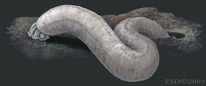
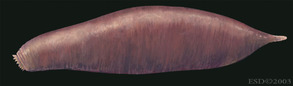
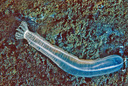
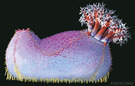
Holothruroidea, or sea cucumbers, have around 1100 described extant species. (Beirne, et al., 2001; Brusca and Brusca, 2003)
Geographic Range
Holothurians are found in oceans all over the world. (Barnes, 1987; Brusca and Brusca, 2003)
- Biogeographic Regions
- indian ocean
- atlantic ocean
- pacific ocean
- mediterranean sea
Habitat
Sea cucumbers are common in shallow water areas to deep ocean floors. While most are benthic, a few are pelagic. (Brusca and Brusca, 2003; Waggoner and Spear, 1994)
- Habitat Regions
- saltwater or marine
- Aquatic Biomes
- coastal
- Other Habitat Features
- intertidal or littoral
Physical Description
Although they vary in color, most holothurians are black, brown, or olive green. Ranging from three cm to one m long, the largest sea cucumbers may have a diameter of 24 cm.
Holothurians generally look long and worm-like, but retain the pentaradial symmetry characteristic of the Echinodermata. Some may be spherical in body shape. The mouth and anus are located on opposite poles, and five rows of tube feet run from the mouth to the anus along the cylindrical body. Ten to 30 branching tentacles surround the mouth. The tentacles are actually part of the water vascular system.


The water vascular system, found in all echinoderms, accommodates the elongated body of the holothurians. Coelomic fluid, rather than sea water, circulates through the water vascular system. The ring canal around the gut has 1-50 polian vessicles, which may function for hydraulic regulation. Each radial canal has rows of ampullae. Podia, which are the external portion of the tube feet, may, be suckered, reduced, or lost. Podia are more randomly scattered along the body than in other echinoderms. The esophagus, foregut and radial canal of the water vascular system are supported by calcareous plates.

Letters are used to describe parts of echinoderms. The ambulacrum opposite the madreorite is section A. Moving clockwise, other parts are coded B through E. Sections C and D are termed the bivium while all the others are collectively termed the trivium. Holothurians mainly orient themselves to have the trivium on the substrate (ventral side) and the bivium facing up (dorsal side).

In the Holothuroidea, the madreporite is unattached to the coelom and is internal, lying beneath the pharynx in the CD-interambulacral position. A short stone canal follows the madreporite.
While support in most echinoderms is from the skeletal structure, in sea cucumbers, thick sheets of body wall muscles provide support. Microscopic ossicles (or sclerietes) are on the dermal layer and are used in taxonomic identification.
Respiratory trees, which branch out near the rectum of the animal are used for gas exchange as water is pumped through the anus. The respiratory trees are part of the organs that are expelled occasionally by the sea cucumber. (Barnes, 1987; Beirne, et al., 2001; Brusca and Brusca, 2003; University of Paisley, 1998; Waggoner and Spear, 1994)
- Other Physical Features
- ectothermic
- heterothermic
- bilateral symmetry
- radial symmetry
Development
As an echinoderm, members of the Holothuroidea are deuterostomes. The larvae, which are planktotrophic or lecithotrophic, have 3-part paired coeloms. Embryonic coelomic structures have specific fates as the bilaterally symmetrical larvae metamorphose into radially symmetric adults.
The larvae develop in sea water. After three days the larval stage is called an auricularia and is similar to the bipinnaria larvae of asteroids. The auricularia has a ciliated locomotor band, then further develops into a larval stage called a doliolaria, where the ciliated band is broken up into three to five ciliated "girdles". Many species of holothurians have another non-feeding, barrel shaped larval stage called a vitellaria. Likely a specialized condition, it develops gradually, retaining many of the larval features. As it is metamorphosing it is sometimes called a pentactula larva.


After larval metamorphosis, the young sea cucumbers ultimately settle on the substrate and become adults. (Barnes, 1987; Brusca and Brusca, 2003)
- Development - Life Cycle
- metamorphosis
Reproduction
Holothurians have a single gonad, and most are dioecious. Although most spawn and are fertilized externally, there are approximately thirty brooding species. Some capture eggs with tentacles, placing the eggs at the sole or dorsal body surface for incubation. A few have internal fertilization and development, where hatched young are released. (Barnes, 1987)
- Key Reproductive Features
- gonochoric/gonochoristic/dioecious (sexes separate)
- simultaneous hermaphrodite
- sexual
- fertilization
- ovoviviparous
- oviparous
While most species release eggs and have no perental investment after spawning, some species brood eggs. A few species also brood the eggs internally until they hatch. (Barnes, 1987)
- Parental Investment
-
pre-fertilization
- provisioning
-
pre-hatching/birth
-
provisioning
- female
-
protecting
- female
-
provisioning
Lifespan/Longevity
Most species live from five to ten years. (Barnes, 1987)
Behavior
Generally, holothuridians are sedentary and/or slow moving, usually burrowing into soft sediments or are lodged in cracks or crevices under rocks. Holothurians crawl using podia or by using body wall muscles. Some deep sea species have elongate podia used for walking. In other species the trivium is modified for creeping. A few pelatic species can swim (although not well) with webbed papillae.
Chemical stimulation changes the mechanical properties of the dermal portion of the sea cucumbers. This allows the animal to become so flexible it can squeeze through narrow passages. Conversely, it can become so rigid that it cannot be dislodged. (Barnes, 1987; Brusca and Brusca, 2003)
Communication and Perception
The non-centralized nervous system of echinoderms allows them to sense their environment from all sides. Holothurians have a nerve ring near the base of the tentacles. The podia are touch-sensitive. Adult pheromones may attract larvae, which tend to settle near conspecific adults. (Barnes, 1987; Brusca and Brusca, 2003)
- Communication Channels
- chemical
- Other Communication Modes
- pheromones
Food Habits
As suspension or deposit feeders holothurians trap particles and plankton on mucus-covered tentacles. The tentacles are pushed into the mouth to ingest food. Secretory cells from papillae of the tentacles and gland cells of the foregut secrete mucus.
In sedentary forms, holothurians hold out extended tentacles to trap particles and plankton. Motile species crawl across the substrate and use tentacles to capture sediment and organic detritus. Sediment feeders are highly selective deposit feeders, generally consuming highly organic sediments. Members of the subclass Apodacea ingest sediments as they burrow through the substrate.
Branched buccal tentacles surround the mouth. From the mouth, the esophogus leads to the foregut and then intestine, where digestion and absorbtion occur. (Brusca and Brusca, 2003)
- Primary Diet
- planktivore
- detritivore
Predation
Holothurians in general are most vulnerable in their larval stage. Some holothurians discharge sticky tubules, known as Cuvierian tubules, at a potential predator. The tubules are sticky clusters found at the base of the respiratory tree. Predators include sea stars, fish, gastropods, and crustaceans as well as humans. Holothurians also expell their organs, which are later regenerated. This is a seasonal event, but is also thought to be an anti-predator defense. (Beirne, et al., 2001; Brusca and Brusca, 2003)

- Anti-predator Adaptations
- cryptic
-
- Known Predators
-
- sea stars, Asteroidea
- gastropods, Gastropoda
- crustaceans, Crustacea
- fish
- humans, Homo sapiens
Ecosystem Roles
Holothurians have an important role as large scale detritus feeders. They cycle up to 90% benthic biomass in ocean. (Beirne, et al., 2001)
- Ecosystem Impact
- biodegradation
Economic Importance for Humans: Positive
Dried sea cucumbers are an important food source and flavoring source in Asia. Before drying, the sea cucumbers are boiled and the bodies contract and thicken and organs are expelled. Sometimes sea cucumbers are considered an aphrodisiac.
Macerated sea cucumbers that release the toxin holothurin with the Cuvierian tubules have been used by South Pacific Islanders to catch tide pool fish. (Barnes, 1987; Beirne, et al., 2001)
- Positive Impacts
- food
- source of medicine or drug
Conservation Status
Some populations of sea cucumbers have been overfished, which has an effect on the ecosystem. Overfishing has in some places reduced their role in breaking down organics on the ocean floor. Areas without the sea cucumbers have become unihabitable for other organisms.
Commercially exploitable species are mainly in the order Aspidochirotida. Large amounts of dried sea cucumbers are traded in Galapagos Islands to Asian markets, mainly Japan, Hong Kong, Taiwan, and Singapore. Stocks have become depleted in these countries, so they have been looking for other sources.
Sea cucumbers in Baja California, eastern Russia, and the Galapagos Archipelago have been the focus of recent attention. In Baja California Isostichopus fuscus has been overharvested. In 1994, the National Institute of Ecology in Mexico declared that I. fuscus was in danger of extinction. In eastern Russia, increasing demand on Cucumaria japonica has led to concern for this species, which is harvested for both food and cosmetic products. Because of commercial exploitation in the Galapagos, Ecuador passed the Galapagos Marine Management Plan in 1999 to regulate conservation of sea cucumbers.
The Australian government is trying to seed juveniles of sandfish, Holothuroidea scabra which were reduced by overfishing. (Beirne, et al., 2001)
-
- IUCN Red List [Link]
- Not Evaluated
Other Comments
When expelling organs, sea cucumbers usually release one or both respiratory trees, the gut and the gonads. This behavior may occur seasonally or in response to predation.
Holothurians have the most developed hemal system of echinoderms, having well developed vessels and several single chambered hearts along the intestinal system. The hemal system functions for gas and food transport. (Barnes, 1987; University of Paisley, 1998)
Contributors
Renee Sherman Mulcrone (author).
Glossary
- Atlantic Ocean
-
the body of water between Africa, Europe, the southern ocean (above 60 degrees south latitude), and the western hemisphere. It is the second largest ocean in the world after the Pacific Ocean.

- Pacific Ocean
-
body of water between the southern ocean (above 60 degrees south latitude), Australia, Asia, and the western hemisphere. This is the world's largest ocean, covering about 28% of the world's surface.
- bilateral symmetry
-
having body symmetry such that the animal can be divided in one plane into two mirror-image halves. Animals with bilateral symmetry have dorsal and ventral sides, as well as anterior and posterior ends. Synapomorphy of the Bilateria.
- biodegradation
-
helps break down and decompose dead plants and/or animals
- chemical
-
uses smells or other chemicals to communicate
- coastal
-
the nearshore aquatic habitats near a coast, or shoreline.
- cryptic
-
having markings, coloration, shapes, or other features that cause an animal to be camouflaged in its natural environment; being difficult to see or otherwise detect.
- detritivore
-
an animal that mainly eats decomposed plants and/or animals
- drug
-
a substance used for the diagnosis, cure, mitigation, treatment, or prevention of disease
- ectothermic
-
animals which must use heat acquired from the environment and behavioral adaptations to regulate body temperature
- external fertilization
-
fertilization takes place outside the female's body
- fertilization
-
union of egg and spermatozoan
- food
-
A substance that provides both nutrients and energy to a living thing.
- heterothermic
-
having a body temperature that fluctuates with that of the immediate environment; having no mechanism or a poorly developed mechanism for regulating internal body temperature.
- internal fertilization
-
fertilization takes place within the female's body
- intertidal or littoral
-
the area of shoreline influenced mainly by the tides, between the highest and lowest reaches of the tide. An aquatic habitat.
- metamorphosis
-
A large change in the shape or structure of an animal that happens as the animal grows. In insects, "incomplete metamorphosis" is when young animals are similar to adults and change gradually into the adult form, and "complete metamorphosis" is when there is a profound change between larval and adult forms. Butterflies have complete metamorphosis, grasshoppers have incomplete metamorphosis.
- motile
-
having the capacity to move from one place to another.
- oviparous
-
reproduction in which eggs are released by the female; development of offspring occurs outside the mother's body.
- ovoviviparous
-
reproduction in which eggs develop within the maternal body without additional nourishment from the parent and hatch within the parent or immediately after laying.
- pheromones
-
chemicals released into air or water that are detected by and responded to by other animals of the same species
- planktivore
-
an animal that mainly eats plankton
- radial symmetry
-
a form of body symmetry in which the parts of an animal are arranged concentrically around a central oral/aboral axis and more than one imaginary plane through this axis results in halves that are mirror-images of each other. Examples are cnidarians (Phylum Cnidaria, jellyfish, anemones, and corals).
- saltwater or marine
-
mainly lives in oceans, seas, or other bodies of salt water.
- sedentary
-
remains in the same area
- sexual
-
reproduction that includes combining the genetic contribution of two individuals, a male and a female
- tactile
-
uses touch to communicate
References
Barnes, R. 1987. Invertebrate Zoology. Orlando, Florida: Dryden Press.
Beirne, L., K. Fitzmier, M. Miller. 2001. "Holothuroidea" (On-line). Biological Diversity 2001. Accessed January 28, 2005 at http://www.earlham.edu/~beirnlu/seacucumber.htm.
Brusca, R., G. Brusca. 2003. Invertebrates. Sunderland, Massachusetts: Sinauer Associates, Inc..
University of Paisley, 1998. "Class Holothuroidea" (On-line). Accessed January 28, 2005 at http://www-biol.paisley.ac.uk/courses/Tatner/biomedia/units/echi6.htm.
Waggoner, D., B. Spear. 1994. "The Holothuroidea" (On-line). Accessed January 28, 2005 at http://www.ucmp.berkeley.edu/echinodermata/holothuroidea.html.