Hirundo rusticabarn swallow




Geographic Range
Barn swallows are native in all the biogeographic regions except Australia and Antarctica. The breeding range of barn swallows includes North America, northern Europe, northcentral Asia, northern Africa, the Middle East, southern China, and Japan. They winter in South America, South Asia, Indonesia, and Micronesia. (Terres, 1980)
- Biogeographic Regions
- nearctic
- palearctic
- oriental
- neotropical
- Other Geographic Terms
- holarctic
Habitat
Barn swallows are very adaptable birds and can nest anywhere with open areas for foraging, a water source, and a sheltered ledge. They seek out open habitats of all types, including agricultural areas, and are commonly found in barns or other outbuildings. They will also build nests under bridges, the eaves of old houses, and boat docks, as well as in rock caves and even on slow-moving trains.
While migrating, they tend to fly over open areas, often near water or along mountain ridges. Barn swallows generally nest below 3000 m elevation. (McWilliams, 2000; Terres, 1980)
- Habitat Regions
- temperate
- tropical
- terrestrial
- Terrestrial Biomes
- savanna or grassland
- chaparral
- forest
- Other Habitat Features
- urban
- suburban
- agricultural
- riparian
- caves
-
- Range elevation
- 3000 (high) m
- 9842.52 (high) ft
Physical Description
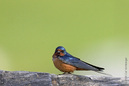
Barn swallows are small birds. They range in size from 14.6 to 19.9 cm long, with a wingspan of 31.8 to 34.3 cm. They weigh between 17 and 20 g. Barn swallows are metallic blue-black above and pale beige below. They have light brown on their throat and forehead, and have a long, deeply-forked tail. Males and females are similar in appearance, though females tend to be less vibrantly colored and have shorter outer tail-streamers.
Asymmetry of physical characteristics in barn swallows tends to be transmitted to the young in distinct parent to offspring patterns. Tail asymmetry tends to pass from father to son and from mother to daughter. Alternatively, wing asymmetry does not appear to transfer at all on a reliable basis from parent to offspring.
Six subspecies of Hirundo rustica are recognized. (Moller, 1994a; Moller, 1994b; Terres, 1980)
- Other Physical Features
- endothermic
- bilateral symmetry
- polymorphic
- Sexual Dimorphism
- male larger
- male more colorful
-
- Range mass
- 17 to 20 g
- 0.60 to 0.70 oz
-
- Range length
- 14.6 to 19.9 cm
- 5.75 to 7.83 in
-
- Range wingspan
- 31.8 to 34.3 cm
- 12.52 to 13.50 in
-
- Average basal metabolic rate
- 0.3158 W
- AnAge
Reproduction
Barn swallows are socially monogamous. However, extra-pair copulations are common, making this species genetically polygamous. Breeding pairs form each spring after arrival on the breeding grounds. Pairs re-form each spring, though pairs that have nested together successfully may mate together for several years. Males try to attract females by spreading their tails to display them and singing.
Several studies have researched sexual selection in barn swallows. Moller (1994) documented female barn swallows selecting for symmetrical wings and tails in potential mates. Males exhibiting greater symmetry acquired mates more quickly than did asymmetric males. Asymmetry can result from genetic factors such as inbreeding or mutations as well as from environmental stress such as food deficiency, parasite infestation, or the presence of pathogens. Moller observed that individuals affected by these factors not only exhibited asymmetry, but also decreased strength and longevity. Therefor, females that selected symmetrical mates would presumably be selecting superior mates. In addition to selecting for symmetry, females also tend to select males with longer tail feathers. Moller observed a connection between the tail length of male barn swallows and their offspring’s vitality and longevity. Males with longer tail feathers exhibit traits of greater longevity which is passed on to their offspring. Females thus gain an indirect fitness benefit from this form of selection, as longer tail feathers indicate a genetically stronger individual who will produce offspring with enhanced vitality. Individuals with longer tails have also been observed to demonstrate greater disease resistance than their short-tailed counterparts. There is also evidence that males select female mates with long tails.
Unmated adults often associate with a breeding pair for up to an entire season. Though these "helpers" do not usually feed the young, they may help with nest defense, nest building, incubation and brooding. "Helpers" are predominantly male, and may succeed in mating with the resident female, leading to polygyny. (Bolzern, et al., 1997; Brown and Brown, 1999; De Lope and Moller, 1993; Moller, 1993; Moller, 1994a; Moller, 1994b)
- Mating System
- monogamous
- polygynandrous (promiscuous)
- cooperative breeder
Barn swallows usually breed between May and August, but this varies greatly with location. They usually raise two broods of chicks each summer. Both birds of a pair make the nest. They build the shell of mud, and line it with grass and feathers. The female lays 3 to 7 eggs (average 5). Both parents incubate the eggs, which hatch in 13 to 15 days. The chicks are naked and helpless when they hatch. Both parents feed and protect the chicks, as well as removing fecal sacs from the nest. The nestlings remain in the nest for about 20 days before fledging. When barn swallows are handled by humans they tend to attempt to fledge at least a day too early. The parents continue to care for the chicks for up to a week after fledging, feeding them and leading them back to the nest to sleep. By two weeks after fledging, the barn swallow chicks have dispersed and often travel widely to other barn swallow colonies. Young barn swallows are able to breed in the first breeding season after they have hatched. Generally, young barn swallows do not produce as many eggs as do older birds. (Brown and Brown, 1999; McWilliams, 2000; Perrins, 1989; Terres, 1980)
- Key Reproductive Features
- iteroparous
- seasonal breeding
- gonochoric/gonochoristic/dioecious (sexes separate)
- sexual
- oviparous
-
- Breeding interval
- Barn Swallows usually produce 2 clutches per season, breeding seasons occur once each year.
-
- Breeding season
- Barn Swallows breed from May to August.
-
- Range eggs per season
- 3 to 7
-
- Average eggs per season
- 4
- AnAge
-
- Range time to hatching
- 13 to 15 days
-
- Average fledging age
- 20.50 days
-
- Range time to independence
- 2 (high) weeks
-
- Average age at sexual or reproductive maturity (female)
- 1 years
-
- Average age at sexual or reproductive maturity (male)
- 1 years
In North America, both barn swallow parents incubate the eggs and feed the nestlings. However, females provide more parental care than do males. During the nestling period, barn swallow parents may feed their nestlings up to 400 times per day. Barn swallows feed their chicks insects compressed into a pellet, which is transported to the nest in the parent’s throat. Although all swallows are socially monogamous, barn swallows differ from most swallow species in the sharing of parental care. Juveniles from the first brood of the season have even been observed assisting their parents in feeding a second brood. (Perrins, 1989; Terres, 1980)
- Parental Investment
- altricial
-
pre-fertilization
- provisioning
-
protecting
- female
-
pre-hatching/birth
-
protecting
- male
- female
-
protecting
-
pre-weaning/fledging
-
provisioning
- male
- female
-
protecting
- male
- female
-
provisioning
-
pre-independence
-
provisioning
- male
- female
-
protecting
- male
- female
-
provisioning
- post-independence association with parents
Lifespan/Longevity
The average lifespan of barn swallows is 4 years. Barn swallows of 8 years of age have been documented, but these are considered the exception. Survival prospects and longevity appear to increase with tail length and wing and tail symmetry. (Moller, 1994a; Moller, 1994b; Perrins, 1989; Terres, 1980)
-
- Range lifespan
Status: wild - 8 (high) years
- Range lifespan
-
- Average lifespan
Status: wild - 4 years
- Average lifespan
-
- Average lifespan
Status: wild - 106 months
- Bird Banding Laboratory
- Average lifespan
Behavior
Barn swallows are diurnal and migratory. They have individual songs and often sing as a chorus.
Barn swallows are often seen in large social groups sitting on telephone wires or other elevated structures. They also nest colonially, probably as a result of the distribution of high quality nest sites. Within a colony, barn swallows defend a territory around their nest. In European barn swallows, these territories range in size from about 4 to 8 square meters. (Hebblethwaite and Shields, 1990; Moller, 1991)
- Key Behaviors
- troglophilic
- flies
- diurnal
- motile
- migratory
- territorial
- colonial
-
- Range territory size
- 4 to 8 m^2
Home Range
A study in West Virginia found that barn swallows foraged within 1.2 km of their nests. In Europe, barn swallows foraged within 500 m of their nest. (Brown and Brown, 1999)
Communication and Perception
Barn swallows use vocalizations and body language (postures and movements) to communicate. Barn swallows sing, both individually and as a group. They have a wide variety of calls used in different situations, from predator alarm calls, to courtship calls, and calls of young in nests. Nestlings give off a faint chirp while begging for food. Barn swallows also make clicking noises, which they create by snapping their jaws together. (Brown and Brown, 1999)
- Other Communication Modes
- choruses
Food Habits
Barn swallows are insectivores. Flies, grasshoppers, crickets, dragonflies, beetles, moths and other flying insects make up 99 % of their diet. They catch most of their prey while in flight, and are able to feed their young at the nest while flying.
Barn swallows forage opportunistically. They have been observed following tractors and plows, catching the insects that are disturbed by the machinery. They drink water by skimming the surface of a body of water while flying. (Brown and Brown, 1999; Perrins, 1989; Terres, 1980)
- Primary Diet
- carnivore
- Animal Foods
- insects
Predation
American kestrels and other hawks, such as sharp-shinned hawks and Cooper's hawks, eastern screech owls, gulls, common grackles, boat-tailed grackles, rats, squirrels, weasels, raccoons, bobcats, domestic cats, snakes, bullfrogs, fish and fire ants are predators of barn swallows. Barn swallows usually give alarm calls when predators come near. Most predators of barn swallows attack the nestlings, but hawks, falcons, and owls tend to hunt adults.
Barn swallows mainly escape predators by being swift and agile in flight and by building their nests in places that are difficult for predators to reach. (Barker, et al., 1994; Brown and Brown, 1999)
-
- Known Predators
-
- American kestrels (Falco sparverius)
- sharp-shinned hawks (Accipiter striatus)
- Cooper's hawks (Accipiter cooperii)
- eastern screech owls (Otus asio)
- gulls (Laridae)
- common grackles (Quiscalus quiscula)
- boat-tailed grackles (Quiscalus major)
- brown rats (Rattus norvegicus)
- squirrels (Sciuridae)
- weasels (Mustela)
- raccoons (Procyon lotor)
- bobcats (Lynx rufus)
- domestic cats (Felis silvestris)
- snakes (Serpentes)
- bullfrogs (Lithobates catesbeianus)
- fish (Actinopterygii)
- fire ants (Formicidae)
Ecosystem Roles
Although incidents of cowbirds parasitizing barn swallow nests are rare, they have been documented. A 1994 observation of 67 Barn Swallow nests found two of these nests to contain cowbird eggs, which were laid by the parent cowbird and left in the barn swallow nest in a parasitic fashion for the barn swallows to raise. Each of these nests contained 1 cowbird egg and both eggs were incubated by the barn swallows along with their own eggs. However, only one of the cowbird eggs hatched. The single cowbird hatchling fledged normally, thus demonstrating that barn swallows are capable of acting as cowbird hosts.
Barn swallows frequently engage in a symbiotic relationship with ospreys, coexisting in a single nesting area to the mutual benefit of both species. Barn swallows will nest either below a much larger osprey nest or in a portion of an abandoned osprey nest. By nesting near an osprey population, the barn swallows receive protection from birds of prey, which are driven away from the nests by the much larger ospreys. In return, ospreys are alerted to the presence of these predators by the barn swallows which give alarm calls when predators are nearby.
Barn swallows eat an enormous amount of insects and are very important in the control of their populations. Barn swallows are also a useful food source for many predators. (Barker, et al., 1994; Brown and Brown, 1999; Wolfe, 1994)
Economic Importance for Humans: Positive
Barn swallows are quite effective in reducing insect pest populations. They also can serve as an indicator or trigger organism, indicating possible environmental trouble, as declines in their relatively abundant numbers may precede other more obvious effects of environmental stress. (Moore, 2001; Perrins, 1989)
- Positive Impacts
- controls pest population
Economic Importance for Humans: Negative
Some humans feel that barn swallow nests are a nuisance, and are unsightly when they are attached to buildings and other man-made structures. Large colonies in urban areas can also create detrimental cleanliness and health issues for humans. Finally, salmonella can be transmitted through their feces, posing a threat to livestock that live in close proximity to barn swallow colonies. (Brown and Brown, 1999; Perrins, 1989)
- Negative Impacts
- causes or carries domestic animal disease
Conservation Status
Barn swallow populations are generally considered to be stable and sufficiently extensive. However, declines in the amount of acreage devoted to agriculture in recent years have resulted in reduced barn swallow numbers. This can be attributed to a reduction in habitat as the barns and outbuildings which once housed barn swallows, give way to more urban settings. Another contributing factor is the reduction in food supply. Insects attracted by the presence of livestock and the ideal surrounding habitat are the primary food source for barn swallows living in agricultural areas. Locations where farming has ceased exhibit a 50% reduction in insect populations.
Barn swallows continue to be widespread and common throughout their range. There are an estimated 190,000,000 individuals worldwide. (Brown and Brown, 1999; Moore, 2001)
-
- IUCN Red List
-
Least Concern
More information
-
- IUCN Red List
-
Least Concern
More information
-
- US Migratory Bird Act
- Protected
-
- US Federal List
- No special status
-
- CITES
- No special status
-
- State of Michigan List
- No special status
Contributors
Tanya Dewey (author), Animal Diversity Web.
Kari Kirschbaum (editor), Animal Diversity Web.
Chava Roth (author), Western Maryland College, Randall L. Morrison (editor), Western Maryland College.
Glossary
- Nearctic
-
living in the Nearctic biogeographic province, the northern part of the New World. This includes Greenland, the Canadian Arctic islands, and all of the North American as far south as the highlands of central Mexico.

- Neotropical
-
living in the southern part of the New World. In other words, Central and South America.
- Palearctic
-
living in the northern part of the Old World. In otherwords, Europe and Asia and northern Africa.
- acoustic
-
uses sound to communicate
- agricultural
-
living in landscapes dominated by human agriculture.
- altricial
-
young are born in a relatively underdeveloped state; they are unable to feed or care for themselves or locomote independently for a period of time after birth/hatching. In birds, naked and helpless after hatching.
- bilateral symmetry
-
having body symmetry such that the animal can be divided in one plane into two mirror-image halves. Animals with bilateral symmetry have dorsal and ventral sides, as well as anterior and posterior ends. Synapomorphy of the Bilateria.
- carnivore
-
an animal that mainly eats meat
- causes or carries domestic animal disease
-
either directly causes, or indirectly transmits, a disease to a domestic animal
- chaparral
-
Found in coastal areas between 30 and 40 degrees latitude, in areas with a Mediterranean climate. Vegetation is dominated by stands of dense, spiny shrubs with tough (hard or waxy) evergreen leaves. May be maintained by periodic fire. In South America it includes the scrub ecotone between forest and paramo.
- chemical
-
uses smells or other chemicals to communicate
- choruses
-
to jointly display, usually with sounds, at the same time as two or more other individuals of the same or different species
- colonial
-
used loosely to describe any group of organisms living together or in close proximity to each other - for example nesting shorebirds that live in large colonies. More specifically refers to a group of organisms in which members act as specialized subunits (a continuous, modular society) - as in clonal organisms.
- cooperative breeder
-
helpers provide assistance in raising young that are not their own
- diurnal
-
- active during the day, 2. lasting for one day.
- endothermic
-
animals that use metabolically generated heat to regulate body temperature independently of ambient temperature. Endothermy is a synapomorphy of the Mammalia, although it may have arisen in a (now extinct) synapsid ancestor; the fossil record does not distinguish these possibilities. Convergent in birds.
- forest
-
forest biomes are dominated by trees, otherwise forest biomes can vary widely in amount of precipitation and seasonality.
- holarctic
-
a distribution that more or less circles the Arctic, so occurring in both the Nearctic and Palearctic biogeographic regions.
Found in northern North America and northern Europe or Asia.
- insectivore
-
An animal that eats mainly insects or spiders.
- iteroparous
-
offspring are produced in more than one group (litters, clutches, etc.) and across multiple seasons (or other periods hospitable to reproduction). Iteroparous animals must, by definition, survive over multiple seasons (or periodic condition changes).
- migratory
-
makes seasonal movements between breeding and wintering grounds
- monogamous
-
Having one mate at a time.
- motile
-
having the capacity to move from one place to another.
- native range
-
the area in which the animal is naturally found, the region in which it is endemic.
- oriental
-
found in the oriental region of the world. In other words, India and southeast Asia.
- oviparous
-
reproduction in which eggs are released by the female; development of offspring occurs outside the mother's body.
- polygynandrous
-
the kind of polygamy in which a female pairs with several males, each of which also pairs with several different females.
- polymorphic
-
"many forms." A species is polymorphic if its individuals can be divided into two or more easily recognized groups, based on structure, color, or other similar characteristics. The term only applies when the distinct groups can be found in the same area; graded or clinal variation throughout the range of a species (e.g. a north-to-south decrease in size) is not polymorphism. Polymorphic characteristics may be inherited because the differences have a genetic basis, or they may be the result of environmental influences. We do not consider sexual differences (i.e. sexual dimorphism), seasonal changes (e.g. change in fur color), or age-related changes to be polymorphic. Polymorphism in a local population can be an adaptation to prevent density-dependent predation, where predators preferentially prey on the most common morph.
- riparian
-
Referring to something living or located adjacent to a waterbody (usually, but not always, a river or stream).
- seasonal breeding
-
breeding is confined to a particular season
- sexual
-
reproduction that includes combining the genetic contribution of two individuals, a male and a female
- suburban
-
living in residential areas on the outskirts of large cities or towns.
- tactile
-
uses touch to communicate
- temperate
-
that region of the Earth between 23.5 degrees North and 60 degrees North (between the Tropic of Cancer and the Arctic Circle) and between 23.5 degrees South and 60 degrees South (between the Tropic of Capricorn and the Antarctic Circle).
- terrestrial
-
Living on the ground.
- territorial
-
defends an area within the home range, occupied by a single animals or group of animals of the same species and held through overt defense, display, or advertisement
- tropical
-
the region of the earth that surrounds the equator, from 23.5 degrees north to 23.5 degrees south.
- tropical savanna and grassland
-
A terrestrial biome. Savannas are grasslands with scattered individual trees that do not form a closed canopy. Extensive savannas are found in parts of subtropical and tropical Africa and South America, and in Australia.
- savanna
-
A grassland with scattered trees or scattered clumps of trees, a type of community intermediate between grassland and forest. See also Tropical savanna and grassland biome.
- temperate grassland
-
A terrestrial biome found in temperate latitudes (>23.5° N or S latitude). Vegetation is made up mostly of grasses, the height and species diversity of which depend largely on the amount of moisture available. Fire and grazing are important in the long-term maintenance of grasslands.
- urban
-
living in cities and large towns, landscapes dominated by human structures and activity.
- visual
-
uses sight to communicate
References
Barker, E., P. Ewins, J. Miller. 1994. Birds breeding in or beneath Osprey nests. Wilson Bulletin, 106: 743-750.
Beecher, M., M. Medvin, P. Stoddard. 1993. Signals for parent-offspring recognition: a comparative analysis of the begging calls of Cliff Swallows and Barn Swallows. Animal Behavior, 45: 841-850.
Bolzern, A., A. Moller, N. Saino. 1997. Immunocompetence, ornamentation, and viability of male Barn Swallows. Proceedings of the National Academy of Sciences, 94: 54-552.
Brown, C., B. Brown. 1999. Barn swallow (Hirundo rustica). Pp. 1-32 in A Poole, F Gill, eds. The Birds of North America, Vol. 452. Philadelphia, PA: The Birds of North America.
De Lope, F., A. Moller. 1993. Female reproductive effort depends on the degree of ornamentation. Evolution, 47: 1152-1161.
Hebblethwaite, M., W. Shields. 1990. Social influences on Barn Swallow foraging in the Adirondacks: a test of competing hypotheses. Animal Behavior, 39: 97-104.
McWilliams, G. 2000. The Birds of Pennsylvania. New York: Cornell University Press.
Moller, A. 1994. Male ornament size as a reliable cue to enhanced offspring viability. Proceedings of the National Academy of Sciences, 91: 6929-6932.
Moller, A. 1994. Patterns of fluctuating asymmetry and selection against asymmetry. Evolution, 48: 658-671.
Moller, A. 1993. Sexual selection in the Barn Swallow *Hirundo rustica*: female tail ornaments. Evolution, 47: 417-432.
Moller, A. 1991. The preening activity of swallows, *Hirundo rustica*, in relation to experementally manipulated loads of haematophagous mites. Animal Behavior, 42: 251-260.
Moore, P. 2001. Dairy declines hard to swallow. Nature, 411: 904-905.
Perrins, C. 1989. Encyclopedia of Birds. England: Equinox Ltd..
Terres, J. 1980. The Audubon Society Encyclopedia of North American Birds. New York: Alfred A. Knopf, Inc.
Wolfe, D. 1994. Brown-headed Cowbirds fledged from Barn Swallow and American Robin nests. Wilson Bulletin, 106: 764-767.