Hippopotamus amphibiushippopotamus


Geographic Range
Hippopotamusi (Hippopotamus amphibius) are found exclusively in the Ethiopian region of the world. Hippos occur in rivers throughout the savanna of Africa and the main rivers of Central Africa. Known populations are found in countries including: Angola, Benin, northern Botswana, Burkina Faso, Burundi, Cameroon, Central African Republic, southern Chad, Côte d’Ivoire, northern Eritrea, Ethiopia, Equatorial Guinea, Gabon, Gambia, Ghana, Guinea, Guinea Bissau, Kenya, Liberia, Malawi, Mozambique, Namibia, Niger, Nigeria, Republic of Congo, Rwanda, Senegal, Sierra Leone, Somalia, South Africa (only in northern and eastern Limpopo Province, eastern Mpumalanga Province, and northern KwaZulu-Natal), Sudan, Swaziland, Tanzania, Togo, Uganda, Zambia, and Zimbabwe. (Estes, 1992; Lewison and Oliver, 2008; Pushkina, 2007; Stevenson-Hamilton, 1912)
Habitat
Hippos are a semi-aquatic mammal, usually inhabiting shallow lakes, rivers, and swamps. The water must be deep enough for the hippo to submerge its entire body in; usually water about 2 meters deep is preferred. During the daytime, herds prefer to sleep in shallow water, or occasionally on a mud bank, grouped closely together. It is in these waters that mating and childbirth occurs. When shallow waters are not present hippos reside in deeper water, leaving only their nostrils above the surface to breathe. Hippos emerge from water at dusk and go ashore to feed, and travel individually down familiar paths usually less than 1.6 km to dense, grassy grazing areas along the banks of the water. ("Hippopotamus", 2011; Estes, 1992; Lewison and Oliver, 2008; Roomer, 1872; Stevenson-Hamilton, 1912)
- Habitat Regions
- temperate
- tropical
- freshwater
- Aquatic Biomes
- lakes and ponds
- rivers and streams
- temporary pools
- Wetlands
- swamp
-
- Average elevation
- 2000 m
- 6561.68 ft
-
- Range depth
- 1.5 to 14 m
- 4.92 to 45.93 ft
-
- Average depth
- 2 m
- 6.56 ft
Physical Description
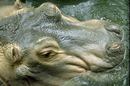
Weighing between 1,300 and 3,200 kg, hippopotamusi measure between 209 and 505 cm in length, including a tail of about 35 cm in length. They stand between 150 and 165 cm tall. Hippopotami have skin tones of a purple gray or slate color, with brownish pink coloring around their eyes and ears. Their bodies are covered with a scarce amount of thin hair, except for thick bristle like hair on their heads and tails. Outer epidermal skin layers are extremely thin, making them vulnerable to wounds from fighting. ("Hippopotamus", 2011; Coughlin and Fish, 2009; Nott, 1886; Roomer, 1872; Stevenson-Hamilton, 1912)
Hippos lack scent and sweat glands. Instead, mucous glands secrete a thick oily layer of red pigmented fluid. For years this fluid was thought to be a mixture of blood and sweat, giving it the nickname “blood sweat.” It is now known that this fluid is a combination of hipposudoric acid and norhipposudoric acid. These compounds create a sunscreen effect by absorbing ultra violet rays from the sun and prevent the growth of disease causing bacteria. The secretion originates colorless and turns an orange-red within minutes of being exposed to the sun. ("Hippopotamus", 2011; Coughlin and Fish, 2009; Nott, 1886; Roomer, 1872; Stevenson-Hamilton, 1912)
Bulky and barrel-shaped, it would seem hippos would be clumsy on both land and water. However, adaptations to their semi-aquatic environments have allowed them to move swiftly on both water and land. On land, they are able to move at speeds up to 30 km per hour and can maintain these speeds for several hundred meters. In shallow waters their short legs provide powerful propulsion through water, while their webbed feet allow them to navigate on shallow river bottoms. Placement of eyes, ears, and nostrils high on their head allows them to remain mostly submerged while still being able to breathe and stay aware of their surroundings. When completely submerging, the nostrils close and ears fold to prevent water from entering them. The jaws of hippopotamusi are capable of opening up to 150 degrees, showing enormous, sharp, incisors and canine tusks. Canines grow to 50 cm and incisors grow to 40 cm, sharpening themselves as they grind their mouths together during grazing. ("Hippopotamus", 2011; Coughlin and Fish, 2009; Nott, 1886; Roomer, 1872; Stevenson-Hamilton, 1912)
Sexual dimorphism is present in hippopotami. Males tend to be about 200 kg larger than females at maturity, but can grow to be almost several thousand kg larger with age. Males appear to continue growing throughout their life, while females reach their maximum weight around age 25. Males reach a maximum length of about 505 cm long, while females usually only reach around 345 cm. The largest hippo ever recorded was a captive male hippo in Munich, Germany, weighing 4,500 kg. Aside from size, male muzzles are larger and have a more developed jowl area than females. Tusks are also twice as long in males than in females. ("Hippopotamus", 2011; Coughlin and Fish, 2009; Nott, 1886; Roomer, 1872; Stevenson-Hamilton, 1912)
- Other Physical Features
- endothermic
- bilateral symmetry
- Sexual Dimorphism
- male larger
-
- Range mass
- 1300 to 4500 kg
- 2863.44 to 9911.89 lb
-
- Range length
- 290 to 505 cm
- 114.17 to 198.82 in
Reproduction
Hippopotami are polygynous, meaning that one bull mates with several females in the social group. Although breeding is not strictly seasonal, conception usually occurs during the dry season, between February and August, and births usually occur during the rainy season, between October and April. (Estes, 1992; Roomer, 1872; Stevenson-Hamilton, 1912; de Magalhaes and Costa, 2009)
- Mating System
- polygynous
When searching for a mate, the dominant male wanders through a resting or grazing herd, smelling each female’s posterior end. He acts unusually submissive towards the females as to avoid being attacked by the herd. The goal of the submissive male is to find a female in heat. Once a mate has been found the courtship begins. The male taunts the female, by pushing her out of the herd. He pursues her into deeper waters, until she becomes frustrated and lashes out and clashing jaws with him. He forces her into submission and mounts her, forcing her head under the water. It is unclear why her head must be under the water. If the female tries to raise her head to breathe, the male will usually snap at her and force her head back down. During mating the males release a wheezy honking to announce that mating has occurred. Hippopotami usually mate every other year, due cost of parental investment into the young. Although breeding can occur year round, it is most common between February and August. Gestation lasts nearly a year, 324 days, and yields just one offspring. The young are not weaned for nearly another year, and maturity is achieved at 3.5 years. (Estes, 1992; Roomer, 1872; Stevenson-Hamilton, 1912; de Magalhaes and Costa, 2009)
- Key Reproductive Features
- iteroparous
- seasonal breeding
- year-round breeding
- gonochoric/gonochoristic/dioecious (sexes separate)
- sexual
- viviparous
-
- Breeding interval
- Hippopotami mate every other year.
-
- Breeding season
- Breeding occurs year round, but peaks between February and August.
-
- Average number of offspring
- 1
-
- Average number of offspring
- 1
- AnAge
-
- Average gestation period
- 324 days
-
- Average gestation period
- 234 days
- AnAge
-
- Average weaning age
- 341 days
-
- Average age at sexual or reproductive maturity (female)
- 1,279 days
-
- Average age at sexual or reproductive maturity (female)
Sex: female - 1279 days
- AnAge
- Average age at sexual or reproductive maturity (female)
-
- Average age at sexual or reproductive maturity (male)
- 1,279 days
-
- Average age at sexual or reproductive maturity (male)
Sex: male - 1279 days
- AnAge
- Average age at sexual or reproductive maturity (male)
Prior to birth, pregnant females become very protective and aggressive to those who encounter her. Pregnant hippos isolate themselves on land or in shallow water and do not rejoin the herd until 14 days after giving birth. At birth, calves weigh between 22 and 55 kg. Mother and calf have a very close relationship. They are often seen cleaning, cuddling, and presumably showing affection to each other. Most attacks on humans and other animals are by females prior to birthing or when protecting their calves. Calves are adapted for underwater nursing; their ears fold back and their nostrils close during sucking, gripping the nipple between the tongue and roof of the mouth. Because hippos live in a social family environment, males are very protective over both the females and calves in the herd and will often attack anything that poses a threat. (Estes, 1992; Roomer, 1872; Stevenson-Hamilton, 1912; de Magalhaes and Costa, 2009)
- Parental Investment
- precocial
- male parental care
- female parental care
-
pre-weaning/fledging
-
protecting
- male
- female
-
protecting
-
pre-independence
-
protecting
- male
- female
-
protecting
- post-independence association with parents
- inherits maternal/paternal territory
Lifespan/Longevity
Hippopotami have average life expectancies around 55 years in both captivity and the wild. The longest living hippopotamus exceeded 61 years in captivity. Infant mortality rates are low, 0.01 deaths per year. (de Magalhaes and Costa, 2009)
-
- Average lifespan
Status: captivity - 61 years
- Average lifespan
-
- Average lifespan
Status: wild - 55 years
- Average lifespan
-
- Average lifespan
Status: captivity - 55 years
- Average lifespan
-
- Average lifespan
Status: wild - 45.0 years
- Max Planck Institute for Demographic Research
- Average lifespan
-
- Average lifespan
Status: captivity - 49.0 years
- Max Planck Institute for Demographic Research
- Average lifespan
-
- Average lifespan
Status: wild - 50.0 years
- Max Planck Institute for Demographic Research
- Average lifespan
-
- Average lifespan
Status: captivity - 40.0 years
- Max Planck Institute for Demographic Research
- Average lifespan
-
- Average lifespan
Status: captivity - 54.3 years
- Max Planck Institute for Demographic Research
- Average lifespan
-
- Average lifespan
Status: wild - 54.5 years
- Max Planck Institute for Demographic Research
- Average lifespan
Behavior
Hippopotami are a very social species, living in groups of about 20 to 100 individuals. They lead very sedentary lives, resting most of the day and leaving their resting pools at dusk to feed. Most of their activity is nocturnal. Females are the leaders of the herd, controlling the centers of the resting pools. Males rest along the outer banks of the pools, protecting the females and calves. By age 7, males compete for dominance. Dominance is usually displayed with yawning, roaring, dung showering, and jaw clashing. Dominant males are usually very intolerant of juveniles attempting to challenge them. Larger males have a tendency to harm or kill the young males during these displays. Territorial behavior consists of wheezing, honking, and dung showering. When approaching new territory they stop and turn their backside towards the area, lift their rear in the air and release dung and urine. Their tails swing back and forth scattering the excreta around the unfamiliar boundary. Male hippos often emerge from the water to spread dung along the shoreline and their grazing paths. Juvenile hippos can often be found following dominant males around smelling and licking their rears. Fighting and defensive displays are usually most intense during the dry season, when living conditions are more crowded and resources are scarce. Defensive displays such as yawning, jaw and tusk clashing, biting, and retreating to resting ponds are common in fighting between males as well as protection of the herd against predators. (Barklow, 2004; Blowers, et al., 2010; Estes, 1992; Lewison and Carter, 2004; Nott, 1886; Roomer, 1872; Stevenson-Hamilton, 1912)
- Key Behaviors
- natatorial
- diurnal
- nocturnal
- motile
- sedentary
- territorial
- social
- colonial
- dominance hierarchies
Home Range
There is no published data on specific territory size of hippos. Territory size depends greatly on the number of individuals in the herd and availability of water and vegetation. They often rest closely together, resting their heads on each other’s backs. (Nott, 1886)
Communication and Perception
Hippos are extremely social and have a large repertoire of surface and underwater sounds. The honking call made by submerged hippos is the most common type of communication, using exhaled breath to alarm their herd of threats. This honking can reach up to 115 decibels, equivalent to a loud thunder, and when conducted by the lead male can create a chorus from other males up to a 1.6 km away. Vocalizations can be made on land or in water and are transmitted simultaneously through both. This is the only known case of amphibious calls in mammals. Sound heard above the surface comes from the hippos nostrils, but is made in the larynx underwater. Hippos have a large fat layer across the larynx that vibrates when the vocalization is made, sending sound throughout the water. Underwater vibrations shake jaw tissues connected the skull and ear of other hippopotami, transmitting the sound. (Barklow, 2004; Estes, 1992)
Visual displays such as wheezing, yawning, honking, and dung showering are common territorial displays. Male hippos often emerge from the water to spread dung along the shoreline or along their grazing paths to mark their territory. Besides smell reception of urine and dung showering, hippos also use the vomeronsal organ, operating like an underwater syringe to draw in urine, to communicate the reproductive status of a male or female (Barklow, 2004; Estes, 1992)
- Other Communication Modes
- choruses
- pheromones
- vibrations
- Perception Channels
- visual
- tactile
- acoustic
- vibrations
- chemical
Food Habits
Hippopotami leave their resting waters at dusk, moving down familiar paths, "hippo paths," to grassy areas surrounding their waterbeds. Hippos prefer to remain close to water beds, however they will travel several kilometers when food is scarce. Grazing lasts between four and five hours each night, covering between 3 and 4 km in circular patterns. Their mainly folivorous diet consists of small shoots, grasses, and reeds. They do not dig for roots or fruits. However, they will consume many other types of plants if they are present. Muscular lips, 50 cm wide, are ideal to pull up grasses. Hippos do not use their teeth to chew their meals, and instead they tear and soften the grasses to prevent any nutritive loss. While their sedentary lifestyle allows for a simple diet, they are known to consume an enormous amount of food each night, 1-1.5% of their body weight (usually around 40 kg of food). Hippos enter and exit their water pools at the same spot, returning from grazing before dawn. Occasionally, if the hippo has traveled too far it will seek a nearby pool to rest in until the following nightfall. Hippos have been observed, on a few occasions, consuming dead animals near their resting pools. However, their stomachs are not suited to digest meat. It is possible that this carnivorous behavior is induced by illness or nutritional deficiencies. (Estes, 1992; Lewison and Carter, 2004; Roomer, 1872; Stevenson-Hamilton, 1912)
- Animal Foods
- carrion
- Plant Foods
- leaves
- wood, bark, or stems
- flowers
Predation
Occasionally lions, hyenas, and crocodiles will prey on young hippopotami. Besides humans, adult hippopotami have no known predators. (Lewison and Oliver, 2008)
- Anti-predator Adaptations
- aposematic
-
- Known Predators
-
- lions (Panthera leo)
- hyenas (Hyaenidae)
- crocodiles (Crocodylidae)
- humans (Homo sapiens)
Ecosystem Roles
Because of their massive size, hippos play an important role in their ecosystems. Daily activities both in and out of water create habitats for smaller organisms. The formation of hippo paths from water to land clears avenues that water can flow through during wet seasons. Flooding of these paths creates most of the lagoons and side pools that small fish retreat to during droughts. (Eltringham, 1999; Mosepele, et al., 2009)
As with all mammals, several forms of parasites affect hippopotami on both the inside and outside of their body. Ectoparasites are parasites found feeding outside of the hippo’s body. Oculotrema hippopotami, monogene flukes, live on the outer surface of a hippopotami’s eye. They attach to the inner edge of the nictitatine membrane and under they eyelid of hippopotami. Although the fluke does not cause serious harm to the eye, the areas affected become extremely irritated. Leeches and ticks are commonly found around the anal region of the hippo. This is not unusual due to their aquatic lifestyle. Other than the loss of blood and irritation around the attachment site, there is no serious damage caused by these parasites. Endoparasites are many. Flatworms and Buxifrons buxifrons are commonly found in the stomach and first 1.5 meters of the small intestine. A tapeworm parasitizes the gut as adults, but occur as cysts in the muscles when in the larval phases. Liver flukes are most commonly found in the livers of young hippopotami, suggesting hippos acquire immunity to the parasite with age. Members of the blood fluke family inhabit the hepatic portal system and the pelvic veins of hippopotami. These flukes lay their eggs in capillaries, which then migrate to the intestine or bladder to be passed outside of the body. Once hatched, the "miracidium" larva penetrates multiple species of freshwater snails and transform into "cercaria" larva. These larva are then released back into the water, where they are then able to penetrate the skin of the hippo. (Eltringham, 1999; Mosepele, et al., 2009)
- Ecosystem Impact
- creates habitat
- keystone species
- monogene flukes (Oculotrema hippopotami)
- leeches (Limnatis nilotica)
- ticks (Rhipicephalus muhsamae)
- ticks (Amblyomma tholloni)
- flatworms (Nilocotyle duplicisphinctris)
- flatrowms (Buxifrons buxifrons)
- tapeworms (Fasciola hepatica)
- liver flukes (Fasciola nyansae)
- blood flukes (Schistosomatidae)
Economic Importance for Humans: Positive
Hippopotami are extremely valuable to native hunters, providing a substantial amount of meat and valuable tusks and hide. Their thick hide is used in making shields and elastic whips. Canine tusks contain ivory, and is illegally sold on the black market. (Lewison and Oliver, 2008; Roomer, 1872; Wilson, 1882)
- Positive Impacts
- food
- body parts are source of valuable material
Economic Importance for Humans: Negative
Hippopotami are usually very docile animals. However, when threatened, especially during drought-burdened seasons, attacks on humans occasionally occur. Accidental encounters with hunters, boaters, and developers occurs usually because the individuals are unaware of a population's presence and can leads to human fatality. ("Hippopotamus", 2011; Estes, 1992; Lewison and Oliver, 2008; Wilson, 1882)
- Negative Impacts
- injures humans
Conservation Status
According to the IUNC Redlist, there has been a 7 to 20% decline in hippopotamus populations over the past 10 years. It was estimated that in the 29 countries within its geographic range, there are only between 125,000 to 148,000 individuals. Although hunting and exploitation of hippopotami are illegal, it remains the main reason for declines in populations. This exploitation is most commonly found in areas where hippo populations are on unprotected land. Habitat loss is another reason for population declines. Hippopotami rely heavily on freshwater bodies, making them vulnerable to drought, agricultural and industrial development, and rerouting of natural water flows. There are few conservation efforts aimed at protecting hippo habitat and populations specifically. Countries where hippopotami are most common have strict hunting regulations and protected habitats, including national parks, reserves, and conservation areas. (Lewison and Oliver, 2008)
-
- IUCN Red List
-
Vulnerable
More information
-
- IUCN Red List
-
Vulnerable
More information
-
- US Federal List
- No special status
-
- CITES
- No special status
-
- State of Michigan List
- No special status
Contributors
kassandra mason (author), Radford University, Karen Powers (editor), Radford University, Kiersten Newtoff (editor), Radford University, Melissa Whistleman (editor), Radford University, Laura Podzikowski (editor), Special Projects.
Glossary
- Ethiopian
-
living in sub-Saharan Africa (south of 30 degrees north) and Madagascar.

- acoustic
-
uses sound to communicate
- aposematic
-
having coloration that serves a protective function for the animal, usually used to refer to animals with colors that warn predators of their toxicity. For example: animals with bright red or yellow coloration are often toxic or distasteful.
- bilateral symmetry
-
having body symmetry such that the animal can be divided in one plane into two mirror-image halves. Animals with bilateral symmetry have dorsal and ventral sides, as well as anterior and posterior ends. Synapomorphy of the Bilateria.
- carrion
-
flesh of dead animals.
- chemical
-
uses smells or other chemicals to communicate
- choruses
-
to jointly display, usually with sounds, at the same time as two or more other individuals of the same or different species
- colonial
-
used loosely to describe any group of organisms living together or in close proximity to each other - for example nesting shorebirds that live in large colonies. More specifically refers to a group of organisms in which members act as specialized subunits (a continuous, modular society) - as in clonal organisms.
- diurnal
-
- active during the day, 2. lasting for one day.
- dominance hierarchies
-
ranking system or pecking order among members of a long-term social group, where dominance status affects access to resources or mates
- endothermic
-
animals that use metabolically generated heat to regulate body temperature independently of ambient temperature. Endothermy is a synapomorphy of the Mammalia, although it may have arisen in a (now extinct) synapsid ancestor; the fossil record does not distinguish these possibilities. Convergent in birds.
- female parental care
-
parental care is carried out by females
- folivore
-
an animal that mainly eats leaves.
- food
-
A substance that provides both nutrients and energy to a living thing.
- freshwater
-
mainly lives in water that is not salty.
- herbivore
-
An animal that eats mainly plants or parts of plants.
- iteroparous
-
offspring are produced in more than one group (litters, clutches, etc.) and across multiple seasons (or other periods hospitable to reproduction). Iteroparous animals must, by definition, survive over multiple seasons (or periodic condition changes).
- keystone species
-
a species whose presence or absence strongly affects populations of other species in that area such that the extirpation of the keystone species in an area will result in the ultimate extirpation of many more species in that area (Example: sea otter).
- male parental care
-
parental care is carried out by males
- motile
-
having the capacity to move from one place to another.
- natatorial
-
specialized for swimming
- native range
-
the area in which the animal is naturally found, the region in which it is endemic.
- nocturnal
-
active during the night
- pheromones
-
chemicals released into air or water that are detected by and responded to by other animals of the same species
- polygynous
-
having more than one female as a mate at one time
- seasonal breeding
-
breeding is confined to a particular season
- sedentary
-
remains in the same area
- sexual
-
reproduction that includes combining the genetic contribution of two individuals, a male and a female
- social
-
associates with others of its species; forms social groups.
- swamp
-
a wetland area that may be permanently or intermittently covered in water, often dominated by woody vegetation.
- tactile
-
uses touch to communicate
- temperate
-
that region of the Earth between 23.5 degrees North and 60 degrees North (between the Tropic of Cancer and the Arctic Circle) and between 23.5 degrees South and 60 degrees South (between the Tropic of Capricorn and the Antarctic Circle).
- territorial
-
defends an area within the home range, occupied by a single animals or group of animals of the same species and held through overt defense, display, or advertisement
- tropical
-
the region of the earth that surrounds the equator, from 23.5 degrees north to 23.5 degrees south.
- vibrations
-
movements of a hard surface that are produced by animals as signals to others
- visual
-
uses sight to communicate
- viviparous
-
reproduction in which fertilization and development take place within the female body and the developing embryo derives nourishment from the female.
- year-round breeding
-
breeding takes place throughout the year
- young precocial
-
young are relatively well-developed when born
References
2011. Hippopotamus. Pp. electronic database in P Lagassé, ed. Columbia Electronic Encyclopedia, Vol. 1, 6th Edition. Columbia University: Columbia University Press. Accessed February 09, 2012 at http://www.encyclopedia.com/topic/hippopotamus.aspx.
Barklow, W. 2004. Amphibious communication with sound in Hippopotamus amphibius. Animal Behaviour, 68/5: 1125-1132.
Blowers, T., J. Waterman, C. Kuhar, T. Bettinger. 2010. Social behaviors within a group of captive female Hippopotamus amphibius. Journal Of Ethology, 28/2: 287-294.
Coughlin, B., F. Fish. 2009. Hippopotamus underwater locomotion: Reduced gravity movements for a massive mammal. Journal Of Mammalogy, 90/3: 675-679.
Eltringham, S. 1999. The Hippos. Soho Square, London: T and A.D. Poyser Ltd.
Estes, R. 1992. The Behavior Guide to African Mammals: Including Hoofed Mammals, Carnivores, Primates. Los Angeles, California: University of California Press.
Lewison, R., W. Oliver. 2008. "Hippopotamus amphibius" (On-line). IUNC Red List of Threatened Species. Accessed February 01, 2012 at http://www.iucnredlist.org/apps/redlist/details/10103/0.
Lewison, R., J. Carter. 2004. Exploring behavior of an unusual megaherbivore: a spatially explicit foraging model of the hippopotamus. Ecological Modeling, 171/1–2: 127-138.
Mosepele, K., P. Moyle, G. Merron, D. Purkey, B. Mosepele. 2009. Fish, floods, and ecosystem engineers: Aquatic conservation in the Okavango Delta, Botswana. Bioscience, 59/1: 53-64.
Nott, J. 1886. Wild Animals Potographed and Described. London: S. Low, Marston, Searle, & Rivington.
Pushkina, D. 2007. The Pleistocene easternmost distribution in Eurasia of the species associated with the Eemian Palaeoloxodon antiquus assemblage.. Mammal Review, 37/3: 224-245.
Roomer, A. 1872. Anecdotal and Descriptive Natural History: The Hippopotamus. London: Groombridge.
Stevenson-Hamilton, J. 1912. Animal Life in Africa. New York: E.P. Dutton and Company.
Wilson, A. 1882. Wild Animals and Birds: Their Haunts and Habits. London, Paris, New York: Cassell, Petter, Galpin & Co..
World Health Organization, 2003. Dangerous aqueous animals. Guidelines for Safe Recreational Water Environments, 1/1: 173-188.
de Magalhaes, J., J. Costa. 2009. A database of vertebrate longevity records and their relation to other life-history traits. Journal of Evolutionary Biology, 22/8: 1770-1774.