Heterocephalus glabernaked mole rat


Geographic Range
Historically, naked mole rats have been found in Uganda and Tanzania. The current range of the species is countries in eastern Africa such as Ethiopia, Somalia and Kenya (Jarvis and Sherman, 2002). (Jarvis and Sherman, 2002)
Habitat
Naked mole rats inhabit underground tunnels in grasslands and savannas of eastern Africa. Their tunnel system is about 2 meters deep they occur at elevations between 1,100 and 3,000 meters. (Jarvis and Sherman, 2002; Sherman, et al., 1991; Woodley and Buffenstein, 2002)
- Habitat Regions
- tropical
- terrestrial
- Terrestrial Biomes
- savanna or grassland
-
- Range elevation
- 1100 to 3000 m
- 3608.92 to 9842.52 ft
-
- Average depth
- 2 m
- 6.56 ft
Physical Description
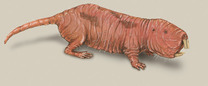
The skin of naked mole rats is brown and pink. The young possess dark spots on their skin, which typically fade away with age. The skin is naked or hairless and wrinkled with very short, sensitive, fringe-like hairs on the body. On average, the length of this species ranges from 147 165 mm long and 30 80 grams in weight. There is no differences in the size of males and females. The queen and the breeding males are the largest individuals in the colony. Since these critters live predominantly underground, their eyes are much smaller than other rodents. They also have thick eyelids, which shut out light. They depend on other senses to survive, such as hearing and touch. (Eun Bae, et al., 2011; Hetling, et al., 2005; Sherman, et al., 1991)
- Other Physical Features
- endothermic
- homoiothermic
- bilateral symmetry
- Sexual Dimorphism
- sexes alike
-
- Range mass
- 30 to 80 g
- 1.06 to 2.82 oz
-
- Average mass
- 35.3 g
- 1.24 oz
-
- Range length
- 147 to 165 mm
- 5.79 to 6.50 in
-
- Average basal metabolic rate
- 0.1280 cm3.O2/g/hr
-
- Average basal metabolic rate
- 0.128 W
- AnAge
Reproduction
Naked mole rats are polyandrous, and very few individuals take part in reproducing. There is typically only one female (the queen) who is dominant, but in some studies there have been two. The queen mates with 1 to 3 male breeders, who are typically larger and older individuals in the colony. The other individuals in the colony serve as non-breeders. Inbreeding is the norm in these colonies, which lead to genetically similar individuals. It is uncommon for members of a colony to disperse from their colony to others, so out-breeding is rare. (Hart and Ratnieks, 2005; Sherman, et al., 1991)
- Mating System
- polyandrous
- eusocial
Acts of aggression, such as shoving and biting, increase in the colony during the breeding season. Males and females become aggressive when competing for dominance, because only dominant individuals can reproduce. Weaker individuals serve as workers, care-takers, and protectors. The queen is the most aggressive individual in the colony during and outside of mating time. She chooses only a select few males to breed with and doesn't breed with any other individuals during her reign. The male breeders usually change when there is a new queen. This only occurs after the death of the former queen or if a new female dominates the past queen. When a new female becomes the queen, she goes through physical changes, such as the extension of her vertebrae, which is necessary for her to bear offspring. The queen breeds throughout the year, producing up to 5 litters of pups a year. The average pregnancy is about 70 days and an average of 7 pups are born each litter. The pups are very small, weighing only about 2 grams. They are fully weaned in approximately 36 days. The female pups reach maturity in 228 days compared to male pups who reach reach maturity in a year. (Hart and Ratnieks, 2005)
- Key Reproductive Features
- iteroparous
- year-round breeding
- gonochoric/gonochoristic/dioecious (sexes separate)
- sexual
- fertilization
- viviparous
-
- Breeding interval
- Naked mole rats breed every 70 to 80 days.
-
- Breeding season
- Naked mole rats breed throughout the year.
-
- Average number of offspring
- 7
-
- Average number of offspring
- 7
- AnAge
-
- Average gestation period
- 70 days
-
- Average gestation period
- 70 days
- AnAge
-
- Average weaning age
- 36 days
-
- Average age at sexual or reproductive maturity (female)
- 228 days
-
- Average age at sexual or reproductive maturity (female)
Sex: female - 228 days
- AnAge
- Average age at sexual or reproductive maturity (female)
-
- Average age at sexual or reproductive maturity (male)
- 1 years
Because the queen breeds throughout the year, her parental investment is limited. The queen takes part in raising the young she produced for the first 36 days, but afterwards it becomes the task of the non-breeders. The non-breeders directly and indirectly assist in taking care of the pups by feeding, protecting, grooming, transporting young when necessary. (Hart and Ratnieks, 2005)
- Parental Investment
- altricial
- male parental care
- female parental care
-
pre-fertilization
-
protecting
- female
-
protecting
-
pre-hatching/birth
-
provisioning
- female
-
protecting
- female
-
provisioning
-
pre-weaning/fledging
-
provisioning
- male
- female
-
protecting
- male
- female
-
provisioning
-
pre-independence
-
provisioning
- male
- female
-
protecting
- male
- female
-
provisioning
Lifespan/Longevity
Naked mole rats are the longest living rodents, living approximately nine times longer than other species. Naked mole rats have been known to reach ages of 30 years. In captivity, these mole rats can live for 22 to 28 years. In some cases, captive rats can exceed 28 years as long as no major changes are made to their lifestyle. Factors limiting naked mole rats lifespan in the wild include predation, climate extremities, and harmful anthropogenic changes like toxic chemicals. The mechanisms in these colonies that enable such longevity are unknown. (Bufferstein, 2008; O'Connor, et al., 2002)
-
- Average lifespan
Status: wild - 30 years
- Average lifespan
-
- Range lifespan
Status: captivity - 22 to 31 years
- Range lifespan
-
- Average lifespan
Status: captivity - 31 years
- Average lifespan
-
- Average lifespan
Status: wild - 30 years
- Average lifespan
-
- Average lifespan
Status: captivity - 28.3 years
- Average lifespan
-
- Average lifespan
Status: captivity - 5.0 years
- Max Planck Institute for Demographic Research
- Average lifespan
-
- Average lifespan
Status: captivity - 10.0 years
- Max Planck Institute for Demographic Research
- Average lifespan
Behavior
Typically, naked mole rats do not follow a circadian rhythm, because the majority of their life is spent underground in darkness. Their hairs are very sensitive which serves as their sight in the dark tunnels. To navigate through the tunnels, mole rats move their heads and tails back and forth. Naked mole rats are eusocial, and within this colony is a queen (breeding female), breeding males, and non-breeders. The non-breeders do all the work, ranging from caring for the young, protecting and feeding the colony, to constructing molehills. Smaller non-breeders usually provide food for colony and nurture the young while the larger non-breeders protect the colony and build molehills. The pups are usually shoved around some weeks after birth to better prepare them for disturbances. (Clarke and Faulkes, 1999; Jarvis and Sherman, 2002)
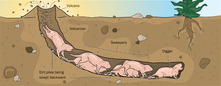
When building new tunnels and molehills, naked mole rats work in an efficient assembly line. Several individuals line up, with one mole rat in the front digging with incisors, while the others push the dirt down the line. The last individual moves the dirt to the surface which serves as the only evidence above ground of a mole rat colony. The first mole rat puts wood in its mouth to block the dirt and prevent chocking. In about a year, nearly 100 mole rats will build between 400 and 500 molehills up to 2.9 km in length. Colonies of naked mole rats prefer to interbreed and rarely mix as they are dispersed amongst grasslands and outsiders are rare. (Clarke and Faulkes, 1999; Jarvis and Sherman, 2002)
Each colony possesses their own distinct odor. This is used to distinguish members of other colonies, but the smell only lasts for a few days if mole rat is away from a colony. Naked mole rats also possess over 18 types of vocalizations which separates the colonies. There are different vocalizations for different situations, e.g., if an individual encounters a predator, they will run back to nest warning the others in a acoustic chirping sound. (Clarke and Faulkes, 1999; Jarvis and Sherman, 2002)
The breeding female of the colony typically shows aggression to the larger breeding males and non-breeders by shoving or walking over them. Because she is head of the colony, she receives food first. At the top of the hierarchy is the queen, followed by the larger breeding males, older non-breeding females and males, younger, smaller non-breeders and lastly the pups. If the queen dies, the larger and older females fight, sometimes to the death, until the dominant female takes over the colony when there are no more contenders. (Clarke and Faulkes, 1999; Jarvis and Sherman, 2002)
-
- Average territory size
- 2.9 km^2
Home Range
One colony can consist of 400 to 500 molehills up to 2.9 km in length. (Clarke and Faulkes, 1999; Jarvis and Sherman, 2002)
Communication and Perception
Naked mole rats live underground in no-light environments, rarely using their vision. Instead they rely on other senses as their vision. The sensitive hairs on their tails and whiskers and are used to maneuver in the darkness. Naked mole rats may use antiphonal vocalizations, also known as soft, acoustic chirps to communicate. They can be used to establish the dominant and subordinate relationships among individuals in the colony. Within the colony, there is one queen and a few head of males of their eusocial community, where only one female and a few males are reproductive. The nonbreeding individuals are known as workers; they care for young, provide food and protect colony. (Jarvis and Sherman, 2002; Yosida and Okanoya, 2009; Yosida, et al., 2007)
- Perception Channels
- tactile
- acoustic
- vibrations
- chemical
Food Habits
Naked mole rats feed on geophytic plants such as roots, bulbs, and tubers which are accessible underground. The foods they prefer are sporadically spread out so the mole rats travel great distances to get food. They leave parts of the plant together in order for plant to continue to flourish, and will later return for future purposes. Once food is found and brought back to nest, it is stored away. In some cases, they are restricted during their search for food, because they are unable to maneuver through soils that are wet or moist. This is when stored foods is utilized until foraging activities can continue. (Honeycutt, 1992; Sherman, et al., 1991)
- Primary Diet
-
herbivore
- eats sap or other plant foods
- Plant Foods
- roots and tubers
- Foraging Behavior
- stores or caches food
Predation
The main predators of naked mole rats are snakes, specifcally rufous beaked snakes. Some studies have found up to three mole rats in the stomach of a single snake. Snakes can easily maneuver through the tunnel system and prey on the mole rats. In cases of predation, the larger mole rats serve as the protectors of the colony. (Honeycutt, 1992; Roberts, et al., 2001)
-
- Known Predators
-
- rufous beaked snake (Rhamphiophis oxyrhynchus)
Ecosystem Roles
Naked mole rats are involved in relationship where parasites use this species as a host and are found in certain locations on the skin. In places where there are layers upon layers of skin forming pockets, parasitic eggs and adult parasites thrive. These parasites are believed to have an effect on the skin because the skin is thicker in sites where parasites are present. Internal parasites include the protozoan, Eimeria muris, which causes coccidiosis. A 1953 report found other parasites such as, Spirilla (a bacterium), Giardia (a protozoan), and Trichomonas (a protist in the clade Excavata) in fecal pellets of naked mole rats. (Jarvis and Sherman, 2002; Porter, 1953; Sherman, et al., 1991; Thigpen, 1940)
- Ecosystem Impact
- soil aeration
- Eimeria muris
- Spirilla
- Giardia species
- Trichomonas
Economic Importance for Humans: Positive
Naked mole rats serve as important species in the ecotourism industry in Kenya. There are several parks and zoos where naked mole rats are protected. (Jarvis and Sherman, 2002)
- Positive Impacts
- ecotourism
Economic Importance for Humans: Negative
With the expansion of human population, naked mole rats could become a problem for individuals in the agriculture industry. These mole rats feed on crops such as sweet potatoes, and corn. (Jarvis and Sherman, 2002; Sherman, et al., 1991)
- Negative Impacts
- crop pest
Conservation Status
Naked mole rats are listed as a species of least concern by the IUCN Redlist. Naked mole rats are protected in nature parks and zoos. (Jarvis and Sherman, 2002)
-
- IUCN Red List
-
Least Concern
More information
-
- IUCN Red List
-
Least Concern
More information
-
- US Federal List
- No special status
-
- CITES
- No special status
-
- State of Michigan List
- No special status
Contributors
Kiara Hagan (author), Radford University, Karen Powers (editor), Radford University, Kiersten Newtoff (editor), Radford University, Melissa Whistleman (editor), Radford University, Laura Podzikowski (editor), Special Projects.
Glossary
- Ethiopian
-
living in sub-Saharan Africa (south of 30 degrees north) and Madagascar.

- acoustic
-
uses sound to communicate
- altricial
-
young are born in a relatively underdeveloped state; they are unable to feed or care for themselves or locomote independently for a period of time after birth/hatching. In birds, naked and helpless after hatching.
- bilateral symmetry
-
having body symmetry such that the animal can be divided in one plane into two mirror-image halves. Animals with bilateral symmetry have dorsal and ventral sides, as well as anterior and posterior ends. Synapomorphy of the Bilateria.
- chemical
-
uses smells or other chemicals to communicate
- colonial
-
used loosely to describe any group of organisms living together or in close proximity to each other - for example nesting shorebirds that live in large colonies. More specifically refers to a group of organisms in which members act as specialized subunits (a continuous, modular society) - as in clonal organisms.
- dominance hierarchies
-
ranking system or pecking order among members of a long-term social group, where dominance status affects access to resources or mates
- ecotourism
-
humans benefit economically by promoting tourism that focuses on the appreciation of natural areas or animals. Ecotourism implies that there are existing programs that profit from the appreciation of natural areas or animals.
- endothermic
-
animals that use metabolically generated heat to regulate body temperature independently of ambient temperature. Endothermy is a synapomorphy of the Mammalia, although it may have arisen in a (now extinct) synapsid ancestor; the fossil record does not distinguish these possibilities. Convergent in birds.
- eusocial
-
the condition in which individuals in a group display each of the following three traits: cooperative care of young; some individuals in the group give up reproduction and specialize in care of young; overlap of at least two generations of life stages capable of contributing to colony labor
- female parental care
-
parental care is carried out by females
- fertilization
-
union of egg and spermatozoan
- fossorial
-
Referring to a burrowing life-style or behavior, specialized for digging or burrowing.
- herbivore
-
An animal that eats mainly plants or parts of plants.
- iteroparous
-
offspring are produced in more than one group (litters, clutches, etc.) and across multiple seasons (or other periods hospitable to reproduction). Iteroparous animals must, by definition, survive over multiple seasons (or periodic condition changes).
- male parental care
-
parental care is carried out by males
- motile
-
having the capacity to move from one place to another.
- native range
-
the area in which the animal is naturally found, the region in which it is endemic.
- polyandrous
-
Referring to a mating system in which a female mates with several males during one breeding season (compare polygynous).
- sexual
-
reproduction that includes combining the genetic contribution of two individuals, a male and a female
- social
-
associates with others of its species; forms social groups.
- soil aeration
-
digs and breaks up soil so air and water can get in
- solitary
-
lives alone
- stores or caches food
-
places a food item in a special place to be eaten later. Also called "hoarding"
- tactile
-
uses touch to communicate
- terrestrial
-
Living on the ground.
- tropical
-
the region of the earth that surrounds the equator, from 23.5 degrees north to 23.5 degrees south.
- tropical savanna and grassland
-
A terrestrial biome. Savannas are grasslands with scattered individual trees that do not form a closed canopy. Extensive savannas are found in parts of subtropical and tropical Africa and South America, and in Australia.
- savanna
-
A grassland with scattered trees or scattered clumps of trees, a type of community intermediate between grassland and forest. See also Tropical savanna and grassland biome.
- temperate grassland
-
A terrestrial biome found in temperate latitudes (>23.5° N or S latitude). Vegetation is made up mostly of grasses, the height and species diversity of which depend largely on the amount of moisture available. Fire and grazing are important in the long-term maintenance of grasslands.
- vibrations
-
movements of a hard surface that are produced by animals as signals to others
- viviparous
-
reproduction in which fertilization and development take place within the female body and the developing embryo derives nourishment from the female.
- year-round breeding
-
breeding takes place throughout the year
References
Anyan, J., M. Seney, L. Bengston, B. Goldman, N. Forger. 2011. Social status and sex effects on neural morphology in Damaraland mole-rats, Fukomys damarensis. Brain, Behavior & Evolution, 77/4: 291-298.
Braude, S. 2000. Dispersal and new colony formation in wild naked mole-rats: Evidence against inbreeding as the system of mating. Behavioral Ecology, 11/1: 7-12.
Bufferstein, R. 2008. Negligible senescence in the longest living rodent, the naked mole-rat: Insights from a successfully aging species. Journal of Comparative Physiology B: Biochemical, Systemic, & Environmental Physiology, 178/4: 439-445.
Burland, T. 2002. Eusociality in African mole-rats: New insights from patterns of genetic relatedness in the Damaraland mole-rat (Cryptomys damarensis). The Royal Society, 269/1495: 1025-1030.
Clarke, F., C. Faulkes. 1999. Kin discrimination and female mate choice in the naked mole-rat Heterocephalus glaber. The Royal Society, 266/1432: 1995-2002.
Eun Bae, K., F. Xiaodong, A. Fushan, Z. Huang, A. Lobanov. 2011. Genome sequencing reveals insights into physiology and longevity of the naked mole rat. Nature, 479/7372: 223-227.
Hart, A., F. Ratnieks. 2005. Crossing the taxonomic divide: Conflict and its resolution in societies of reproductively totipotent individuals. Journal of Evolutionary Biology, 18/2: 383-395.
Hetling, J., M. Baig-Silva, C. Comer, M. Pardue, D. Samaan. 2005. Features of visual function in the naked mole-rat Heterocephalus glaber. Journal of Comparative Physiology A: Neuroethology, Sensory, Neural & Behavioral Physiology, 191/4: 317-330.
Honeycutt, R. 1992. Naked mole-rats. American Scientist, 80/1: 43-53.
Jarvis, J., P. Sherman. 2002. Heterocephalus glaber. Mammalian Species, 706: 1-9.
O'Connor, T., A. Lee, J. Jarvis, R. Buffenstein. 2002. Prolonged longevity in naked mole-rats: Age-related changes in metabolism, body composition and gastrointestinal function. Comparative Biochemistry & Physiology Part A: Molecular & Integrative Physiology, 133/3: 835.
Pinto, M., K. Jepsen, C. Terranova, R. Buffenstein. 2010. Lack of sexual dimorphism in femora of the eusocial and hypogonadic naked mole-rat: A novel animal model for the study of delayed puberty on the skeletal system. Bone, 46/1: 112-120.
Porter, A. 1953. Report of the Honorary Parasitologist for the year 1952. Proceedings of the Zoological Society of London, 123/2: 253-257.
Roberts, S., L. Gosling, E. Thornton, J. McClung. 2001. Scent-marking by male mice under the risk of predation. Behavioral Ecology, 12/6: 698-705.
Sherman, P., J. Jarvis, R. Alexander. 1991. The Biology of the Naked Mole-Rat. Princeton, New Jersey: Princeton University Press.
Thigpen, L. 1940. Histology of the skin of a normally hairless rodent. Journal of Mammalogy, 21/4: 449-456.
Woodley, R., R. Buffenstein. 2002. Thermogenic changes with chronic cold exposure in the naked mole-rat (Heterocephalus glaber). Comparative Biochemistry & Physiology Part A: Molecular & Integrative Physiology, 133/3: 827.
Yosida, S., K. Kobayasi, M. Ikebuchi, R. Ozaki, K. Okanoya. 2007. Antiphonal vocalization of a subterranean rodent, the naked mole-rat (Heterocephalus glaber). Ethology, 113/7: 703-710.
Yosida, S., K. Okanoya. 2009. Naked mole-rat is sensitive to social hierarchy encoded in antiphonal vocalization. Ethology, 115/9: 823-831.