Halichoerus grypusgray seal



Geographic Range
The grey seal (Halichoerus grypus) occurs in temperate and subarctic waters on both sides of the North Atlantic ocean resulting in three distinct populations. The western Atlantic population is found in the Canadian maritime provinces located from Cape Chidley on the Labrador coast to Nova Scotia. Grey seals located on the southwestern coasts of Iceland, on the Faeroe Islands and the British Isles comprise the eastern Atlantic population. In addition, the eastern Atlantic population extends further onto the coasts of Norway, northwestern Russia, and even French, Dutch, Gernman and Portugal coasts. The third population is found in the Baltic Sea.
- Biogeographic Regions
- nearctic
- palearctic
- atlantic ocean
Habitat
The habitat of the grey seal differs among each individual group of seals. Some are found along rocky continental coasts, while others are comfortable on isolated islands. There are also many grey seal populations around that haul out on icebergs and ice shelves.
- Habitat Regions
- temperate
- polar
- terrestrial
- saltwater or marine
- Terrestrial Biomes
- icecap
- Aquatic Biomes
- coastal
- brackish water
Physical Description
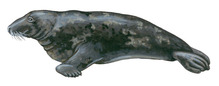
At birth, grey seal pups weigh approximately 16 kg and have long, creamy white fur which is shed after the first three weeks of life. They fatten quickly on the rich milk from their mothers, and by moulting age have nearly quadrupled in body mass. At this time the young seals show coat patterns which differentiate the sexes. The female grey seal is silver-grey in colour, with small scattered dark spots, while the males are a dark grey with silver grey spots. The three populations of grey seals differ in exact colorings (grey, brown, silver), however the patterns are similar among the individual sexes -- female grey seals have dark spots on a lighter background while the males have a lighter spotting on a dark background fur, but both sexes in the three populations have a relatively dark back and lighter belly.
In addition to coat markings, the nose of a grey seal can distinguish a male from a female. The male grey seal has a long-arched roman nose which is the basis for its Latin name, Halichoerus grypus, meaning the hooked-nose sea pig. The shoulders of the male are massive with the overall bulk supplemented by a buildup of scar tissue from fighting during breeding seasons. The average adult male reaches his maximum size of 2.2 meters long and 220 kg at 11 years of age. The female is smaller and does not attain full size until approximately 15 years of age, reaching an average weight of 150 kg and length of 1.8 meters (measured from nose to tail). She has a more narrow, short nose and a straight profile to the dorsal surface of the head.
- Other Physical Features
- endothermic
- homoiothermic
- bilateral symmetry
- Sexual Dimorphism
- male larger
- sexes shaped differently
-
- Range mass
- 150 to 220 kg
- 330.40 to 484.58 lb
-
- Range length
- 1.8 to 2.2 m
- 5.91 to 7.22 ft
Reproduction
An interesting case demonstrates a breeding difference between populations. Land-breeding gray seals are polygynous, with males competing to monopolize matings with as many as 7 females. Ice-breeding seals do not appear to be polygynous. Due to the instability of the early January ice, little is known of their habits. However, initial research indicates that a more monogamous system exists.
- Mating System
- monogamous
- polygynous
The breeding season of the grey seal varies greatly, occurring anywhere from mid-December to October, depending upon the location of the population. Breeding rookeries are formed on various types of habitat including sandy beaches, rocky islands, coasts, caves, and ice. During the months prior to the breeding season, seals actively feed. The females do so to grow for the future developing fetus and to build the fat reserves which will sustain them and the calf for the fasting which follows the birth, usually lasting for three weeks. The males also actively feed, because they too will fast for the breeding season, however their fasting will typically last for up to six weeks. The males ordinarily enter the rookeries once the females give birth and try to gain sole access to groups of females. Territory-related fighting occurs during the breeding season, although it is relatively minor compared to other seal species. Fighting in grey seal communities differs among populations, but generally increases as does the density of females. The successful males are able to mate with up to ten females, depending upon locality and density of the females.
Sixteen percent of female grey seals are sexually mature on their third birthday and give birth to their first young one year later. This figure rises to seventy-one percent by the fourth year and eighty-nine percent by the fifth year of life. The males also become sexually mature at age three, but due to competition for females, rarely mate before they are eight years old.
Once impregnated and following a gestation period of eleven months, females usually give birth a day after coming ashore at the rookery. Grey seals are attentive mothers and defend their pups against predation and intrusion. The pup is nursed for approximately 2 weeks after it is born, gaining around 1.5 kg per day. Once the pup is weaned, the female mates with one or more males and then leaves the pup at the rookery. The pup will remain on land, living off of its blubber reserves until it has fully molted, at which point it will feed at sea. The young seals generally disperse in many different directions from the rookery and are known to wander to distances of over 1,000 km.
- Key Reproductive Features
- iteroparous
- seasonal breeding
- gonochoric/gonochoristic/dioecious (sexes separate)
- sexual
- viviparous
-
- Breeding season
- The breeding season of the grey seal varies greatly, occurring anywhere from mid-December to October.
-
- Average number of offspring
- 1
-
- Average number of offspring
- 1
- AnAge
-
- Average gestation period
- 11 months
-
- Average gestation period
- 240 days
- AnAge
-
- Average weaning age
- 14 days
-
- Average time to independence
- 14 days
-
- Range age at sexual or reproductive maturity (female)
- 3 (low) years
-
- Range age at sexual or reproductive maturity (male)
- 3 to 8 years
Lifespan/Longevity
Their lifespan ranges from 15 to 25 years, with the oldest recorded wild female grey seal living to be 46 years of age.
-
- Range lifespan
Status: wild - 46 (high) years
- Range lifespan
-
- Typical lifespan
Status: wild - 15 to 25 years
- Typical lifespan
-
- Average lifespan
Sex: male
Status: captivity - 43.0 years
- Max Planck Institute for Demographic Research
- Average lifespan
Behavior
Grey seals forage underwater and spend the remainder of their time on the coastlines. They are non-migratory creatures yet disperse widely after breeding season.
- Key Behaviors
- natatorial
- motile
- nomadic
- solitary
Communication and Perception
Food Habits
Halichoerus grypus is an opportunistic feeder consuming between four and six percent of its body weight in one feeding per day. The diet consists of a large variety of fish and the occasional crustaceans and mollusks. According to King, at least 29 different species of fish have been recorded as being eaten by these seals. Fish taken include nearly any species found at pelagic and midwater levels as well as bottom dwelling fish at depths of seventy or more meters.
The feeding methods of the grey seal vary among populations, however they are most often social feeders. Social feeding reduces the opportunity for the prey to escape thereby increasing the feeding efficiency. When small fish are caught by the seal, they are usually consumed underwater and are swallowed whole. However, when large fish are captured, they are brought to the surface and held in the prehensile front flippers. The fish head is then bitten off and discarded, while the remainder of the fish is broken into small pieces able to be swallowed.
- Animal Foods
- fish
- mollusks
- aquatic crustaceans
Ecosystem Roles
These seals are also hosts for a parasitic roundworm called cod worm (Pseudoterranova decipiens), that infects cod and other commercially harvested fish.
- cod worm (Pseudoterranova decipiens)
Economic Importance for Humans: Positive
In the past, grey seal pups were killed and harvested on a large commercial scale for their skins. There have been no recent large-scale hunts.
Economic Importance for Humans: Negative
Grey seals are widely believed by commercial fisherman to be a pest. They may remove fish from nets, become tangled in nets, damage traps, and feed on farmed fish. These seals are also hosts for a parasitic roundworm called codworm (Pseudoterranova decipiens), that infects cod and other commercially harvested fish.
There is some dispute about the large-scale impacts of grey seals on the Atlantic fisheries, but they are at least occasionally a problem in local situations.
Conservation Status
The grey seal species as a whole is under no special conservation status. In fact, many countries allow either monitored or unlimited hunting of the seals. For nearly a decade, from 1982 until 1993, Norway, Iceland and Canada offered bounties and local culls for the grey seal. Many fisherman believe that this species competes with them for fish, and seals damage nets and traps. Recently the species has been given great legal protection in Europe, and fewer culls are being authorized.
The Baltic Sea population of this species is much smaller than the two Atlantic population, probably due to hunting and pollution of its habitat. It has greater legal protection.
-
- IUCN Red List
-
Least Concern
More information
-
- IUCN Red List
-
Least Concern
More information
-
- US Federal List
- No special status
-
- CITES
- No special status
Other Comments
Pollution in the Baltic Sea has led to the declining population of the grey seal. The most dramatic increase in DDT and PCB levels in the Baltic occurred after 1955. Research conducted by Zakharov and Yablokov on skulls of grey seals investigated the notion that these increased pollutants result in skull asymmetry. Their study investigated whether morphological changes could be found in the grey seal population born during the major pollution episode that occurred after 1960. They studied skulls taken from seals born before 1940 and after 1960. It was shown that the pollution group had sharply increased levels of asymmetry in almost all characters analyzed. The findings indicate a dramatic change in the development stability of the Baltic grey seal during the period of heavy pollution after 1960, which could attribute to the rapid decline of the species (Zakharov 1990).
Contributors
Julia Smith (author), University of Michigan-Ann Arbor, Phil Myers (editor), Museum of Zoology, University of Michigan-Ann Arbor.
Glossary
- Atlantic Ocean
-
the body of water between Africa, Europe, the southern ocean (above 60 degrees south latitude), and the western hemisphere. It is the second largest ocean in the world after the Pacific Ocean.

- Nearctic
-
living in the Nearctic biogeographic province, the northern part of the New World. This includes Greenland, the Canadian Arctic islands, and all of the North American as far south as the highlands of central Mexico.
- Palearctic
-
living in the northern part of the Old World. In otherwords, Europe and Asia and northern Africa.
- bilateral symmetry
-
having body symmetry such that the animal can be divided in one plane into two mirror-image halves. Animals with bilateral symmetry have dorsal and ventral sides, as well as anterior and posterior ends. Synapomorphy of the Bilateria.
- brackish water
-
areas with salty water, usually in coastal marshes and estuaries.
- carnivore
-
an animal that mainly eats meat
- chemical
-
uses smells or other chemicals to communicate
- coastal
-
the nearshore aquatic habitats near a coast, or shoreline.
- endothermic
-
animals that use metabolically generated heat to regulate body temperature independently of ambient temperature. Endothermy is a synapomorphy of the Mammalia, although it may have arisen in a (now extinct) synapsid ancestor; the fossil record does not distinguish these possibilities. Convergent in birds.
- iteroparous
-
offspring are produced in more than one group (litters, clutches, etc.) and across multiple seasons (or other periods hospitable to reproduction). Iteroparous animals must, by definition, survive over multiple seasons (or periodic condition changes).
- monogamous
-
Having one mate at a time.
- motile
-
having the capacity to move from one place to another.
- natatorial
-
specialized for swimming
- native range
-
the area in which the animal is naturally found, the region in which it is endemic.
- nomadic
-
generally wanders from place to place, usually within a well-defined range.
- piscivore
-
an animal that mainly eats fish
- polar
-
the regions of the earth that surround the north and south poles, from the north pole to 60 degrees north and from the south pole to 60 degrees south.
- polygynous
-
having more than one female as a mate at one time
- saltwater or marine
-
mainly lives in oceans, seas, or other bodies of salt water.
- seasonal breeding
-
breeding is confined to a particular season
- sexual
-
reproduction that includes combining the genetic contribution of two individuals, a male and a female
- solitary
-
lives alone
- tactile
-
uses touch to communicate
- temperate
-
that region of the Earth between 23.5 degrees North and 60 degrees North (between the Tropic of Cancer and the Arctic Circle) and between 23.5 degrees South and 60 degrees South (between the Tropic of Capricorn and the Antarctic Circle).
- terrestrial
-
Living on the ground.
- viviparous
-
reproduction in which fertilization and development take place within the female body and the developing embryo derives nourishment from the female.
References
"Offshore/Inshore Fisheries Development" (On-line). Accessed October 5, 1999 at http://www.ifmt.nf.ca/mi-net/fishdeve/grseal.htm.
"Seal Conservation Society" (On-line). Accessed October 5, 1999 at http://www.greenchannel.com/tec/species/grey.htm.
Hewer, H. 1974. British Seals. London: Collins.
Hickling, G. 1962. Grey Seals and the Farne Islands. London: Routledge and Kegan Paul.
King, J. 1983. Seals of the World. Ithaca, New York: Comstock Publishing Associates.
Riedman, M. 1990. The Pinnipeds: Seals, Sea Lions, and Walruses. Oxford: University of California Press.
Zakharov, V., A. Yablokov. 1990. Skull Asymmetry in the Baltic Grey Seal: Effects of Environmental Pollution. Ambio, 19: 266-269.