Gulo gulowolverine
Geographic Range
Wolverines are found in North America and northern Eurasia, in the boreal zone of the northern hemisphere. They require large expanses of relatively undisturbed, boreal habitat. Wolverines are found in Scandinavia and Russia to 50 degrees North latitude. In North America they are found in Alaska and northern Canada, but can also be found in mountainous regions along the Pacific Coast as far south as the Sierras of California. Historically, wolverines were found in more southerly areas of Europe and North America, but these populations were extirpated mainly due to hunting, clearing of forests, and other human activities. Their distribution once extended as far south as Colorado, Indiana, and Pennsylvania in North America. ("Alaska Fish and Wildlife Service", 2007; "United States Fish and Wildlife Service", 2008; Abramov and Wozencraft, 2008; "Alaska Fish and Wildlife Service", 2007; "United States Fish and Wildlife Service", 2008; "Wolverine", 2009; Abramov and Wozencraft, 2008; Burt, 1948; Pasitschniak-Arts and Lariviere, 1995)
- Biogeographic Regions
- nearctic
- palearctic
- Other Geographic Terms
- holarctic
Habitat
Wolverines are found in alpine forests, tundra, open grasslands, and boreal shrub transition zones at or above timberline. Generally they live in areas with low human development and need large, undisturbed ranges in order to survive. During the winter, females construct nests to store food and hide young. They construct rough beds of grass or leaves in caves or rock crevices, in burrows made by other animals, or under a fallen tree. They occasionally construct their nests under the snow. Wolverines are found exclusively in areas with cold climates, which may be related to their reliance on scavenging and caching large animal prey. Cold weather helps preserve the meat for later use. ("Encyclopedia Britannica", 2009; "The Wolverine Foundation", 2006; "United States Fish and Wildlife Service", 2008; Pasitschniak-Arts and Lariviere, 1995; Roel, et al., 2006; Ruggiero, et al., 2007)
- Habitat Regions
- temperate
- polar
- terrestrial
Physical Description
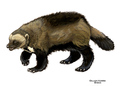
Wolverines are one of the largest members of the family Mustelidae and are unmistakable in appearance. They are terrestrial mammals with body lengths of 65 to 105 cm, tail lengths of 13 to 26 cm, and shoulder heights of 36 to 45 cm. Wolverines weigh from 9 to 30 kg, females are generally smaller than males by about 10% in linear measurements and 30% in weight. They have short, powerful limbs and 5 toes on each paw. They use a semi-plantigrade form of locomotion, with their weight primarily on their metatarsals. This distributes weight better and can be useful when traveling and hunting in snow. On hard ground, ungulates can outrun wolverines. In snow, wolverines are less likely to sink in and can often catch much larger animals that become immobilized in deep snow. Wolverine fur is usually brown or brownish-black, with a yellow or gold stripe extending from the crown of the head laterally across each shoulder and to the rump, where the stripes join at the tail. Wolverines have a stocky appearance, with a robust body, short, powerful limbs, a large head, and small, rounded ears. They have sharp claws that are semi-retractable and a very powerful bite, with which they crush bone. They are rarely seen by humans because of their low population densities and the remote terrain in which they live. ("Alaska Fish and Wildlife Service", 2007; "Encyclopedia Britannica", 2009; "The Wolverine Foundation", 2006; "United States Fish and Wildlife Service", 2008; Burt, 1948; Pasitschniak-Arts and Lariviere, 1995)
There are two subspecies of wolverines: North American wolverines (G. gulo luscus) and European wolverines (G. gulo gulo). Differences seem to be mainly genetic and probably as a result of the isolation of these two continental populations. Another possible subspecies on Vancouver Island, Canada: G. gulo vancouverensis. This population has skull morphology differences with those found on the mainland, but their status has yet to be decided. ("Alaska Fish and Wildlife Service", 2007; "The Wolverine Foundation", 2006; "United States Fish and Wildlife Service", 2008; Burt, 1948; Pasitschniak-Arts and Lariviere, 1995)
- Other Physical Features
- endothermic
- homoiothermic
- bilateral symmetry
- Sexual Dimorphism
- male larger
-
- Range mass
- 9 to 30 kg
- 19.82 to 66.08 lb
-
- Range length
- 65 to 105 cm
- 25.59 to 41.34 in
-
- Average basal metabolic rate
- 31.765 W
- AnAge
Reproduction
Wolverines are generally solitary animals. Males and females come together only briefly for mating, from May to August. Males have large home ranges, encompassing the home ranges of several females. Males may mate with each female in their home range and sometimes those in overlapping ranges. Males and females remain together for several days. Females may also mate with members of different home ranges, but litters are usually fathered by one male. Males fiercely defend their territory by marking it with scent from their anal gland. ("Alaska Fish and Wildlife Service", 2007; Burt, 1948; Pasitschniak-Arts and Lariviere, 1995)
- Mating System
- polygynous
Female wolverines mate every other year. Mating occurs from May to August, with most females being in heat from June to August. Males remain near females during the breeding season, but females initiate copulation. Like many other mustelids, ovulation is believed to be induced by copulation and the embryo is not implanted immediately, but rather waits in diapause for about 6 months. After implantation, gestation takes only another 30 to 50 days. With delayed implantation, pregnancy can last from 120 to 272 days depending on when the embryo is fertilized and when it implants. Females build snow-dens in which they give birth and nurse. The litter is usually born between January and April and averages 3 kits, weighing 85 g each. Weaning is complete at 3 months and the young begin foraging on their own at 5 to 7 months, when they become independent. Adult size is attained at around 1 year and sexual maturity at 2 to 3 years old. Wolverines require snow cover that persists through spring so that food can be cached until the kits are large enough to being foraging on their own. ("AnAge: The Animal Aging and Longevity Database", 2005; "The Wolverine Foundation", 2006; "Wolverine", 2009; Abramov and Wozencraft, 2008; Lofroth, et al., 2007; Nowak, 1999; Pasitschniak-Arts and Lariviere, 1995)
- Key Reproductive Features
- iteroparous
- gonochoric/gonochoristic/dioecious (sexes separate)
- sexual
- viviparous
- delayed implantation
-
- Breeding interval
- Females give birth in alternate years.
-
- Breeding season
- Breeding occurs from May to August.
-
- Range number of offspring
- 1 to 5
-
- Average number of offspring
- 3
- AnAge
-
- Range gestation period
- 120 to 272 days
-
- Average weaning age
- 3 months
-
- Average time to independence
- 1 years
-
- Average age at sexual or reproductive maturity (female)
- 710 days
-
- Average age at sexual or reproductive maturity (female)
Sex: female - 710 days
- AnAge
- Average age at sexual or reproductive maturity (female)
-
- Average age at sexual or reproductive maturity (male)
- 776 days
-
- Average age at sexual or reproductive maturity (male)
Sex: male - 776 days
- AnAge
- Average age at sexual or reproductive maturity (male)
Females give birth to a litter of around 3 kits in a snow den. After females give birth they hide with their young. The mother defends her territory and intruders are not tolerated. This territorial behavior continues until the young are ready to hunt on their own. Young remain with their mother until the fall of the year they were born, when they disperse. Females mate again in the following year, giving birth to young in the second year after the previous litter. Females may help to train their young in hunting techniques before they disperse. ("Alaska Fish and Wildlife Service", 2007; "AnAge: The Animal Aging and Longevity Database", 2005; "Encyclopedia Britannica", 2009; "Wolverine", 2009; Copeland, 1996; Lofroth, et al., 2007; Pasitschniak-Arts and Lariviere, 1995)
- Parental Investment
- altricial
-
pre-fertilization
- provisioning
-
protecting
- female
-
pre-hatching/birth
-
provisioning
- female
-
protecting
- female
-
provisioning
-
pre-weaning/fledging
-
provisioning
- female
-
protecting
- female
-
provisioning
-
pre-independence
-
provisioning
- female
-
protecting
- female
-
provisioning
Lifespan/Longevity
In the wild, wolverines generally live for 5 to 7 years but some can live up to 13 years. Females in captivity have bred up to 10 years old and live up to 17 years. The main causes of death are starvation, being killed by competitors (such as wolves), and trapping. ("Alaska Fish and Wildlife Service", 2007; "AnAge: The Animal Aging and Longevity Database", 2005; "The Wolverine Foundation", 2006; Abramov and Wozencraft, 2008; Nowak, 1999; Pasitschniak-Arts and Lariviere, 1995)
-
- Range lifespan
Status: wild - 13 (high) years
- Range lifespan
-
- Range lifespan
Status: captivity - 17 (high) years
- Range lifespan
-
- Typical lifespan
Status: wild - 5 to 7 years
- Typical lifespan
-
- Average lifespan
Status: captivity - 18.0 years
- Max Planck Institute for Demographic Research
- Average lifespan
-
- Average lifespan
Status: captivity - 17.3 years
- Max Planck Institute for Demographic Research
- Average lifespan
Behavior
In general, wolverines are solitary, only coming together to mate. They are territorial and do not tolerate individuals of the same sex. Territories are marked with secretions from anal scent glands and urine. Wolverines also spray their food caches with scent gland secretions to discourage other animals from raiding them. They are nocturnal but can be active during the day. In areas where there are extended times of light or darkness, wolverines may alternate three- to four-hour periods of activity and sleep. Wolverines do not appear to be bothered by snow and are active year-round, even in the most severe weather. Wolverines are known for their ferocity and have been known to attack black bears and wolves over food. Wolverines are mainly terrestrial and move with a loping gallop. They can climb trees with great speed and are excellent swimmers. Wolverines gallop with great endurance, sometimes moving 10 to 15 km without rest, although their speed probably does not exceed 15 km per hour. They may cover up to 45 km in one day in their activities. Play has been observed between mates and between siblings as well as between kits and their mothers. Wolverines are also known to play with objects. ("Alaska Fish and Wildlife Service", 2007; "AnAge: The Animal Aging and Longevity Database", 2005; "The Wolverine Foundation", 2006; "United States Fish and Wildlife Service", 2008; "Wolverine", 2009; Burt, 1948; Pasitschniak-Arts and Lariviere, 1995)
-
- Range territory size
- 600 to 2000 km^2
Home Range
Wolverines have large home ranges and may defend smaller territories. Males have home ranges of 600 to 1000 square kilometers. Female home ranges are 50 to 350 square kilometers. Although, home range size varies seasonally and home ranges can cover as much as 2,000 sq km in winter. Males and females defend their range and mark it with scent from their anal glands. Population densities of wolverines are low because of their requirements for very large home ranges. ("United States Fish and Wildlife Service", 2008; "Wolverine", 2009; Abramov and Wozencraft, 2008; Burt, 1948; Pasitschniak-Arts and Lariviere, 1995)
Communication and Perception
Like most mustelids, wolverines have anal scent glands which are used to mark territories and food caches. Due to their scavenging lifestyle, they have an advanced sense of smell. Wolverines also have good hearing, but likely have poor vision. Wolverines are rarely vocal, except for occasional grunts and growls when irritated. ("Encyclopedia Britannica", 2009; "The Wolverine Foundation", 2006; Lofroth, et al., 2007; Pasitschniak-Arts and Lariviere, 1995)
- Other Communication Modes
- scent marks
Food Habits
The wolverine diet can include anything from small eggs to large ungulates. They are capable of bringing down prey that is five times bigger than themselves, but generally only under conditions that leave large ungulate prey stranded in deep snow. They have large claws with pads on the feet that allow them to chase down prey in deep snow. Large ungulate prey species include reindeer, roe deer, wild sheep, elk or red deer, maral and moose. Wolverines can be very swift when on the attack, reaching speeds of over 48 km an hour. Large prey are killed by biting the back or front of the neck, severing neck tendons or crushing the trachea. Wolverines are opportunistic and their diet vary with season and location. They are also specialized for scavenging and will readily take over carcasses that have been killed by other large predators. Wolverines are extremely strong and aggressive for their size, they have been reported to drive bears, cougars, and even packs of wolves from their kills in order to take the carcass. They have also been reported scavenging whale, walrus, and seal carcasses. Female wolverines may hunt more small to medium-sized animals such as rabbits and hares, ground squirrels, marmots, and lemmings, when they are rearing young. The amount of food available to females may be key in determining population size; more food leads to greater reproductive success. The scientific name Gulo gulo comes from the latin word for glutton. Like other mustelids, they can be somewhat driven to kill when given the opportunity, resulting in them killing more prey than they can eat or cache. Wolverines have been known to kill large numbers of captive reindeer in deep snow, simply because the reindeer cannot escape. ("The Wolverine Foundation", 2006; "Wolverine", 2009; "Alaska Fish and Wildlife Service", 2007; "Encyclopedia Britannica", 2009; "The Wolverine Foundation", 2006; "United States Fish and Wildlife Service", 2008; "Wolverine", 2009; Burt, 1948; Lofroth, et al., 2007; Pasitschniak-Arts and Lariviere, 1995)
- Animal Foods
- birds
- mammals
- eggs
- carrion
- Foraging Behavior
- stores or caches food
Predation
Wolverines have few, if any, natural predators. They are fierce and aggressive, able to defend themselves against animals several times their size, such as wolves and mountain lions. However, wolves, mountain lions, black bears, brown bears, and golden eagles can be threats to young or inexperienced wolverines. Wolves are the dominant predator of wolverines, but generally only under circumstances where the wolverine cannot escape by climbing a tree. Wolverines use scents from their anal gland and urine to scent-mark food caches, discouraging other predators. ("Alaska Fish and Wildlife Service", 2007; "United States Fish and Wildlife Service", 2008; Lofroth, et al., 2007; Pasitschniak-Arts and Lariviere, 1995)
-
- Known Predators
-
- wolves (Canis lupus)
- mountain lions (Puma concolor)
- black bears (Ursus americanus)
- brown bears (Ursus arctos)
- golden eagles (Aquila chrysaetos)
Ecosystem Roles
Wolverines are scavengers, using the kills of larger predators, such as bear and wolves. Wolverines have few (if any) natural predators, and prey on large game and smaller animals. Wolverines are reliant on other large predators for food when snow conditions don't make it possible for them to hunt large prey themselves. The presence of wolverine urine discourages presence and feeding of black-tailed deer (Odocoileus hemionus columbianus) and snowshoe hares (Lepus americanus). Wolverines are parasitized by many kinds of endo and ectoparasites, including flukes (Opisthorchis felineus), tapeworms (Bothriocephalus, Taenia twitchelli, Mesocestoides kirbyi), roundworms (Dioctophyme renale, Soboliphyme baturini), trematodes (Alaria), nematodes (Trichinella spiralis, Molineus patens, Ascaris devosi, Physaloptera torquata, Physaloptera sibrica), ticks (Dermacentor variabilis), fleas (Oropsylla alaskensis, and ear canker mites (Otodectes cynotis). ("Alaska Fish and Wildlife Service", 2007; "The Wolverine Foundation", 2006; Burt, 1948; Pasitschniak-Arts and Lariviere, 1995)
- flukes (Opisthorchis felineus)
- tapeworms (Bothriocephalus)
- tapeworms (Taenia twitchelli)
- tapeworms (Mesocestoides kirbyi)
- roundworms (Dioctophyme renale)
- roundworms (Soboliphyme baturini)
- trematodes (Alaria)
- nematodes (Trichinella spiralis)
- nematodes (Molineus patens)
- nematodes (Ascaris devosi)
- nematodes (Physaloptera torquata)
- nematodes (Physaloptera sibrica)
- ticks (Dermacentor variabilis)
- fleas (Oropsylla alaskensis)
- ear canker mites (Otodectes cynotis)
Economic Importance for Humans: Positive
Wolverine are sometimes hunted for their fur because it is prized for its frost resistant properties. Native peoples used them to line parkas. However, their skins are no longer used widely in commerce. Wolverines are also important members of the ecosystems in which they live, they are important as top predators and scavengers. ("Alaska Fish and Wildlife Service", 2007; "United States Fish and Wildlife Service", 2008; Burt, 1948)
- Positive Impacts
- body parts are source of valuable material
Economic Importance for Humans: Negative
Wolverines live in remote areas where human populations are sparse. Many wolverines are shot due to their habit of preying upon animals that are trapped for fur. They have been extensively hunted in Scandinavia because of its alleged predation on domestic reindeer. It has been considered a nuisance throughout its range because it will eat animals already caught in fur traps and will break into cabins and food caches, eating and spraying the contents with its strong scent. Wolverines can even break into canned goods with their sharp canines. Wolverines are supposedly very difficult to trap; when a wolverine finds a trap, it may spring it by turning it upside down or by dropping a stick into it. Wolverines have also been known to carry traps away and bury them deep in the snow. ("The Wolverine Foundation", 2006; Abramov and Wozencraft, 2008; Pasitschniak-Arts and Lariviere, 1995; Roel, et al., 2006)
- Negative Impacts
- injures humans
- crop pest
Conservation Status
Wolverines generally occur at relatively low population densities and have vanished from most of their former range in the United States. In Scandinavia, estimates vary from one individual per 200 to 500 sq km. Encroaching human populations alter the abundance and habits of large ungulates, eliminate large predator populations, or kill wolverines directly. Numbers have declined due to fur trapping and hunting by those believing the wolverine to be a nuisance. In Russia, wolverines are a game species and extensive overhunting has led to population decline. In the United States, wolverines can only be harvested in Montana and Alaska. Wolverines have been nearly eliminated in the United States and have disappeared over most of southeastern and south-central Canada. In Europe, they can only be found now in parts of Scandinavia and northern Russia. Wolverines are listen by the IUCN as Least Concern, though the European populations are at higher risk. Conservation efforts include education, protecting habitat, and eliminating unregulated hunting. In Sweden farmers and herders are compensated for identifying dens and reporting them. Other Scandinavian countries have adopted measures to limit the amount of wolverines in reindeer herding areas through selected hunting. ("United States Fish and Wildlife Service", 2008; Abramov and Wozencraft, 2008; Roel, et al., 2006)
-
- IUCN Red List
-
Least Concern
More information
-
- IUCN Red List
-
Least Concern
More information
-
- US Federal List
- No special status
-
- CITES
- No special status
Other Comments
Despite the fact that wolverines have been claimed as an emblematic animal by the state of Michigan ("The Wolverine State"), evidence suggests that wolverines did not historically occur there. The "Wolverine State" appelation most likely came from the fact that Detroit was a major fur trading post for wolverine trappers. Wolverines are also known as glutton, skunk bear, Indian devil, and carcajou. ("Alaska Fish and Wildlife Service", 2007; Burt, 1948)
Contributors
Liz Ballenger (author), University of Michigan-Ann Arbor, Matthew Sygo (author), University of Michigan-Ann Arbor.
Vincent Patsy (author), University of Michigan-Ann Arbor.
Phil Myers (editor, instructor), Museum of Zoology, University of Michigan-Ann Arbor, Tanya Dewey (editor), Animal Diversity Web.
Glossary
- Nearctic
-
living in the Nearctic biogeographic province, the northern part of the New World. This includes Greenland, the Canadian Arctic islands, and all of the North American as far south as the highlands of central Mexico.

- Palearctic
-
living in the northern part of the Old World. In otherwords, Europe and Asia and northern Africa.
- acoustic
-
uses sound to communicate
- altricial
-
young are born in a relatively underdeveloped state; they are unable to feed or care for themselves or locomote independently for a period of time after birth/hatching. In birds, naked and helpless after hatching.
- bilateral symmetry
-
having body symmetry such that the animal can be divided in one plane into two mirror-image halves. Animals with bilateral symmetry have dorsal and ventral sides, as well as anterior and posterior ends. Synapomorphy of the Bilateria.
- carnivore
-
an animal that mainly eats meat
- carrion
-
flesh of dead animals.
- chemical
-
uses smells or other chemicals to communicate
- delayed implantation
-
in mammals, a condition in which a fertilized egg reaches the uterus but delays its implantation in the uterine lining, sometimes for several months.
- diurnal
-
- active during the day, 2. lasting for one day.
- endothermic
-
animals that use metabolically generated heat to regulate body temperature independently of ambient temperature. Endothermy is a synapomorphy of the Mammalia, although it may have arisen in a (now extinct) synapsid ancestor; the fossil record does not distinguish these possibilities. Convergent in birds.
- forest
-
forest biomes are dominated by trees, otherwise forest biomes can vary widely in amount of precipitation and seasonality.
- holarctic
-
a distribution that more or less circles the Arctic, so occurring in both the Nearctic and Palearctic biogeographic regions.
Found in northern North America and northern Europe or Asia.
- iteroparous
-
offspring are produced in more than one group (litters, clutches, etc.) and across multiple seasons (or other periods hospitable to reproduction). Iteroparous animals must, by definition, survive over multiple seasons (or periodic condition changes).
- motile
-
having the capacity to move from one place to another.
- mountains
-
This terrestrial biome includes summits of high mountains, either without vegetation or covered by low, tundra-like vegetation.
- native range
-
the area in which the animal is naturally found, the region in which it is endemic.
- nocturnal
-
active during the night
- omnivore
-
an animal that mainly eats all kinds of things, including plants and animals
- polar
-
the regions of the earth that surround the north and south poles, from the north pole to 60 degrees north and from the south pole to 60 degrees south.
- polygynous
-
having more than one female as a mate at one time
- scavenger
-
an animal that mainly eats dead animals
- scent marks
-
communicates by producing scents from special gland(s) and placing them on a surface whether others can smell or taste them
- sedentary
-
remains in the same area
- sexual
-
reproduction that includes combining the genetic contribution of two individuals, a male and a female
- solitary
-
lives alone
- stores or caches food
-
places a food item in a special place to be eaten later. Also called "hoarding"
- tactile
-
uses touch to communicate
- taiga
-
Coniferous or boreal forest, located in a band across northern North America, Europe, and Asia. This terrestrial biome also occurs at high elevations. Long, cold winters and short, wet summers. Few species of trees are present; these are primarily conifers that grow in dense stands with little undergrowth. Some deciduous trees also may be present.
- temperate
-
that region of the Earth between 23.5 degrees North and 60 degrees North (between the Tropic of Cancer and the Arctic Circle) and between 23.5 degrees South and 60 degrees South (between the Tropic of Capricorn and the Antarctic Circle).
- terrestrial
-
Living on the ground.
- tundra
-
A terrestrial biome with low, shrubby or mat-like vegetation found at extremely high latitudes or elevations, near the limit of plant growth. Soils usually subject to permafrost. Plant diversity is typically low and the growing season is short.
- visual
-
uses sight to communicate
- viviparous
-
reproduction in which fertilization and development take place within the female body and the developing embryo derives nourishment from the female.
References
2007. "Alaska Fish and Wildlife Service" (On-line). Accessed April 10, 2009 at http://www.adfg.state.ak.us/pubs/notebook/furbear/wolverin.php.
2005. "AnAge: The Animal Aging and Longevity Database" (On-line). Accessed April 09, 2009 at http://genomics.senescence.info/species/entry.php?species=Gulo_gulo.
2009. "Encyclopedia Britannica" (On-line). Accessed April 10, 2009 at http://www.britannica.com/EBchecked/topic/646740/wolverine.
2006. "The Wolverine Foundation" (On-line). Accessed April 11, 2009 at http://www.wolverinefoundation.org/specacct.htm.
2008. "United States Fish and Wildlife Service" (On-line). Accessed April 10, 2009 at http://ecos.fws.gov/speciesProfile/SpeciesReport.do?spcode=A0FA.
2009. "Wolverine" (On-line). Accessed April 11, 2009 at http://www.wolverines-wolverines.com/.
Abramov, B., C. Wozencraft. 2008. "International Union for the Conservation of Nature 2008 Red List" (On-line). Accessed April 08, 2009 at http://www.iucnredlist.org/details/9561.
Burt, W. 1948. The mammals of Michigan. Ann Arbor, MI: University of Michigan Press.
Copeland, J. 1996. Biology of the wolverine in central Idaho. MSc Thesis.
Lofroth, E., J. Krebs, W. Harrower, D. Lewis. 2007. Food habits of wolverine Gulo gulo in montane ecosystems of British Columbia, Canada. Wildlife Biology, 13: 13-37.
Nowak, R. 1999. Walker's mammals of the World. Baltimore: Johns Hopkins University Press.
Pasitschniak-Arts, M., S. Lariviere. 1995. Gulo gulo. Mammalian Species, 499: 1-10.
Roel, M., A. Landa, v. Jiska, J. Linnell, R. Andersen. 2006. Impact of infrastructure on habitat selection of wolverines (Gulo gulo). Wildlife Biology September 2006 : Vol. 12, Issue 3, pg(s) 285-295, Vol. 12, Issue 3: 285-95.
Ruggiero, L., K. McKelvey, K. Aubry, J. Copeland, D. Pletscher. 2007. Wolverine Conservation and Management. Journal of Wildlife Management, 71(7): 2145-46. Accessed April 10, 2009 at http://www.bioone.org/doi/abs/10.2193/2007-053.