Grus canadensissandhill crane


Geographic Range
In North America, this species breeds as far north as Alaska and the Arctic coast of Canada south into the Great Lakes region and westward across Idaho, Nevada and Oregon. It also breeds in the extreme southeastern United States and Cuba. The winter range of this species includes parts of California, New Mexico, Arizona, Texas, Georgia, Florida and northern Mexico. Populations of sandhill cranes are also found in northeastern Siberia, Andyrland, and on the Chyukotski peninsula and Wrangel Island. (Tacha, et al., 1992)
- Biogeographic Regions
- nearctic
- palearctic
- neotropical
Habitat
Most sandhill crane populations nest in open grasslands, such as wet meadows, and freshwater marshes or bogs. There are six subspecies of sandhill cranes, and each typically nests in the open, wet grassland habitats of their region. The Cuban population of sandhill cranes (Grus canadensis nesiotes) is an exception, inhabiting dry, isolated regions, sometimes in rocky and mountainous terrain.
Sandhill cranes prefer to be far from human habitation. However, during migration, they are commonly seen feeding on crops and crop residue in agricultural fields. At night they congregate to roost in large marshes. (Tacha, et al., 1992)
- Habitat Regions
- temperate
- tropical
- terrestrial
- Terrestrial Biomes
- savanna or grassland
- forest
- Other Habitat Features
- agricultural
- riparian
Physical Description
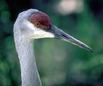
Sandhill cranes are large birds with heavy bodies and long necks and legs. They stand about 1.2 m tall, with wing spans of about 2 m. They are uniformly grayish, with a white cheek and a bald red crown. Sandhill cranes can be distinguished from other large wading birds in flight by their outstretched neck, and their wingbeats, which are a slow downward beat followed by a quick upward flick.
Male and female sandhill cranes are similar in appearance, though males are usually larger than females. For example, males of the G. c. canadensis subspecies average 3.75 kg whereas females average 3.34 kg. Juvenile sandhill cranes tend to be much more brownish than adults.
There are six subspecies of sandhill cranes. These subspecies are distinguished based upon morphology (size) and geographic separation. (Peterson, 1980; Tacha, et al., 1992)
- Other Physical Features
- endothermic
- bilateral symmetry
- polymorphic
- Sexual Dimorphism
- male larger
-
- Range mass
- 3200 to 5200 g
- 112.78 to 183.26 oz
-
- Average wingspan
- 2 m
- 6.56 ft
Reproduction
Sandhill cranes are perennially monogamous. Breeding pairs remain together from year to year, maintaining the pair bond by performing courtship displays, remaining in close proximity and calling together in unison. Breeding pairs form during spring migration. This species is noted for its elaborate courtship displays. Five courtship displays have been identified as part of "dancing," the primary mechanism of pair formation in this species. These displays are the Upright wing stretch, Horizontal head pump, Bow, Vertical leap and Vertical toss. Three courtship displays are used exclusively by paired adults to maintain the pair bond and synchronize reproductive development. These are the Bill up, Copulation and Unison call displays. (Tacha, et al., 1992)
- Mating System
- monogamous
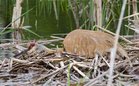
Sandhill cranes raise one brood per year. In non-migratory populations, egg-laying can begin as early as December or as late as August. In migratory populations, egg-laying usually begins between early April and late May. Both members of a breeding pair build the nest using plant material from the surrounding areas. Nest sites are usually in marshes, bogs, or swales, though cranes will occasionally nest on dry land.
The female lays 1 to 3 (usually 2) eggs that are oval-shaped and dull brown with reddish brown markings. Both parents participate in incubation, which lasts 29 to 32 (usually 30) days. Incubation begins with the laying of the first egg and continues until the second egg has hatched. The chicks are precocial; they hatch covered in down, with their eyes open and are able to leave the nest within 24 hours of hatching. The parents brood the chicks for up to 3 weeks after hatching. They feed the young intensively for the first few weeks, and with decreasing frequency until they reach independence at 9 or 10 months old.
The chicks remain with their parents until 1 or 2 months before the parents begin laying the next clutch of eggs. After leaving their parents, the chicks form nomadic flocks with other subadults and non-breeders. They remain with these flocks until they form breeding pairs and begin breeding between the ages of 2 and 7 years old. (Tacha, et al., 1992)
- Key Reproductive Features
- iteroparous
- seasonal breeding
- gonochoric/gonochoristic/dioecious (sexes separate)
- sexual
- oviparous
-
- Breeding interval
- Sandhill cranes raise one brood per year.
-
- Breeding season
- In non-migratory populations, egg-laying can happen any time between December and August. In migratory populations, sandhill cranes usually lay their eggs in April and May.
-
- Range eggs per season
- 1 to 3
-
- Average eggs per season
- 2
- AnAge
-
- Range time to hatching
- 29 to 32 days
-
- Average time to hatching
- 30 days
-
- Range time to independence
- 9 to 10 months
-
- Range age at sexual or reproductive maturity (female)
- 2 to 7 years
-
- Range age at sexual or reproductive maturity (male)
- 2 to 7 years
Sandhill cranes provide extended biparental care to their young. Both members of a breeding pair build the nest, incubate the eggs and feed and protect the chicks for up to 10 months after hatching. (Tacha, et al., 1992)
- Parental Investment
- precocial
-
pre-fertilization
- provisioning
-
protecting
- female
-
pre-hatching/birth
-
protecting
- male
- female
-
protecting
-
pre-weaning/fledging
-
provisioning
- male
- female
-
protecting
- male
- female
-
provisioning
-
pre-independence
-
provisioning
- male
- female
-
protecting
- male
- female
-
provisioning
- post-independence association with parents
Lifespan/Longevity
Sandhill cranes that reach independence are expected to live about seven years. The oldest known sandhill crane lived at least 21.6 years.
-
- Range lifespan
Status: wild - 21.6 (high) years
- Range lifespan
-
- Average lifespan
Status: wild - 375 months
- Bird Banding Laboratory
- Average lifespan
Behavior
Sandhill cranes are diurnal and partially migratory. Northern populations move south during the winter months whereas southern populations remain near the breeding sites year round.
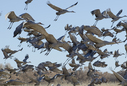
Cranes are usually found in pairs and family groups. During the migration and winter, family groups may join with non-mated cranes to form survival groups that feed and roost together. These survival groups often congregate at migratory staging areas and on the wintering grounds. (Tacha, et al., 1992)
-
- Range territory size
- 0.10 to 0.85 km^2
Home Range
Two studies resident sandhill crane populations in Florida estimated average home ranges of 657 and 1366 hectares.
Communication and Perception
Sandhill cranes communicate primarily using physical displays (see Mating Systems section) and vocalizations. Adult sandhill cranes have a repertoire of more than a dozen calls, which can be described as variations on "trills", "purrs" and "rattles". Calls are used in territorial advertisement, social interactions and to notify others of a nearby predator. Breeding pairs may call in duet in order to advertise their occupancy of a territory. (Tacha, et al., 1992)
Food Habits
Sandhill cranes are omnivorous birds that use their bills to probe for subsurface food and glean seeds and other foods. These birds feed on land or in shallow marshes with vegetation. Foods vary depending on what is available. Cultivated grains such as corn, wheat and sorghum are a major food source in their diet when available. In northern latitudes, a wider variety of foods are consumed, including berries, small mammals, insects, snails, reptiles, and amphibians. (Tacha, et al., 1992)
- Primary Diet
- omnivore
- Animal Foods
- mammals
- amphibians
- reptiles
- insects
- mollusks
- Plant Foods
- seeds, grains, and nuts
- fruit
Predation
When approached by an avian predator, sandhill cranes fly at the predator, kicking it with their feet. When approached by a mammalian predator, sandhill cranes move toward the predator with their wings spread and their bill pointed at the predator. If the predator persists, sandhill cranes will attack, hissing, stabbing with their bills and kicking with their feet. (Tacha, et al., 1992)
Ecosystem Roles
Young and sick sandhill cranes provide food for their predators. Sandhill cranes affect the populations of species that they prey upon. They also host at least 24 different species of parasites. (Tacha, et al., 1992)
Economic Importance for Humans: Positive
Sandhill cranes feed on insects and rodents that may damage crops. (Tacha, et al., 1992)
- Positive Impacts
- controls pest population
Economic Importance for Humans: Negative
Sandhill cranes feed on crops where they are available.
- Negative Impacts
- crop pest
Conservation Status
Sandhill cranes are protected under the U.S. Migratory Bird Act and CITES Appendix II. Two subspecies of sandhill cranes, Grus canadensis nesiotes (Cuba sandhill crane) and Grus canadensis pulla (Mississippi sandhill crane), are federally endangered in the United States. Low reproduction rates limit population recovery in this species, especially by the mid-continent population, which is subject to hunting. Reintroduction of captive-reared birds has been instrumental in maintaining population size. Protection of wetland habitats is also essential for the survival of this species. (Tacha, et al., 1992)
-
- IUCN Red List
-
Least Concern
More information
-
- IUCN Red List
-
Least Concern
More information
-
- US Migratory Bird Act
- Protected
-
- US Federal List
- Endangered No special status
-
- CITES
- Appendix II
-
- State of Michigan List
- No special status
Contributors
Kari Kirschbaum (author, editor), Animal Diversity Web.
Marie S. Harris (author), University of Michigan-Ann Arbor.
Glossary
- Nearctic
-
living in the Nearctic biogeographic province, the northern part of the New World. This includes Greenland, the Canadian Arctic islands, and all of the North American as far south as the highlands of central Mexico.

- Neotropical
-
living in the southern part of the New World. In other words, Central and South America.
- Palearctic
-
living in the northern part of the Old World. In otherwords, Europe and Asia and northern Africa.
- acoustic
-
uses sound to communicate
- agricultural
-
living in landscapes dominated by human agriculture.
- bilateral symmetry
-
having body symmetry such that the animal can be divided in one plane into two mirror-image halves. Animals with bilateral symmetry have dorsal and ventral sides, as well as anterior and posterior ends. Synapomorphy of the Bilateria.
- bog
-
a wetland area rich in accumulated plant material and with acidic soils surrounding a body of open water. Bogs have a flora dominated by sedges, heaths, and sphagnum.
- chemical
-
uses smells or other chemicals to communicate
- diurnal
-
- active during the day, 2. lasting for one day.
- endothermic
-
animals that use metabolically generated heat to regulate body temperature independently of ambient temperature. Endothermy is a synapomorphy of the Mammalia, although it may have arisen in a (now extinct) synapsid ancestor; the fossil record does not distinguish these possibilities. Convergent in birds.
- forest
-
forest biomes are dominated by trees, otherwise forest biomes can vary widely in amount of precipitation and seasonality.
- introduced
-
referring to animal species that have been transported to and established populations in regions outside of their natural range, usually through human action.
- iteroparous
-
offspring are produced in more than one group (litters, clutches, etc.) and across multiple seasons (or other periods hospitable to reproduction). Iteroparous animals must, by definition, survive over multiple seasons (or periodic condition changes).
- marsh
-
marshes are wetland areas often dominated by grasses and reeds.
- migratory
-
makes seasonal movements between breeding and wintering grounds
- monogamous
-
Having one mate at a time.
- motile
-
having the capacity to move from one place to another.
- native range
-
the area in which the animal is naturally found, the region in which it is endemic.
- omnivore
-
an animal that mainly eats all kinds of things, including plants and animals
- oviparous
-
reproduction in which eggs are released by the female; development of offspring occurs outside the mother's body.
- polymorphic
-
"many forms." A species is polymorphic if its individuals can be divided into two or more easily recognized groups, based on structure, color, or other similar characteristics. The term only applies when the distinct groups can be found in the same area; graded or clinal variation throughout the range of a species (e.g. a north-to-south decrease in size) is not polymorphism. Polymorphic characteristics may be inherited because the differences have a genetic basis, or they may be the result of environmental influences. We do not consider sexual differences (i.e. sexual dimorphism), seasonal changes (e.g. change in fur color), or age-related changes to be polymorphic. Polymorphism in a local population can be an adaptation to prevent density-dependent predation, where predators preferentially prey on the most common morph.
- riparian
-
Referring to something living or located adjacent to a waterbody (usually, but not always, a river or stream).
- seasonal breeding
-
breeding is confined to a particular season
- sedentary
-
remains in the same area
- sexual
-
reproduction that includes combining the genetic contribution of two individuals, a male and a female
- social
-
associates with others of its species; forms social groups.
- swamp
-
a wetland area that may be permanently or intermittently covered in water, often dominated by woody vegetation.
- tactile
-
uses touch to communicate
- temperate
-
that region of the Earth between 23.5 degrees North and 60 degrees North (between the Tropic of Cancer and the Arctic Circle) and between 23.5 degrees South and 60 degrees South (between the Tropic of Capricorn and the Antarctic Circle).
- terrestrial
-
Living on the ground.
- territorial
-
defends an area within the home range, occupied by a single animals or group of animals of the same species and held through overt defense, display, or advertisement
- tropical
-
the region of the earth that surrounds the equator, from 23.5 degrees north to 23.5 degrees south.
- tropical savanna and grassland
-
A terrestrial biome. Savannas are grasslands with scattered individual trees that do not form a closed canopy. Extensive savannas are found in parts of subtropical and tropical Africa and South America, and in Australia.
- savanna
-
A grassland with scattered trees or scattered clumps of trees, a type of community intermediate between grassland and forest. See also Tropical savanna and grassland biome.
- temperate grassland
-
A terrestrial biome found in temperate latitudes (>23.5° N or S latitude). Vegetation is made up mostly of grasses, the height and species diversity of which depend largely on the amount of moisture available. Fire and grazing are important in the long-term maintenance of grasslands.
- visual
-
uses sight to communicate
- young precocial
-
young are relatively well-developed when born
References
Peterson, R. 1980. Eastern Birds; A completely new field guide to all the birds of eastern and central North America. New York: Houghton Mifflin Company.
Tacha, T., S. Nesbitt, P. Vohs. 1992. Sandhill Crane (Grus canadensis). Pp. 1-24 in A Poole, P Stettenheim, F Gill, eds. The Birds of North America, Vol. 31. Philadelphia, PA: The Academy of Natural Sciences; Washington, DC: The American Ornithologists' Union.