GobiidaeGobies

Diversity
Currently 212 genera and 1,875 species are recognized, making gobies the largest marine fish family and the most species-rich family of vertebrates. Gobies and blennies combined make up a dominant portion of the small fish inhabiting benthic tropical reefs around the world. Additionally, gobies are usually the most abundant freshwater fish on oceanic islands. This group is so poorly known due to their cryptic and secretive nature that 10 to 20 new species are described each year, making them the marine family with the greatest number of newly described species. The range of morphology, behavior, habitat and reproductive strategies within this family is undeniably impressive. (Hoese, 1998; Nelson, 1994; Thresher, 1984)
Geographic Range
Gobies are found worldwide in fresh, brackish and saltwater. They are concentrated in the tropics and subtropics, mainly of the Indo-Pacific, but some marine species can be found in the subarctic streams of southern Siberia. Gobies have been transported beyond their natural range via the intake pipes or ballast water of large ships. One species, Neogobius melanostomus, a native of the Black and Caspian Seas, was introduced into one of the Great Lakes in North America around 1990 and has since spread into all five. Between 1960 and 1963 two marine gobies native to Japan, Korea, and China had established populations along the California coastline and by 1980 they were established in several parts of Australia. (Berra, 2001; Hoese, 1998)
- Biogeographic Regions
- nearctic
- palearctic
- oriental
- ethiopian
- neotropical
- australian
- oceanic islands
- indian ocean
- atlantic ocean
- pacific ocean
- mediterranean sea
- Other Geographic Terms
- island endemic
Habitat
Gobies are extremely successful in their ability to exploit microhabitats inaccessible to most other fishes; they are found from subarctic streams in Siberia to mountain streams at altitudes of 2,000 m on islands to ocean depths of 800 m. On coral reefs, they can be found in the numerous cracks and crevices or out in the open among corals (Gobiosoma). Others build burrows (Signigobius) or use the burrows of invertebrates, ranging from polychaete worms to clams. Members of the genera Boleophthalmus, Periophthalmus, Periophthalmadon, Scartelaos, and Bathygobius have uniquely adapted to tidepools, mudflats and mangrove swamps, where some even climb out of the water for extended periods to forage (discussed further in Food Habits). Still others build numerous holes along sandy beaches (Coryphopterus) or compose a large part of the fishes in estuaries, inland seas and continental shelf environments as deep as 800 m. (Böhlke and Chaplin, 1994; Hoese, 1998; Moyle and Cech, 2000)
The approximately 200 species found in freshwater form a separate category of gobies. Gobies are extremely successful in freshwater habitats where few other fish are found, such as oceanic islands. Half of the freshwater species are part of the subfamily Sicydiinae. Members of this group exhibit a high degree of island endemism and some even reach the headwaters of high-elevation rivers (2,000 m) in mountains. Some species have a short marine life-stage while others have evolved to live completely within freshwater environments. (Berra, 2001; Böhlke and Chaplin, 1994; Hoese, 1998; Nelson, 1994)
- Habitat Regions
- temperate
- tropical
- saltwater or marine
- freshwater
- Aquatic Biomes
- pelagic
- benthic
- reef
- lakes and ponds
- rivers and streams
- temporary pools
- coastal
- abyssal
- brackish water
- Other Habitat Features
- estuarine
- intertidal or littoral
Systematic and Taxonomic History
As might be expected in such a large family, there is some controversy over the classification of gobies. Recently, the eleotrid-like forms within the Gobiodei were named as a separate family, the Eleotridae. If one were to include eleotrids, as some authors recommend (Hoese and Gill, 1993), the gobies would rival the cyprinids as the largest fish family in the world. Hoese (1984) and Birdsong et al. (1988) recognize four subfamilies of the Gobiidae and Pezold (1993) adds one more. The five currently recognized subfamilies are Oxudercinae, Amblyopinae, Sicydiinae, Gobionellinae, and Gobiinae. (Berra, 2001)
Physical Description
Most gobies are extremely small; in fact, the smallest known vertebrate is a goby from Japan, no longer than 10 mm at sexual maturity. The largest, Gobioides broussenetii from the Caribbean, may reach 50 cm TL. Gobies are usually recognized by their small size, the existence of two dorsal fins (the first with eight flexible spines and the second soft), and a blunt round head with large eyes. Some gobies have prominent head barbells as well. Most gobies, and all freshwater species, have pelvic fins united to form an adhesive or sucking disc. However, some reef species have separated pelvic fins although the degree of separation is highly variable. The scales may be cycloid, ctenoid, or absent and the lateral line is absent. (Click here to see a fish diagram). (Berra, 2001; Moyle and Cech, 2000; Nelson, 1994)

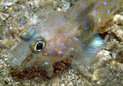
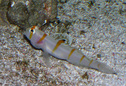
Coloration in gobies ranges from vivid, especially in reef species like the brilliantly marked neon gobies, to drab, as in many estuarine species (Bathygobius). Still others may be pallid or translucent (Coryphopterus). Although most reef gobies are sexually monomorphic in terms of permanent coloration and gross morphology, temporary sexual dichromatism (color differences between the sexes) has been observed during courtship and spawning on reefs and other habitats. When permanent sexual dimorphism does occur, it may vary even within a genus. For instance, males in some genera, Lythrypnus and Coryphopterus, have longer dorsal and/or anal spines than females, but other species within these genera lack any morphological differences. Permanent sexual dichromatism also exists in some species but investigators have been unable to explain why there is such variation within genera. (Böhlke and Chaplin, 1994; Hoese and Moore, 1998; Thresher, 1984)

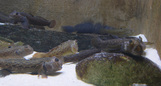
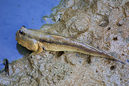
Many gobies have evolved unique physical adaptations for life in tidal or estuarine environments. For instance, mudskippers, which span the genera Boleophthalmus, Periophthalmus, Periophthalmadon, and Scartelaos, are essentially amphibious. The skin contains numerous blood vessels enabling them to take up atmospheric oxygen and a muscular tail helps them to skip over the mud. Additionally, their eyes are perched high on the head to allow them to forage effectively and avoid predation. Another goby, Gillichthys mirabilis, has evolved a highly vascularized buccopharynx, which allows it to gulp air from the surface when the waters it inhabits become depleted of oxygen. (Berra, 2001; Hoese, 1998)
- Other Physical Features
- ectothermic
- bilateral symmetry
- Sexual Dimorphism
- sexes alike
- male larger
- sexes colored or patterned differently
- male more colorful
- sexes shaped differently
- ornamentation
Development
In most gobies, eggs hatch in one to five days and grow rapidly within a few days. At hatching the larvae are quite advanced with pigmented eyes, well-developed jaws, digestive tracts, and vertical fin folds. The small transparent larvae (between 2 and 10 mm long) are usually dispersed in the water column where they swim for three to 20 days. Finally, the larvae settle into a suitable habitat and develop colors that allow them to blend in with the surroundings. They reach sexual maturity within a few months. However, in temperate climates development may take much longer, with sexual maturity occurring after one to two years. (Hoese, 1998)
A notable exception to this developmental pattern (and there are likely many others) can be found in burrowing gobies. In this species, the male remains in a burrow, which is sealed shut by the female, for up to five days. During this time, the burrow is periodically reopened and the eggs cleaned by both male and female before the male is again sealed in the burrow. The eggs develop entirely within the burrow and only one juvenile apparently exits the burrow, suggesting that juveniles receive nourishment through cannibalism, as well as food reserves and their surroundings. Upon exiting, the juvenile immediately begins a benthic existence. (Thresher, 1984)
Reproduction
Gobies exhibit a wide variety of mating systems but most seem to be promiscuous, either organized into a hierarchical social system, such as Coryphopterus personatus, or small territories maintained by individuals, such as Coryphopterus glaucofrenum and Lythrypnus dalli. A typical mating sequence begins with nest preparation by the male, which involves clearing and cleaning the area where eggs will be deposited. In response, the ventral area of the female swells and the male proceeds to swim back and forth between the female and nest site and in some cases the male will nudge the female with its snout. The male may also make exaggerated swimming motions in place by anchoring himself with the sucking disc. (Thresher, 1984)
There is evidence of monogamy in some gobies (Ioglossus spp., Gobiodon spp., Valencienna spp., Gobiosoma spp., and Paragobiodon spp., among others) but some of these pairings are the result of fierce territorialism toward other members of the same sex, which confines mating to that individual. However, there is evidence that some gobies recognize mates as individuals (Elacatinus lobeli), possibly through olfactory cues. In fact, extensive research on frillfin gobies has revealed a complex suite of visual, chemical, auditory, and olfactory cues used in courting behavior. For instance, an ovarian pheromone produce by female frillfin gobies has been shown to elicit courtship in males, even if the female is not present. Male frillfin gobies have also been observed making a knocking sound to initiate courtship. An example of visual cues is well illustrated by the alamo’o, which is found in the Hawaiian Islands. In this species, the male attracts females by perching on a rock and waving its rear end, which is bright yellow, back and forth in the current. Although there are very few studies as extensive as these for all gobies it is likely that a mixture of visual, tactile, chemical, auditory, or olfactory cues will be found in other gobies as well. (Moyle and Cech, 2000; Thresher, 1984)
- Mating System
- monogamous
- polygynous
- polygynandrous (promiscuous)
Most gobies have extended spawning seasons with peak spawning depending on the species, but in colder regions breeding may only occur once or twice a year. Females may deposit from five to several hundred eggs, which the male then fertilizes. Some gobies exhibit protogynous hermaphroditism, such as members of the genus Paragobiodon. Individuals may be found in pairs, trios, or male-dominated harems depending on the species. In Paragobiodon harems the largest individual is always the dominant male and the second largest the functional female, and sex change is socially controlled. Most likely, similar hermaphroditism will be found in other territorial and pair-forming gobies. In estuarine species the lunar cycle is thought to play a role in spawning behavior as well as larval recruitment. (Hoese, 1998; Thresher, 1984)
- Key Reproductive Features
- iteroparous
- seasonal breeding
- year-round breeding
- gonochoric/gonochoristic/dioecious (sexes separate)
- sequential hermaphrodite
- sexual
- fertilization
- oviparous
In most cases, male gobies guard the eggs after they are fertilized. The young probably stay close to adults for a period of time after hatching. Even if females are permanently paired, they rarely take part in parental care. In some freshwater island species parental care is not practiced at all. For instance, in the subfamily Sicydiinae the larvae are carried downstream to the ocean where they feed and grow before ascending the freshwater streams. (Berra, 2001; Böhlke and Chaplin, 1994; Thresher, 1984)
- Parental Investment
- male parental care
Lifespan/Longevity
Tropical gobies develop very quickly and probably live no longer than one year but in cooler areas some species may live between two and ten years. (Hoese, 1998)
Behavior
Nearly all gobies are benthic (bottom-dwelling) but in some groups (Iglossus, Nemateleotris) individuals hover just above the bottom, seldom moving very far from shelter. Many male gobies are extremely aggressive towards invading males but exhibit a much more relaxed behavior in response to females entering their territory. Pheromones are thought to play a pivotal role in this recognition. The various forms of social hierarchies found in gobies are discussed in Reproduction above. Some gobies engage in symbiotic relationships with sponges, branched corals, or other fishes in the form of cleaners Gobiosoma. However, other apparently symbiotic relationships are better described as parasitic. For instance, gobies that use sea urchins as cover have been observed feeding on the urchins’ tube feet. (Berra, 2001; Moyle and Cech, 2000; Thresher, 1984)
Communication and Perception
There is considerable evidence that gobies use visual, tactile, chemical, auditory, or olfactory cues in reproduction and territorial behavior (see Reproduction and Behavior). It is quite likely that investigators will find more evidence of different types of communication as research progresses. (Moyle and Cech, 2000; Thresher, 1984)
- Other Communication Modes
- pheromones
Food Habits
Gobies are classified as zooplanktivores, omnivores, and carnivores, as they feed on a wide variety of small organisms like crabs, shrimps, smaller crustaceans (such as copepods, amphipods, and ostracods), mollusks, annelids, polychaetes, formaninferans, sponges, small fishes, and eggs of various invertebrates and fishes. Many gobies are quite selective in their feeding habits, favoring an individual prey item, such as a minute algae or small invertebrate. Others have evolved unusual adaptations to allowing feeding in habitats formerly off-limits to fish. For instance, mudskippers (Boleophthalmus, Periophthalmus, Periophthalmadon, and Scartelaos) take on an amphibious character, actively foraging over mudflats and up mangrove roots for crustaceans and insects (see Physical Description for more information on this). Members of the genus Gobiosoma are well known for their brilliant colors used to distinguish them as cleaner fishes. These gobies feed on the parasites and dead skin of larger fish. Some freshwater species of the subfamily Sicydiinae are amphidromous: the larvae are carried downstream to the ocean where they feed and grow (they travel for feeding, not reproduction, unlike many other fishes) before migrating back to freshwater island habitats. (Allen and Robertson, 1994; Berra, 2001; Harmelin-Vivien, 2002)
- Primary Diet
-
carnivore
- piscivore
- eats eggs
- eats non-insect arthropods
- molluscivore
- herbivore
- omnivore
- planktivore
Predation
Due to their small size, gobies must be wary of many different predators, such as sea snakes, shore birds and larger fishes. It’s no surprise that they have developed a wide range of behaviors to defend themselves. Perhaps the most characteristic feature of gobies is their secretive nature. They rarely leave their burrows and display a wide range of coloration for camouflage. Some gobies are translucent and have only a few colored spots to match their surroundings while others have formed symbiotic relationships with shrimp. In the latter case Crytocentrus steinitzni sits outside the burrow watching guard while the shrimp clears out the burrow they share. Cleaner fishes of the genus Gobiosoma enjoy relative freedom from predation due to their color pattern and cleaning behavior. Others live within sponges, sea urchins, the branches of corals, or the roofs of caves for protection. Some gobies even rely on chemical protection, producing a poison called tetrodotoxin, which also occurs in pufferfishes and species of salamander. Some morphological adaptations can be found in mudskippers (Boleophthalmus, Periophthalmus, Periophthalmadon, and Scartelaos). The eyes of mudskippers are located on the tops of their heads to detect and avoid shore birds as well as to locate prey, and their powerful tail allows them to move quickly along the mud. (Böhlke and Chaplin, 1994; Helfman, et al., 1997; Hoese, 1998)
- Anti-predator Adaptations
- aposematic
- cryptic
-
- Known Predators
-
- larger fish (Actinopterygii)
- sea snakes (Hydrophiidae)
- shore birds (Charadriiformes)
Ecosystem Roles
Gobies are extremely important in almost any ecosystem they occupy because their relative abundance makes them an essential part of the food chain. Gobies have the greatest impact on the benthic environment since most reside there. Gobies may be the keystone species (dominant in the food chain) in the freshwaters of small oceanic islands because they are often one of the few species of fish that exist in these areas. (Allen and Robertson, 1994; Helfman, et al., 1997)
- Ecosystem Impact
- keystone species
- parasite
- Branched Corals
- Sponges
- Sea Urchins
- Shrimps
Economic Importance for Humans: Positive
In the Caribbean and Philippines amphidromous gobies (see Food Habits) form a large portion of the catch as they migrate upstream in freshwater creeks. A number of gobies have been successfully bred in captivity, and some are also popular in the aquarium trade. (Allen and Robertson, 1994; Hoese, 1998)
Economic Importance for Humans: Negative
No specific information was found concerning any negative impacts to humans.
Conservation Status
There are five critically endangered gobies, 18 listed as vulnerable, and 12 listed as low risk. Agricultural practices and the introduction of non-native species are some important causes for their decline. This is not surprising considering the diversity of this family and the fact that many are confined to a single lake or river system, or one or few islands. Some may go extinct before humans become aware of their existence. (Hoese, 1998; The World Conservation Union, 2002)
-
- IUCN Red List [Link]
- Not Evaluated
Other Comments
The fossil history of gobies is from the Eocene epoch to present. (Berg, 1958)
Contributors
R. Jamil Jonna (author), Animal Diversity Web.
Glossary
- Atlantic Ocean
-
the body of water between Africa, Europe, the southern ocean (above 60 degrees south latitude), and the western hemisphere. It is the second largest ocean in the world after the Pacific Ocean.

- Australian
-
Living in Australia, New Zealand, Tasmania, New Guinea and associated islands.
- Ethiopian
-
living in sub-Saharan Africa (south of 30 degrees north) and Madagascar.
- Nearctic
-
living in the Nearctic biogeographic province, the northern part of the New World. This includes Greenland, the Canadian Arctic islands, and all of the North American as far south as the highlands of central Mexico.
- Neotropical
-
living in the southern part of the New World. In other words, Central and South America.
- Pacific Ocean
-
body of water between the southern ocean (above 60 degrees south latitude), Australia, Asia, and the western hemisphere. This is the world's largest ocean, covering about 28% of the world's surface.
- Palearctic
-
living in the northern part of the Old World. In otherwords, Europe and Asia and northern Africa.
- abyssal
-
on or near the ocean floor in the deep ocean. Abyssal regions are characterized by complete lack of light, extremely high water pressure, low nutrient availability, and continuous cold (3 degrees C).
- aposematic
-
having coloration that serves a protective function for the animal, usually used to refer to animals with colors that warn predators of their toxicity. For example: animals with bright red or yellow coloration are often toxic or distasteful.
- benthic
-
Referring to an animal that lives on or near the bottom of a body of water. Also an aquatic biome consisting of the ocean bottom below the pelagic and coastal zones. Bottom habitats in the very deepest oceans (below 9000 m) are sometimes referred to as the abyssal zone. see also oceanic vent.
- bilateral symmetry
-
having body symmetry such that the animal can be divided in one plane into two mirror-image halves. Animals with bilateral symmetry have dorsal and ventral sides, as well as anterior and posterior ends. Synapomorphy of the Bilateria.
- brackish water
-
areas with salty water, usually in coastal marshes and estuaries.
- carnivore
-
an animal that mainly eats meat
- chemical
-
uses smells or other chemicals to communicate
- coastal
-
the nearshore aquatic habitats near a coast, or shoreline.
- colonial
-
used loosely to describe any group of organisms living together or in close proximity to each other - for example nesting shorebirds that live in large colonies. More specifically refers to a group of organisms in which members act as specialized subunits (a continuous, modular society) - as in clonal organisms.
- crepuscular
-
active at dawn and dusk
- cryptic
-
having markings, coloration, shapes, or other features that cause an animal to be camouflaged in its natural environment; being difficult to see or otherwise detect.
- diurnal
-
- active during the day, 2. lasting for one day.
- dominance hierarchies
-
ranking system or pecking order among members of a long-term social group, where dominance status affects access to resources or mates
- ectothermic
-
animals which must use heat acquired from the environment and behavioral adaptations to regulate body temperature
- estuarine
-
an area where a freshwater river meets the ocean and tidal influences result in fluctuations in salinity.
- external fertilization
-
fertilization takes place outside the female's body
- fertilization
-
union of egg and spermatozoan
- food
-
A substance that provides both nutrients and energy to a living thing.
- freshwater
-
mainly lives in water that is not salty.
- herbivore
-
An animal that eats mainly plants or parts of plants.
- intertidal or littoral
-
the area of shoreline influenced mainly by the tides, between the highest and lowest reaches of the tide. An aquatic habitat.
- introduced
-
referring to animal species that have been transported to and established populations in regions outside of their natural range, usually through human action.
- island endemic
-
animals that live only on an island or set of islands.
- iteroparous
-
offspring are produced in more than one group (litters, clutches, etc.) and across multiple seasons (or other periods hospitable to reproduction). Iteroparous animals must, by definition, survive over multiple seasons (or periodic condition changes).
- keystone species
-
a species whose presence or absence strongly affects populations of other species in that area such that the extirpation of the keystone species in an area will result in the ultimate extirpation of many more species in that area (Example: sea otter).
- male parental care
-
parental care is carried out by males
- migratory
-
makes seasonal movements between breeding and wintering grounds
- molluscivore
-
eats mollusks, members of Phylum Mollusca
- monogamous
-
Having one mate at a time.
- motile
-
having the capacity to move from one place to another.
- natatorial
-
specialized for swimming
- native range
-
the area in which the animal is naturally found, the region in which it is endemic.
- nocturnal
-
active during the night
- oceanic islands
-
islands that are not part of continental shelf areas, they are not, and have never been, connected to a continental land mass, most typically these are volcanic islands.
- omnivore
-
an animal that mainly eats all kinds of things, including plants and animals
- oriental
-
found in the oriental region of the world. In other words, India and southeast Asia.
- oviparous
-
reproduction in which eggs are released by the female; development of offspring occurs outside the mother's body.
- parasite
-
an organism that obtains nutrients from other organisms in a harmful way that doesn't cause immediate death
- pelagic
-
An aquatic biome consisting of the open ocean, far from land, does not include sea bottom (benthic zone).
- pet trade
-
the business of buying and selling animals for people to keep in their homes as pets.
- pheromones
-
chemicals released into air or water that are detected by and responded to by other animals of the same species
- piscivore
-
an animal that mainly eats fish
- planktivore
-
an animal that mainly eats plankton
- polygynandrous
-
the kind of polygamy in which a female pairs with several males, each of which also pairs with several different females.
- polygynous
-
having more than one female as a mate at one time
- protogynous
-
condition of hermaphroditic animals (and plants) in which the female organs and their products appear before the male organs and their products
- reef
-
structure produced by the calcium carbonate skeletons of coral polyps (Class Anthozoa). Coral reefs are found in warm, shallow oceans with low nutrient availability. They form the basis for rich communities of other invertebrates, plants, fish, and protists. The polyps live only on the reef surface. Because they depend on symbiotic photosynthetic algae, zooxanthellae, they cannot live where light does not penetrate.
- saltwater or marine
-
mainly lives in oceans, seas, or other bodies of salt water.
- seasonal breeding
-
breeding is confined to a particular season
- sexual
-
reproduction that includes combining the genetic contribution of two individuals, a male and a female
- sexual ornamentation
-
one of the sexes (usually males) has special physical structures used in courting the other sex or fighting the same sex. For example: antlers, elongated tails, special spurs.
- social
-
associates with others of its species; forms social groups.
- tactile
-
uses touch to communicate
- temperate
-
that region of the Earth between 23.5 degrees North and 60 degrees North (between the Tropic of Cancer and the Arctic Circle) and between 23.5 degrees South and 60 degrees South (between the Tropic of Capricorn and the Antarctic Circle).
- territorial
-
defends an area within the home range, occupied by a single animals or group of animals of the same species and held through overt defense, display, or advertisement
- tropical
-
the region of the earth that surrounds the equator, from 23.5 degrees north to 23.5 degrees south.
- visual
-
uses sight to communicate
- year-round breeding
-
breeding takes place throughout the year
References
Allen, G., D. Robertson. 1994. Fishes of the Tropical Eastern Pacific. Honolulu, HI: University of Hawaii Press.
Berg, L. 1958. System Der Rezenten und Fossilen Fischartigen und Fische. Berlin: VEB Deutscher Verlag der Wissenschaften.
Berra, T. 2001. Freshwater Fish Distribution. San Diego, CA: Academic Press.
Böhlke, J., C. Chaplin. 1994. Fishes of the Bahamas and Adjacent Tropical Waters. Wynnewood, PA: Published for the Academy of Natural Sciences of Philadelphia by Livingston.
Froese, R., D. Pauly, D. Woodland. 2003. "Fish Base" (On-line). FishBase World Wide Web electronic publication. Accessed July 20, 2003 at http://www.fishbase.org/.
Harmelin-Vivien, M. 2002. Energetics and Fish Diversity on Coral Reefs. Pp. 269 in P Sale, ed. Coral Reef Fishes: Dynamics and Diversity in a Complex Ecosystem. San Diego, CA: Academic Press.
Helfman, G., B. Collete, D. Facey. 1997. The Diversity of Fishes. Malden, MA: Blackwell.
Hoese, D., R. Moore. 1998. Fishes of the Gulf of Mexico, Texas, Louisiana, and Adjacent Waters – second edition. College Station, TX: Texas A&M University Press.
Hoese, D. 1998. Gobies. Pp. 218 in W Eschmeyer, J Paxton, eds. Encyclopedia of fishes – second edition. San Diego, CA: Academic Press.
Moyle, P., J. Cech. 2000. Fishes: An Introduction to Ichthyology – fourth edition. Upper Saddle River, NJ: Prentice-Hall.
Nelson, J. 1994. Fishes of the World – third edition. New York, NY: John Wiley and Sons.
The World Conservation Union, 2002. "IUCN 2002" (On-line). 2002 IUCN Red List of Threatened Species. Accessed July 20, 2003 at http://www.iucnredlist.org/.
Thresher, R. 1984. Reproduction in reef fishes. Neptune City, NJ: T.F.H. Publications.