Gastropoda
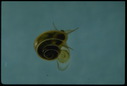


The Class Gastropoda includes the snails and slugs. Most gastropods have a single, usually spirally coiled shell into which the body can be withdrawn, but the shell is lost or reduced some important groups. Gastropods are characterized by "torsion," a process that results in the rotation of the visceral mass and mantle on the foot. The result is that the mantle cavity (including anus) lies in the anterior body, over the head and mouth, and the gut and nervous system are twisted. Torsion takes place during the veliger stage, usually very rapidly. Veligers are at first bilaterally symmetric, but torsion destroys this pattern and results in an asymmetric adult. Some species reverse torsion ("detorsion"), but evidence of having passed through a twisted phase can be seen in the anatomy of these forms. Many snails have an operculum, a horny plate that seals the opening when the snail's body is drawn into the shell.
Gastropods have a muscular foot which is used for "creeping" locomotion in most species. In some, it is modified for swimming or burrowing. Most gastropods have a well-developed head that includes eyes, 1-2 pairs of tentacles, and a concentration of nervous tissue (ganglion).
Gastropods are dioecious, and some forms are hermaphroditic. Hermaphroditic forms exchange bundles of sperm to avoid self-fertilization; copulation may be complex and in some species ends with each individual sending a sperm-containing dart into the tissues of the other. Marine species have veliger larvae.
Torsion in gastropods has the unfortunate result that wastes are expelled from the gut and nephridia near the gills. A variety of morphological and physiological adaptations have arisen to separate water used for respiration from water bearing waste products.
Gastropods are by far the largest group of molluscs. Their 40,000 species comprise over 80% of living molluscs. Gastropod feeding habits are extremely varied, although most species make use of a radula in some aspect of their feeding behavior. Some graze, some browse, some feed on plankton, some are scavengers or detritivores, some are active carnivores.
Sources:
Hickman, C.P. and L. S. Roberts. 1994. Animal Diversity. Wm. C. Brown, Dubuque, IA.
Brusca, R. C., and G. J. Brusca. Invertebrates. 1990. Sinauer Associates, Sunderland, MA.
Great Lakes area freshwater snails
 These are species with
general aquatic distribution in perennial waters
These are species with
general aquatic distribution in perennial waters

 These are species that inhabit
quiet bays or ponds
These are species that inhabit
quiet bays or ponds

 These are
intermittant pool or intermittant stream species
These are
intermittant pool or intermittant stream species

 These are
riverine species
These are
riverine species

 These are
marsh species
These are
marsh species

 These are
mud flat species
These are
mud flat species

 These are species that
burrow in sand or mud in rivers or lakes
These are species that
burrow in sand or mud in rivers or lakes

 These are
deep water lake species
These are
deep water lake species

 These are non-native species,
introduced from other regions.
These are non-native species,
introduced from other regions.

Contributors
Phil Myers (author), Museum of Zoology, University of Michigan-Ann Arbor, John B. Burch (author), Mollusk Division, Museum of Zoology, University of Michigan-Ann Arbor.
Glossary
- bilateral symmetry
-
having body symmetry such that the animal can be divided in one plane into two mirror-image halves. Animals with bilateral symmetry have dorsal and ventral sides, as well as anterior and posterior ends. Synapomorphy of the Bilateria.
- ectothermic
-
animals which must use heat acquired from the environment and behavioral adaptations to regulate body temperature