Fulmarus glacialisnorthern fulmar


Geographic Range
Northern fulmars are found throughout the northern Atlantic and Arctic oceans in the northern hemisphere. They occur as far south as Cape Cod, Massachusetts in the western Atlantic, the British Isles in the eastern Atlantic, Japan in the western Pacific and California in the eastern Pacific. There are 3 recognized subspecies: F. g. glacialis in the northernmost Atlantic, F. g. audubonii is found in the lower Arctic of the north Atlantic, and F. g. rodgersii is found in the north Pacific. (del Hoyo, et al., 1992; Huettmann and Diamond, 2000)
Northern fulmars range widely across the Atlantic, with individuals regularly traveling between North America and Britain, including immature individuals. In the western Atlantic, most northern fulmars in 11 large colonies above 65 degrees North latitude in eastern Canada. Additional breeding colonies are found in Greenland, Newfoundland, and Labrador. Concentrations of northern fulmars occur around Newfoundland in early spring and some evidence suggests a general northwards movement in populations between May and July. Fledglings disperse southwards rapidly from breeding colonies in September and October. In winter the majority of northern fulmars occur in offshore waters and are rarely observed. (Huettmann and Diamond, 2000)
- Biogeographic Regions
- arctic ocean
- atlantic ocean
- pacific ocean
- Other Geographic Terms
- holarctic
Habitat
Northern fulmars are found in ocean waters over continental shelves. They are found from the pack ice of Arctic waters to temperate waters. They seem to prefer shelf break habitats (the area where the continental shelf begins to descend towards the sea floor) or areas over the continental slope. They are rarely seen more than 100 km from shore. They breed on rocky cliffs and islands up to 1 km inland, but typically close to the water or coastal. They have occasionally been reported nesting on human structures, like houses in coastal areas. (del Hoyo, et al., 1992; Hatch and Nettleship, 1998)
- Habitat Regions
- temperate
- polar
- saltwater or marine
- Aquatic Biomes
- coastal
Physical Description
There are 4 color morphs of northern fulmars: very dark, dark, light, and very light. Color morphs seem to differ in their distribution during the breeding season and in the timing of their molt. The 3 recognized subspecies are distinguished by differences in bill length and thickness and the proportion of the different color morphs, although the subspecies do have individuals of multiple color morphs generally. Individuals of different color morphs seem to mate indiscriminantly, although breeding colonies tend to be made up mainly of a single color morph. Immature individuals cannot be distinguished from adults. Most molting occurs in July. Molting seems to make some populations unable to fly, but not others. Males are slightly larger, on average 835 g whereas females average 700 g (range of masses is 450 to 1000 g). The sexes are similar in overall appearance. Northern fulmars are from 45 to 50 cm long with wingspans of 102 to 112 cm. (del Hoyo, et al., 1992; Hatch and Nettleship, 1998; Huettmann and Diamond, 2000)
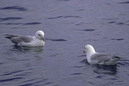
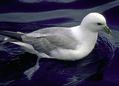
Northern fulmars have thick, yellow to gray bills with darker areas over the "tubes." Their legs and feet are flesh-colored to gray. Dark color morphs are more common in the southern portions of their range in the Atlantic and the northern portions of their range in the Pacific. Light color morphs are more common in the northern portion of the range in the Pacific. Atlantic populations tend to have robust bills and are almost exclusively light color morphs, whereas Pacific populations have bills that are more slender and exhibit the full range of color variation. Light morphs are uniformly pale, with head, neck, and ventral surfaces white and with their backs and wings being gray. Dark morphs are uniformly dark gray. Nearly all individuals of any color morph have a light to white patch on the dorsal surface of their wings formed by the exposed lighter portion of their primaries, this is only lacking in the darkest of individuals. Individuals can vary between the very dark ("double dark") and light ("double light") morphs described above. Variation is more of less continuous, but is divided into 4 morph categories for convenience. (Hatch and Nettleship, 1998)
Northern fulmars can be confused with pink-footed shearwaters (Puffinus creatopus) or flesh-footed shearwaters (Puffinus carneipes), but can be distinguished by their thick, rounded heads and stubby bills. (Hatch and Nettleship, 1998)
- Other Physical Features
- endothermic
- homoiothermic
- bilateral symmetry
- polymorphic
- Sexual Dimorphism
- male larger
-
- Range mass
- 450 to 1000 g
- 15.86 to 35.24 oz
-
- Average mass
- 700 to 835 g
- oz
-
- Range length
- 45 to 50 cm
- 17.72 to 19.69 in
-
- Range wingspan
- 102 to 112 cm
- 40.16 to 44.09 in
Reproduction
Northern fulmars are monogamous and rejoin their mates each year at the same nest site for breeding. If an individual's mate dies, they will mate with a young, inexperienced mate following year, but at the same nest site. Males and females associate at the nesting colony for a few weeks before they lay an egg. They copulate frequently, then both depart to forage during the pre-laying phase. (Hatch and Nettleship, 1998)
- Mating System
- monogamous
During the pre-laying period, females store sperm in their reproductive tract and begin the process of yolk formation, which takes about 23 days. After yolk formation, females ovulate, the egg is fertilized, and the female returns to the colony and lays her egg within a few hours of arrival. Egg-laying occurs about 3 weeks after breeding. (Hatch and Nettleship, 1998)
Northern fulmars begin to breed in April and lay their eggs in late May to early June in large colonies on ledges and among rocks. They may also nest in areas with more soil and vegetation than other seabirds and will even nest on buildings and walls. Nests are fairly simple scrapes, sometimes lined with bits of vegetation. From 80 to 99% of nests are re-used by at least 1 member of the original pair each year. Females lay a single, white egg and incubation lasts for 47 to 53 days. The process of hatching takes from 4 to 5 days. Young fledge at 49 to 58 days in early September, with the last young northern fulmars leaving their natal sites by early October. Sexual maturity is not reached until 5 to 20 years old (average 8 years in males, 12 years in females). (del Hoyo, et al., 1992; Hatch and Nettleship, 1998)
- Key Reproductive Features
- iteroparous
- seasonal breeding
- gonochoric/gonochoristic/dioecious (sexes separate)
- sexual
- oviparous
- sperm-storing
-
- Breeding interval
- Northern fulmars breed once yearly.
-
- Breeding season
- Breeding occurs in the late spring and early summer, beginning in May.
-
- Range eggs per season
- 1 to 1
-
- Average eggs per season
- 1
- AnAge
-
- Range time to hatching
- 47 to 53 days
-
- Range fledging age
- 49 to 58 days
-
- Average fledging age
- 53 days
-
- Range age at sexual or reproductive maturity (female)
- 5 to 20 years
-
- Average age at sexual or reproductive maturity (female)
- 12 years
-
- Range age at sexual or reproductive maturity (male)
- 5 to 20 years
-
- Average age at sexual or reproductive maturity (male)
- 8 years
Both parents incubate the eggs, staying on the nest for from 1 to 11 (average 4.6) days until relieved by the other parent. Males often take particularly long incubation shifts at the beginning of incubation, presumably to allow the female to recover from laying the egg. Young hatch with a light covering of down and are closely tended by parents for 10 to 16 days after hatching, after which parents primarily visit the nest to feed their young. They are able to thermoregulate at 3 to 6 days old. Parents feed their young by regurgitation in response to the chick's food begging call. Young fledge at 49 to 58 (average 53) days old, about 4 to 5 days after the parents have stopped feeding them. Young fledge at 115 to 119% of adult body mass. (del Hoyo, et al., 1992; Hatch and Nettleship, 1998)
- Parental Investment
- altricial
-
pre-fertilization
- provisioning
-
protecting
- female
-
pre-hatching/birth
-
provisioning
- female
-
protecting
- male
- female
-
provisioning
-
pre-weaning/fledging
-
provisioning
- male
- female
-
protecting
- male
- female
-
provisioning
Lifespan/Longevity
Northern fulmars have exceptionally long lifespans. Average adult life expectancy is estimated at 31.8 years. Birds have been reported breeding at over 50 years old. Annual survival rates are approximately 0.988 for adults. Most mortality is during the egg and early hatchling phase. (del Hoyo, et al., 1992; Hatch and Nettleship, 1998)
-
- Typical lifespan
Status: wild - 50 (high) years
- Typical lifespan
-
- Average lifespan
Status: wild - 31.8 years
- Average lifespan
Behavior
Northern fulmars forage both during the day and at night, although much foraging may occur at night. They are found in colonial nesting colonies during the breeding season. Northernmost, Arctic populations are migratory, moving southwards as the polar ice expands in winter. They are absent from their northern ranges from November to February, in general. All other populations are more nomadic or dispersive, ranging widely in search of good foraging opportunities outside of the breeding season and dispersing from breeding colonies to pelagic foraging areas at the end of the season. Young northern fulmars range more widely than adults and often cross oceans. During the breeding season individuals spend about 39% of their time at the colony and 61% of their time foraging. They spend more time foraging during the pre-laying period. (del Hoyo, et al., 1992; Hatch and Nettleship, 1998)
Northern fulmars fly in a manner typical of the family (Procellariidae), with stuff wing beats and gliding. They tend to fly close to the water. They also soar and use upwellings of air to support aerial maneuvers near cliff colonies. Average air speed in flight has been calculated at 13 m/s (47 km/h). Northern fulmars are buoyant on the water and spend a fair amount of time preening. They bathe with enthusiasm, sometimes even becoming completely soaked and unable to fly for some time after bathing. (Hatch and Nettleship, 1998)
-
- Average territory size
- 1 m^2
Home Range
Home range sizes for northern fulmars are not reported. They defend small nesting areas (about 1 m around the nest) at breeding colonies and will fight with other birds, although rarely. They will also use oil-spitting to defend their nesting site. Mean distance to neighboring nests averaged 1.6 m in one study. (Hatch and Nettleship, 1998)
Communication and Perception
Northern fulmars are one of the few species of birds with a well-developed sense of smell. They may use olfaction to detect and find prey and can be attracted to areas by fish oil smells. Similar to other petrels and shearwaters, they emit a strong, musky odor. Individuals emit this odor when handled and colonies and flocks are easily detected by their smell. Birds sometimes engage in allopreening upon returning to breeding colonies. (Hatch and Nettleship, 1998)
Northern fulmar vocalizations have been described as "cackling" or "braying" at various speeds. These vocalizations are used during courtship, at approaches to nesting colonies, and in aggression against intruders. They make other calls as well, described as grunts, mewing, and spitting, which warns a threat that these birds are about to spit stomach oil at them, a defensive mechanism. Hatchlings use a food-begging call that stimulates parents to regurgitate. (Hatch and Nettleship, 1998)
They also use a variety of visual displays in aggressive encounters, including raising their wings, rushing at other birds, and pushing their breasts against the other bird. They also use their spitting call and oil spitting in aggressive encounters. (Hatch and Nettleship, 1998)
Food Habits
Northern fulmars eat fish, squid, and large zooplankton such as amphipods (Thysanoessa, Hyperia, Gammarus, and Themisto species). They are opportunistic feeders and also take discarded fish and carrion, such as whale, walrus, and seal blubber. They eat a wide variety of prey, but seem to prefer fish with high fat content. They drink seawater. They capture prey mainly at the surface, but will occasionally dive as well. Northern fulmars often accompany fishing fleets, forming large aggregations to take advantage of fish waste. They are one of the few bird species with a well-developed sense of smell and are thought to use olfaction to detect prey. They tend to forage at marine upwellings that cause temporary concentrations of large zooplankton, including areas near ice sheets or upwelling associated with feeding gray whales (Eschrictius robustus) or trawling operations. Northern fulmars travel widely in search of food. During the breeding season individual leave the colony on foraging trips of 4 to 5 days that may take them up to 460 km from the colony, although most foraging is within 100 km of the colony. (del Hoyo, et al., 1992; Hatch and Nettleship, 1998)
- Primary Diet
-
carnivore
- piscivore
- eats non-insect arthropods
- molluscivore
- scavenger
- Animal Foods
- fish
- carrion
- mollusks
- aquatic crustaceans
- cnidarians
- zooplankton
Predation
Northern fulmars are preyed on by red foxes (Vulpes vulpes) and Arctic foxes (Vulpes lagopus) at breeding colonies. Other introduced predators include ground squirrels (Spermophilus) and rats (Rattus norvegicus). Northern fulmars are not susceptible to these terrestrial predators, except at breeding colonies. They will spit a foul smelling oil at predators when threatened. (del Hoyo, et al., 1992; Hatch and Nettleship, 1998)
-
- Known Predators
-
- red foxes (Vulpes vulpes)
- Arctic foxes (Vulpes lagopus)
- ground squirrels (Spermophilus)
- rats (Rattus norvegicus)
Ecosystem Roles
Northern fulmars are important predators and scavengers in arctic and temperate pelagic waters. They occur in large breeding colonies with other cliff-nesting seabirds, including murres (Uria), kittiwakes (Rissa), and cormorants (Phalacrocorax). They may use areas of breeding islands with more vegetation and soil accumulation than these other species. They feed on large zooplankton brought to the surface by feeding gray whales (Eschrictius robustus) and are often found in close association with black-legged kittiwakes (Rissa tridactyla) in arctic waters. (Hatch and Nettleship, 1998)
Northern fulmars are susceptible to various diseases, including viral ornithosis, which can be transmitted to humans, and shellfish paralysis. Ectoparasites reported are chewing lice (Procellariphaga brevifimbiata, Saemundssonia occidentalis, and Perineus nigrolimbatus), endoparasites reported are nematodes (Stegophorus stellaepolaris). (Hatch and Nettleship, 1998)
- murres (Uria)
- kittiwakes (Rissa)
- cormorants (Phalacrocorax)
- gray whales (Eschrictius robustus)
- black-legged kittiwakes (Rissa tridactyla)
- chewing lice (Procellariphaga brevifimbiata)
- chewing lice (Saemundssonia occidentalis)
- chewing lice (Perineus nigrolimbatus)
- nematodes (Stegophorus stellaepolaris)
Economic Importance for Humans: Positive
Northern fulmars have been historically collected for food at nesting colonies. (Hatch and Nettleship, 1998)
- Positive Impacts
- food
Economic Importance for Humans: Negative
There are no adverse effects of northern fulmars on humans.
Conservation Status
Northern fulmars have a large range and large population sizes, they are considered "least concern" by the IUCN. Northern fulmar populations have increased dramatically in the northern Atlantic and expanded their range in the last 2 centuries, possibly as a result of greater food availability from fish discards from commercial fishing operations. They were once heavily exploited at colonies for food, but are not generally taken for food currently. They may be threatened by coastal pollution near breeding colonies and likely suffer mortality associated with entanglement in fishing gear. (del Hoyo, et al., 1992; Hatch and Nettleship, 1998)
-
- IUCN Red List
-
Least Concern
More information
-
- IUCN Red List
-
Least Concern
More information
-
- US Migratory Bird Act
- Protected
-
- US Federal List
- No special status
-
- CITES
- No special status
Other Comments
Fulmarus glacialis may be most closely related to Antarctic fulmars (Fulmarus glacialoides). (Hatch and Nettleship, 1998)
Contributors
Tanya Dewey (author), Animal Diversity Web.
Glossary
- Arctic Ocean
-
the body of water between Europe, Asia, and North America which occurs mostly north of the Arctic circle.
- Atlantic Ocean
-
the body of water between Africa, Europe, the southern ocean (above 60 degrees south latitude), and the western hemisphere. It is the second largest ocean in the world after the Pacific Ocean.

- Pacific Ocean
-
body of water between the southern ocean (above 60 degrees south latitude), Australia, Asia, and the western hemisphere. This is the world's largest ocean, covering about 28% of the world's surface.
- acoustic
-
uses sound to communicate
- altricial
-
young are born in a relatively underdeveloped state; they are unable to feed or care for themselves or locomote independently for a period of time after birth/hatching. In birds, naked and helpless after hatching.
- bilateral symmetry
-
having body symmetry such that the animal can be divided in one plane into two mirror-image halves. Animals with bilateral symmetry have dorsal and ventral sides, as well as anterior and posterior ends. Synapomorphy of the Bilateria.
- carnivore
-
an animal that mainly eats meat
- carrion
-
flesh of dead animals.
- chemical
-
uses smells or other chemicals to communicate
- coastal
-
the nearshore aquatic habitats near a coast, or shoreline.
- colonial
-
used loosely to describe any group of organisms living together or in close proximity to each other - for example nesting shorebirds that live in large colonies. More specifically refers to a group of organisms in which members act as specialized subunits (a continuous, modular society) - as in clonal organisms.
- diurnal
-
- active during the day, 2. lasting for one day.
- endothermic
-
animals that use metabolically generated heat to regulate body temperature independently of ambient temperature. Endothermy is a synapomorphy of the Mammalia, although it may have arisen in a (now extinct) synapsid ancestor; the fossil record does not distinguish these possibilities. Convergent in birds.
- food
-
A substance that provides both nutrients and energy to a living thing.
- holarctic
-
a distribution that more or less circles the Arctic, so occurring in both the Nearctic and Palearctic biogeographic regions.
Found in northern North America and northern Europe or Asia.
- iteroparous
-
offspring are produced in more than one group (litters, clutches, etc.) and across multiple seasons (or other periods hospitable to reproduction). Iteroparous animals must, by definition, survive over multiple seasons (or periodic condition changes).
- migratory
-
makes seasonal movements between breeding and wintering grounds
- molluscivore
-
eats mollusks, members of Phylum Mollusca
- monogamous
-
Having one mate at a time.
- motile
-
having the capacity to move from one place to another.
- natatorial
-
specialized for swimming
- native range
-
the area in which the animal is naturally found, the region in which it is endemic.
- nocturnal
-
active during the night
- nomadic
-
generally wanders from place to place, usually within a well-defined range.
- oviparous
-
reproduction in which eggs are released by the female; development of offspring occurs outside the mother's body.
- piscivore
-
an animal that mainly eats fish
- polar
-
the regions of the earth that surround the north and south poles, from the north pole to 60 degrees north and from the south pole to 60 degrees south.
- polymorphic
-
"many forms." A species is polymorphic if its individuals can be divided into two or more easily recognized groups, based on structure, color, or other similar characteristics. The term only applies when the distinct groups can be found in the same area; graded or clinal variation throughout the range of a species (e.g. a north-to-south decrease in size) is not polymorphism. Polymorphic characteristics may be inherited because the differences have a genetic basis, or they may be the result of environmental influences. We do not consider sexual differences (i.e. sexual dimorphism), seasonal changes (e.g. change in fur color), or age-related changes to be polymorphic. Polymorphism in a local population can be an adaptation to prevent density-dependent predation, where predators preferentially prey on the most common morph.
- saltwater or marine
-
mainly lives in oceans, seas, or other bodies of salt water.
- scavenger
-
an animal that mainly eats dead animals
- seasonal breeding
-
breeding is confined to a particular season
- sexual
-
reproduction that includes combining the genetic contribution of two individuals, a male and a female
- social
-
associates with others of its species; forms social groups.
- sperm-storing
-
mature spermatozoa are stored by females following copulation. Male sperm storage also occurs, as sperm are retained in the male epididymes (in mammals) for a period that can, in some cases, extend over several weeks or more, but here we use the term to refer only to sperm storage by females.
- tactile
-
uses touch to communicate
- temperate
-
that region of the Earth between 23.5 degrees North and 60 degrees North (between the Tropic of Cancer and the Arctic Circle) and between 23.5 degrees South and 60 degrees South (between the Tropic of Capricorn and the Antarctic Circle).
- visual
-
uses sight to communicate
- zooplankton
-
animal constituent of plankton; mainly small crustaceans and fish larvae. (Compare to phytoplankton.)
References
Hatch, S., D. Nettleship. 1998. Northern fulmar (Fulmarus glacialis). The Birds of North America Online, 361: 1-20. Accessed July 13, 2009 at http://bna.birds.cornell.edu.proxy.lib.umich.edu/bna/species/361.
Huettmann, F., A. Diamond. 2000. Seabird migration in the Canadian northwest Atlantic Ocean: moulting locations and movement patterns of immature birds. Canadian Journal of Zoology, 78: 624-627.
del Hoyo, J., A. Elliott, J. Sargatal. 1992. Handbook of the Birds of the World, Volume I. Barcelona: Lynx Edicions.