Fratercula arcticaAtlantic puffin


Geographic Range
The Atlantic puffin (Fratercula arctica) is a migratory species, spending most of the time traveling back and forth across the Atlantic Ocean, returning every breeding season to its native breeding areas. Sixty percent of the individuals inhabit the coast of Iceland during breeding season. This species is also found on the Great Island in Newfoundland throughout the summer breeding season. The Atlantic puffin has also been found off the coast of Greenland, United Kingdom, Eastern Canada, and the Netherlands as well as Ireland.
When the Atlantic puffin is not breeding (late summer until spring), it is traveling across the Atlantic Ocean from the United Kingdom to Maine (United States) in the late summer, then from Maine to the coast of Spain every winter, spending months on the water. (Kress and Nettleship, 1988; Merkel, et al., 1998)
- Biogeographic Regions
- nearctic
- palearctic
- atlantic ocean
Habitat
Atlantic puffins are a migratory species; they usually spend most of their time at sea, traveling across the Atlantic Ocean. However, when the Atlantic puffins breed in summer, they inhabit rocky cliffs along the coast with an altitude of 218 meters. The puffins use large rocky areas for protection against the elements, as well as predators. The puffins use their long bills to shovel out a burrow that is on average 70-110 cm long and put feathers and some grass to complete the nest.
When Atlantic puffins are not breeding, they are traveling across the Atlantic Ocean and resting on the water when tired. When in flight, these birds stay at about 30 m above the water. (Barrett and Rikardsen, 1992; Guildford, et al., 2011)
- Habitat Regions
- saltwater or marine
- Aquatic Biomes
- coastal
-
- Range elevation
- 0 to 218 m
- 0.00 to 715.22 ft
Physical Description
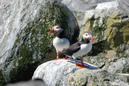
The Atlantic puffin is a densely-feathered seabird. On average, the Atlantic puffin is 18 cm tall with a wingspan of 50.8 cm. Males are slightly larger and more colorful (during breeding season) than females.
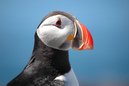
The Atlantic puffin’s weight averages 500g with a metabolic rate of 313-335 kJ/d. The puffin has dense black feathers on the back, and a white chest. The feathers of the puffin have a wax coating, which helps the species repel water. The beak of the Atlantic puffin is large and colorful (a combination of yellow, red, and orange). The top jaw of the beak has jagged marks on it so the species can carry more fish when hunting. In the winter, the beak color of the Atlantic puffin is dull, but it becomes vibrant in the breeding season. In males, the beak is especially vibrant, as it is used for mating behaviors. The species is commonly known as the "clown of the ocean" because of its colorful features.
When flying the species can flap its wings on average of 400 beats per minute. When traveling over the Atlantic Ocean, the beak of the Atlantic puffin becomes duller in color because of the shedding of the plates of the beak.
As a puffling, the chick is black and fluffy. The eyes can immediately open and it can stand as soon as it hatches. The initial weight of the puffling is around 42.5 g. (Breton, et al., 2006; Durant, et al., 2006; Rodway, 1997)
- Other Physical Features
- endothermic
- bilateral symmetry
- Sexual Dimorphism
- male larger
- male more colorful
-
- Average mass
- 500 g
- 17.62 oz
-
- Average mass
- 490.5 g
- 17.29 oz
- AnAge
-
- Average length
- 18 cm
- 7.09 in
-
- Average wingspan
- 50.8 mm
- 2.00 in
-
- Average basal metabolic rate
- 313-335 cm3.O2/g/hr
Reproduction
The Atlantic puffin is a monogamous species, keeping the same partner for a lifetime. In late spring the puffins breed. The puffin will court a potential partner with an action called billing. Billing occurs when two puffins touch their beaks together, back and forth, like the nodding of the head. This is a bonding trait that only occurs between mated pairs. It is still unclear whether or not a puffin finds its mate before or after the journey across the Atlantic Ocean. It is also still unclear how the puffins find the same mate every breeding season. (Creelman and Storey, 1991a; Durant, et al., 2003)
- Mating System
- monogamous
Both the female and male Atlantic puffin are sexually mature around 5 years old (range = 3-6 years). Once mature, in the late spring, these birds will mate in colonies. It takes 12-14 days to find a mate, breed and lay an egg.
When the bird is coupled up, one of the pair starts to dig a burrow for the potential egg. The other puffin will stand on the outside of the burrow, kicking away loose dirt near the entrance. The Atlantic puffin relies on abundant food for the success of the breeding season; indeed, Creelman and Storey (1991) found a positive correlation between breeding success and food abundance.
The pair only cares for one egg/potential offspring per breeding cycle. The egg incubates for approximately 39-45 days. A new hatching weighs between 39-45g on average. When hatched, the puffin young can immediately stand up and walk. The young fledges between 38-50 days, and then becomes independent. The young puffin will return to the breeding site after two or more years, typically 3-6. (Creelman and Storey, 1991a; Durant, et al., 2003)
- Key Reproductive Features
- iteroparous
- seasonal breeding
- gonochoric/gonochoristic/dioecious (sexes separate)
- sexual
- oviparous
-
- Breeding interval
- Once Per Year
-
- Breeding season
- Late Spring
-
- Range eggs per season
- 0 to 1
-
- Average eggs per season
- 1
-
- Average eggs per season
- 1
- AnAge
-
- Range time to hatching
- 39 to 45 days
-
- Average time to hatching
- 43 days
-
- Range fledging age
- 38 to 50 days
-
- Average fledging age
- 45 days
-
- Range time to independence
- 38 to 50 days
-
- Average time to independence
- 40 days
-
- Range age at sexual or reproductive maturity (female)
- 3 to 6 years
-
- Average age at sexual or reproductive maturity (female)
- 5 years
-
- Range age at sexual or reproductive maturity (male)
- 3 to 6 years
-
- Average age at sexual or reproductive maturity (male)
- 5 years
In pre-fertilization, the male and female puffin both work on the burrow together, ensuring that it is a suitable place to incubate an egg. When the egg is incubating, the female will spend more time incubating the egg, while the male will spend most of its time protecting the burrow from any predators. Throughout fledging (38-50 days), the male will continue to spend its time protecting the burrow while the female puffin will go out to catch food in the ocean. The puffin can do long distance feeding trips that can be up to 66 km away from the nest. This continues until the young becomes independent and leaves the burrow. The puffin young will leave for two or more years, or until it has reached sexual maturity. The parents of the young will not invest any more time into the young. (Creelman and Storey, 1991b; Durant, et al., 2003)
- Parental Investment
- male parental care
- female parental care
-
pre-fertilization
- provisioning
-
protecting
- male
- female
-
pre-hatching/birth
-
provisioning
- female
-
protecting
- male
-
provisioning
-
pre-weaning/fledging
-
provisioning
- female
-
protecting
- male
-
provisioning
-
pre-independence
-
provisioning
- female
-
protecting
- male
-
provisioning
Lifespan/Longevity
The lifespan for an Atlantic puffin in the wild ranges from 15 to 23 years, but the average lifespan is 20 years. The maximum reported longevity of an Atlantic puffin in the wild is 31 years, 11 months old. This was found based on 172 recoveries of 18,611 banded Atlantic puffin between 1955 and 2000. In captivity, the Atlantic puffin typically will have a longer life. The average lifespan of a captive puffin averages from 25 years to 31 years. The oldest Atlantic puffin in captivity was aged at 36 years old. (Guildford, et al., 2011; Rodway, 1997)
-
- Range lifespan
Status: wild - 15 to 25 years
- Range lifespan
-
- Range lifespan
Status: captivity - 36 (high) years
- Range lifespan
-
- Typical lifespan
Status: wild - 15 to 23 years
- Typical lifespan
-
- Average lifespan
Status: wild - 20 years
- Average lifespan
-
- Typical lifespan
Status: captivity - 25 to 36 years
- Typical lifespan
-
- Average lifespan
Status: captivity - 31 years
- Average lifespan
Behavior
During breeding season, the Atlantic puffin is a social species. When the puffin migrates across the Atlantic Ocean, it travels in a colony of puffins. There is not any social system with Atlantic puffins, but the males will defend their territories.
The "pelican walk" is a type of hostile behavior for puffins; they walk with exaggerated movements, with their head tucked and their body erect. This signals the other puffins in the colony to back off their territory. Alternately, a puffin can be less noticeable when it sulks its head and walks carefully around other puffins.
When the puffin is not breeding, it will fly across the Atlantic Ocean, periodically stopping on the water to rest or to feed. It will fly during the daytime and rest on the water at night. It uses its webbed feet and waterproof feathers to help it swim in the ocean.
The puffin is diurnal, sleeping on the ocean at night and flying in the daytime. While traveling across the Atlantic Ocean, the puffin rarely communicates with the other birds. It is not social with the other birds outside of breeding times. (Creelman and Storey, 1991b; Durant, et al., 2003; Durant, et al., 2004)
- Key Behaviors
- flies
- natatorial
- diurnal
- motile
- migratory
- territorial
- colonial
-
- Range territory size
- 1.00 to 2.75 m^2
-
- Average territory size
- 1.75 m^2
Home Range
During the breeding season, the puffin can do long distance feeding trips that can be up to 66 km away from the nest. The puffin can also do daytime feeding trips being around 9-17 km away from the nest. It actively defends the burrow, which covers an area of 1.00-2.75 m2. When taking care of young, a puffin will take shorter trips so it can go back and check on the burrow and the partner. (Creelman and Storey, 1991b; Creelman and Storey, 1991a; Durant, et al., 2003; Durant, et al., 2006; Harris, et al., 2005; Harris, et al., 2012)
Communication and Perception
The Atlantic puffin has rather simple calls only used when breeding. This call is a deep growling sound, usually made when in its burrow.
When mating, Atlantic puffins use tactile signals to communicate territories as well as using these signals for reproductive purposes. When breeding, Atlantic puffins are protective of their nest.
Puffins are colorful (especially males) for reproductive reasons. Both males and females can see the color, so it's through that brighter males attract higher quality females. (Schreiber and Burger, 2001)
Food Habits
The Atlantic puffin is piscivorous, feeding on small oceanic fish Diet studies have listed the following fish as part of the puffin’s diet: large capelin (Mallotus villosus), sand lance (Ammodytes), and herring (Clupea harengus). The Atlantic puffin also consumes sand eels (Hyperoplus), and sometimes crustaceans are fed to the chicks. These seabirds also have the ability to drink salt water, which helps them when they are traveling long distances across the Atlantic Ocean. To catch fish, the puffins fly up to a high altitude, then dives into the water. The puffin catches around 12 small fish in its beak at one time. Parents catch more food to feed their young. The puffin feeds about forty times a day. (Barrett and Rikardsen, 1992; Eilertsen, et al., 2008)
- Animal Foods
- fish
- aquatic crustaceans
Predation
The Atlantic puffin has many predators at land and at sea. When the species is migrating across the Atlantic ocean, the predators that puffins worry about the most are large fish and grey seals (Halichoerus grypus). The puffin will put its head underneath the water to be aware of potential predators.
While breeding on land, the puffin have a variety of predators. These predators can include cats (Felis catus), dogs (Canis lupus familiaris), red foxes (Vulpes vulpes), the Norway rat (Rattus norvegicus) and weasels.
The species also has aerial predators. The great black backed gull (Larus marinus) is the top arial predator of the Atlantic Puffin. These gulls will fly above and swoop down to attack the puffin. The puffin will then fly as fast as it can back into its burrow. (Falk, et al., 1992; Kovacs and Meyers, 2000; Wanless, et al., 1990)
-
- Known Predators
-
- Halichoerus grypus (grey seal)
- Felis catus (cats)
- Canis lupus familiaris (dogs)
- Vulpes vulpes (red fox)
- Rattus norvegicus (Norway rat)
- weasels
- Larus marinus (black-backed gull)
Ecosystem Roles
The Atlantic puffins have many predator-prey relationships. Atlantic puffins are prey to a variety of terrestrial and aquatic mammals, and large fish. They prey marine invertebrates, including mollusks and crustaceans.
When the puffin are breeding and foraging for the baby chicks, small sea birds called skuas (Family Stercorariidae) will chase after the puffins after the puffins have food in their mouths. The skuas will catch the fish that the puffin drops. This relationship is not mutualistic nor harmful for the puffin, only an annoyance.
Parasites of the puffin include feather mites (Dermanyssus gallinae), fleas (Ceratophyllidae) and ticks (Ixodes uriae). These species of parasites are abundant in chicks as well as adult Atlantic puffins. (Durant, et al., 2006; Moen, 1991; Wanless, et al., 1990)
- skuas
- feather mites Dermanyssus gallinae
- fleas (Family Ceratophyllidae)
- ticks lxodes uriae
Economic Importance for Humans: Positive
In the past, puffins were used as food for many coastal people. They used to take the birds out of their nests and eat the fledging birds.
Today, the Atlantic puffin benefits the human population economically by contributing to ecotourism. Many people visit Maine to see these colorful birds in the late summer. This provides revenue for the tour guides of Maine. Income from ecotourism in Maine was estimated at $4 billion dollars in 2012.
This species has also recently been researched and studied because of the species as bioindicators. Scientists have also been studying the species because of the warmer climates and the migration habits of fish. (Kovacs and Meyers, 2000; Schreiber and Burger, 2001)
- Positive Impacts
- food
- ecotourism
- research and education
Economic Importance for Humans: Negative
There are no known adverse effects of Atlantic puffin on humans
Conservation Status
The Atlantic puffin is listed as “Vulnerable” according to the IUCN Red List. The Atlantic puffin is protected through the US Migratory Bird Act. A species that is protected under these lists have rights to not be hunted, pursued, taken, captured, to kill or an attempt to take the bird. It is not listed on the US Federal List, CITES, and through the State of Michigan.
The Atlantic puffin has been considered vulnerable according to the IUCN Red List because of mortality associated with ingesting plastics. The Atlantic puffin species is also threatened by the warming of the earth. As the earth warms, the fish that usually live closer to the islands will move farther away from the islands and puffins are unable to follow them due to the lack of stamina and energy.
Atlantic Puffins are bioacumulators of marine pollution. The puffin eats a lot of fish, so they have high amounts of metal in their systems. The fish potentially have high levels of arsenic and mercury. (Falk, et al., 1992; Moen, 1991)
-
- IUCN Red List
-
Least Concern
More information
-
- IUCN Red List
-
Least Concern
More information
-
- US Migratory Bird Act
- Protected
-
- US Federal List
- No special status
-
- CITES
- No special status
-
- State of Michigan List
- No special status
Contributors
Jessica Painter (author), Radford University, Cari Mcgregor (editor), Radford University, Zeb Pike (editor), Radford University, Karen Powers (editor), Radford University, April Tingle (editor), Radford University, Jacob Vaught (editor), Radford University, Genevieve Barnett (editor), Colorado State University.
Glossary
- Atlantic Ocean
-
the body of water between Africa, Europe, the southern ocean (above 60 degrees south latitude), and the western hemisphere. It is the second largest ocean in the world after the Pacific Ocean.

- Nearctic
-
living in the Nearctic biogeographic province, the northern part of the New World. This includes Greenland, the Canadian Arctic islands, and all of the North American as far south as the highlands of central Mexico.
- Palearctic
-
living in the northern part of the Old World. In otherwords, Europe and Asia and northern Africa.
- acoustic
-
uses sound to communicate
- bilateral symmetry
-
having body symmetry such that the animal can be divided in one plane into two mirror-image halves. Animals with bilateral symmetry have dorsal and ventral sides, as well as anterior and posterior ends. Synapomorphy of the Bilateria.
- carnivore
-
an animal that mainly eats meat
- chemical
-
uses smells or other chemicals to communicate
- coastal
-
the nearshore aquatic habitats near a coast, or shoreline.
- colonial
-
used loosely to describe any group of organisms living together or in close proximity to each other - for example nesting shorebirds that live in large colonies. More specifically refers to a group of organisms in which members act as specialized subunits (a continuous, modular society) - as in clonal organisms.
- diurnal
-
- active during the day, 2. lasting for one day.
- ecotourism
-
humans benefit economically by promoting tourism that focuses on the appreciation of natural areas or animals. Ecotourism implies that there are existing programs that profit from the appreciation of natural areas or animals.
- endothermic
-
animals that use metabolically generated heat to regulate body temperature independently of ambient temperature. Endothermy is a synapomorphy of the Mammalia, although it may have arisen in a (now extinct) synapsid ancestor; the fossil record does not distinguish these possibilities. Convergent in birds.
- female parental care
-
parental care is carried out by females
- food
-
A substance that provides both nutrients and energy to a living thing.
- iteroparous
-
offspring are produced in more than one group (litters, clutches, etc.) and across multiple seasons (or other periods hospitable to reproduction). Iteroparous animals must, by definition, survive over multiple seasons (or periodic condition changes).
- male parental care
-
parental care is carried out by males
- migratory
-
makes seasonal movements between breeding and wintering grounds
- monogamous
-
Having one mate at a time.
- motile
-
having the capacity to move from one place to another.
- natatorial
-
specialized for swimming
- native range
-
the area in which the animal is naturally found, the region in which it is endemic.
- oviparous
-
reproduction in which eggs are released by the female; development of offspring occurs outside the mother's body.
- piscivore
-
an animal that mainly eats fish
- saltwater or marine
-
mainly lives in oceans, seas, or other bodies of salt water.
- seasonal breeding
-
breeding is confined to a particular season
- sexual
-
reproduction that includes combining the genetic contribution of two individuals, a male and a female
- tactile
-
uses touch to communicate
- territorial
-
defends an area within the home range, occupied by a single animals or group of animals of the same species and held through overt defense, display, or advertisement
- visual
-
uses sight to communicate
References
Barrett, R., F. Rikardsen. 1992. Chick growth, fledging periods and adult mass loss of Atlantic puffins (Fratercula arctica) during years of prolonged food stress. Colonial Waterbirds, 15/1: 24-32.
Breton, A., A. Diamond, S. Kress. 2006. Encounter, survival and movement probabilities from an Atlantic puffin (Fratercula arnica) metapopulation. Ecological Monographs, 76/1: 133-149.
Creelman, E., A. Storey. 1991. Sex differences in reproductive behavior of Atlantic puffins. The Condor, 93/2: 390-398.
Creelman, E., A. Storey. 1991. Sex differences in reproductive behavior of Atlantic puffins. The Condor, 93/2: 390-398.
Durant, J., T. Ankrler-Nilssen, N. Stenseth. 2003. Trophic interactions under climate fluctuations: The Atlantic puffin as an example. Proceedings of the Royal Society of London B: Biological Sciences, 270/1523: 1461-1466.
Durant, J., A. Tycho, H. Dag. 2004. Regime shifts in the breeding of an Atlantic puffin population. Ecology Letters, 7/5: 388-394.
Durant, J., A. Tycho, C. Nills. 2006. Ocean climate prior to breeding affects the duration of the nestling period in the Atlantic puffin. Biology Letters, 2/4: 122-128. Accessed January 20, 2016 at http://rsbl.royalsocietypublishing.org/content/2/4/628.
Eilertsen, K., R. Barrett, P. Torstein. 2008. Diet, growth and early survival of Atlantic puffin (Fratercula arctic) chicks in North Norway. Waterbirds, 31/1: 107-114.
Falk, K., J. Jensen, K. Kampp. 1992. Winter diet of Atlantic puffins (Fratercula arctica) in the northeast Atlantic. Colonial Waterbirds, 15/2: 230-235.
Guildford, T., R. Freeman, D. Boyle, B. Dean, H. Kirk. 2011. A dispersive migration in the Atlantic puffin and its implications for migratory navigation. PLoS ONE, 6/7: 213.
Harris, M., T. Anker-Nilssen, R. McCleery, K. Erikstad, D. Shaw, V. Grosbois. 2005. Effect of wintering area and climate on the survival of adult Atlantic puffins Fratercula arctica in the eastern Atlantic.. Marine Ecology Progress Series, 297/1: 283-296.
Harris, M., M. Bogdanova, F. Daunt, S. Wanless. 2012. Using GPS technology to assess feeding areas of Atlantic Puffins Fratercula arctica. Ringing & Migration, 27/1: 43-49.
Kovacs, C., R. Meyers. 2000. Anatomy and histochemistry of flight muscles of wing-propelled diving bird, the Atlantic puffin, Fratercula arctica. Journal of Morphology, 244/2: 109-125.
Kress, S., D. Nettleship. 1988. Re-establishment of Atlantic puffins (Fratercula arctica) at a former breeding site in the Gulf of Maine. Journal of Field Ornithology, 59/2: 161-170.
Merkel, F., N. Nielsen, B. Olsen. 1998. Clumped arrivals at an Atlantic puffin colony. Colonial Waterbirds, 21/2: 261-267.
Moen, S. 1991. Morphologic and genetic variation among breeding colonies of the Atlantic puffin. The Auk, 108/4: 755-763.
Rodway, M. 1997. Relationship between wing length and body mass in atlantic puffin chicks. Journal of Field Ornithology, 14/2: 338-347.
Schreiber, E., J. Burger. 2001. Biology of Marine Birds. New Jersey: CRC Press.
Wanless, S., M. Harris, J. Morris. 1990. A comparison of feeding areas used by individual common murres (Uria aalge), razorbils (Alca torda) and an Atlantic puffin (Fratercula arctica) during the breedng season. Colonial Waterbirds, 12/1: 16-24.