Falco columbariusmerlin

Geographic Range
Merlins are found throughout the Northern Hemisphere. There are nine recognized subspecies worldwide, with three in North America: F. c. columbarius, F. c. suckleyi, and F. c. richardsoni.
Falco columbarius columbarius summers in eastern Canada, southward to Michigan and westward to the eastern border of the Great Plains. This subspecies winters in the Gulf States, eastern Mexico, northern Venezuela, Ecuador, and the West Indies.
The summer range of Falco columbarius richardsoni includes the interior of western North America. This subspecies winters in southern California, northern Mexico, and southern Texas.
Falco columbarius suckleyi is found in the northwestern coastal regions from northern California to Sitka, Alaska.
- Biogeographic Regions
- nearctic
- palearctic
- oriental
- neotropical
- Other Geographic Terms
- holarctic
Habitat
Merlins favor open country, preferring grasslands, seashores, sand dunes, marshlands, steppes, and deserts. Merlins rarely live in forested areas throughout much of their range, but frequently breed in coniferous forests of the Northern Hemisphere.
- Habitat Regions
- temperate
- terrestrial
- Terrestrial Biomes
- taiga
- desert or dune
- savanna or grassland
- chaparral
- Aquatic Biomes
- coastal
- Wetlands
- marsh
Physical Description
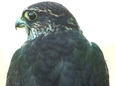
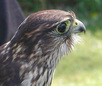
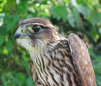
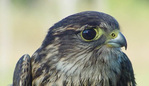
Male merlins have slaty blue, purplish, or dark umber-brown upper parts, streaked with black from the crown to shoulders and back. The tail is barred by dark umber-brown or blackish bands and is tipped in white. The underparts are cream to a rich buff with heavy longitudinally streaks of dark umber-brown or black coloration, except for the throat which is an unmarked white. The sides of the head are buff with fine darker streakings. The forehead and line above the eye is white. The beak is bluish horn; the cere and feet are chromo yellow; the claws are black; and the iris is deep brown.
Females and young are similiar to males in their markings, but differ from males in coloration. The upperparts are dark brown. The neck is streaked with lighter brown and the tail is banded in yellow bars with a white tip.
Falco columbarius bendirei (Bendire's merlins): Lighter in the upper parts than Falco columbarius columbarius. The tail is black with three white bars.
Falco columbarius columbarius (American merlins): (see description of Falco columbarius). In males, the cere and feet turn reddish with age.
Falco columbarius richardsoni (Richardson's merlins): Lighter overall coloration and the tail is marked by five dark and six white bands.
Falco columbarius suckleyi (Black pigeon hawks): Darker in overall coloration than Falco columbarius columbarius. The throat of males is streaked with black markings, while the lower body parts are brownish-black with chestnut and white markings. The lower parts of young males and females are heavily marked with dusky coloration and the spotting is either faint or absent from the wings.
- Other Physical Features
- endothermic
- homoiothermic
- bilateral symmetry
- Sexual Dimorphism
- sexes colored or patterned differently
-
- Average mass
- 195 g
- 6.87 oz
- AnAge
-
- Range length
- 25 to 33 cm
- 9.84 to 12.99 in
-
- Range wingspan
- 60 to 68 cm
- 23.62 to 26.77 in
Reproduction
Males arrive to the breeding area before the females, usually returning to the same general area year after year. Nesting pairs don't necessarily use the same actual site each year. In open country and grassland, nests are generally scrapes located in dense vegetation. In regions of sand dunes, dune grasses may be used to create a nest. Even in wooded areas, nests may be scrapes, but empty crow nests are preferred. During the nesting period, Falco columbarius become highly aggressive towards other raptors and crows in the area. This aggressive behavior towards other predatory birds is beneficial to other woodland song and ground birds in the nesting range; since Falco columbarius hunts only in open country, thereby leaving the woodland birds relatively free from predators during the mating season. Normally the nest contains four to six eggs measuring 1.5 x 1.22 inches. The eggs are laid at two-day intervals. The coloration of the round oval eggs are variations of light buff white almost obscured by a regular pattern of rich chestnut-brown, purple and chocolate blotchings.
The eggs are laid in early April to early May in the southern ranges and in late May through June in the North. The female is the main incubator, although the male does share in the duties. The incubation period lasts 25-32 days. At the end of the incubation period, the eggs hatch in intervals.
Quills appear on the young after fourteen days, and by eighteen days the down is almost completely covered with feathers, except in the head region. Flight is achieved at 25-30 days after hatching.
Upon leaving the nest, the young remain nearby for several weeks until they are mature enough to migrate southward. Within a week's time of leaving the nest, the young are capable of distance flights, and at two weeks' time, they begin to catch insects. By six weeks the young are skilled in catching small birds, and shortly afterwards, they migrate southward from the breeding area. The success rate among the the young is exceptionally high, often three birds per nest survive to continue breeding.
Falco columbarius: Breeds throughout northern Europe, Asia and North America.
Falco columbarius bendirei: Breeds in northwestern Alaska to northern Saskatchewan and into northern California.
Falco columbarius columbarius: Breeds in eastern Canada to the eastern border of the Great Plains and southwards into Nova Scotia and northern Michigan.
Falco columbarius richardsoni: Breeding range is located in the Great Plains from southern Alberta and Saskatchewan to northern Montana and North Dakota.
Falco columbarius suckleyi: Breeding occurs only in western British Columbia and perhaps on Vancouver Island.
- Key Reproductive Features
- iteroparous
- seasonal breeding
- gonochoric/gonochoristic/dioecious (sexes separate)
- sexual
- oviparous
-
- Breeding interval
- Merlins breed once yearly.
-
- Breeding season
- Merlins breed from April to July, depending on the latitude.
-
- Range eggs per season
- 4 to 6
-
- Average eggs per season
- 5
- AnAge
-
- Range time to hatching
- 25 to 32 days
-
- Average time to independence
- 6 weeks
Lifespan/Longevity
-
- Average lifespan
Status: wild - 143 months
- Bird Banding Laboratory
- Average lifespan
Behavior
Falco columbarius is not a social bird except in the mating season. During this period, the male and female share duties in raising the young. During incubation, the female remains on the nest while the male does the hunting. Rarely does the male visit the nest, often leaving the prey nearby for the female to retrieve. When the young are older, both male and female share hunting duties. Once the young leave for good, presumably the male and female return to their solitary life style. Flight (similiar to the flight of the swallow) is fast with steady wingbeats, often skimming in a low zigzagging pattern over the ground. Falco columbarius seldom soars. The call is a series of sharp "ki-ki-ki-ki-kee."
- Key Behaviors
- flies
- motile
Communication and Perception
Food Habits
Merlins prey mainly on small birds of the ground and low vegetation, including larks (Alaudidae), sparrows (Passeridae and Emberizidae), finches (Fringillidae) and ptarmigans and grouse (Tetraoninae). Some small mammals, lizards, snakes, insects, and - in North America - dragonflies, also make up a portion of the diet. The relative proportions are about 80% birds, 5% mammals, and 15% insects.
- Primary Diet
-
carnivore
- eats terrestrial vertebrates
- Animal Foods
- birds
- mammals
- insects
Economic Importance for Humans: Positive
Merlins occasionally prey on agricultural insect pests, such as grasshoppers and crickets. These small falcons are also widely used in falconry. Considered a lady's gaming bird, Falco columbarius is relatively easy to train for small game hunting and usually returned to the wild after a season.
- Positive Impacts
- pet trade
- controls pest population
Economic Importance for Humans: Negative
The diet of Falco columbarius consists mainly of small birds, including many small birds which benefit agriculture and forestry. In the northern the breeding range, Falco columbarius individuals sometimes attack small domestic poultry; however, these attacks are quite rare.
Conservation Status
Falco columbarius is widely distributed, but nowhere common. With expanding human development, the breeding habitats and hunting grounds of these falcons are being destroyed rapidly. This species is listed as threatened in the state of Michigan.
-
- IUCN Red List
-
Least Concern
More information
-
- IUCN Red List
-
Least Concern
More information
-
- US Migratory Bird Act
- Protected
-
- US Federal List
- No special status
-
- CITES
- Appendix II
-
- State of Michigan List
- Threatened
Other Comments
For many years Falco columbarius was considered two, separate species: European merlins, Falco aesalon and American merlins, Falco columbarius. J.L. Peters in 1931 realized that Falco aesalon was a sub-species of Falco columbarius. Currently, Falco columbarius consists of seven European sub-species and four American sub-species: Falco columbarius bendirei, Falco columbarius columbarius, Falco columbarius richardsoni, and Falco columbarius suckleyi.
Contributors
Tanya Dewey (editor), Animal Diversity Web.
Graham Garett Grove (author), University of Michigan-Ann Arbor.
Glossary
- Nearctic
-
living in the Nearctic biogeographic province, the northern part of the New World. This includes Greenland, the Canadian Arctic islands, and all of the North American as far south as the highlands of central Mexico.

- Neotropical
-
living in the southern part of the New World. In other words, Central and South America.
- Palearctic
-
living in the northern part of the Old World. In otherwords, Europe and Asia and northern Africa.
- acoustic
-
uses sound to communicate
- bilateral symmetry
-
having body symmetry such that the animal can be divided in one plane into two mirror-image halves. Animals with bilateral symmetry have dorsal and ventral sides, as well as anterior and posterior ends. Synapomorphy of the Bilateria.
- carnivore
-
an animal that mainly eats meat
- chaparral
-
Found in coastal areas between 30 and 40 degrees latitude, in areas with a Mediterranean climate. Vegetation is dominated by stands of dense, spiny shrubs with tough (hard or waxy) evergreen leaves. May be maintained by periodic fire. In South America it includes the scrub ecotone between forest and paramo.
- chemical
-
uses smells or other chemicals to communicate
- coastal
-
the nearshore aquatic habitats near a coast, or shoreline.
- desert or dunes
-
in deserts low (less than 30 cm per year) and unpredictable rainfall results in landscapes dominated by plants and animals adapted to aridity. Vegetation is typically sparse, though spectacular blooms may occur following rain. Deserts can be cold or warm and daily temperates typically fluctuate. In dune areas vegetation is also sparse and conditions are dry. This is because sand does not hold water well so little is available to plants. In dunes near seas and oceans this is compounded by the influence of salt in the air and soil. Salt limits the ability of plants to take up water through their roots.
- endothermic
-
animals that use metabolically generated heat to regulate body temperature independently of ambient temperature. Endothermy is a synapomorphy of the Mammalia, although it may have arisen in a (now extinct) synapsid ancestor; the fossil record does not distinguish these possibilities. Convergent in birds.
- holarctic
-
a distribution that more or less circles the Arctic, so occurring in both the Nearctic and Palearctic biogeographic regions.
Found in northern North America and northern Europe or Asia.
- iteroparous
-
offspring are produced in more than one group (litters, clutches, etc.) and across multiple seasons (or other periods hospitable to reproduction). Iteroparous animals must, by definition, survive over multiple seasons (or periodic condition changes).
- marsh
-
marshes are wetland areas often dominated by grasses and reeds.
- motile
-
having the capacity to move from one place to another.
- native range
-
the area in which the animal is naturally found, the region in which it is endemic.
- oriental
-
found in the oriental region of the world. In other words, India and southeast Asia.
- oviparous
-
reproduction in which eggs are released by the female; development of offspring occurs outside the mother's body.
- pet trade
-
the business of buying and selling animals for people to keep in their homes as pets.
- seasonal breeding
-
breeding is confined to a particular season
- sexual
-
reproduction that includes combining the genetic contribution of two individuals, a male and a female
- tactile
-
uses touch to communicate
- taiga
-
Coniferous or boreal forest, located in a band across northern North America, Europe, and Asia. This terrestrial biome also occurs at high elevations. Long, cold winters and short, wet summers. Few species of trees are present; these are primarily conifers that grow in dense stands with little undergrowth. Some deciduous trees also may be present.
- temperate
-
that region of the Earth between 23.5 degrees North and 60 degrees North (between the Tropic of Cancer and the Arctic Circle) and between 23.5 degrees South and 60 degrees South (between the Tropic of Capricorn and the Antarctic Circle).
- terrestrial
-
Living on the ground.
- tropical savanna and grassland
-
A terrestrial biome. Savannas are grasslands with scattered individual trees that do not form a closed canopy. Extensive savannas are found in parts of subtropical and tropical Africa and South America, and in Australia.
- savanna
-
A grassland with scattered trees or scattered clumps of trees, a type of community intermediate between grassland and forest. See also Tropical savanna and grassland biome.
- temperate grassland
-
A terrestrial biome found in temperate latitudes (>23.5° N or S latitude). Vegetation is made up mostly of grasses, the height and species diversity of which depend largely on the amount of moisture available. Fire and grazing are important in the long-term maintenance of grasslands.
- visual
-
uses sight to communicate
References
Brown, Leslie and Amadon, Dean, EAGLES, HAWKS AND FALCONS OF THE WORLD (vol. II), McGraw-Hill Book Company, New York, 1968.
Bruun,Bertel and Robbins, Chandler S. and Zim, Hebert S., A GUIDE TO IDENTIFICATION: BIRDS OF NORTH AMERICA, Golden Press, New York, 1983.
Burton,Maurice, NEW LAROUSSE ENCYCLOPEDIA OF ANIMAL LIFE, Bonanza, Hong Kong, 1987.
Grossman, Mary Louise and Hamlet, John, BIRDS OF PREY OF THE WORLD, Clarkson N. Potter, New York, 1964.
MacKenzie, John P.S., BIRDS OF PREY, Paper Birch Press, Ashland, WI, 1986.
May, John Bichard, THE HAWKS OF NORTH AMERICA, The National Association of Aububon Societies, New York, 1935.
Pearson, T. Gilbert, BIRDS OF AMERICA, Garden City Publishing Company, Garden City, New York, 1936.
Sprunt, Alexander Jr., NORTH AMERICAN BIRDS OF PREY, Harper and Brothers, New York, 1955.
Whitfield, Dr. Philip, MACMILLAN ILLUSTRATED ANIMAL ENCYCLOPEDIA, Macmillan, New York, 1984.