Eumops bonariensisdwarf bonneted bat
Geographic Range
The range of the mastiff bat, or Eumops bonariensis, extends from Veracruz, Mexico, through Central America and into South America. In southern South America mastiff bats are found throughout Paraguay, sections of Uruguay, and as far south as the Buenos Aires province in Argentina. Mastiff bats have only been found in the lowlands throughout this range. (Redford and Eisenburg 1992, Reid 1997)
- Biogeographic Regions
- neotropical
Habitat
Eumops bonariensis individuals are found at low elevations in dry, deciduous tropical forests as well as thorn scrub. (Eisenburg 1989, Nowak 1999, Reid 1997)
- Terrestrial Biomes
- forest
- scrub forest
Physical Description
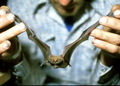
Eumops bonariensis is the smallest of the eight species which comprise the genus Eumops. Mastiff bats have agouti hair coloring. The base of each hair is pale while the tips are frosted. Bristles are not located on the rump but some short hairs can be found on the calcar, which is the bone that gives structure to the membrane between the tail and the hind foot. The snout is broad and flat with a few slight wrinkles on the lips. Their large ears are rounded and, when laid forward, touch the tip of the nose. The fur is soft and somewhat long (5mm). The dorsal side is gray-brown or brown whereas the ventral side is gray-brown. Little else is known specifically about this species but many physical traits are common to all Eumops species. Each species in this genus have a thick head with a broad muzzle. The eyes of Eumops are small compared to species of bats from other genera. Eumops have legs which are short, strong, and muscular with broad feet and a well developed fibula. The wings of Eumops are long, flat, and narrow giving them a high-aspect ratio. The dental formula for the genus is I:1/2,C:1/1,P:2/2, and M:3/3. Measurements (in mm) specifically for E. bonariensis are: head-body length 49-68, tail 28-47, hind foot 6-11, ear 12-19, and forearm 39-48. (Anderson and Jones 1984, Emmons and Feer 1990, Eisenburg 1989, Kunz 1982, Nowak 1999, Redford and Eisenburg 1992, Reid 1997)
- Other Physical Features
- endothermic
- bilateral symmetry
-
- Range mass
- 7 to 13 g
- 0.25 to 0.46 oz
Reproduction
Information specifically about the reproduction of mastiff bats is not well known. However, members of the family Molossidae typically have 1 young and breed once each year. Breeding occurs before ovulation, which occurs in the late winter or early spring. Gestation lasts 70-90 days. The resulting offspring weigh 3-4g but typically do not exceed 22% of the adult weight. (Grzimek 1989, Nowak 1999)
- Key Reproductive Features
- gonochoric/gonochoristic/dioecious (sexes separate)
- sexual
Behavior
Eumops bonariensis individuals prefer to roost in tree holes and in the iron roofs of man-made buildings. They are considered common house bats in Paraguay. Activity peaks within 2 hours of sunset and then again before dawn. Eumops typically fly as fast as 65 km/hr but may reach as fast as 95 km/hr in groups. These bats live in groups that usually consist of 10-20 bats at least 6 meters off the ground. The bats of this genus roost high enough to gain the speed for flight required by their long narrow wings as each bat drops out of the roost. (Anderson and Jones 1984, Emmons and Feer 1990, Nowak 1999, Redford and Eisenburg 1992, Reid 1997)
- Key Behaviors
- motile
Communication and Perception
Food Habits
The diet of mastiff bats consists of larger, hard-shelled insects, particularly beetles, as well as moths. Eumops are specialized for rapid aerial pursuit of these insects. The long narrow wings and the ability to retract their tail membrane allow the bats in this genus to reduce drag and enhance speed. Eumops have rapid and relatively straight flight compared to that of other insectivorous bats. Laterally placed eyes and ears give Eumops a wide field of perception, which aids in capturing prey. All Eumops emit echolocation "chirps" which are audible to humans. This system allows Eumops to locate prey and then catch it in mid-flight. (Emmons and Feer 1990, Findley 1993, Macdonald 1993, Nowak 1999, Redford and Eisenburg 1992, Reid 1997)
Economic Importance for Humans: Positive
Positive benefits to humans unknown.
Economic Importance for Humans: Negative
Negative effects on humans unknown.
Conservation Status
Status is unknown.
-
- IUCN Red List
-
Least Concern
More information
Other Comments
Although fairly common throughout its range, the biology of Eumops bonariensis is not well understood.
Contributors
John Labbe (author), St. Lawrence University, Erika Barthelmess (editor), St. Lawrence University.
Glossary
- Neotropical
-
living in the southern part of the New World. In other words, Central and South America.

- bilateral symmetry
-
having body symmetry such that the animal can be divided in one plane into two mirror-image halves. Animals with bilateral symmetry have dorsal and ventral sides, as well as anterior and posterior ends. Synapomorphy of the Bilateria.
- chemical
-
uses smells or other chemicals to communicate
- endothermic
-
animals that use metabolically generated heat to regulate body temperature independently of ambient temperature. Endothermy is a synapomorphy of the Mammalia, although it may have arisen in a (now extinct) synapsid ancestor; the fossil record does not distinguish these possibilities. Convergent in birds.
- forest
-
forest biomes are dominated by trees, otherwise forest biomes can vary widely in amount of precipitation and seasonality.
- motile
-
having the capacity to move from one place to another.
- native range
-
the area in which the animal is naturally found, the region in which it is endemic.
- scrub forest
-
scrub forests develop in areas that experience dry seasons.
- sexual
-
reproduction that includes combining the genetic contribution of two individuals, a male and a female
- tactile
-
uses touch to communicate
References
Anderson, S., J. Jones, Jr.. 1984. Orders and families of recent mammals of the world. New York: Wiley.
Eisenberg, J. 1989. Mammals of the Neotropics. Chicago: University of Chicago Press.
Emmons, L., F. Feer. 1990. Neotropical rainforest mammals : a field guide. Chicago: University of Chicago Press.
Findley, J. 1993. Bats : a community perspective. New York: Cambridge University Press.
Grzimek, B. 1989. Grzimek's encyclopedia of mammals. New York: McGraw-Hill.
Kunz, T. 1982. Ecology of bats. New York: Plenum Press.
Macdonald, D. 1984. The Encyclopedia of mammals. New York: Facts on File.
Nowak, R. 1999. Walker's mammals of the world. Baltimore: Johns Hopkins University Press.
Redford, K., J. Eisenburg. 1989. Mammals of the Neotropics. Chicago: University of Chicago Press.
Reid, F. 1997. A field guide to the mammals of Central America & Southeast Mexico. New York: Oxford University Press.