Eschrichtius robustusgray whale
Geographic Range
Gray whales occur in the eastern and western north Pacific. Eastern north Pacific gray whales use shallow arctic feeding grounds during the summer, which are located in the Bering and Chukchi Seas. During the fall, they migrate south along the west coast of North America to their winter calving grounds, located in the warm waters off coast of Baja California. Four specific locations have been identified as important calving grounds for eastern gray whales: Laguna Ojo de Liebre, Guerrero Negro, Bahia Magdalena, and Laguna San Ignacio. Eastern gray whales are often seen during migration, off the western shores of the United States and British Colombia. During the return migration in the spring, a small population of about 80 individuals remains in more southerly Canadian waters. Relative to their eastern counterparts, western Pacific gray whales are poorly understood and are often referred to as the Korean, Western Pacific, or Okhotsk Sea stock. Their feeding grounds extend from the Okhotsk Sea, south along the east coast of Russia to the southern tip of south Korea. During the fall, they likely migrate to the South China Sea to give birth to young in sheltered lagoons and bays along the southern Chinese coast. However, this has not been well documented, as fewer studies have focused on this population. ("COSEWIC Assessment and Status Report on the Grey Whale Eschrichtius robustus Eastern North Pacific Population in Canada", 2004; Bryant, 1995; Clapham, et al., 1999; Jones, et al., 1984; Rice, et al., 1984; Sullivan, et al., 1983; Reilly, et al., 2008)
A third north Atlantic gray whale population existed as recently as the 1700's and was described by whalers and colonists in North America, Iceland, Great Britain and Scandinavia. They have since been extirpated from the north Atlantic, likely due to over-hunting by whalers along with other anthropogenic influences (e.g., coastal development in their former calving grounds). ("COSEWIC Assessment and Status Report on the Grey Whale Eschrichtius robustus Eastern North Pacific Population in Canada", 2004; Bryant, 1995; Clapham, et al., 1999; Jones, et al., 1984; Rice, et al., 1984; Sullivan, et al., 1983; Reilly, et al., 2008)
- Biogeographic Regions
- nearctic
- palearctic
- oriental
- arctic ocean
- pacific ocean
Habitat
Gray whales feed in shallow coastal waters with muddy or sandy bottoms. They are migratory and rely on a variety of coastal habitats. During summer, they stay in waters of up to 60 m in depth and within 0.5 km to 166 km of shore. During fall, eastern gray whales migrate along the west coast of North America and spend winter in waters of less than 4 m in depth. These waters tend to be hyper-saline and are between 15 and 20 degrees C. Winter calving grounds usually have muddy or sandy bottoms and may contain eelgrass beds or be adjacent to mangrove swamps. ("COSEWIC Assessment and Status Report on the Grey Whale Eschrichtius robustus Eastern North Pacific Population in Canada", 2004; "Eschrichtius robustus, Gray Whale", 1998; Jones, et al., 1984)
- Habitat Regions
- temperate
- tropical
- polar
- saltwater or marine
-
- Range depth
- < 4 to 60 m
- to 196.85 ft
Physical Description
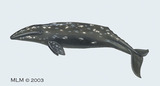
Gray whales have mottled gray backs, a trait shared among several mysticete species. They are often hosts to dense infestations of skin parasites (e.g., barnacles and orange whale lice) that give their skin a rough and patchy appearance. In gray whales, these parasites often cover the entire body, however, in other baleen whales (right whales, Eubalaena australis and humpback whales, Megaptera novaeangliae), infestations are limited to specific areas of the body. Gray whale calves weigh between 500 kg and 600 kg at birth and are about 4.6 m in length. Adult females are slightly larger than males and are between 11.7 m and 15.2 m. Males are between 11.1 m and 14.3 m in length. Gray whales can weigh as much as 36,000 kg. ("COSEWIC Assessment and Status Report on the Grey Whale Eschrichtius robustus Eastern North Pacific Population in Canada", 2004; "Eschrichtius robustus, Gray Whale", 1998; Jones, et al., 1984; Rice, et al., 1984)
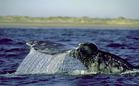
Unlike humpback whales (Megaptera novaeangliae), with which they are commonly confused, gray whales do not have dorsal fins. Rather, they have a large hump at the anterior end of the tail stock, followed by 7 to 15 knobs or knuckles of decreasing size. Gray whales have small, paddle-shaped flippers, compared to the large white flippers of humpback whales. The caudal fin has 2 wide, gray flukes separated by a deep notch. Their upper jaw extends past the lower jaw, and they have 2 to 5 throat pleats, which allow the mouth and throat to expand while feeding. Adults have 130 to 180 cream-colored baleen plates that are 5 to 25 cm in length. ("COSEWIC Assessment and Status Report on the Grey Whale Eschrichtius robustus Eastern North Pacific Population in Canada", 2004; "Eschrichtius robustus, Gray Whale", 1998; Jones, et al., 1984; Rice, et al., 1984)
- Other Physical Features
- endothermic
- homoiothermic
- bilateral symmetry
- Sexual Dimorphism
- female larger
-
- Range mass
- 36000 (high) kg
- 79295.15 (high) lb
-
- Range length
- 11.1 to 15.2 m
- 36.42 to 49.87 ft
Reproduction
Although little is known of gray whale mating behavior, group mating events of three or more individual have been documented. Gray whales have a high reproductive rate, relative to other baleen whales. ("COSEWIC Assessment and Status Report on the Grey Whale Eschrichtius robustus Eastern North Pacific Population in Canada", 2004)
- Mating System
- polygynandrous (promiscuous)
Gray whales mate throughout the year, however, most conceptions occur during the fall migration. After 13 to 14 months of gestation, females give birth to a single calf (one occurrence of twin fetuses was reported in 1987), which nurses until it is 6 to 7 months old. Eastern gray whale calves are born in late January in the warm coastal waters of Baja California, Mexico; however, early calving during the fall migration has been documented. Although less information is available for western gray whales, their winter calving grounds are thought to be along the coast of the South China Sea and likely have characteristics that are similar to the calving grounds of their eastern counterparts. Calving grounds are typically in shallow lagoons that are less than 4 m in depth and are hyper-saline. Preference for shallow water during calving may have contributed to the extirpation of the north Atlantic population in the mid 1700's. ("COSEWIC Assessment and Status Report on the Grey Whale Eschrichtius robustus Eastern North Pacific Population in Canada", 2004; Sund, 1975)
Sexual maturation in gray whales occurs around 8 years of age, but has been documented in individuals as young as 5 and as old as 11. Nevertheless, studies suggest that size may be a better indicator of sexual maturity than age. Males average 11.1 m in length at time of sexual maturation and females average 11.7 meters. Sixty percent of the population consists of sexually mature adults. The average generation length (number of years between an individual's birth and the age at which they give birth) for gray whales is 22 years. ("COSEWIC Assessment and Status Report on the Grey Whale Eschrichtius robustus Eastern North Pacific Population in Canada", 2004; "Eschrichtius robustus, Gray Whale", 1998; "Observed and Maximum Rates of Increase in Gray Whales, Eschrichtius robustus", 1984; Rice, et al., 1984; Sumich and Harvey, 1986)
- Key Reproductive Features
- iteroparous
- seasonal breeding
- year-round breeding
- gonochoric/gonochoristic/dioecious (sexes separate)
- sexual
- viviparous
-
- Breeding interval
- Every other year
-
- Breeding season
- Year round mating with most conceptions occuring in late November to early December
-
- Range number of offspring
- 1 (high)
-
- Range gestation period
- 13 to 14 months
-
- Range weaning age
- 6 to 7 months
-
- Average time to independence
- unknown years
-
- Range age at sexual or reproductive maturity (female)
- 5 to 11 years
-
- Range age at sexual or reproductive maturity (male)
- 5 to 11 years
Gray whales replenish fat reserves during the summer. Pregnant females are especially dependent on these reserves. From the time they leave the summer feeding grounds in the fall, to when they return in early summer, females rely on fat reserves for energy and milk production. During times of limited food availability, interval between individual calving events may be extended. ("COSEWIC Assessment and Status Report on the Grey Whale Eschrichtius robustus Eastern North Pacific Population in Canada", 2004; Jones, et al., 1984; Sullivan, et al., 1983)
Gray whale cows often hold newborn calves to the surface to help them breathe and are fiercely defensive of their young, especially against potential predators such as orcas (Orcinus orca) and human whalers. Gray whales inherit their mother's feeding grounds and are often seen, 1 year after they become independent, in their mother's feeding grounds. ("COSEWIC Assessment and Status Report on the Grey Whale Eschrichtius robustus Eastern North Pacific Population in Canada", 2004; Jones, et al., 1984; Sullivan, et al., 1983)
- Parental Investment
- precocial
- female parental care
-
pre-hatching/birth
-
provisioning
- female
-
provisioning
-
pre-weaning/fledging
-
provisioning
- female
-
protecting
- female
-
provisioning
-
pre-independence
-
provisioning
- female
-
protecting
- female
-
provisioning
- inherits maternal/paternal territory
Lifespan/Longevity
Information on the lifespan of gray whales is limited, however, estimates range from 25 to 80 years old. Mortality rates are highest for young gray whales with an average annual calf mortality of 5.4%. About 75% of first-year mortalities occur during the first 2 weeks after birth. Mortality records indicate that calves represent about 91% of deaths at winter calving grounds, followed by yearlings (0 to 19.5%) and adults (0 to 5%). Annual adult mortality is estimated to be between 0.1 and 5% per year. Due to their large size and consequent feeding requirements, gray whales cannot be held in captivity. ("COSEWIC Assessment and Status Report on the Grey Whale Eschrichtius robustus Eastern North Pacific Population in Canada", 2004; Jones, et al., 1984; Rice, et al., 1984; Sumich and Harvey, 1986)
-
- Range lifespan
Status: wild - 25 to 80 years
- Range lifespan
Behavior
Gray whales prefer to stay close to shore. As a result, they are one of the more recognizable whale species. They are often observed from shore during migration and have been known to come within arm’s length of many whale-watching boats. They have regular and predictable breathing patterns, exhaling 3 to 5 times from their blowhole, about 15 to 30 seconds apart. Prior to diving, they raise their tail flukes out of the water, after which they may stay submerged for as long as 15 minutes. ("COSEWIC Assessment and Status Report on the Grey Whale Eschrichtius robustus Eastern North Pacific Population in Canada", 2004; "Eschrichtius robustus, Gray Whale", 1998; Jones, et al., 1984; Sund, 1975)
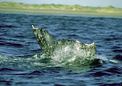
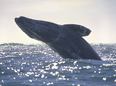
Like many whale species, gray whales practice “spyhopping”, which involves lifting their heads out of the water, while exposing the entire rostrum for several minutes at a time. Individuals may spyhop while looking for predators or fellow whales. Gray whales also “breach” (jumping into the air and splashing down on their side or back, also known as lunging or cresting), which has been interpreted as a form of communication, an attempt to remove skin parasites, and a form of play. Gray whales often feed close to shore in very shallow waters, which may lead to the appearance of an individual being stranded. ("COSEWIC Assessment and Status Report on the Grey Whale Eschrichtius robustus Eastern North Pacific Population in Canada", 2004; "Eschrichtius robustus, Gray Whale", 1998; Jones, et al., 1984; Sund, 1975)
Gray whale cows are fiercely protective of their young. Historical accounts of whalers who attempted to exploit their calving lagoons, frequently referred to cows as "Devilfish". They are also referred to as "mussel diggers" for their bottom feeding behavior. ("COSEWIC Assessment and Status Report on the Grey Whale Eschrichtius robustus Eastern North Pacific Population in Canada", 2004; "Eschrichtius robustus, Gray Whale", 1998; Jones, et al., 1984; Sund, 1975)
- Key Behaviors
- natatorial
- motile
- migratory
Home Range
Although little is known of their actual home range size, gray whales annually migrate between their polar summer feeding grounds and their temperate to tropical calving grounds. They have one of the longest migrations of any mammal species, traveling from 16,000 to 22,530 km per year. During migration, they swim at a steady speed of 4.8 to 9.6 km per hour. ("COSEWIC Assessment and Status Report on the Grey Whale Eschrichtius robustus Eastern North Pacific Population in Canada", 2004; "Eschrichtius robustus, Gray Whale", 1998)
Communication and Perception
Little is known about perception and communication in gray whales. Most whales communicate using a variety of high and low frequency "whale songs", including prolonged deep moans. Evidence suggests that gray whales use a simple array of short pulses and moans. Short pulses may be used for basic echolocation. ("COSEWIC Assessment and Status Report on the Grey Whale Eschrichtius robustus Eastern North Pacific Population in Canada", 2004; Wursig, 1989)
- Communication Channels
- acoustic
- Other Communication Modes
- choruses
- Perception Channels
- visual
- tactile
- acoustic
- echolocation
- chemical
Food Habits
Gray whales are mysticetes (i.e., filter feeders) and are the only large cetacean known primarily as bottom feeders. They feed in shallow water with muddy or sandy bottoms or in kelp beds. To feed, they dive to the ocean floor and fill their mouths with a large volume of sediment. They force the sediment through their baleen plates, which trap a wide variety of crustaceans (Crustacea) including amphipods (Amphipoda) and ghost shrimp (Neotrypaea californiensis), as well as polychaete worms (Polychaeta), herring eggs (Clupea pallasii) and various forms of larvae. Food items are scraped off baleen plates with their large tongue and ingested. ("COSEWIC Assessment and Status Report on the Grey Whale Eschrichtius robustus Eastern North Pacific Population in Canada", 2004; Heyning and Mead, 1997; Obst and Hunt, 1990; Oliver and Slattery, 1985; Rice, et al., 1984; Sund, 1975; Weitcamp, et al., 1992)
Gray whales are considered opportunistic feeders and use group feeding strategies on schools of small fish during their southern migration. During feeding episodes, three to four whales corral a school of fish, as a single whale swims up through the school with its mouth agape. The head of the feeding whale emerges out of the water and remains in this position for up to a few minutes. Each whale in the group repeats this process until the school of fish has been significantly depleted. ("COSEWIC Assessment and Status Report on the Grey Whale Eschrichtius robustus Eastern North Pacific Population in Canada", 2004; Heyning and Mead, 1997; Obst and Hunt, 1990; Oliver and Slattery, 1985; Rice, et al., 1984; Sund, 1975; Weitcamp, et al., 1992)
- Primary Diet
-
carnivore
- piscivore
- eats eggs
- eats non-insect arthropods
- molluscivore
- vermivore
- eats other marine invertebrates
- Animal Foods
- fish
- eggs
- mollusks
- aquatic or marine worms
- aquatic crustaceans
- cnidarians
- other marine invertebrates
- zooplankton
- Foraging Behavior
- filter-feeding
Predation
The only non-human predator of gray whales is the killer whale, also known as the orca (Orcinus orca). Nearly 18% of all gray whales show evidence of orca attack, with juveniles being the most vulnerable. Orca’s hunt in pods and can separate a calf from its mother. Once separated from its mother, the orca pod drowns the calf by holding on to its flippers and tail flukes with their teeth. Adult gray whales often place themselves between their calf and potential predators. When under attack, adults may also swim toward shallow water or kelp beds, where orcas typically do not enter. ("COSEWIC Assessment and Status Report on the Grey Whale Eschrichtius robustus Eastern North Pacific Population in Canada", 2004; Baldridge, 1972; Darling and Taber, 2001)
-
- Known Predators
-
- Killer Whales (Orcinus orca)
- Humans (Homo sapiens)
Ecosystem Roles
Gray whales are hosts to many endo- and ecto-parasites, including barnacles and whale lice. They are major predators of benthic amphipods (Amphipoda) and other marine invertebrates, including ghost shrimp (Palaemonetes). It is not known if gray whales contribute a significant degree of top down control on these prey species. Gray whales are primarily bottom feeders that disrupt muddy ocean bottoms, leaving feeding pits that are then colonized by other organisms. During feeding events, large mud plumes follow whales to the surface, carrying with them many invertebrates that are then eaten by sea birds and fish. Birds commonly associated with gray whales include northern fulmars (Fulmarus glacialis), red phalaropes (Phalaropus fulicarius), black-legged kitti-wakes (Rissa tridactyla), and thick-billed murres (Uria lomvia). Gray whales also eat herring eggs and spawn (Clupea pallasii) along their coastal migration routes and are considered to be opportunistic feeders that also feed upon schools of small baitfish. ("COSEWIC Assessment and Status Report on the Grey Whale Eschrichtius robustus Eastern North Pacific Population in Canada", 2004; "Eschrichtius robustus, Gray Whale", 1998; Obst and Hunt, 1990; Oliver and Slattery, 1985; Rice, et al., 1984; Sund, 1975; Weitcamp, et al., 1992)
- Ecosystem Impact
- creates habitat
- soil aeration
- barnacles, (Cryptolepas rhachianecti)
- cyamids, (Cyamus)
- trematode, (Ogmogaster antarcticus)
- trematode, (Ogmogaster pentalineatus)
- trematode, (Lecithodesmus goliath)
- spiny-headed worms, (Acanthocephala)
- nematodes, (Anisakis simplex)
- northern fulmar, (Fulmarus glacialis)
- red phalarope, (Phalaropus fulicarius)
- black-legged kitti-wake, (Rissa tridactyla)
- thick-billed murre, (Uria lomvia)
Economic Importance for Humans: Positive
Gray whales have been hunted for thousands of years by indigenous populations along the coasts of North America and Russia. Commercial whaling for baleen, blubber, oil, and meat has occurred sporadically since 1900; however, over the past 400 years over-hunting has significantly decreased gray whale abundance. Although commercial whaling is illegal, indigenous subsistence hunting is allowed in North America and Russia. Finally, ecotourism and whale watching are important components of local economies along gray whale migratory routes. ("COSEWIC Assessment and Status Report on the Grey Whale Eschrichtius robustus Eastern North Pacific Population in Canada", 2004; "Draft Environmental Assessment on Issuing a Quota to the Makah Indian Tribe for a Subsistance Hunt on Gray Whales for the Years 2001 and 2002", 2001; Darling and Taber, 2001; Jones, et al., 1984)
- Positive Impacts
- food
- body parts are source of valuable material
- ecotourism
- research and education
Economic Importance for Humans: Negative
Gray whales have no known negative impact on humans; however, future conservation efforts may limit costal development. ("COSEWIC Assessment and Status Report on the Grey Whale Eschrichtius robustus Eastern North Pacific Population in Canada", 2004; Clapham, et al., 1999)
Conservation Status
In 2003, the International Whaling Commission (IWC) established an indigenous hunting limit of 620 gray whales over five years, with no more than 140 individuals to be taken in a single year. In 2005, the IWC estimated that 400 individuals could be sustainably taken in any one year. Additionally, the major breeding lagoons of the eastern Pacific population are protected by their inclusion in the El Vizcaino Biosphere Reserve, limiting disturbances from boating, fishing, and coastal development. ("COSEWIC Assessment and Status Report on the Grey Whale Eschrichtius robustus Eastern North Pacific Population in Canada", 2004; "Observed and Maximum Rates of Increase in Gray Whales, Eschrichtius robustus", 1984; "U.S. Fish and Wildlife Service - Species Profile (Gray Whale, Eschrichtius robustus)", 1994; Bryant, 1995; Clapham, et al., 1999; Jones, et al., 1984; Reilly, et al., 2008)
The Committee on the Status of Endangered Wildlife in Canada designated the eastern north Pacific gray whale as a species of "Special Concern". After international protection from commercial whaling, gray whale populations experienced a 2.5% annual growth increase until 1998, when the population peaked at around 27,000 individuals. Over the following four years, however, the population declined by more than a third, possibly due to a lack of food in their summer feeding grounds. Since 2002, the eastern north Pacific gray whale population has steadily increased. The United States Fish and Wildlife Service lists the western north Pacific gray whale population as "endangered" and indicates that the eastern north Pacific stock was delisted in 1994. When the western and eastern Pacific populations are considered a single population, the IUCN considers them as a species of "Least Concern". However, the western Pacific population is separately listed as “critically endangered”. ("COSEWIC Assessment and Status Report on the Grey Whale Eschrichtius robustus Eastern North Pacific Population in Canada", 2004; "Observed and Maximum Rates of Increase in Gray Whales, Eschrichtius robustus", 1984; "U.S. Fish and Wildlife Service - Species Profile (Gray Whale, Eschrichtius robustus)", 1994; Bryant, 1995; Clapham, et al., 1999; Jones, et al., 1984; Reilly, et al., 2008)
-
- IUCN Red List
-
Critically Endangered
More information
-
- IUCN Red List
-
Critically Endangered
More information
-
- US Federal List
- Endangered
-
- CITES
- Appendix I
-
- State of Michigan List
- No special status
Contributors
Travis Kidd (author), Northern Michigan University, Alec Lindsay (editor), Northern Michigan University, John Berini (editor), Animal Diversity Web Staff, Tanya Dewey (editor), University of Michigan-Ann Arbor.
Glossary
- Arctic Ocean
-
the body of water between Europe, Asia, and North America which occurs mostly north of the Arctic circle.
- Nearctic
-
living in the Nearctic biogeographic province, the northern part of the New World. This includes Greenland, the Canadian Arctic islands, and all of the North American as far south as the highlands of central Mexico.

- Pacific Ocean
-
body of water between the southern ocean (above 60 degrees south latitude), Australia, Asia, and the western hemisphere. This is the world's largest ocean, covering about 28% of the world's surface.
- Palearctic
-
living in the northern part of the Old World. In otherwords, Europe and Asia and northern Africa.
- acoustic
-
uses sound to communicate
- benthic
-
Referring to an animal that lives on or near the bottom of a body of water. Also an aquatic biome consisting of the ocean bottom below the pelagic and coastal zones. Bottom habitats in the very deepest oceans (below 9000 m) are sometimes referred to as the abyssal zone. see also oceanic vent.
- bilateral symmetry
-
having body symmetry such that the animal can be divided in one plane into two mirror-image halves. Animals with bilateral symmetry have dorsal and ventral sides, as well as anterior and posterior ends. Synapomorphy of the Bilateria.
- carnivore
-
an animal that mainly eats meat
- chemical
-
uses smells or other chemicals to communicate
- choruses
-
to jointly display, usually with sounds, at the same time as two or more other individuals of the same or different species
- coastal
-
the nearshore aquatic habitats near a coast, or shoreline.
- echolocation
-
The process by which an animal locates itself with respect to other animals and objects by emitting sound waves and sensing the pattern of the reflected sound waves.
- ecotourism
-
humans benefit economically by promoting tourism that focuses on the appreciation of natural areas or animals. Ecotourism implies that there are existing programs that profit from the appreciation of natural areas or animals.
- endothermic
-
animals that use metabolically generated heat to regulate body temperature independently of ambient temperature. Endothermy is a synapomorphy of the Mammalia, although it may have arisen in a (now extinct) synapsid ancestor; the fossil record does not distinguish these possibilities. Convergent in birds.
- female parental care
-
parental care is carried out by females
- filter-feeding
-
a method of feeding where small food particles are filtered from the surrounding water by various mechanisms. Used mainly by aquatic invertebrates, especially plankton, but also by baleen whales.
- food
-
A substance that provides both nutrients and energy to a living thing.
- iteroparous
-
offspring are produced in more than one group (litters, clutches, etc.) and across multiple seasons (or other periods hospitable to reproduction). Iteroparous animals must, by definition, survive over multiple seasons (or periodic condition changes).
- migratory
-
makes seasonal movements between breeding and wintering grounds
- molluscivore
-
eats mollusks, members of Phylum Mollusca
- motile
-
having the capacity to move from one place to another.
- natatorial
-
specialized for swimming
- native range
-
the area in which the animal is naturally found, the region in which it is endemic.
- oriental
-
found in the oriental region of the world. In other words, India and southeast Asia.
- piscivore
-
an animal that mainly eats fish
- polar
-
the regions of the earth that surround the north and south poles, from the north pole to 60 degrees north and from the south pole to 60 degrees south.
- polygynandrous
-
the kind of polygamy in which a female pairs with several males, each of which also pairs with several different females.
- saltwater or marine
-
mainly lives in oceans, seas, or other bodies of salt water.
- seasonal breeding
-
breeding is confined to a particular season
- sexual
-
reproduction that includes combining the genetic contribution of two individuals, a male and a female
- soil aeration
-
digs and breaks up soil so air and water can get in
- tactile
-
uses touch to communicate
- temperate
-
that region of the Earth between 23.5 degrees North and 60 degrees North (between the Tropic of Cancer and the Arctic Circle) and between 23.5 degrees South and 60 degrees South (between the Tropic of Capricorn and the Antarctic Circle).
- tropical
-
the region of the earth that surrounds the equator, from 23.5 degrees north to 23.5 degrees south.
- visual
-
uses sight to communicate
- viviparous
-
reproduction in which fertilization and development take place within the female body and the developing embryo derives nourishment from the female.
- year-round breeding
-
breeding takes place throughout the year
- young precocial
-
young are relatively well-developed when born
- zooplankton
-
animal constituent of plankton; mainly small crustaceans and fish larvae. (Compare to phytoplankton.)
References
Committee on the Status of Endangered Wildlife in Canada. COSEWIC Assessment and Status Report on the Grey Whale Eschrichtius robustus Eastern North Pacific Population in Canada. unknown. Ottawa, Ontario: COSEWIC. 2004.
U.S. Department of Commerce National Oceanic and Atmospheric Administration National Marine Fisheries Service. Draft Environmental Assessment on Issuing a Quota to the Makah Indian Tribe for a Subsistance Hunt on Gray Whales for the Years 2001 and 2002. unknown. United States: U.S. Department of Commerce National Oceanic and Atmospheric Administration National Marine Fisheries Service. 2001.
1998. "Eschrichtius robustus, Gray Whale" (On-line). MarineBio.org. Accessed March 20, 2009 at http://marinebio.org/species.asp?id=279..
International Whaleing Commission. Observed and Maximum Rates of Increase in Gray Whales, Eschrichtius robustus. 8479 Special Issue Six. California: STEPHEN B. REILLY. 1984. Accessed March 31, 2009 at http://swfsc.noaa.gov/publications/CR/1984/8479.PDF.
1994. "U.S. Fish and Wildlife Service - Species Profile (Gray Whale, Eschrichtius robustus)" (On-line). Accessed March 22, 2009 at http://ecos.fws.gov/speciesProfile/SpeciesReport.do?spcode=A02P.
Baldridge, A. 1972. Killer Whales Attack and Eat a Gray Whale. Journal of Mammalogy, 53/4: 898-900. Accessed March 22, 2009 at http://www.jstor.org/stable/1379230.
Bryant, P. 1995. Dating Remains of Gray Whales from the Eastern North Atlantic. Journal of Mammology, 76/3: 857-861. Accessed February 22, 2009 at http://www.jstor.org/stable/1382754.
Clapham, P., S. Young, R. Brownell Jr.. 1999. Baleen whales: conservation issues and the status of the most endangered populations. Mammal Review, 29/1: 35-60. Accessed March 29, 2009 at http://www3.interscience.wiley.com/cgi-bin/fulltext/119075248/PDFSTART.
Darling, J., A. Taber. 2001. Gray Whale. Pp. 256-261 in D MacDonald, ed. The Encyclopedia of Mammals. Oxfordshire, United Kingdom: Andromeda Oxford Limited.
Goerlitz D.S., , Urbán J., Rojas-Bracho L., Belson M., Schaeff C.M.. 2003. Mitochondrial DNA variation among Eastern North Pacific gray whales (Eschrichtius robustus) on winter breeding grounds in Baja California. Canadian Journal of Zoology, 81/12: 1965-1972.
Heyning, J., J. Mead. 1997. Thermoregulation in the Mouths of Feeding Gray Whales. Science, 278: 1138-1139. Accessed March 16, 2009 at http://www.jstor.org/stable/2894257.
Jones, M., S. Swartz, S. Leatherwood. 1984. The Gray Whale: Eschrichtius robustus. Orlando, Florida 32887: Academic Press, Inc..
Obst, B., G. Hunt. 1990. Marine Birds Feed at Gray Whale Mud Plumes in the Bering Sea. The Auk, 107/4: 678-688. Accessed February 22, 2009 at http://www.jstor.org/stable/4087998.
Oliver, J., P. Slattery. 1985. Destruction and Opportunity on the Sea Floor: Effects of Gray Whale Feeding. Ecology, 66/6: 1965-1975. Accessed March 16, 2009 at http://www.jstor.org/stable/2937392.
Reilly, S., J. Bannister, P. Best, M. Brown, R. Brownell Jr., D. Butterworth,, P. Clapham, J. Cooke, G. Donovan, J. Urban, A. Zerbini. 2008. "IUCN 2008 Red List" (On-line). IUCN 2008 Red List - Eschrichtius robustus. Accessed March 22, 2009 at http://www.iucnredlist.org/details/8097.
Rice, D., A. Wolman, H. Braham. 1984. The Gray Whale, Eschrichtius robustus. Marine Fisheries Review, 46/4: 7-14. Accessed March 31, 2009 at spo.nmfs.noaa.gov.
Sullivan, R., J. Stack, W. Houck. 1983. Observations of Gray Whales (Eschrichtius robustus) along Northern California. Journal of Mammalogy, 64/4: 689-692. Accessed February 22, 2009 at http://www.jstor.org/stable/1380527.
Sumich, J., J. Harvey. 1986. Juvenile Mortality in Gray Whales (Eschrichtius robustus). Journal of Mammalogy, 67/1: 179-182. Accessed March 16, 2009 at http://www.jstor.org/stable/1381019.
Sund, P. 1975. Evidence of Feeding during Migration and of an Early Birth of the California Gray Whale (Eschrichtius robustus). Journal of Mammalogy, 56/1: 265-266. Accessed May 04, 2009 at http://www.jstor.org/stable/1379635.
Weitcamp, L., R. Wissmar, C. Simenstad, K. Fresh, J. Odell. 1992. Gray whale foraging on ghost shrimp (Callianassa californiensis) in littoral sand flats of Puget Sound, U.S.A.. Canadian Journal of Zoology, 70: 2275-2280.
Wursig, B. 1989. Cetaceans. Science, New series, 244/4912: 1550-1557. Accessed April 05, 2009 at http://www.jstor.org/stable/1704121.