Eonycteris spelaealesser dawn bat

Geographic Range
Long-tongued dawn fruit bats or lesser dawn fruit bats, Eonycteris spelaea, are found throughout much of south Asia, from southern China to the islands of Indonesia, and from southwestern India to throughout the Philippines. (Nowak, 1999; Wilson and Reeder, 2005)
Habitat
Eonycteris spelaea is almost exclusively a cave roosting species. Eonycteris major, their closest relative, has also been known to use hollow tree cavities. Eonycteris spelaea is found in various habitats ranging from forested to mixed agricultural types. They are common in cultivated areas away from forests, within forests they mostly occur in openings. Secondary lowland, primary lowland, and transitional montane-mossy forests are most often used by these bats. (Findley, 1993; Hodgkison, et al., 2003; Kunz and Racey, 1998; Nowak, 1999)
- Habitat Regions
- tropical
- terrestrial
- Terrestrial Biomes
- forest
- rainforest
- Other Habitat Features
- agricultural
- caves
-
- Range elevation
- 50 to 1,250 m
- 164.04 to ft
-
- Average elevation
- 500 m
- 1640.42 ft
Physical Description
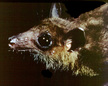
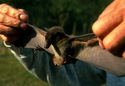
Lesser dawn bats have large eyes, small, simple ears, and lack a tragus. The muzzle is narrow and the tongue long and extendable, with rasp-like papillae. Dorsal pelage is dark brown and the belly is paler. The necks of males are covered with long scent-dispersing "osmetrichia" hairs that are darker than the pelage of the head and body. The second finger is independent and lacks a claw. Molariform teeth are considerably reduced and barely extend past the gums. The dental formula in Eonycteris is i 2/2, c 1/1, pm 3/3, m 2/3 x 2 = 34. The type of tongue, a tail length between 12 and 33 mm, and absence of an index finger claw distiguishes Eonycteris. (Kunz and Fenton, 2003; Macdonald, 2001; McNab, 1989; Nowak, 1999)
- Other Physical Features
- endothermic
- homoiothermic
- bilateral symmetry
- Sexual Dimorphism
- male larger
-
- Range mass
- 35 to 82 g
- 1.23 to 2.89 oz
-
- Average mass
- 60 g
- 2.11 oz
-
- Range length
- 85 to 125 mm
- 3.35 to 4.92 in
-
- Range wingspan
- 60 to 85 (forearm length) mm
- 2.36 to in
-
- Average wingspan
- 72.5 (forearm length) mm
- in
-
- Range basal metabolic rate
- 0.881 to 0.979 cm3.O2/g/hr
-
- Average basal metabolic rate
- 0.93 cm3.O2/g/hr
Reproduction
Lesser dawn fruit bats are thought to be polygynous with single males mating with multiple females. Penis, baculum, and testes size are not a factor in male reproductive success, as sperm competition does not occur as in multi-male polyandrous and polygynandrous mating systems. However, residual baculum lengths are greater than in monogamous systems. It is reasonable that body size is a factor in mate selection in both sexes as it is generally an indicator of superior genes and fitness. (Hosken, et al., 2001; Hutchins, et al., 2003)
- Mating System
- polygynous
There is conflicting information on the cycle/pattern of estrus as well as birth in E. spelaea females. One study finds females exhibiting a pattern characterized by synchronous births and seasonal, bimodal polyestry, while other sources find no synchronicity between females and no seasonal synchronicity. Lesser dawn fruit bats are polyestrus and births occur in two seasonal peaks, which is consistent with females coming into estrus twice a year. The usual number of offspring per year is two. Gestation is reported to be 3 to 4 months; however, other reports suggest gestation periods possibly as long as 200 days (between 6 and 7 months). Weaning occurs at 3 months. Females mature between 6 months and 1 year. Males mature between 1 and 2 years. (Heideman and Utzurrum, 2003; Hutchins, et al., 2003; Nowak, 1999)
- Key Reproductive Features
- iteroparous
- seasonal breeding
- year-round breeding
- gonochoric/gonochoristic/dioecious (sexes separate)
- sexual
- fertilization
- viviparous
-
- Breeding interval
- Breeding intervals are unknown, but females may breed up to twice each year.
-
- Breeding season
- Breeding is not synchronized with a particular season, but tends to be bimodal.
-
- Range number of offspring
- 1 to 2
-
- Average number of offspring
- 1
-
- Range gestation period
- 3 to 6 months
-
- Average weaning age
- 3 months
-
- Range age at sexual or reproductive maturity (female)
- 6 to 12 months
-
- Range age at sexual or reproductive maturity (male)
- 1 to 2 years
Reports suggest that females are the sole providers of pre-independence parental care. After birth, altricial young take hold of a nipple and stay attached for 4 to 6 weeks as the female flies around. After this time, young can make flights independently for short distances. Complete weaning occurs at 3 months. (Nowak, 1999)
- Parental Investment
- altricial
-
pre-fertilization
- provisioning
-
protecting
- female
-
pre-hatching/birth
-
provisioning
- female
-
protecting
- female
-
provisioning
-
pre-weaning/fledging
-
provisioning
- female
-
protecting
- female
-
provisioning
-
pre-independence
-
provisioning
- female
-
protecting
- female
-
provisioning
Lifespan/Longevity
There is little information available on the longevity of this species in the wild or in captivity. The highest lifespans in captivity of other Pteropodidae species include: straw-colored fruit bats (Eidolon helvum), 21.8 years; flying foxes (Pteropus), 31.4 years; and rousette fruit bats (Rousettus), 22.9 years. (Jones, 1982)
Behavior
Lesser dawn fruit bats are gregarious, roosting during the day in the high ceilings of caves in colonies numbering from a dozen to over ten thousand individuals. The roosting colony is divided into sexually segregated clusters. Colonies of Rousettus leschenaultii and E. major share roost caves with E. spelaea. This species is nocturnal and will often travel 20 to 40 km from their day roosts to the night flowering trees where they feed. Lesser dawn fruit bats forage in flocks. Feeding occurs between 1900 and 0200 hours. A behavior unique to E. spelaea is the production of wing-clapping sounds during movement in dark situations. This is thought to be a primitive form of echolocation that aids orientation, or simply a product of slowed flight which may reduce the force with which bats collide with other objects in dark caves. (Gould, 1978; Gould, 1988; Hutchins, et al., 2003; Kunz and Fenton, 2003; Macdonald, 2001; Nowak, 1999)
Home Range
There is little available information on the home range of E. spelaea. However, this species travels considerable distances to feed, and may often fly 20 to 40 km from their day roosts to the night flowering trees where they feed. Long flights between roosting and feeding grounds is common in Pteropodidae. (Neuweiler, 2000; Nowak, 1999)
Communication and Perception
There is little available information on the way lesser dawn fruit bats communicate and perceive their environment. The presence of long scent-dispersing "osmetrichia" hairs on males indicates the use of olfaction and is probably used in reproductive state determination and mating. In many species of bats males have a much stronger odor than females. Pteropodidae species have large, well-developed eyes, and conspicious simple ears. The perception of their environment is mostly visual. However, E. spelaea is unique in the production of wing-clapping sounds during movement in dark situations, which may be a primitive form of echolocation that aids orientation. Most Pteropodidae species locate food by smell. (Kunz and Fenton, 2003; Macdonald, 2001; Nowak, 1999)
- Communication Channels
- chemical
- Other Communication Modes
- scent marks
Food Habits
Diet consists primarily of the nectar and pollen of night flowering plant species. Two studies state that stomach and tongue contents contained pollen exclusively. Lesser dawn fruit bats are nectarivorous generalists that have been documented feeding on over 31 plant species. The nectar and pollen of Oroxylum indicum is described as their preferred and principle food source. Eonycteris spelaea and O. indicum are referred to as an example of coevolution because the flowers are adapted to the head morphology and feeding behavior of the this bat species. Durio zibethinus, Parkia speciosa, Musa acuminata, and Ficus species are also used. Lesser dawn fruit bats have shown a particular affinity for a specific species of Agave. They use durian fruit nectar and pollen, and it is suggested that they are the among the most important pollinators of this economically important fruit. It is also reported that Eonycteris are occasional flower eaters. In captivity, individuals have been fed coconut (Cocos) pulp and guava (Psidium). (Allen, 1939; Gould, 1978; Heideman and Utzurrum, 2003; Hutchins, et al., 2003; Neuweiler, 2000; Nowak, 1999; Peterson, 1964; Wilson, 1997)
- Primary Diet
- herbivore
- Plant Foods
- fruit
- nectar
- pollen
- flowers
Predation
There is very little information available on the predators of this species, nor the adaptations it uses to evade predation. Like most bats, their nocturnality, flight, and habit of roosting in inaccessible places protects them from most predation. They are likely to be vulnerable to predation by climbing snakes and nocturnal birds of prey, such as owls.
Ecosystem Roles
The primary ecological function of E. spelaea is pollination. A possible secondary role is seed dispersal, however, the use of fruit as a wild food item is not confirmed. (Allen, 1939; Hutchins, et al., 2003; Kunz and Fenton, 2003; Neuweiler, 2000; Nowak, 1999; Wilson, 1997)
- Ecosystem Impact
- pollinates
Economic Importance for Humans: Positive
The primary significance of E. spelaea to humans is the pollination of commercially important plant species, especially durian fruits (Durio spp.), which can add up to $120 million (U.S. dollars) to the Southeast Asian economy annually. Lesser dawn bats are also hunted for use as food. Bat guano from the Philippines is harvested for use as fertilizer. (Gould, 1978; Hutchins, et al., 2003; Neuweiler, 2000; Nowak, 1999; Wilson, 1997)
- Positive Impacts
- food
- produces fertilizer
- pollinates crops
Economic Importance for Humans: Negative
There are no known adverse effects of E. spelaea on humans. (Hutchins, et al., 2003)
Conservation Status
Lesser dawn fruit bats are considered lower risk/least concern by the IUCN. The major threat to E. spelaea is loss and degradation of forest habitat through ongoing wood extraction and limestone quarrying. Conservation actions that are needed include monitoring and research of population numbers, range and trends. The subspecies E. spelaea glandifera of Indonesia and the Philippines and Sulawesi was reported as vulnerable 1992. Populations in Java and the Lesser Sundas Islands are considered endangered because of cave disturbance, hunting, and habitat destruction. Populations of E. spelaea glandifera in the Philippines seem more adaptable to habitat alterations but are at risk due to hunting and human disturbance. (Nowak, 1999; Wilson and Reeder, 2005)
-
- IUCN Red List
-
Least Concern
More information
-
- IUCN Red List
-
Least Concern
More information
-
- US Federal List
- No special status
-
- CITES
- Appendix I
Contributors
Tanya Dewey (editor), Animal Diversity Web.
Andrew Reinke (author), University of Wisconsin-Stevens Point, Chris Yahnke (editor, instructor), University of Wisconsin-Stevens Point.
Glossary
- acoustic
-
uses sound to communicate
- agricultural
-
living in landscapes dominated by human agriculture.
- altricial
-
young are born in a relatively underdeveloped state; they are unable to feed or care for themselves or locomote independently for a period of time after birth/hatching. In birds, naked and helpless after hatching.
- bilateral symmetry
-
having body symmetry such that the animal can be divided in one plane into two mirror-image halves. Animals with bilateral symmetry have dorsal and ventral sides, as well as anterior and posterior ends. Synapomorphy of the Bilateria.
- chemical
-
uses smells or other chemicals to communicate
- colonial
-
used loosely to describe any group of organisms living together or in close proximity to each other - for example nesting shorebirds that live in large colonies. More specifically refers to a group of organisms in which members act as specialized subunits (a continuous, modular society) - as in clonal organisms.
- endothermic
-
animals that use metabolically generated heat to regulate body temperature independently of ambient temperature. Endothermy is a synapomorphy of the Mammalia, although it may have arisen in a (now extinct) synapsid ancestor; the fossil record does not distinguish these possibilities. Convergent in birds.
- fertilization
-
union of egg and spermatozoan
- food
-
A substance that provides both nutrients and energy to a living thing.
- forest
-
forest biomes are dominated by trees, otherwise forest biomes can vary widely in amount of precipitation and seasonality.
- herbivore
-
An animal that eats mainly plants or parts of plants.
- iteroparous
-
offspring are produced in more than one group (litters, clutches, etc.) and across multiple seasons (or other periods hospitable to reproduction). Iteroparous animals must, by definition, survive over multiple seasons (or periodic condition changes).
- motile
-
having the capacity to move from one place to another.
- native range
-
the area in which the animal is naturally found, the region in which it is endemic.
- nectarivore
-
an animal that mainly eats nectar from flowers
- nocturnal
-
active during the night
- oriental
-
found in the oriental region of the world. In other words, India and southeast Asia.

- polygynous
-
having more than one female as a mate at one time
- rainforest
-
rainforests, both temperate and tropical, are dominated by trees often forming a closed canopy with little light reaching the ground. Epiphytes and climbing plants are also abundant. Precipitation is typically not limiting, but may be somewhat seasonal.
- scent marks
-
communicates by producing scents from special gland(s) and placing them on a surface whether others can smell or taste them
- seasonal breeding
-
breeding is confined to a particular season
- sedentary
-
remains in the same area
- sexual
-
reproduction that includes combining the genetic contribution of two individuals, a male and a female
- social
-
associates with others of its species; forms social groups.
- tactile
-
uses touch to communicate
- terrestrial
-
Living on the ground.
- tropical
-
the region of the earth that surrounds the equator, from 23.5 degrees north to 23.5 degrees south.
- visual
-
uses sight to communicate
- viviparous
-
reproduction in which fertilization and development take place within the female body and the developing embryo derives nourishment from the female.
- year-round breeding
-
breeding takes place throughout the year
References
Allen, G. 1939. Bats. New York, New York: Dover Publications, Inc..
Findley, J. 1993. Bats: a community perspective. New York, New York: Cambridge University Press.
Gould, E. 1978. Foraging Behavior of Malaysian Nectar-Feeding Bats. BIOTROPICA, 10(3): 184-193. Accessed November 07, 2006 at http://www.jstor.org/view/00063606/di995218/99p0018i/0?frame=noframe&userID=8fec23ca@uwsp.edu/01cc99332200501b32266&dpi=3&config=jstor.
Gould, E. 1988. Wing-clapping sounds of Eonycteris spelaea (Pteropodidae) in Malaysia. Journal of Mammology, 69(2): 378-379. Accessed November 30, 2006 at http://www.jstor.org/view/00222372/ap050277/05a00200/0?frame=noframe&userID=8fec23ca@uwsp.edu/01cce4406500501b42562&dpi=3&config=jstor.
Heideman, P., R. Utzurrum. 2003. Seasonality and synchrony of reproduction in three species of nectarivorous Philippines bats. BMC Ecology, 3:11: N/A. Accessed November 29, 2006 at http://www.pubmedcentral.nih.gov/picrender.fcgi?artid=305358&blobtype=pdf.
Hodgkison, R., S. Balding, A. Zubaid, T. Kunz. 2003. Fruit Bats (Chiroptera: Pteropodidae) as Seed Dispersers and Pollinators in Lowland Malaysian Rain Forest. BIOTROPICA, 35(4): 491-502. Accessed November 09, 2006 at http://www.bioone.org/archive/0006-3606/35/4/pdf/i0006-3606-35-4-491.pdf.
Hosken, D., K. Jones, K. Chipperfield, A. Dixson. 2001. Is the bat os penis sexually selected. Behav Ecol Sociobiol, 50: 450-460. Accessed November 29, 2006 at http://www.zoo.cam.ac.uk/ioz/people/Publications/2001%20Be%20Ecol%20Socio%2050_450-460.pdf.
Hutchins, M., D. Kleiman, G. Valerius, M. McDade. 2003. Grzimek's Animal Life Encyclopedia, 2nd edition. Farmington Hills, MI: Gale Group.
Jones, M. 1982. Longevity of captive mammals.. Zoological Garten N. F. Jena, 52: 113-128.
Kunz, T., M. Fenton. 2003. Bat Ecology. Chicago and London: The University of Chicago Press.
Kunz, T., P. Racey. 1998. Bat Biology and Conservation. Washington and London: Smithsonian Institution Press.
Macdonald, D. 2001. The Encyclopedia of Mammals. New York, New York: Barnes & Nobel Books.
McNab, B. 1989. Temperature regulation and rate of metabolism in three Bornean bats. Journal of Mammology, 70(1): 153-161. Accessed November 05, 2006 at http://www.jstor.org/view/00222372/ap050280/05a00170/0.
Neuweiler, G. 2000. The Biology of Bats. New York, New York: Oxford University Press.
Nowak, R. 1999. Walker’s Mammals of the World. Baltimore and London, Maryland and England: The Johns Hopkins University Press.
Peterson, R. 1964. Silently, by Night. New York, Toronto, and London: McGraw-Hill Book Company.
Wilson, D. 1997. Bats in Question. Washington and London: Smithsonian Institution Press.
Wilson, D., D. Reeder. 2005. Mammal Species of the World: A Taxonomic and Geographic Reference. Baltimore, Maryland: The John Hopkins University Press.