Dorcopsis luctuosagray dorcopsis
Geographic Range
Gray dorcopsis are native to eastern and southeastern New Guinea. (Bourke, 1989; Morrison, 2001)
- Biogeographic Regions
- australian
- Other Geographic Terms
- island endemic
Habitat
Living only up to an altitude of 500 meters, Dorcopsis luctuosa inhabits dense, lowland tropical rainforests. ("Dorcopsis Luctuosa", 2003; Morrison, 2001)
- Habitat Regions
- tropical
- terrestrial
- Terrestrial Biomes
- rainforest
-
- Range elevation
- 0 to 500 m
- 0.00 to 1640.42 ft
Physical Description
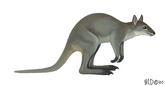
The general color of the thick, short fur on the back of Dorcopsis luctuosa is dark smoky gray. The fur color gradually transitions from this color to dull gray on the chest and belly. A conspicuous yellow patch surrounds the cloaca. The fur on the nape projects forward. The tip of the tail is cornified and lacks hair. The fore and hind limbs of gray dorcopsis are similar in size compared to those in other macropodids. They have small, round ears and long, narrow faces. The dentition includes small upper canines and large premolars. The fourth premolar is greater in length than the length of the first and second molars combined. Dimorphism between the sexes is great; males weigh up to 11.6 kg (25 lbs), while females weigh up to just 3.6 kg (8 lbs). Males grow up to 970 mm in head and body length, and the tail is an additional 390 mm. Females have a head and body length of 525 mm, with a 310 mm tail. However, these ranges are based on the measurements of relatively few individuals. ("Dorcopsis Luctuosa", 2003; Bourke, 1989; British Museum (Natural History) and Thomas, 1888; Fisher, et al., 2001; Flannery, 1995)
- Other Physical Features
- endothermic
- homoiothermic
- bilateral symmetry
- Sexual Dimorphism
- male larger
-
- Range mass
- 3.6 to 11.6 kg
- 7.93 to 25.55 lb
-
- Range length
- 525 to 970 mm
- 20.67 to 38.19 in
Reproduction
Gray dorcopsis are presumed to be promiscuous. A dominance heirarchy, which is established by size and fighting, generally dictates which males are allowed to mate. In captivity, males has been known to chase females and sniff around the cloaca before mating. By checking the cloaca, the male determines if the female is in estrus. ("Dorcopsis Luctuosa", 2003; Bourke, 1989; Menzies, 1989)
- Mating System
- polygynandrous (promiscuous)
Female Dorcopsis luctuosa reach maturity at 15 months. Females give birth to one offspring, which travels to the pouch, attaches to a nipple, and suckles to further develop. Total time spent in the pouch is 180-190 days, but the joey continues to nurse after it has left the pouch. In a closely related species, Dorcopsis muelleri, the time until weaning is 270 days. The female gives birth to another offspring soon after the previous one has left the pouch. The gestation period is probably very similar to other Macropodidae, from 30 to 45 days. (Bourke, 1989; Fisher, et al., 2001; Flannery, 1995; Menzies, 1989)
- Key Reproductive Features
- iteroparous
- year-round breeding
- gonochoric/gonochoristic/dioecious (sexes separate)
- sexual
- viviparous
- embryonic diapause
- post-partum estrous
-
- Breeding interval
- The female may give birth to another offspring once the previous offspring leaves the pouch, so time between births is around 190 days.
-
- Breeding season
- Breeding occurs year round.
-
- Range number of offspring
- 1 to 1
-
- Average number of offspring
- 1
- AnAge
-
- Range gestation period
- 30 to 45 days
-
- Average weaning age
- 270 days
-
- Average age at sexual or reproductive maturity (female)
- 15 months
-
- Average age at sexual or reproductive maturity (female)
Sex: female - 450 days
- AnAge
- Average age at sexual or reproductive maturity (female)
Female gray dorcopsis are responsible for parental care. A female may support up to three offspring at a time: an embryo, one offspring in the pouch, and another outside of the pouch. As a result, the mother may be nursing two offspring simultaneously. The mother produces different kinds of milk suited to the needs of each offspring. The joey is not independent once it leaves the pouch; the mother provides milk and protection from other gray dorcopsis. The mother may also engage in play fighting with the joey. (Ganslosser, 1989; Menzies, 1989)
- Parental Investment
- altricial
-
pre-fertilization
- provisioning
-
protecting
- female
-
pre-hatching/birth
-
provisioning
- female
-
protecting
- female
-
provisioning
-
pre-weaning/fledging
-
provisioning
- female
-
protecting
- female
-
provisioning
-
pre-independence
-
provisioning
- female
-
protecting
- female
-
provisioning
Lifespan/Longevity
Little is known about the lifespan of gray dorcopsis in the wild, but they have lived to nearly 14 years old in captivity. ("Ageing, longevity, and life history of Dorcopsis luctuosa", 2005)
-
- Range lifespan
Status: captivity - 13.9 (high) years
- Range lifespan
-
- Average lifespan
Status: captivity - 13.9 years
- AnAge
- Average lifespan
Behavior
Gray dorcopsis are crepuscular in captivity, though thought to be nocturnal in the wild. They do not hop much, which is probably an adaptation to their enclosed forest habitat. As is true of other Dorcopsis, their tail is arched and only the tip touches the ground when the animal is resting. When eating, gray dorcopsis nip food with their incisors, and then they use their forepaws to transfer the food to the premolars and molars at the side of the mouth for chewing. (Bourke, 1989; Menzies, 1989)
Dorcopsis luctuosa is a social species, with groups of a few males and females. Both males and females fight, with female bouts lasting just a few seconds and male bouts lasting over ten seconds. Females typically bite, while males hit when fighting. In captivity, these animals are usually not aggressive, which promotes social grouping. ("Dorcopsis Luctuosa", 2003; Bourke, 1989; Ganslosser, 1989)
Age and size typically dictates social rank in Dorcopsis luctuosa, but both sexes will fight. They can usually stop a chase or attack by lowering their head and stooping. ("Dorcopsis Luctuosa", 2003; Bourke, 1989; Ganslosser, 1989)
- Key Behaviors
- terricolous
- saltatorial
- nocturnal
- crepuscular
- motile
- sedentary
- social
- dominance hierarchies
Home Range
No information is available on home ranges in gray dorcopsis.
Communication and Perception
These animals can usually stop a chase or attack by lowering their head and stooping. As in most Macropodidae, stamping of the feet signifies alarm. Another behavior of the gray dorcopsis is to stand against a tree and rub their chest, which contains scent glands, against the tree. They also mark by rubbing their cloaca on the ground. (Bourke, 1989; Ganslosser, 1989; Menzies, 1989)
- Other Communication Modes
- pheromones
- scent marks
Food Habits
An herbivore and a browser, gray dorcopsis eat soft vegetation such as leaves, flowers, and fruits. (Bourke, 1989)
- Plant Foods
- leaves
- fruit
- flowers
Predation
There is no information on gray dorcopsis predators. Social groups help to protect each other from danger because many eyes are watching for signs of attack.
Ecosystem Roles
Dorcopsis luctuosa are known to host several parasites which are listed below. More research needs to be done, as other parasite species of the gray dorcopsis likely exist. As a fairly large browser, D. luctuosa likely influences the growth of vegetation such as trees and flowers, and it is probably a disperser of the seeds of the fruit it consumes. (Royal Society of South Australia, 1999; Royal Society of South Australia, 2001)
- Ecosystem Impact
- disperses seeds
- Cervonemella reardoni
- Coronostrongylus coronatus
- Paralabiostrongylus bicollaris
Economic Importance for Humans: Positive
Gray dorcopsis are a food source for the natives of New Guinea. They are sold for meat in the markets of Port Moresby. They may be a tourist attraction in zoos, as gray dorcopsis are raised and held in captivity, and they may attract ecotourist interest in their native habitats. ("Dorcopsis Luctuosa", 2003; Flannery, 1995; Menzies, 1989)
- Positive Impacts
- food
- ecotourism
Economic Importance for Humans: Negative
There are no known adverse effects of Dorcopsis luctuosa on humans.
Conservation Status
Gray dorcopsis are not vulnerable or endangered currently.
-
- IUCN Red List
-
Vulnerable
More information
-
- IUCN Red List
-
Vulnerable
More information
-
- US Federal List
- No special status
-
- CITES
- No special status
Contributors
Tanya Dewey (editor), Animal Diversity Web.
Stephen Shemes (author), University of Michigan-Ann Arbor, Phil Myers (editor, instructor), Museum of Zoology, University of Michigan-Ann Arbor.
Glossary
- Australian
-
Living in Australia, New Zealand, Tasmania, New Guinea and associated islands.

- acoustic
-
uses sound to communicate
- altricial
-
young are born in a relatively underdeveloped state; they are unable to feed or care for themselves or locomote independently for a period of time after birth/hatching. In birds, naked and helpless after hatching.
- bilateral symmetry
-
having body symmetry such that the animal can be divided in one plane into two mirror-image halves. Animals with bilateral symmetry have dorsal and ventral sides, as well as anterior and posterior ends. Synapomorphy of the Bilateria.
- chemical
-
uses smells or other chemicals to communicate
- crepuscular
-
active at dawn and dusk
- dominance hierarchies
-
ranking system or pecking order among members of a long-term social group, where dominance status affects access to resources or mates
- ecotourism
-
humans benefit economically by promoting tourism that focuses on the appreciation of natural areas or animals. Ecotourism implies that there are existing programs that profit from the appreciation of natural areas or animals.
- embryonic diapause
-
At about the time a female gives birth (e.g. in most kangaroo species), she also becomes receptive and mates. Embryos produced at this mating develop only as far as a hollow ball of cells (the blastocyst) and then become quiescent, entering a state of suspended animation or embryonic diapause. The hormonal signal (prolactin) which blocks further development of the blastocyst is produced in response to the sucking stimulus from the young in the pouch. When sucking decreases as the young begins to eat other food and to leave the pouch, or if the young is lost from the pouch, the quiescent blastocyst resumes development, the embryo is born, and the cycle begins again. (Macdonald 1984)
- endothermic
-
animals that use metabolically generated heat to regulate body temperature independently of ambient temperature. Endothermy is a synapomorphy of the Mammalia, although it may have arisen in a (now extinct) synapsid ancestor; the fossil record does not distinguish these possibilities. Convergent in birds.
- folivore
-
an animal that mainly eats leaves.
- food
-
A substance that provides both nutrients and energy to a living thing.
- herbivore
-
An animal that eats mainly plants or parts of plants.
- island endemic
-
animals that live only on an island or set of islands.
- iteroparous
-
offspring are produced in more than one group (litters, clutches, etc.) and across multiple seasons (or other periods hospitable to reproduction). Iteroparous animals must, by definition, survive over multiple seasons (or periodic condition changes).
- motile
-
having the capacity to move from one place to another.
- native range
-
the area in which the animal is naturally found, the region in which it is endemic.
- nocturnal
-
active during the night
- pheromones
-
chemicals released into air or water that are detected by and responded to by other animals of the same species
- polygynandrous
-
the kind of polygamy in which a female pairs with several males, each of which also pairs with several different females.
- rainforest
-
rainforests, both temperate and tropical, are dominated by trees often forming a closed canopy with little light reaching the ground. Epiphytes and climbing plants are also abundant. Precipitation is typically not limiting, but may be somewhat seasonal.
- saltatorial
-
specialized for leaping or bounding locomotion; jumps or hops.
- scent marks
-
communicates by producing scents from special gland(s) and placing them on a surface whether others can smell or taste them
- sedentary
-
remains in the same area
- sexual
-
reproduction that includes combining the genetic contribution of two individuals, a male and a female
- social
-
associates with others of its species; forms social groups.
- tactile
-
uses touch to communicate
- terrestrial
-
Living on the ground.
- tropical
-
the region of the earth that surrounds the equator, from 23.5 degrees north to 23.5 degrees south.
- visual
-
uses sight to communicate
- viviparous
-
reproduction in which fertilization and development take place within the female body and the developing embryo derives nourishment from the female.
- year-round breeding
-
breeding takes place throughout the year
References
2005. "Ageing, longevity, and life history of Dorcopsis luctuosa" (On-line). AnAge. Accessed April 14, 2006 at http://genomics.senescence.info/species/entry.php?species=Dorcopsis_luctuosa.
"Asean Regional Centre for Biodiversity Conservation" (On-line). Accessed March 22, 2006 at http://arcbc.org/cgi-bin/abiss.exe/spd?SID=1854051550&spd=10985&tx=MA.
2003. Dorcopsis Luctuosa. M Hutchins, D Kleiman, V Gesit, M McDade, eds. Grzimek’s Animal Life Encyclopedia, Vol. Volume 12-16: Mammals I-V, Second Edition Edition. Farmington Hills, MI: Gale Group.
Bourke, D. 1989. Observations on the behavior of the Gray Dorcopsis Wallaby, Dorcopsis luctuosa (Marsupialia: Macropodidae), in captivity. Pp. 633-640 in G Grigg, P Jarman, I Hume, eds. Kangaroos, Wallabies, and Rat-Kangaroos. New South Wales: Surrey Beatty & Sons.
British Museum (Natural History), D., O. Thomas. 1888. Catalogue of the Marsupialia and Monotremata. London: Printed by order of the trustees.
Fisher, D., I. Owens, C. Johnson. 2001. The ecological basis of life history variation in marsupials. Ecology, 82: 3531-3540. Accessed March 22, 2006 at http://esapubs.org/archive/ecol/E082/042/appendix-A.htm.
Flannery, T. 1995. Mammals of New Guinea. New York: Reed Brothers.
Ganslosser, U. 1989. Agonistic behavior in Macropodoids - a review. Pp. 475-513 in G Grigg, P Jarman, I Hume, eds. Kangaroos, Wallabies, and Rat-Kangaroos. New South Wales: Surrey Beatty & Sons.
Menzies, J. 1989. Observations on a captive forest wallaby. Pp. 629-631 in G Grigg, P Jarman, I Hume, eds. Kangaroos, Wallabies, and Rat-Kangaroos. New South Wales: Surrey Beatty & Sons.
Morrison, J. 2001. "Southern New Guinea freshwater swamp forests" (On-line). Accessed March 22, 2006 at http://www.worldwildlife.org/wildworld/profiles/terrestrial/aa/aa0121_full.html.
Royal Society of South Australia, 2001. Cervonemella reardoni (Nematoda: Cloacinidae) from the stomachs of scrub wallabies, Dorcopsis spp, in Papua New Guinea. Transactions of the Royal Society of South Australia, 125: 141-145.
Royal Society of South Australia, 1999. Cloacinidae (Nematoda: Strongyloidea) including a new species, Dorcopsinema simile, from Dorcopsulus vanheurni (Marsupialia: Macropodidae) from Papua New Guinea. Transactions of the Royal Society of South Australia, 123: 137-142.