Dendroica fuscaBlackburnian warbler

Geographic Range
Blackburnian warblers are commonly found throughout southeast Canada, from Alberta into the Great Lake areas to Newfoundland and into the Appalachians as far south as Georgia during the summer season. However, during migration, this species is seen throughout the eastern coast of North America and as far west as Oklahoma. For the most part, they migrate over the Gulf of Mexico; however, some fly over the eastern coast of Texas. During the winter they can be found in Costa Rica, Panama, and into Peru. (Morse, 1994; Rappole, 1995)
- Biogeographic Regions
- nearctic
- neotropical
Habitat
Blackburnian warblers inhabit deciduous and coniferous forests during the summer. They prefer coniferous forests, but will be found in spruce trees or hemlock in deciduous forests. In any forest type in their summer range, blackburnian warblers are most active foraging and vocalizing in conifers. Tree species preferred by blackburnian warblers are pines Pinus, spruces Picea, and hemlocks Tsuga. They prefer the upper third of tree canopies in dense, mature forests. During the winter they are found in wet forests from Panama into South America. (Greenberg, 1979; Lawrence, 1953; Morse, 1994; Young, et al., 2005; Zerda Lerner and Stauffer, 1998)
- Habitat Regions
- temperate
- tropical
- terrestrial
- Terrestrial Biomes
- taiga
- forest
- rainforest
Physical Description
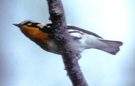
Male blackburnian warblers are easily identified by their orange throat, breast and forehead. They have a black crown and cheeks and are noted for their wing bars and tail spots. Blackburnian warblers have white bars on a black back, wings, and tail. There are black streaks on a white background on the sides and flanks. The lower breast and stomach is slightly orange, fading to white towards the tail.
Females have a pale orange to yellow faces and breasts, with brownish crowns, cheeks, and wings. There are two bars of white on the wings. Females also have white bellies and undertail coverts with grayish streaks on her sides and flanks.
Blackburnian warblers are, on average, 13 cm in length with a wingspan of 21 cm. Like most warblers, they have small, flattened, and short bills, and have thin, black legs with 3 toes in front and one in back (Sibley, 2001). (Morse, 1994; Sibley, et al., 2001)
- Other Physical Features
- endothermic
- homoiothermic
- bilateral symmetry
- Sexual Dimorphism
- sexes colored or patterned differently
- male more colorful
-
- Range mass
- 9 to 12 g
- 0.32 to 0.42 oz
-
- Range length
- 9.5 to 19 cm
- 3.74 to 7.48 in
-
- Average length
- 13 cm
- 5.12 in
-
- Average wingspan
- 21 cm
- 8.27 in
Reproduction
Male blackburnian warblers attract their mates by singing in tree tops. When a potential mate comes close, males flick their tail and peck at the branch. Males defend their mate from other males by flicking their tail, pecking at branches, and occasionally fighting. Blackburnian warblers, like other songbirds, are socially monogamous. Males typically help raise and feed the young. In some cases they have been absent, likely due to occasional extra-pair copulations. (Lawrence, 1953; Nice, 1926)
- Mating System
- monogamous
Blackburnian warblers typically nest in the higher canopy of the tallest trees. Their nest usually consists of twigs attached by spider silk, dry spruce twigs and bark, the inside consists of dead pine needles and grasses in the shape of a fine cup positioned away from the trunk and hidden in the foliage on the horizontal branches. Females are the primary builders and will take 3 to 6 days to build nests. They start building nests close to the time they lay eggs. They typically breed between May and July, with 1 brood per year of 4 to 5 eggs. The eggs hatch in about 2 weeks and the young fledge between 2 and 4 weeks. Females are usually in their second year of life before breeding. Males have been known to breed while they are still subadults (less than 1 year old), but are more successful and more likely to breed in their second year of life. Males help feed females while incubating eggs. However, she will spend some time off of the nest. (Lawrence, 1953; Nice, 1926)
- Key Reproductive Features
- iteroparous
- seasonal breeding
- gonochoric/gonochoristic/dioecious (sexes separate)
- sexual
- oviparous
-
- Breeding interval
- Blackburnian warblers breed once yearly.
-
- Breeding season
- Blackburnian warblers breed from May to July.
-
- Range eggs per season
- 2 to 4
-
- Average eggs per season
- 4
-
- Average time to hatching
- 2 weeks
-
- Range fledging age
- 2 to 4 weeks
-
- Average time to independence
- 2-3 months
-
- Average age at sexual or reproductive maturity (female)
- 2 years
-
- Range age at sexual or reproductive maturity (male)
- 1 to 2 years
-
- Average age at sexual or reproductive maturity (male)
- 2 years
Blackburnian warblers spend, on average, 22 minutes on the nest and 5 minutes off the nest after the eggs hatch. Both males and females feed the young, females more so than males. Males feed more than one hatchling at a time and females typically only feed one young at a time. They feed the young every 10 to 20 minutes. They take 2 to 4 weeks until the young fledge, both parents care for the young during that time. It takes several months before the young are independent of the parents. (Lawrence, 1953; Morse, 1994; Nice, 1926)
- Parental Investment
- altricial
- male parental care
- female parental care
-
pre-fertilization
- provisioning
-
protecting
- female
-
pre-hatching/birth
-
provisioning
- male
- female
-
protecting
- male
- female
-
provisioning
-
pre-weaning/fledging
-
provisioning
- male
- female
-
protecting
- male
- female
-
provisioning
-
pre-independence
-
provisioning
- male
- female
-
protecting
- male
-
provisioning
Lifespan/Longevity
Blackburnian warblers live in the wild for a average of 3 to 6 years. The primary cause of death is not surviving through migration. Because of poor weather or insufficient energy stores, death is more common during spring migration, especially when flying over the Gulf of Mexico. Blackburnian warblers are not kept in captivity. (Dunn and Garrett, 1997; Elphick, et al., 2001; Morse, 1994; "Reference Atlas to the Birds of North America", 2003)
-
- Range lifespan
Status: wild - 8 (high) years
- Range lifespan
-
- Typical lifespan
Status: wild - 3 to 6 years
- Typical lifespan
Behavior
Blackburnian warblers usually fly in mixed-species flocks. Typically there are 1 to 2 blackburnian warblers per flock, but there can be as many as 7. They are not very social with each other or other species other than foraging near each other. They have learned to co-exist with other species and avoid direct competition by staying in the upper third of the tree canopy and foraging and nesting on the outside of the branches, a form of niche partitioning. Even in the same habitats and with similar food sources, different species of the Dendroica are able to survive in separate niches. (Lawrence, 1953; MacArthur, 1958; Morse, 1994)
- Key Behaviors
- arboreal
- flies
- diurnal
- crepuscular
- motile
- migratory
- territorial
-
- Average territory size
- 14000 m^2
Home Range
Blackburnian warblers typically live in a 0.4 to 1.1 hectare area. However, they live on small islands if there are tall, mature trees and suitable food sources. (Morse, 1967; Morse, 1994)
Communication and Perception
Blackburnian warblers sing at dusk and dawn in the frequency range of 4 to 12 KHz. They typically sing the same song at both times. Males duet during these times and sing at each other after hostile encounters with other males. Males are usually stationary, perched higher in tree than females when singing. Singing is used to advertise for breeding and to advertise territories. They have two distinct song types, occasionally alternating them during breeding season. They flick their tail and peck at branches while singing during breeding season. Blackburnian warblers sing one song while stationary at the top of the tree and during encounters with other males. They chirp twice frequently throughout aggressive encounters with other males. The other song is primarily used while foraging and while in the presence of a female. Blackburnian warblers who do not find mates sing the second song type for long periods of time. (Morse, 1967; Morse, 1989)
Food Habits
Blackburnian warblers are insectivorous, diurnal foragers, usually gleaning insects from leaves. They also hover to capture insects from the bottom of leaves. They feed on caterpillars, mayflies, mosquitos, gnats, spiders, and other small invertebrates. (Crawford and Jennings, 1989; Lawrence, 1953; Morse, 1994)
- Primary Diet
- carnivore
- Animal Foods
- insects
- terrestrial non-insect arthropods
Predation
Blackburnian warblers are typically preyed on by larger birds of prey and some mammals. Most predation is on eggs, hatchlings, and fledglings, or on adults as they watch and defend nests. Hawks are the most common predators. (Lawrence, 1953; Morse, 1994)
-
- Known Predators
-
- sharp-shinned hawks (Accipiter striatus)
- Cooper's hawks (Accipiter cooperii)
- red squirrels (Tamiasciurus hudsonicus)
- blue jays (Cyanocitta cristata)
Ecosystem Roles
Blackburnian warblers are known for their increased presence during spruce budworm (Choristoneura species) breakouts, in which their survival and reproduction are greater because of the abundance of prey. These warblers are also well-known for interspecific niche partitioning. Which is how they avoid direct competition with species of the same genus; they coexist by using different parts of the same tree for nesting and foraging.
Blackburnian warblers are used as hosts by mites and lice. (Betts, et al., 2006; Betts, et al., 2007; Crawford and Jennings, 1989; Morse, 1994; Peters, 1936; Schulte, et al., 2005; Zerda Lerner and Stauffer, 1998)
- Menacanthus chrysophzeum
- Ricinus pauens
- Proctophyllodes species
Economic Importance for Humans: Positive
Blackburnian warblers are strong indicators of mixed deciduous-coniferous forests and undisturbed, mature coniferous forests. Surveyors use this species to study the ecology and effect of forest fragmentation by timber harvesting. They are also important for controlling spruce budworm (Choristoneura species) outbreaks. (Betts, et al., 2006; Betts, et al., 2007; Crawford and Jennings, 1989; Schulte, et al., 2005; Zerda Lerner and Stauffer, 1998)
- Positive Impacts
- controls pest population
Economic Importance for Humans: Negative
There is no known negative impact of blackburnian warblers on humans.
Conservation Status
Currently, blackburnian warbler populations are not considered threatened. However, wintering habitats are rapidly declining and they are sensitive to forest fragmentation. (Morse, 1994)
-
- IUCN Red List
-
Least Concern
More information
-
- IUCN Red List
-
Least Concern
More information
-
- US Migratory Bird Act
- Protected
-
- US Federal List
- No special status
-
- CITES
- No special status
-
- State of Michigan List
- No special status
Contributors
Reese Clark (author), Radford University, Rachelle Sterling (editor), Special Projects, Karen Powers (editor), Radford University, Tanya Dewey (editor), University of Michigan-Ann Arbor.
Glossary
- Nearctic
-
living in the Nearctic biogeographic province, the northern part of the New World. This includes Greenland, the Canadian Arctic islands, and all of the North American as far south as the highlands of central Mexico.

- Neotropical
-
living in the southern part of the New World. In other words, Central and South America.
- acoustic
-
uses sound to communicate
- altricial
-
young are born in a relatively underdeveloped state; they are unable to feed or care for themselves or locomote independently for a period of time after birth/hatching. In birds, naked and helpless after hatching.
- arboreal
-
Referring to an animal that lives in trees; tree-climbing.
- bilateral symmetry
-
having body symmetry such that the animal can be divided in one plane into two mirror-image halves. Animals with bilateral symmetry have dorsal and ventral sides, as well as anterior and posterior ends. Synapomorphy of the Bilateria.
- carnivore
-
an animal that mainly eats meat
- chemical
-
uses smells or other chemicals to communicate
- crepuscular
-
active at dawn and dusk
- diurnal
-
- active during the day, 2. lasting for one day.
- endothermic
-
animals that use metabolically generated heat to regulate body temperature independently of ambient temperature. Endothermy is a synapomorphy of the Mammalia, although it may have arisen in a (now extinct) synapsid ancestor; the fossil record does not distinguish these possibilities. Convergent in birds.
- female parental care
-
parental care is carried out by females
- forest
-
forest biomes are dominated by trees, otherwise forest biomes can vary widely in amount of precipitation and seasonality.
- insectivore
-
An animal that eats mainly insects or spiders.
- iteroparous
-
offspring are produced in more than one group (litters, clutches, etc.) and across multiple seasons (or other periods hospitable to reproduction). Iteroparous animals must, by definition, survive over multiple seasons (or periodic condition changes).
- male parental care
-
parental care is carried out by males
- migratory
-
makes seasonal movements between breeding and wintering grounds
- monogamous
-
Having one mate at a time.
- motile
-
having the capacity to move from one place to another.
- native range
-
the area in which the animal is naturally found, the region in which it is endemic.
- oviparous
-
reproduction in which eggs are released by the female; development of offspring occurs outside the mother's body.
- rainforest
-
rainforests, both temperate and tropical, are dominated by trees often forming a closed canopy with little light reaching the ground. Epiphytes and climbing plants are also abundant. Precipitation is typically not limiting, but may be somewhat seasonal.
- seasonal breeding
-
breeding is confined to a particular season
- sexual
-
reproduction that includes combining the genetic contribution of two individuals, a male and a female
- tactile
-
uses touch to communicate
- taiga
-
Coniferous or boreal forest, located in a band across northern North America, Europe, and Asia. This terrestrial biome also occurs at high elevations. Long, cold winters and short, wet summers. Few species of trees are present; these are primarily conifers that grow in dense stands with little undergrowth. Some deciduous trees also may be present.
- temperate
-
that region of the Earth between 23.5 degrees North and 60 degrees North (between the Tropic of Cancer and the Arctic Circle) and between 23.5 degrees South and 60 degrees South (between the Tropic of Capricorn and the Antarctic Circle).
- terrestrial
-
Living on the ground.
- territorial
-
defends an area within the home range, occupied by a single animals or group of animals of the same species and held through overt defense, display, or advertisement
- tropical
-
the region of the earth that surrounds the equator, from 23.5 degrees north to 23.5 degrees south.
- visual
-
uses sight to communicate
References
National Geographic Society. 2003. Reference Atlas to the Birds of North America. Washington D.C.: National Geographic Society.
Betts, M., D. Mitchell, A. Diamond, J. Bêty. 2007. Uneven Rates of Landscape Change as a Source of Bias in Roadside Wildlife Surveys. Journal of Wildlife Management, 71: 2266-2273.
Betts, M., B. Zitske, A. Hadley, A. Diamond. 2006. Migrant Forest Songbirds Undertake Breeding Dispersal Following Timber Harvest. Northeastern Naturalist, 13: 531-536.
Crawford, H., D. Jennings. 1989. Predation by Birds on Spruce Budworm Choristoneura Fumiferana: Functional, Numerical, and Total Responses. Ecology, 70: 152-163.
Dunn, J., K. Garrett. 1997. A Field Guide to Warblers of North America. New York, NY: Houghton Mifflin Company.
Elphick, C., J. Dunning, D. Sibley. 2001. The Sibley Guide to Bird Life and Behavior. New York: Alfred A Knopf.
Greenberg, R. 1979. Body Size, Breeding Habitat, and Winter Exploitation Systems in Dendroica. The Auk, 96: 756-766.
Kendeigh, C. 1945. Nesting behaviors of Wood Warblers. The Wilson Bulletin, Vol. 57, No. 3: 145-164.
Lawrence, L. 1953. Notes on the Nesting Behavior of the Blackburnian Warbler. The Wilson Bulletin, 65: 135-144.
MacArthur, R. 1958. Population Ecology of Some Warblers of Northeastern Coniferous Forests. Ecology, Vol. 39, No. 4: 599-619.
Morse, D. 1994. Blackburnian Warbler (Dendroica fusca). The Birds of North America, 102: 583.
Morse, D. 1989. Song Patterns of Warblers at Dawn and Dusk. The Wilson Bulletin, 101: 26-35.
Morse, D. 1967. The Contexts of Songs in Black-Throated Green and Blackburnian Warblers. The Wilson Bulletin, 79: 64-74.
Nice, M. 1926. Behavior of Blackburnian, Myrtle, and Black-Throated Blue Warblers, with Young. The Wilson Bulletin, 38: 82-83.
Peters, H. 1936. A list of external parasites from birds of the eastern part of the United States. Bird-Banding, Vol. 7, No. 1: 9-27.
Rappole, J. 1995. The Ecology of Migrant Birds: A neotropical Perspective. Washington and London: Smithsonian Institution Press.
Schulte, L., A. Pidgeon, D. Mladenoff. 2005. One Hundred Fifty Years of Change in Forest Bird Breeding Habitat: Estimates of Species Distribution. Conservation Biology, 19: 1944-1956.
Sibley, D., J. Dunning, Jr, C. Elphick. 2001. The Sibley Guide to Bird Life & Behavior. New York: Alfred A. Knopf, Inc..
Veneir, L., D. McKenney, Y. Wang, J. McKee. 1999. Models of large-scale breeding-bird distribution as a function of macro-climate in Ontario, Canada. Journal of Biogeography, 26: 315-328.
Young, L., M. Betts, A. Diamond. 2005. Do Blackburnian Warblers select mixed forests? The importance of spatial resolution in defining habitat. Forest Ecology and Management, 214: 358-372.
Zerda Lerner, S., D. Stauffer. 1998. Habitat Selection by Blackburnian Warblers Wintering in Colombia. Journal of Field Ornithology, 69: 457-465.