Cricetomys gambianusGambian rat
Geographic Range
Gambian rats are found in central Africa, in regions south of the Sahara desert as far south as Zululand. This includes countries such as Nigeria among others. (Ajayi, et al., 1978; Kingdon, 1989)
Habitat
Gambian rats inhabit a variety of habitats ranging from arid areas to temperate areas, but need some form of shelter to survive. Therefore, they are not usually found in completely open areas, but in areas with cover from hollow trees, rock outcroppings, or burrows made by other animals. They are occasionally known to venture into urban areas and can become pest animals. (Ajayi, 1977a; Kingdon, 1989)
- Habitat Regions
- terrestrial
- Terrestrial Biomes
- savanna or grassland
- forest
- mountains
- Other Habitat Features
- urban
- agricultural
-
- Range elevation
- 3500 (high) m
- 11482.94 (high) ft
Physical Description
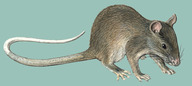
Gambian rats are similar in size to the other species of giant pouched rat, African giant pouched rats, and are often confused with this species. Gambian rats have coarse, brown fur and a dark ring around the eyes, in contrast to African giant pouched rats, which have soft, grey coats with white fur on the belly. Their long tails are scaly and they have narrow heads with small eyes. The main physical characteristic of Gambian rats and all Cricetomys in general are their large cheek pouches. These pouches can expand to a great size, allowing Gambian rats to transport massive quantities of food if necessary. Cheek pouches also exist in other families of rodentia, such as the African hamster and members of the subfamily Cricetinae. Males and females are usually the same size, with little sexual dimorphism. Gambian rats can reach sizes up to 910 mm and beyond, including the tail. These rats also have a very low fat content, which may be the cause of their succeptibility to cold. (Ajayi, 1977b; Kingdon, 1989; Nowak, 1997; Ryan, 1989)
- Other Physical Features
- endothermic
- homoiothermic
- bilateral symmetry
- Sexual Dimorphism
- sexes alike
-
- Range mass
- 1 to 1.47 kg
- 2.20 to 3.24 lb
-
- Range length
- 645 to 910 mm
- 25.39 to 35.83 in
-
- Average basal metabolic rate
- 71 cm3.O2/g/hr
-
- Average basal metabolic rate
- 6.024 W
- AnAge
Reproduction
Mating in Gambian rats involves the formation of a social pair-bond between one male and one female. The male usually sniffs or licks the urogenital areas of the female before attempting to mount the female. Gambian rats also display peculiar courtship behaviors. The male and female often stand upright and scratch one another, then chase each other until the female is ready for copulation. If the female is not receptive or rejects the male, she bites the male on the tail and back among other areas before courtship behaviors begin. (Ajayi, et al., 1978; Amador, 2003; Kingdon, 1989)
- Mating System
- monogamous
Gambian rats are seasonal breeders, usually breeding in the summer. The estrous cycle lasts between 3 and 15 days, while the length of estrus ranges from about 1.4 to 7.8 days. Interestingly, the estrous cycle is often irregular and seems dependent upon many external factors, the environment being one. Other factors include the presence of males, and captivity. Females reach sexual maturity at about 6 months and will typically have about 9 litters annually. The gestation period is approximately 30 to 32 days. Females are also very aggressive when giving birth to a litter. (Ajayi, et al., 1978; Kingdon, 1989; Malekani, et al., 2002; Nowak, 1997)
- Key Reproductive Features
- iteroparous
- seasonal breeding
- gonochoric/gonochoristic/dioecious (sexes separate)
- sexual
- viviparous
-
- Breeding interval
- Gambian rats breed seasonally
-
- Breeding season
- Breeding usually occurs in the summer
-
- Range number of offspring
- 1 to 5
-
- Average number of offspring
- 3.5
- AnAge
-
- Range gestation period
- 30 to 32 days
-
- Average weaning age
- 28 days
-
- Average time to independence
- 30 days
-
- Average age at sexual or reproductive maturity (female)
- 6 months
-
- Average age at sexual or reproductive maturity (female)
Sex: female - 158 days
- AnAge
- Average age at sexual or reproductive maturity (female)
Gambian rat young are born hairless, with eyes and ears closed. The characteristic long tail does not show substantial growth until about 30 to 35 days. The eyes do not open until about 21 days into development, although the young are completely covered with fur and have open ears at about 14 days. The female provides the most parental care, both as a source of warmth for the naked young and as a source of milk. The female also changes her food preference before the young are weaned, choosing softer foods. The male, on the other hand, shows almost no care to the young. It shows tolerance at best, and will sometimes kill it's young and eat them. This is not seen as often in females. An interesting form of altruism exists amongst females, where a female with a separate litter may take care of a motherless litter. (Ajayi, et al., 1978)
- Parental Investment
- altricial
-
pre-fertilization
-
protecting
- female
-
protecting
-
pre-hatching/birth
-
protecting
- female
-
protecting
-
pre-weaning/fledging
-
provisioning
- female
-
protecting
- female
-
provisioning
-
pre-independence
-
provisioning
- female
-
protecting
- female
-
provisioning
Lifespan/Longevity
Gambian rats live for about 5 to 7 years in captivity, although some have been known to live as long as 8 years. Life expectancy in the wild is hard to document because of the small size of these creatures and because they are hunted so often by indigenous people. (Ajayi, et al., 1978; Nowak, 1997)
-
- Typical lifespan
Status: captivity - 5 to 7 years
- Typical lifespan
Behavior
Gambian rats are nocturnal animals, mostly due to the fact that they have little or no tolerance for the intense heat of a typical African day. They are nearly inactive during the day, and come out at night in search of food. Gambian rats often use a vast system of tunnels or hollow trees for their nests, where they rest during the day and come out at night in search of food. These nests are often located in cool areas, providing more evidence for their intolerance to heat. Interestingly, Gambian rats find almost as much value in the act of carrying as much as the act of hoarding food. This results in confusing hoarding patterns when food is plentiful in any season. The pouches inside the cheeks of Gambian rats can hold over 100 ml when full and this allows Gambian rats to transport and extraordinary amount of material in a short period of time. Some studies have shown Gambian rats to transport 3 kg in two and a half hours. Gambian rats are also very good climbers and swimmers, and climb in excess of 2 meters easily. Both sexes are very territorial. Although Gambian rats are generally solitary in the wild, females often form large groups containing many mothers and their litters while males usually remain solitary. These rats adapt rapidly to new situations, such as captivity. Gambian rats have also been known to huddle together when temperatures drop. Due to their low body fat they do not retain heat easily. (Ajayi, 1977a; Ajayi, et al., 1978; Kingdon, 1989; Knight, 1988; Nowak, 1997)
- Key Behaviors
- cursorial
- nocturnal
- motile
- daily torpor
- territorial
- social
Home Range
Although Gambian rats are usually passive and shy in the wild, they are very protective of their nests and are aggressive in defending it. However, outside of the nest, there is no truly defined home range. (Ajayi, et al., 1978; Kingdon, 1989; Nowak, 1997)
Communication and Perception
Gambian rats use screeching as the main form of communication. Gambian rats emit one single short cry which is distinguishable from the longer, varied pitch of African giant pouched rats. Males also use olfactory cues during courtship when they sniff the urine left by female Gambian rats. (Kingdon, 1989)
- Other Communication Modes
- scent marks
Food Habits
Gambian rats are hoarders, and carry as much food as they can fit inside the pouches located on the inner cheeks. They are omnivores and feed on a variety of fruits, vegetables, nuts, and even insects when available. Some common foods include cassava, beans, sweet potatoes, and other roots. Termites have been known to be eaten along with snails. (Ajayi, 1977a; Amador, 2003; Kingdon, 1989; Nowak, 1997)
- Primary Diet
- omnivore
- Animal Foods
- insects
- mollusks
- Plant Foods
- roots and tubers
- seeds, grains, and nuts
- fruit
- Foraging Behavior
- stores or caches food
Predation
There are no true predators in the wild that target Gambian rats. Although a few instances have been recorded where a bird of prey or another predator has eaten Gambian rats, they usually band together and are formidable opponents against potential predators. The biggest predator of Gambian rats is humans, the indigenous African population. These rats are considered a delicacy and are often hunted for food. (Ajayi, 1977a; Kingdon, 1989)
-
- Known Predators
-
- humans (Homo sapiens)
Ecosystem Roles
Gambian rats serve to keep insect populations under control, but also act as transporters of seeds from different plants when they eat the fruits produced. Several parasitic worms inhabit the gastrointenstinal tracts of these rats, but the most prevelant of these are the Strongyloides. A study performed also showed minor prescences of tape worms among other parasites. Other parasites include Xenopsylla cheopis, Aspicularis tetraptera, Ixodes rasus, and Ornithonyssus bacoti. Hymenolepis is usually found in the small intestine while Aspicularis is found in the rectum and colon. (Ajayi, 1977a; Bobe and Mabela, 1997; Dipeolu and Ajayi, 1976; Kingdon, 1989)
- Ecosystem Impact
- disperses seeds
Economic Importance for Humans: Positive
The biggest economic impact of Gambian rats is as a source of food in Africa. They are considered rather tasty and are hunted and even raised on farms for their meat. This had led to a significant drop in the population. A smaller industry is the pet industry, although these rats are rather large and sensitive to temperature changes, resulting in a need for high maintenance. In the scientific community, these rats are often used for experiments, and these rats provide a wealth of information on rodent physiology and behavior. (Ajayi, 1977a; Kingdon, 1989; Nowak, 1997)
Economic Importance for Humans: Negative
Gambian rats are sometimes considered pests in urban areas where they may infest the sewers. In rural areas, they may destroy farm crops and build burrows in the soil which lead to soil desiccation and loss of plant crops. Gambian rats often inhabit barns and other farm buildings which can lead to property damage. (Ajayi, 1977a; Ajayi, 1977a)
- Negative Impacts
- crop pest
Conservation Status
Gambian rats are in danger of being overhunted, but due to their rapid generation time the population has not reached the levels of critically endangered or otherwise. (Ajayi, 1977a; Kingdon, 1989)
-
- IUCN Red List
-
Least Concern
More information
-
- IUCN Red List
-
Least Concern
More information
-
- US Federal List
- No special status
-
- CITES
- No special status
Other Comments
Research has shown that the cheek pouches of C. gambianus most likely evolved in parallel to those of Sciuridae and other members of the family Muridae. (Ryan, 1989)
Contributors
Matthew Wund (editor), University of Michigan-Ann Arbor.
Michael S. Joo (author), University of Michigan-Ann Arbor, Phil Myers (editor, instructor), Museum of Zoology, University of Michigan-Ann Arbor.
Glossary
- Ethiopian
-
living in sub-Saharan Africa (south of 30 degrees north) and Madagascar.

- acoustic
-
uses sound to communicate
- agricultural
-
living in landscapes dominated by human agriculture.
- altricial
-
young are born in a relatively underdeveloped state; they are unable to feed or care for themselves or locomote independently for a period of time after birth/hatching. In birds, naked and helpless after hatching.
- bilateral symmetry
-
having body symmetry such that the animal can be divided in one plane into two mirror-image halves. Animals with bilateral symmetry have dorsal and ventral sides, as well as anterior and posterior ends. Synapomorphy of the Bilateria.
- chemical
-
uses smells or other chemicals to communicate
- endothermic
-
animals that use metabolically generated heat to regulate body temperature independently of ambient temperature. Endothermy is a synapomorphy of the Mammalia, although it may have arisen in a (now extinct) synapsid ancestor; the fossil record does not distinguish these possibilities. Convergent in birds.
- food
-
A substance that provides both nutrients and energy to a living thing.
- forest
-
forest biomes are dominated by trees, otherwise forest biomes can vary widely in amount of precipitation and seasonality.
- iteroparous
-
offspring are produced in more than one group (litters, clutches, etc.) and across multiple seasons (or other periods hospitable to reproduction). Iteroparous animals must, by definition, survive over multiple seasons (or periodic condition changes).
- monogamous
-
Having one mate at a time.
- motile
-
having the capacity to move from one place to another.
- mountains
-
This terrestrial biome includes summits of high mountains, either without vegetation or covered by low, tundra-like vegetation.
- native range
-
the area in which the animal is naturally found, the region in which it is endemic.
- nocturnal
-
active during the night
- omnivore
-
an animal that mainly eats all kinds of things, including plants and animals
- pet trade
-
the business of buying and selling animals for people to keep in their homes as pets.
- scent marks
-
communicates by producing scents from special gland(s) and placing them on a surface whether others can smell or taste them
- seasonal breeding
-
breeding is confined to a particular season
- sexual
-
reproduction that includes combining the genetic contribution of two individuals, a male and a female
- social
-
associates with others of its species; forms social groups.
- stores or caches food
-
places a food item in a special place to be eaten later. Also called "hoarding"
- tactile
-
uses touch to communicate
- terrestrial
-
Living on the ground.
- territorial
-
defends an area within the home range, occupied by a single animals or group of animals of the same species and held through overt defense, display, or advertisement
- tropical savanna and grassland
-
A terrestrial biome. Savannas are grasslands with scattered individual trees that do not form a closed canopy. Extensive savannas are found in parts of subtropical and tropical Africa and South America, and in Australia.
- savanna
-
A grassland with scattered trees or scattered clumps of trees, a type of community intermediate between grassland and forest. See also Tropical savanna and grassland biome.
- temperate grassland
-
A terrestrial biome found in temperate latitudes (>23.5° N or S latitude). Vegetation is made up mostly of grasses, the height and species diversity of which depend largely on the amount of moisture available. Fire and grazing are important in the long-term maintenance of grasslands.
- urban
-
living in cities and large towns, landscapes dominated by human structures and activity.
- visual
-
uses sight to communicate
- viviparous
-
reproduction in which fertilization and development take place within the female body and the developing embryo derives nourishment from the female.
References
Ajayi, S. 1977. Live and carcass weights of giant rat Cricetomys gambianus and domestic rabbit Oryctalagus cuniculus. East African Wildlife Journal, 15(3): 223-228.
Ajayi, S. 1977. Field observations on the African giant rat Cricetomys gambianus in southern Nigeria. East African Wildlife Journal, 15(3): 191-198.
Ajayi, S., O. Tewe, E. Faturoti. 1978. Behavioral changes in African giant rat (Cricetomys gambianus Waterhouse) under domestication. East African Wildlife Journal, 16(2): 137-143.
Amador, A. 2003. "ISAS" (On-line). Accessed March 29, 2004 at http://www.il-st-acad-sci.org/mammals/mami1002.html.
Bobe, L., M. Mabela. 1997. Incidence of four gastro-intestinal parasite worms in group of cricetomas, Cricetomys gambianus (Rodent: Cricetidae), caught it Lukaya- Democratic Republic of Congo. Tropicultura, 15(3): 132-135.
Dipeolu, O., S. Ajayi. 1976. Parasites of theAfrican giant rat Cricetomys gambianus in Ibadan Nigeria. East African Wildlife Journal, 14(1): 85-89.
Kingdon, J. 1989. East African Mammals. London, New York: Academic Press.
Knight, M. 1988. Thermoregulation in the largest African cricetid, the giant rat Cricetomys gambianus. Comparative Biochemistry and Physiology A-Physiology, 89(4): 705-708.
Malekani, M., L. Westlin, J. Paulus, H. Potgieter. 2002. Oestrous occurrence in captive female Cricetomys gambianus (Rodentia : Cricetidae). Journal of Zoology, 257(3): 295-301.
Nowak, R. 1997. "Mammals of the World" (On-line). Accessed March 28, 2004 at http://www.press.jhu.edu/books/walkers_mammals_of_the_world/rodentia/rodentia.muridae.cricetomys.html.
Ryan, J. 1989. Evolution of cheek pouches in African pouched rats (Rodentia: Cricetomyinae). Journal of Mammalogy, 70(2): 267-274.