Coryphaena hippurusDorado(Also: Mahi mahi lapa; Mahi mahi oma; Mahihi)
Geographic Range
Tropical and subtropical areas of the Atlantic, Pacific, and Indian Oceans. (Benetti, et al., 1995a)
- Biogeographic Regions
- neotropical
- indian ocean
- atlantic ocean
- pacific ocean
Habitat
In pelagic regions, Coryphaena hippurus is commonly found near floating objects, apparently because its prey seek refuge under the objects (Palko, et al. 1982).
The dolphin fish is a top predator in the Atlantic Sargassum. Common Sargassum fauna, such as members of the Balistidae, Carangidae, and crabs (Decapoda), have been found in the stomachs of dolphin fishes caught there (Beardsley, 1967).
Though it is most frequently found in tropical waters, Coryphaena hippurus has been detected and studied as far north as Ireland (Quigley, 1996). (Beardsley, 1967; Palko, et al., 1982; Quigley and Flannery, 1996)
- Habitat Regions
- temperate
- tropical
- saltwater or marine
Physical Description
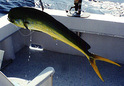
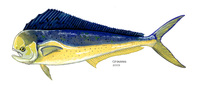
Coryphaena hippurus has a long, slender, tapered body specialized for swimming at high speeds. It has pigmented pelvic fins and bands of pigment laterally on both the body and median fins. There is a square supraorbital region, and the dorsal fin runs nearly to the bright yellow caudal fin. C. hippurus is a bright blue-green dorsally, and yellowish-white with pigments ventrally. Sexual dimorphism is evident, but only noticeable after 6 months of age (Benetti, et al. 1995). Males are physically larger and heavier than females of the same age, and males have a more pronounced neurocranium (Ditty, 1994). Dolphin fish commonly reach 1 meter in length, but can reach up to 2 meters. They usually weight around 14 kg but can weigh more than 30 kg, with a maximum recorded weight of 39.5 kg. (Benetti, et al., 1995a; Ditty, et al., 1994)
- Other Physical Features
- ectothermic
- heterothermic
- bilateral symmetry
- Sexual Dimorphism
- male larger
- sexes shaped differently
-
- Range mass
- 39.5 (high) kg
- 87.00 (high) lb
-
- Average mass
- 14 kg
- 30.84 lb
-
- Range length
- 2 (high) m
- 6.56 (high) ft
-
- Average length
- 1 m
- 3.28 ft
Reproduction
Males and females are sexually mature in their first year, usually by 4-5 months old. Spawning can occur at body lengths of 20 cm. Females may spawn two to three times per year, and produce between 80,000 and 1,000,000 eggs per event.
In waters above 34° C, larvae are found all year, with greater numbers detected in spring and fall. In one study, seventy percent of the youngest larvae collected in the northern Gulf of Mexico were found at a depth greater than 180 meters. Spawning occurs normally in captivity, with 100,000 eggs per event. Problems maintaining salinity, food of adequate nutritional value and proper size, and dissolved oxygen are responsible for larval mortality rates of 20-40% (Lee, 1997). (Beardsley, 1967; Ditty, et al., 1994; Lee, 1997)
- Key Reproductive Features
- iteroparous
- year-round breeding
- gonochoric/gonochoristic/dioecious (sexes separate)
- sexual
- fertilization
- oviparous
-
- Breeding interval
- Nutritional levels are likely to determine how frequently females can spawn.
-
- Breeding season
- In warm waters, spawning can occur year round.
-
- Range number of offspring
- 80,000 to 1,000,000
-
- Range age at sexual or reproductive maturity (female)
- 12 (high) months
-
- Average age at sexual or reproductive maturity (female)
- 4-5 months
-
- Range age at sexual or reproductive maturity (male)
- 12 (high) months
-
- Average age at sexual or reproductive maturity (male)
- 4-5 months
Lifespan/Longevity
In captivity (aquaculture), dolphinfish have not been sustained for more than 18 months (Benetti, 1995). In the wild, they are believed to live an average of 2 years, and a maximum of 5 years (Beardsley, 1967). (Beardsley, 1967; Benetti, et al., 1995b; Ditty, et al., 1994)
-
- Range lifespan
Status: captivity - 18 (high) months
- Range lifespan
-
- Typical lifespan
Status: wild - 5 (high) years
- Typical lifespan
-
- Average lifespan
Status: wild - 2 years
- Average lifespan
-
- Average lifespan
Status: captivity - 4 years
- AnAge
- Average lifespan
Behavior
Dolphin are active generalist predators which expend high amounts of energy in epipelagic regions for prey capture. Due to their oxygen needs, dolphin must swim continuously to ventilate their gills. In order to achieve such high gas exchange, dolphin gills have a larger surface area than those of most other teleosts. This contributes to the higher energy expenditure relative to other teleosts. Dolphin grow most rapidly in the wild, often reaching 1 meter in length and a mass of 8 kilograms at the end of the first year. However, in captivity (aquaculture), dolphin grow more slowly and have less streamlined bodies. This is attributed to reduced swimming due to small tanks and high population density (Benetti, et al. 1995).
Intraspecies cannibalism has been observed in some members (Massuti, et al. 1998).
- Key Behaviors
- natatorial
- motile
Communication and Perception
Food Habits
Dolphin observed in the western Mediterranean are visual generalist predators, and hence feed primarily during the day, when adequate sunlight is available. They feed on teleosts, cephalopods, and crustaceans, with a positive correlation between dolphin size and prey size (Massuti, et al. 1998).
In captivity, dolphin fed a similar diet to that found in the wild (fish, squid, etc.) grow more slowly than those in the wild, but more rapidly than those fed with protein-rich food pellets in captivity (Benetti, 1995).
Economic Importance for Humans: Positive
C. hippurus is one of the most popular sportfish globally. Because it is prized for its meat as well, it is harvested commercially both in the wild and via aquaculture
(Benetti, 1995).
Dolphin grows rapidly in captivity, with low mortality, which has allowed for hatcheries and farms throughout the world (Morgan, et al. 1996; Lee, 1997).
Conservation Status
-
- IUCN Red List
-
Least Concern
More information
-
- IUCN Red List
-
Least Concern
More information
-
- US Federal List
- No special status
-
- CITES
- No special status
Other Comments
Due to recent advancements in larval rearing via prolonged research, dolphin aquaculture presents a potentially lucrative and abundant source of food for humans, and reduces the chance of commercial and sport overfishing in the wild. (Lee, 1997)
Contributors
William Fink (editor), University of Michigan-Ann Arbor.
Joshua Bostwick (author), University of Michigan-Ann Arbor.
Glossary
- Atlantic Ocean
-
the body of water between Africa, Europe, the southern ocean (above 60 degrees south latitude), and the western hemisphere. It is the second largest ocean in the world after the Pacific Ocean.

- Neotropical
-
living in the southern part of the New World. In other words, Central and South America.
- Pacific Ocean
-
body of water between the southern ocean (above 60 degrees south latitude), Australia, Asia, and the western hemisphere. This is the world's largest ocean, covering about 28% of the world's surface.
- bilateral symmetry
-
having body symmetry such that the animal can be divided in one plane into two mirror-image halves. Animals with bilateral symmetry have dorsal and ventral sides, as well as anterior and posterior ends. Synapomorphy of the Bilateria.
- chemical
-
uses smells or other chemicals to communicate
- coastal
-
the nearshore aquatic habitats near a coast, or shoreline.
- ectothermic
-
animals which must use heat acquired from the environment and behavioral adaptations to regulate body temperature
- external fertilization
-
fertilization takes place outside the female's body
- fertilization
-
union of egg and spermatozoan
- heterothermic
-
having a body temperature that fluctuates with that of the immediate environment; having no mechanism or a poorly developed mechanism for regulating internal body temperature.
- iteroparous
-
offspring are produced in more than one group (litters, clutches, etc.) and across multiple seasons (or other periods hospitable to reproduction). Iteroparous animals must, by definition, survive over multiple seasons (or periodic condition changes).
- motile
-
having the capacity to move from one place to another.
- natatorial
-
specialized for swimming
- native range
-
the area in which the animal is naturally found, the region in which it is endemic.
- oviparous
-
reproduction in which eggs are released by the female; development of offspring occurs outside the mother's body.
- pelagic
-
An aquatic biome consisting of the open ocean, far from land, does not include sea bottom (benthic zone).
- saltwater or marine
-
mainly lives in oceans, seas, or other bodies of salt water.
- sexual
-
reproduction that includes combining the genetic contribution of two individuals, a male and a female
- tactile
-
uses touch to communicate
- temperate
-
that region of the Earth between 23.5 degrees North and 60 degrees North (between the Tropic of Cancer and the Arctic Circle) and between 23.5 degrees South and 60 degrees South (between the Tropic of Capricorn and the Antarctic Circle).
- tropical
-
the region of the earth that surrounds the equator, from 23.5 degrees north to 23.5 degrees south.
- year-round breeding
-
breeding takes place throughout the year
References
Beardsley, G. 1967. Age, Growth, and Reproduction of the Dolphin, Coryphaena hippurus, in the Straits of Florida.. Copeia, 1967: 441-451.
Benetti, D., R. Brill, S. Kraul. 1995. The standard metabolic rate of dolphin fish.. Journal of Fish Biology, 46(6): 987-996.
Benetti, D., E. Iverson, A. Ostrowski. 1995. Growth rates of captive dolphin, Coryphaena hippurus, in Hawaii.. Fishery Bulletin, 93(1): 152-157.
Ditty, J., R. Shaw, C. Grimes, J. Cope. 1994. Larval development, distribution, and abundance of common dolphin, Coryphaena hippurus, and pompano dolphin, C. equiselis (family: Coryphaenidae), in the northern Gulf of Mexico.. Fishery Bulletin, 92(2): 275-291.
Lee, C. 1997. Marine finfish hatchery technology in the USA – status and future.. Hydrobiologia, 358(1-3): 45-54.
Massuti, E., S. Deudero, P. Sanchez, B. Morales-Nin. 1998. Diet and feeding of dolphin (Coryphaena hippurus) in western Mediterranean waters.. Bulletin of Marine Science, 63(2): 329-341.
Morgan, J., S. Balfry, M. Vijayan, G. Iwama. 1996. Physiological responses to hyposaline exposure and handling and confinement stress in juvenile dolphin (mahimahi: Coryphanea hippurus).. Canadian Journal of Fisheries and Aquatic Sciences, 53(8): 1736-1740.
Palko, B., G. Beardsley, W. Richards. 1982. Synopsis of the biological data on dolphinfishes, Coryphaena hippurus and Coryphaena equiselis. NMFS Circ. 443: NOAA Tech. Rep..
Potthoff, T. 1980. Development and structure of fins and fin supports in dolphin fishes. Fishery Bulletin, 78(2): 277-312.
Quigley, D., K. Flannery. 1996. Common dolphin-fish Coryphanea hippurus L. in Irish and other north-. Irish Naturalists’ Journal, 25(7): 260-263.