Condylura cristatastar-nosed mole
Geographic Range
Condylura cristata is native to eastern North America. This species ranges further north than other New World talpids, reaching about 55°N latitude in Québec and Newfoundland. The range extends from the Atlantic Ocean west to Manitoba and North Dakota and south to Ohio and Virginia. Condylura cristata is also found along the Atlantic coast south to Georgia as well as throughout the Appalachian mountains. (Kurta, 1995)
Habitat
Star-nosed moles are found in a variety of habitats with moist soil. Unlike other North American moles, Condylura cristata prefers areas of poor drainage, including both coniferous and deciduous forests, clearings, wet meadows, marshes and peatlands. Condylura cristata also inhabits the banks of streams, lakes and ponds, into which it ventures for food. Although it prefers wet areas, this species has been found in dry meadows as far as 400 m from water. Condylura cristata can be found along the coast and is known from elevations up to 1676 m in the Great Smoky Mountains. (Baker, 1983; Hamilton, 1931; Kurta, 1995; Linzey and Brecht, 2004; Lyon, 1936)
- Habitat Regions
- temperate
- terrestrial
- freshwater
- Aquatic Biomes
- lakes and ponds
- rivers and streams
- Other Habitat Features
- riparian
-
- Range elevation
- 0 to 1676 m
- 0.00 to 5498.69 ft
Physical Description
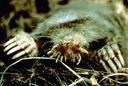
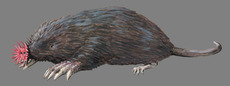
Condylura cristata is one of the most distinctive mammal species. Its nose is hairless and is ringed by a unique 'star' of 22 pink, fleshy tentacles. The star is bilaterally symmetrical with 11 appendages per side that vary in length from between 1 and 4 mm. Condylura cristata ranges from 175 to 205 mm in total length and weighs between 35 and 75 g. Like other moles it has a stout, roughly cylindrical body with heavily-built forelimbs, broad feet and large claws. Its hair is short, dense and coarser than that of other moles. The pelage is dark brown to black on the back and lighter brown underneath. The tail is 65 to 85 mm long, constricted at the base, annulated, scaly and covered with coarse hair. During winter the tail swells 3 to 4 times its normal diameter. Females have 8 mammae, and the testes of males can be 8.8% of the total body weight during the mating season. Sexes are otherwise similar in appearance. (Baker, 1983; Hamilton, 1931; Kurta, 1995; Linzey and Brecht, 2004; Lyon, 1936; Van Vleck, 1965)
Star-nosed moles are the sole living member of the genus Condylura. There are two described subspecies: C. cristata cristata in the north and C. cristata parva in the south. The latter subspecies is distinguished primarily by its smaller size. Two fossil species, C. kowalskii and C. izabellae, are known from the middle Pliocene of Poland. (Petersen and Yates, 1980; Skoczen, 1979)
- Other Physical Features
- endothermic
- bilateral symmetry
- Sexual Dimorphism
- sexes alike
-
- Range mass
- 35 to 75 g
- 1.23 to 2.64 oz
-
- Range length
- 175 to 205 mm
- 6.89 to 8.07 in
-
- Average basal metabolic rate
- 0.615 W
- AnAge
Reproduction
Condylura cristata appears to be monogamous for one breeding season. Males and females are thought to pair up as early as autumn and remain together through the mating season in March and April. Little is known about how the star-nosed mole finds or attracts a mate. (Baker, 1983; Hamilton, 1931)
- Mating System
- monogamous
Condylura cristata mates in the spring from about mid-March through April. Gestation lasts approximately 45 days, and young are born in late April through mid-June. Females produce one litter of offspring per year of between 2 and 7 young, though 5 is a typical litter size. If a female's first reproductive effort was unsuccessful, she may mate again, producing a litter as late as July. At birth the young are hairless, are approximately 49 mm long and weigh about 1.5 g. The eyes and ears are closed and the tentacles of the star are folded back along the rostrum. Eyes, ears and star become functional after about 2 weeks. Young are independent at 30 days and reach maturity at 10 months. (Baker, 1983; Eadie and Hamilton, 1956; Kurta, 1995)
- Key Reproductive Features
- iteroparous
- seasonal breeding
- gonochoric/gonochoristic/dioecious (sexes separate)
- sexual
- viviparous
-
- Breeding interval
- Star nosed moles breed once yearly, though females may mate again if their first litter is unsuccessful.
-
- Breeding season
- Star nosed moles breed from mid-March through April.
-
- Range number of offspring
- 2 to 7
-
- Average number of offspring
- 5
-
- Average number of offspring
- 4.4
- AnAge
-
- Average gestation period
- 45 days
-
- Average weaning age
- 30 days
-
- Average time to independence
- 30 days
-
- Average age at sexual or reproductive maturity (female)
- 10 months
-
- Average age at sexual or reproductive maturity (female)
Sex: female - 304 days
- AnAge
- Average age at sexual or reproductive maturity (female)
-
- Average age at sexual or reproductive maturity (male)
- 10 months
-
- Average age at sexual or reproductive maturity (male)
Sex: male - 304 days
- AnAge
- Average age at sexual or reproductive maturity (male)
Little is known about parental investment in Condylura cristata, but there is likely no post-weaning care. (Baker, 1983)
- Parental Investment
- altricial
Lifespan/Longevity
Not much is known about the lifespan of Condylura cristata in the wild. Since a female's reproductive effort is limited to only 1 litter per year, is is speculated that C. cristata may have a relatively long lifespan for a mammal of its size, perhaps 3 to 4 years. Some star-nosed moles have lived 2 years in captivity. (Baker, 1983; Gould, et al., 1993; Kurta, 1995)
-
- Range lifespan
Status: captivity - 2 (high) years
- Range lifespan
-
- Typical lifespan
Status: wild - 3 to 4 years
- Typical lifespan
-
- Average lifespan
Status: wild - 3 to 4 years
- Average lifespan
-
- Average lifespan
Status: captivity - 2.5 years
- AnAge
- Average lifespan
Behavior
Like many other moles, C. cristata is fossorial, digging a network of tunnels through moist soil. The tunnels are 3.3 to 7.6 cm wide, typically wider than tall, and can extend as much as 270 m along the edge of a suitably wet habitat. The mole digs shallow surface tunnels for foraging but, unlike the eastern mole, it does not dig deeper burrows for protection in the winter. The surface tunnels vary in depth from 3 to 60 cm, only occasionally coming close enough to the surface to cause a raised ridge. The loose soil dug from the tunnels is pushed out onto the surface, forming 'molehills' that can be 60 cm wide and 15 cm high. A spherical nest about 13 cm in diameter is constructed in the tunnel system above the water line, often under a log or similar protective object, and lined with dry leaves or grass. Unlike other North American moles, C. cristata is semiaquatic, so many of its tunnels open under the surface of a stream or lake. Its fossorial forelimbs also make good paddles and it swims underwater with alternate strokes of both front and hind feet, resulting in a characteristic zigzag motion. Condylura cristata is also more active on the surface than other moles, using runways (often made by other small mammals) through meadow or marsh vegetation. Condylura cristata is active throughout the winter, burrowing through snow and even swimming under the ice of frozen ponds. (Baker, 1983; Fisher, 1885; Hamilton, 1931; Hickman, 1983; Kurta, 1995; Lyon, 1936; Merriam, 1884; Rust, 1966; Tenny, 1871; Wiegert, 1961)
The star is used in a number of different activities. When C. cristata is burrowing, the tentacles are held forward over the nostrils to prevent soil from entering the nose. This behavior also occurs while consuming prey. During normal foraging activity, the tentacles are constantly being used to feel the mole's surroundings, moving so rapidly that they appear as a blur of motion, touching as many as 12 objects per second. The upper two tentacles are held more rigidly, straight out in front of the nose. When C. cristata encounters a potential prey item with its star, it focuses the lowest, shortest tentacles on the prey. Using these supersensitive organs, identification of prey can be made in under half a second. (Baker, 1983; Catania, 2002; Hamilton, 1931)
- Key Behaviors
- terricolous
- fossorial
- natatorial
- diurnal
- nocturnal
- crepuscular
- motile
- colonial
-
- Average territory size
- 4000 m^2
Home Range
The home range of an individual star-nosed mole is thought to be less than 4000 square meters. Condylura cristata is more social than other moles in eastern North America and is believed to form small, loose colonies of related individuals. It is not known if more than one mole will share a network of tunnels, other than paired males and females during the breeding season. In favorable habitat, the density of moles may be as great as 75 per hectare, though 25 or fewer per hectare is more common. (Baker, 1983; Eadie and Hamilton, 1956; Hamilton, 1931)
Communication and Perception
Condylura cristata, equipped with its unique star, has perhaps the best sense of touch of any mammal. Each of the 22 appendages that make up the star is completely covered with tiny papillae known as Eimer's organs. Each Eimer's organ contains 3 types of tactile receptors, 2 of which are found in the skin of other mammals. The third type is unique to the star-nosed mole and is thought to allow the mole to identify objects by their microscopic texture. The star possesses over 25,000 Eimer's organs in a space less than 1 square cm, making it incredibly sensitive. A vast portion of the mole's brain is devoted to processing this tactile information. The shortest pair of tentacles at the bottom of the star have the greatest density of Eimer's organs and are apparently used to identify prey items. Although it has not been demonstrated conclusively, it is thought that the star may also be used to detect faint electrical signals from the star-nosed mole's aquatic prey. Laboratory tests have shown that C. cristata seems to be drawn to batteries placed underwater as well as to the areas of strongest electrical activity on prey items. If true, C. cristata and the platypus (Ornithorhynchus anatinus) are the only mammals known to possess this ability.
Although externally visible, the eyes of C. cristata may only be useful for sensing light and dark. Its hearing seems to be excellent, as the external ear openings are much larger than those of other North American species. Its sense of smell is probably also fairly well-developed. Young star-nosed moles make some high-pitched vocalizations and adults are known to make wheezing sounds. There is little information available on how individuals communicate with each other. (Baker, 1983; Catania, 2002; Gould, et al., 1993; Hamilton, 1931; Van Vleck, 1965)
Food Habits
Condylura cristata feeds primarily on invertebrates. Like other fossorial moles, C. cristata patrols its burrows searching for earthworms that enter through the walls. When it has access to a body of water, however, C. cristata prefers to hunt aquatic prey. About half of its diet consists of worms (Annelida), and 80% of these are aquatic species such as leeches. Aquatic insects make up another 30% of its diet, including the larvae of caddisflies (Trichoptera), midges (Chironomidae), dragonflies and damselflies (Odonata), crane flies (Tipulidae), horse flies (Tabanidae), predacious diving beetles (Dytiscidae) and stoneflies (Plecoptera). Condylura cristata will also take occasional terrestrial insects, aquatic crustaceans, mollusks and small fish. (Baker, 1983; Hamilton, 1931; Kurta, 1995; Lyon, 1936; Rust, 1966)
- Primary Diet
-
carnivore
- vermivore
- Animal Foods
- fish
- insects
- mollusks
- terrestrial worms
- aquatic or marine worms
- aquatic crustaceans
Predation
Condylura cristata is preyed upon by a number of different animals. Since this species spends time underwater as well as more time above ground than other moles, it is more vulnerable to predation. From the air, C. cristata is hunted by owls both large and small as well as by hawks during the day. On the ground, both domestic dogs and cats will capture star-nosed moles. A number of mustelids prey on C. cristata, including skunks, weasels, and the fisher. Another mustelid, the mink, is semiaquatic and may hunt Condylura cristata underwater. Other known aquatic predators include the bullfrog and largemouth bass. (Baker, 1983; Christian, 1977; Hamilton, 1931; Kurta, 1995; Linzey and Brecht, 2004)
-
- Known Predators
-
- great horned owls (Bubo virginianus)
- eastern screech owls (Otus asio)
- barred owls (Strix varia)
- barn owls (Tyto alba)
- saw-whet owls (Aegolius acadicus)
- red-tailed hawks (Buteo jamaicensis)
- red-shouldered hawks (Buteo lineatus)
- rough-legged hawks (Buteo lagopus)
- broad-winged hawks (Buteo platypterus)
- domestic dogs (Canis lupus familiaris)
- red foxes (Vulpes vulpes)
- domestic cats (Felis silvestris)
- striped skunks (Mephitis mephitis)
- fishers (Martes pennanti)
- long-tailed weasels (Mustela frenata)
- American minks (Neovison vison)
- bullfrogs (Lithobates catesbeianus)
- largemouth bass (Micropterus salmoides)
Ecosystem Roles
Condylura cristata is an important part of many wetland ecosystems. It provides food for a number of carnivores and is a voracious predator of aquatic invertebrates. By tunneling through moist ground, C. cristata provides aeration to the roots of plants which might otherwise be trapped in anoxic soil. (Baker, 1983; Kurta, 1995; Lyon, 1936)
- Ecosystem Impact
- soil aeration
Economic Importance for Humans: Positive
Condylura cristata benefits humans by preying on the larvae of pest insects. They also aerate the soil of plants that may be beneficial to humans. (Baker, 1983)
- Positive Impacts
- controls pest population
Economic Importance for Humans: Negative
Since C. cristata inhabits poorly-drained wet areas, it is not often found in areas that humans frequent. However, it may occasionally extend its tunnels into lawns adjacent to wetlands, damaging the sod. Trapping is generally an effective way to remove star-nosed moles. (Baker, 1983; Hamilton, 1931)
Conservation Status
Condylura cristata is a relatively common species, and since it is rather inconspicuous and inhabits wet areas, humans do not generally impact this species directly. Large numbers are sometimes caught in muskrat traps, but this does not seem to negatively effect their population size. However, since C. cristata is dependent on wetlands for survival, the ongoing destruction of wetlands to make way for an expanding human population may affect the status of this species in the future. (Baker, 1983; Hamilton, 1931)
-
- IUCN Red List
-
Least Concern
More information
-
- IUCN Red List
-
Least Concern
More information
-
- US Federal List
- No special status
-
- CITES
- No special status
-
- State of Michigan List
- No special status
Contributors
Matthew Wund (editor), University of Michigan-Ann Arbor.
Sean Zera (author), University of Michigan-Ann Arbor, Phil Myers (editor, instructor), Museum of Zoology, University of Michigan-Ann Arbor.
Glossary
- Nearctic
-
living in the Nearctic biogeographic province, the northern part of the New World. This includes Greenland, the Canadian Arctic islands, and all of the North American as far south as the highlands of central Mexico.

- acoustic
-
uses sound to communicate
- altricial
-
young are born in a relatively underdeveloped state; they are unable to feed or care for themselves or locomote independently for a period of time after birth/hatching. In birds, naked and helpless after hatching.
- bilateral symmetry
-
having body symmetry such that the animal can be divided in one plane into two mirror-image halves. Animals with bilateral symmetry have dorsal and ventral sides, as well as anterior and posterior ends. Synapomorphy of the Bilateria.
- bog
-
a wetland area rich in accumulated plant material and with acidic soils surrounding a body of open water. Bogs have a flora dominated by sedges, heaths, and sphagnum.
- carnivore
-
an animal that mainly eats meat
- chemical
-
uses smells or other chemicals to communicate
- colonial
-
used loosely to describe any group of organisms living together or in close proximity to each other - for example nesting shorebirds that live in large colonies. More specifically refers to a group of organisms in which members act as specialized subunits (a continuous, modular society) - as in clonal organisms.
- crepuscular
-
active at dawn and dusk
- diurnal
-
- active during the day, 2. lasting for one day.
- endothermic
-
animals that use metabolically generated heat to regulate body temperature independently of ambient temperature. Endothermy is a synapomorphy of the Mammalia, although it may have arisen in a (now extinct) synapsid ancestor; the fossil record does not distinguish these possibilities. Convergent in birds.
- forest
-
forest biomes are dominated by trees, otherwise forest biomes can vary widely in amount of precipitation and seasonality.
- fossorial
-
Referring to a burrowing life-style or behavior, specialized for digging or burrowing.
- freshwater
-
mainly lives in water that is not salty.
- iteroparous
-
offspring are produced in more than one group (litters, clutches, etc.) and across multiple seasons (or other periods hospitable to reproduction). Iteroparous animals must, by definition, survive over multiple seasons (or periodic condition changes).
- marsh
-
marshes are wetland areas often dominated by grasses and reeds.
- monogamous
-
Having one mate at a time.
- motile
-
having the capacity to move from one place to another.
- natatorial
-
specialized for swimming
- native range
-
the area in which the animal is naturally found, the region in which it is endemic.
- nocturnal
-
active during the night
- riparian
-
Referring to something living or located adjacent to a waterbody (usually, but not always, a river or stream).
- seasonal breeding
-
breeding is confined to a particular season
- sexual
-
reproduction that includes combining the genetic contribution of two individuals, a male and a female
- soil aeration
-
digs and breaks up soil so air and water can get in
- swamp
-
a wetland area that may be permanently or intermittently covered in water, often dominated by woody vegetation.
- tactile
-
uses touch to communicate
- taiga
-
Coniferous or boreal forest, located in a band across northern North America, Europe, and Asia. This terrestrial biome also occurs at high elevations. Long, cold winters and short, wet summers. Few species of trees are present; these are primarily conifers that grow in dense stands with little undergrowth. Some deciduous trees also may be present.
- temperate
-
that region of the Earth between 23.5 degrees North and 60 degrees North (between the Tropic of Cancer and the Arctic Circle) and between 23.5 degrees South and 60 degrees South (between the Tropic of Capricorn and the Antarctic Circle).
- terrestrial
-
Living on the ground.
- visual
-
uses sight to communicate
- viviparous
-
reproduction in which fertilization and development take place within the female body and the developing embryo derives nourishment from the female.
References
Baker, R. 1983. Michigan Mammals. Detroit: Michigan State University Press.
Catania, K. 2002. The Nose Takes a Starring Role. Scientific American, 2002/July: 54-59.
Christian, D. 1977. An Occurrence of Fish Predation on a Star-nosed Mole. Jack-Pine Warbler, 55/1: 43.
Eadie, W., W. Hamilton. 1956. Notes on reproduction in the star-nosed mole. Journal of Mammalogy, 37/2: 223-231.
Fisher, A. 1885. The Star-Nosed Mole Amphibious. The American Naturalist, 19/9: 895.
Gould, E., W. McShea, T. Grand. 1993. Function of the star in the star-nosed mole, Condylura cristata . Journal of Mammalogy, 74/1: 108-116.
Hamilton, W. 1931. Habits of the star-nosed mole, Condylura cristata . Journal of Mammalogy, 12/4: 345-355.
Hickman, G. 1983. Influence of the semiaquatic habitat in determining burrow structure of the star-nosed mole (Condylura cristata). Canadian Journal of Zoology, 61: 1688-1692.
Kurta, A. 1995. Mammals of the Great Lakes Region. Ann Arbor: The University of Michigan Press.
Linzey, D., C. Brecht. 2004. "Condylura cristata (Linnaeus); Star-nosed Mole" (On-line). Discover Life. Accessed February 09, 2004 at http://www.discoverlife.org/nh/tx/Vertebrata/Mammalia/Talpidae/Condylura/cristata/.
Lyon, M. 1936. Mammals of Indiana. American Midland Naturalist, 17/1: 1-373.
Merriam, C. 1884. The star-nosed mole amphibious. Science, 4/92: 429.
Petersen, K., T. Yates. 1980. Condylura cristata. Mammalian Species, 129: 1-4.
Rust, C. 1966. Notes on the star-nosed mole (Condylura cristata). Journal of Mammalogy, 47/3: 538.
Skoczen, S. 1979. Condylura Illiger, 1811 (Insectivora, Talpidae) a new genus of fossil mole for Poland and Old World. Przeglad Zoologiczny, 23/2: 167-171.
Tenny, S. 1871. On the appearance of the star-nosed mole on the snow at Niles, Michigan. The American Naturalist, 5/5: 314.
Van Vleck, D. 1965. The anatomy of the nasal rays of Condylura cristata . Journal of Mammalogy, 46/2: 248-253.
Wiegert, R. 1961. Nest construction and oxygen consumption of Condylura . Journal of Mammalogy, 42/4: 528-529.