Chilopoda


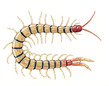


Centipedes are uniramian arthropods whose bodies are made up of a chain of many (up to 177) flattened segments, each except the one behind the head and last two bearing a single pair of appendages (legs). The appendages of the first body segment have been modified to form large, poisonous fangs that are used to capture prey. The bite of a large centipede, however, can be painful to an adult and dangerous to a small child.
Centipedes are predatory, feeding on soil invertebrates such as earthworms and terrestrial insects. All centipedes are terrestrial, but they require moist microhabitats. Fertilization is internal, with spermatophore transferred in ways similar to many arachnids. Centipedes lay eggs, which in some species are carefully brooded by the female. When they hatch, the young resemble miniature adults.
Centipedes are a diverse group, including some 20 families and over 2500 species. Most are small, but a few attain up to 10 inches in length.
References:
- Hickman, C.P. and L. S. Roberts. 1994. Animal Diversity. Wm. C. Brown, Dubuque, IA.
- Brusca, R. C., and G. J. Brusca. Invertebrates. 1990. Sinauer Associates, Sunderland, MA.
- Pearse, V., J. Pearse, M. Buchsbaum, and R. Buchsbaum. 1987. Living Invertebrates. Blackwell Scientific Publications, Palo Alto, Ca.
Contributors
Phil Myers (author), Museum of Zoology, University of Michigan-Ann Arbor.