Chauliodus sloaniManylight viperfish(Also: Sloan's fangfish)
Geographic Range
Chauliodus sloani, commonly called Sloane’s viperfish or Sloane’s fangfish, are known to inhabit almost all marine waters in the temperate and tropical zones. Their range extends from about 63 ° N to 50 ° S. There are a few regions in the Atlantic, Indian, and Pacific Ocean north of the equator where there have been no records of Sloane’s viperfish (Gibbs, 1984). Chauliodus sloani have been found in the Mediterranean and other adjoining seas as well (Gibbs, 1984). (Gibbs, 1984; )
- Biogeographic Regions
- nearctic
- palearctic
- oriental
- ethiopian
- neotropical
- australian
- indian ocean
- atlantic ocean
- pacific ocean
- mediterranean sea
- Other Geographic Terms
- cosmopolitan
Habitat
Chauliodus sloani are primarily bathypelagic fish. The bathypelagic region extends from 1000 to 2000 meters below the surface in the open ocean. They have been collected from a maximum depth of 2800 meters (Butler et al., 2001). Chauliodus sloani engage in asynchronous diel vertical migration which means that during the night they can be found in less deep regions such as the mesopelagic, which generally characterizes the depth range of 200 to 1000 meters (Sutton and Hopkins, 1996). It is thought that Sloane’s viperfish prefer regions of higher dissolved oxygen content because other relatives such as Chauliodus pammelas have more highly developed gills (Butler et al., 2001). (Butler, et al., 2001; Sutton and Hopkins, 1996)
- Habitat Regions
- temperate
- tropical
- saltwater or marine
- Aquatic Biomes
- pelagic
-
- Range depth
- 400 to 2800 m
- 1312.34 to 9186.35 ft
Physical Description
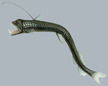
Sloane’s fangfish are very slender with a maximum length of 35 centimeters (Gibbs, 1984). These iridescent fish come in shades of blue, green, black, or silver. Chauliodus sloani have an adipose fin and a forked caudal fin and their dorsal fin is positioned right behind the head (Gibbs, 1984). Almost all of the fins contain soft rays. The first soft ray of the dorsal fin is elongated and extends to about half the length of the body (McGrouther, 2003). These fish have approximately 2.4 % lipid content in their body (Gibbs, 1984). This low lipid content and the fact that they vertically migrate indicate that Chauliodus sloani probably have some form of swim bladder (Gartner, Crabtree and Sulak, 1997). Members of the genus Chauliodus are believed to eat at least once every 12 days which suggests a relatively low basal metabolic rate (Butler et al., 2001). The lower jaw protrudes beyond the upper jaw and both are lined with fang-like teeth which give the fish its common name. There are rows of 24 or more photophores (light-producing cells) along the lateral and ventral surface of the fish (Butler et al., 2001). They are not sexually dimorphic. (Butler, et al., 2001; Gartner, et al., 1997; Gibbs, 1984; McGrouther, 2003; )
- Other Physical Features
- ectothermic
- bilateral symmetry
- Sexual Dimorphism
- sexes alike
-
- Range length
- 35 (high) cm
- 13.78 (high) in
Development
The larvae of Chauliodus sloani are similar in appearance to the leptocephalus of eels and are approximately 6 millimeters long when hatched. When they double in size the pectoral and caudal fins begin to develop (Gibbs, 1984). It is not known how long Chauliodus sloani take to grow from the larval stage to the adult form. (Gibbs, 1984; )
- Development - Life Cycle
- metamorphosis
Reproduction
Hardly anything is known about the mating system of Chauliodus sloani. Factors such as the depth at which they live and the fact that they do not survive very long in captivity make it very difficult to study this behavior (Christophe, Baguet, and Marechal, 1979). (Christophe, et al., 1979)
Very little is known about the reproductive habits of Chauliodus sloani but like many fish they are dioecious (Gibbs, 1984). Sloane’s viperfish are not known to be sexually dimorphic since the specimens caught are rarely sexed. Since differences in species-specific photophore stimulations exist, it can be presumed that the light emissions are used in communication activities between individuals such as mate attraction (Christophe, Baguet and Marechal, 1979). Several sources have noted that external spawning takes place in this oviparous species (McGrouther, 2003). Chauliodus sloani are low fecundity organisms (Gibbs, 1984). Spawning probably occurs year round in the species although the larvae are known to be in the highest numbers from January to March (Gibbs, 1984). (Christophe, et al., 1979; Gibbs, 1984; McGrouther, 2003; )
- Key Reproductive Features
- year-round breeding
- gonochoric/gonochoristic/dioecious (sexes separate)
- sexual
- oviparous
-
- Breeding season
- Year-round
Like other types of reproductive characteristics, very little information has been gathered in respect to the parental investment of Chauliodus sloani.
Lifespan/Longevity
Due to the difficulty of studying them in the wild, there is very little data on the lifespan of Sloane’s viperfish. Studies of the bands in the otoliths (plates in the inner ear) have yielded an estimated longevity of 15 to 30 years for most deep-sea fishes. However, it's difficult to know whether these bands occur strictly at annual intervals (Haedrich, 1997). Chauliodus sloani specimens have been contained in captivity for as long as 12-18 hours (Christophe, Baguet and Marechal, 1979). (Christophe, et al., 1979; Haedrich, 1997)
-
- Range lifespan
Status: captivity - 12 to 18 hours
- Range lifespan
-
- Typical lifespan
Status: wild - 15 to 30 years
- Typical lifespan
Behavior
Chauliodus sloani inhabit depths that make them very difficult to study. For this reason, very little is known about their behavior. As mentioned above, they vertically migrate during the night. Many fish do this to improve their chances of finding food and to avoid predators that could normally see them during the day. However, in an asynchronous diel pattern, only some individuals migrate and the depths of migration may vary. It is noted that larger specimens of Chauliodus sloani tend to reside at a greater average depth than smaller specimens (Butler et al., 2001). (Butler, et al., 2001)
- Key Behaviors
- natatorial
- diurnal
- nocturnal
- motile
- solitary
Home Range
Chauliodus sloani are not known to have a specific home range. This is due to the difficulty in studying them in their own environment.
Communication and Perception
Since the eyes are rather large in Sloane's viperfish, it is presumed that they have retained use of sight as a form of perception (Gartner, Crabtree and Sulak, 1997). Chauliodus sloani, like other deep-water fish, also probably make use of their bioluminescent photophores to communicate with other conspecifics (Christophe, Baguet and Marechal, 1979). (Christophe, et al., 1979; Gartner, et al., 1997)
- Other Communication Modes
- photic/bioluminescent
Food Habits
Sloane’s viperfish have some characteristics typical of deep-water fishes which aid in acquiring food in regions of low light. These features include a straight intestine and an elongated, distensible stomach (Gartner, Crabtree and Sulak, 1997). They also have a relatively large gape, and hinged fangs. This specialized dentition can rotate inward to prevent prey from escaping and ease its passage into the gullet (Gartner, Crabtree and Sulak, 1997). Another feature that is unique to the genus Chauliodus is a hinged connection between the skull and backbone that rotates the skull upward to allow further manipulation of large prey into the throat (Gartner, Crabtree and Sulak, 1997). Chauliodus sloani prey on a variety of nektonic, planktonic, and benthic organisms. This includes other bony fishes and crustaceans. Some examples of nektonic prey include Cyclothone, Bregmaceros, Diaphus, Lampanyctus, and Myctophum (Gibbs, 1984). Larger specimens of Sloane’s fangfish are believed to be exclusively piscivorous while the smaller or younger fish consume a higher ratio of marine arthropods (Butler et al., 2001). Chauliodus sloani are known to be able to prey on fish that are 63 % of their own body length (Butler et al., 2001). These fish acquire food by arching their elongated first dorsal ray over the head and in front of the mouth as a lure (Gartner, Crabtree and Sulak, 1997). They may use their photophores to attract prey as well (McGrouther, 2003). As asynchronous diel migrators, they are presumed to wait at depths that act as common passages for other vertical migrators and catch prey as they ascend to feed (Gartner, Crabtree and Sulak, 1997). (Butler, et al., 2001; Gartner, et al., 1997; Gibbs, 1984; McGrouther, 2003; )
- Animal Foods
- fish
- aquatic crustaceans
Predation
Chauliodus sloani are preyed upon by larger bathy- and mesopelagic nekton. Remains of Sloane’s viperfish have been found in the stomach of Coryphaena hippurus, some mammalian dolphins (Lagenodelphis, Stenella) and various sharks (Centroscymnus, Galeus). Many species of the family Merlucciidae have been known to prey on Chauliodus sloani as well (Gibbs, 1984). The dark colorings and lack of light at very great depths are the only known sources of protection against predators. These anti-predator characteristics couple with an asynchronous pattern of diel migration to help Chauliodus sloani avoid being eaten (Butler et al., 2001). (Butler, et al., 2001; Gibbs, 1984; )
- Anti-predator Adaptations
- cryptic
-
- Known Predators
-
- common dolphinfish (Coryphaena hippurus)
- Fraser's dolphins (Lagenodelphis hosei)
- spinner dolphins (Stenella longirostris)
- blackmouth catsharks (Galeus melastomus)
- portuguese dogfish (Centroscymnus coelolepis)
- coster dories (Allocyttus verrucosus)
- orange roughy (Hoplostethus atlanticus)
Ecosystem Roles
Sloane’s fangfish function as higher-trophic level predators in their ecosystem (Gartner, Crabtree, and Sulak, 1997). They are considered to be very important contributors to the predation on myctophids (Butler et al., 2001). Chauliodus sloani serve as prey for the few types of organisms mentioned above. (Butler, et al., 2001; Gartner, et al., 1997)
- Ecosystem Impact
- keystone species
Economic Importance for Humans: Positive
Chauliodus sloani have no known positive impact on humans. Their deep water range limits any type of contact with humans on a regular basis other than the few that are caught in deep water trawls. Since they are among the most common stomiids caught, they provide an opportunity for research on bioluminescence in the deep sea and the behavior of other deep-sea fish (Sutton and Hopkins, 1996). (Sutton and Hopkins, 1996)
- Positive Impacts
- research and education
Economic Importance for Humans: Negative
Despite their fearsome appearance, Chauliodus sloani are considered to be harmless to humans. As noted above, this is due to the rare occurrence of contact with humans (Gibbs, 1984). (Gibbs, 1984; )
Conservation Status
Chauliodus sloani are not on the IUCN Red List and are not known to have any specific conservation status (Gibbs, 1984). It would be suspected that due to the deep-water range of this stomiid, it is very difficult to characterize the overall population of this species. There is probably very little impact from humans that would cause any negative conservation status for Chauliodus sloani. (Gibbs, 1984; )
-
- IUCN Red List
- Not Evaluated
-
- US Federal List
- No special status
-
- CITES
- No special status
Other Comments
Sloane’s viperfish were first identified by Bloch and Schneider in 1801 (McGrouther, 2003). The genus name Chauliodus (for which nine different species are known) comes from the Greek words chaulios which means “open-mouthed” and odous which refers to “teeth” (Gibbs, 1984). (Gibbs, 1984; McGrouther, 2003; )
Contributors
Matthew Wund (editor), University of Michigan-Ann Arbor.
Daniel Swanson (author), University of Michigan-Ann Arbor, William Fink (editor, instructor), University of Michigan-Ann Arbor.
Glossary
- Atlantic Ocean
-
the body of water between Africa, Europe, the southern ocean (above 60 degrees south latitude), and the western hemisphere. It is the second largest ocean in the world after the Pacific Ocean.

- Australian
-
Living in Australia, New Zealand, Tasmania, New Guinea and associated islands.
- Ethiopian
-
living in sub-Saharan Africa (south of 30 degrees north) and Madagascar.
- Nearctic
-
living in the Nearctic biogeographic province, the northern part of the New World. This includes Greenland, the Canadian Arctic islands, and all of the North American as far south as the highlands of central Mexico.
- Neotropical
-
living in the southern part of the New World. In other words, Central and South America.
- Pacific Ocean
-
body of water between the southern ocean (above 60 degrees south latitude), Australia, Asia, and the western hemisphere. This is the world's largest ocean, covering about 28% of the world's surface.
- Palearctic
-
living in the northern part of the Old World. In otherwords, Europe and Asia and northern Africa.
- bilateral symmetry
-
having body symmetry such that the animal can be divided in one plane into two mirror-image halves. Animals with bilateral symmetry have dorsal and ventral sides, as well as anterior and posterior ends. Synapomorphy of the Bilateria.
- carnivore
-
an animal that mainly eats meat
- chemical
-
uses smells or other chemicals to communicate
- cosmopolitan
-
having a worldwide distribution. Found on all continents (except maybe Antarctica) and in all biogeographic provinces; or in all the major oceans (Atlantic, Indian, and Pacific.
- cryptic
-
having markings, coloration, shapes, or other features that cause an animal to be camouflaged in its natural environment; being difficult to see or otherwise detect.
- diurnal
-
- active during the day, 2. lasting for one day.
- ectothermic
-
animals which must use heat acquired from the environment and behavioral adaptations to regulate body temperature
- keystone species
-
a species whose presence or absence strongly affects populations of other species in that area such that the extirpation of the keystone species in an area will result in the ultimate extirpation of many more species in that area (Example: sea otter).
- metamorphosis
-
A large change in the shape or structure of an animal that happens as the animal grows. In insects, "incomplete metamorphosis" is when young animals are similar to adults and change gradually into the adult form, and "complete metamorphosis" is when there is a profound change between larval and adult forms. Butterflies have complete metamorphosis, grasshoppers have incomplete metamorphosis.
- motile
-
having the capacity to move from one place to another.
- natatorial
-
specialized for swimming
- native range
-
the area in which the animal is naturally found, the region in which it is endemic.
- nocturnal
-
active during the night
- oriental
-
found in the oriental region of the world. In other words, India and southeast Asia.
- oviparous
-
reproduction in which eggs are released by the female; development of offspring occurs outside the mother's body.
- pelagic
-
An aquatic biome consisting of the open ocean, far from land, does not include sea bottom (benthic zone).
- photic/bioluminescent
-
generates and uses light to communicate
- piscivore
-
an animal that mainly eats fish
- saltwater or marine
-
mainly lives in oceans, seas, or other bodies of salt water.
- sexual
-
reproduction that includes combining the genetic contribution of two individuals, a male and a female
- solitary
-
lives alone
- tactile
-
uses touch to communicate
- temperate
-
that region of the Earth between 23.5 degrees North and 60 degrees North (between the Tropic of Cancer and the Arctic Circle) and between 23.5 degrees South and 60 degrees South (between the Tropic of Capricorn and the Antarctic Circle).
- tropical
-
the region of the earth that surrounds the equator, from 23.5 degrees north to 23.5 degrees south.
- visual
-
uses sight to communicate
- year-round breeding
-
breeding takes place throughout the year
References
Butler, M., S. Bollens, B. Burkhalter, L. Madin, E. Horgan. 2001. Mesopelagic fishes of the Arabian Sea: distributrion, abundance and diet of Chauliodus pammelas, Chauliodus sloani, Stomias affinis, and Stomias nebulosus. Deep Sea Research Part II: Topical Stuides in Oceanography, 48/6-7: 1369-1383.
Christophe, B., F. Baguet, G. Marechal. 1979. Luminescence of Chauliodus photophores by electrical stimulation. Comparative Biochemistry and Physiology A: Comparative Physiology, 64A: 367-372.
Gartner, J., R. Crabtree, K. Sulak. 1997. Deep-Sea Fishes: Feeding at Depth. San Diego: Academic Press Limited.
Gibbs, R. 1984. Chauliodontidae. Pp. 336-337 in P Whitehead, M Bauchot, J Hureau, J Nielsen, E Tortonese, eds. Fishes of the north-eastern Atlantic and the Mediterranean, Vol. 1. Paris: UNESCO. Accessed November 11, 2004 at http://www.fishbase.org/Summary/SpeciesSummary.cfm?ID=1786&genusname=Chauliodus&speciesname=sloani.
Haedrich, R. 1997. Deep-Sea Fishes: Distribution and Population Ecology. San Diego: Academic Press Limited.
McGrouther, M. 2003. "Australian Museum Online" (On-line). Accessed October 24, 2004 at http://www.amonline.net.au/fishes/fishfacts/fish/csloani.htm.
Sutton, T., T. Hopkins. 1996. Species composition, abundance, and vertical distribution of the stomiid (Pisces: Stomiiformes) fish assemblage of the Gulf of Mexico. Bulletin of Marine Science, 59/3: 530-542.