Chaetura pelagicachimney swift

Geographic Range
Chimney swifts are found from central Alberta to Newfoundland, and south to Florida, the Gulf states, and eastern Texas. They are migratory, wintering at the headwaters of the Amazon in western Brazil and eastern Peru. Chimney swifts are considered accidental species in Greenland and Bermuda. (Palmer and Fowler, 1975)
- Biogeographic Regions
- nearctic
- neotropical
Habitat
In temperate zones, chimney swifts are found most often in areas settled by humans. In the tropics, they are also found near irrigated agricultural lands and areas inhabited by humans. In natural tropical settings, chimney swifts are found at the edge of rivers bordered by forest or the edge of lowland evergreen forests and secondary growth scrub, and even over the Andean valleys in Peru and Ecuador. They can be found at elevations of 2500 m. (Chantler and Driessens, 2000)
- Habitat Regions
- temperate
- tropical
- terrestrial
- Terrestrial Biomes
- forest
- rainforest
- scrub forest
- mountains
- Other Habitat Features
- suburban
- agricultural
- riparian
-
- Range elevation
- 2500 (high) m
- 8202.10 (high) ft
Physical Description
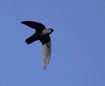
In general, chimney swifts are a dark grayish to brownish-gray, sooty color. Males and females look alike. The tail has stiff bristle-like or spiny feather tips (Palmer and Fowler, 1975; Whittemore, 1981). There may be as many as seven tail spines (Chantler and Driessens, 2000). They have been described as resembling a "flying cigar" (Palmer and Fowler, 1975). Chimney swifts have large eyes. They weigh 21.33 g on average. Wing length averages 130.4 mm and tail length averages 39.1 mm (Chantler and Driessens, 2000). (Chantler and Driessens, 2000; Palmer and Fowler, 1975; Whittemore, 1981)
- Other Physical Features
- endothermic
- bilateral symmetry
- Sexual Dimorphism
- sexes alike
-
- Average mass
- 21.33 g
- 0.75 oz
-
- Average mass
- 22.8 g
- 0.80 oz
- AnAge
Reproduction
Chimney swifts are monogamous; records indicate that some chimney swifts will remain with the same mate for up to eight or nine years. (Dexter, 1969)
- Mating System
- monogamous
The breeding season for chimney swifts is from May to July. Nests are placed in the dark in chimneys and occasionally in hollow trees. The basket-like, half-cup nest consists of sticks and is secured to the wall of a chimney by secreted mucilage (saliva). It is usually at least 15.5 m off the ground, but this can vary greatly (Palmer and Fowler, 1975; Whittemore, 1981; Chantler and Driessens, 2000).
Three to seven white, somewhat glossy eggs are laid per clutch (Palmer and Fowler, 1975; Whittemore, 1981; Chantler and Driessens, 2000). Each egg is approximately 2.0 by 1.3 cm. Both parents incubate the eggs (Palmer and Fowler, 1975), and the incubation period is from 19 to 21 days (Chantler and Driessens, 2000). Females will cover the eggs or young at night. Nestlings may leave the nest 14 to 19 days after hatching, but the first flight typically occurs 30 days after hatching (Chantler and Driessens, 2000). Chimney swifts can have more than one brood per season, and will re-nest if the first nest and eggs are destroyed (Whittemore, 1981).
Some nesting colonies can be quite large, made up of thousands of individuals (Chantler and Driessens, 2000). The size of the nesting colony depends on the size of the roosting site; usually there are a few pairs to a few hundred birds in a colony (Dexter, 1969; Chantler and Driessens, 2000). (Chantler and Driessens, 2000; Palmer and Fowler, 1975; Whittemore, 1981)
- Key Reproductive Features
- iteroparous
- seasonal breeding
- gonochoric/gonochoristic/dioecious (sexes separate)
- sexual
- fertilization
- oviparous
-
- Breeding interval
- Chimney swifts breed once yearly, but occasionally have more than one brood per season.
-
- Breeding season
- Breeding occurs from May to July.
-
- Range eggs per season
- 4 to 7
-
- Average eggs per season
- 5
-
- Average eggs per season
- 4
- AnAge
-
- Range time to hatching
- 19 to 21 days
-
- Range fledging age
- 14 to 19 days
Young chimney swifts are altricial and are fed by both parents.
Sometimes birds other than the breeding pair will help feed and care for young, a behavior called extra-parental cooperation or cooperative breeding. Chimney swifts are known to form cooperative breeding groups of three to four birds. These groups may remain as a nesting unit throughout the season, sharing incubation, brooding, and feeding duties (Dexter, 1952; Chantler and Driessens, 2000). Records indicate that one colony had more than one-third of the breeding pairs form cooperative groups; there were 22 threesomes and 6 foursomes (Dexter, 1952). (Chantler and Driessens, 2000; Dexter, 1952)
- Parental Investment
- no parental involvement
- altricial
- pre-fertilization
-
pre-hatching/birth
- protecting
-
pre-weaning/fledging
-
provisioning
- male
- female
-
provisioning
Lifespan/Longevity
A female chimney swift was recorded to have lived ten years (Dexter, 1956). (Dexter, 1956)
-
- Range lifespan
Status: wild - 10 (high) years
- Range lifespan
-
- Average lifespan
Status: wild - 168 months
- Bird Banding Laboratory
- Average lifespan
Behavior
Chimney swifts use both their feet and tail to cling to vertical surfaces (Whittemore, 1981). These birds are highly gregarious, and several thousand may be found roosting in large industrial chimneys (Chantler and Driessens, 2000).
Migration begins in August and continues into early October. No chimney swifts have been recorded in the northern part of their range after October. They return in early spring, usually in April (Dexter, 1969; Chantler and Driessens, 2000). (Chantler and Driessens, 2000; Dexter, 1969; Whittemore, 1981)
Home Range
We do not have information on the home range for chimney swifts at this time.
Communication and Perception
Chimney swift calls are described as a twitter (Palmer and Fowler, 1975). The most common twitterings are accelerating and decelerating chipping (Chantler and Driessens, 2000).
Chimney swifts also are likely to use touch and vision in communication. They perceive their environment through vision, hearing, touch, and a weakly developed sense of smell. (Chantler and Driessens, 2000; Palmer and Fowler, 1975)
Food Habits
Chimney swifts feed exclusively while in flight. They are primarily insectivores (Palmer and Fowler, 1975). They forage by hovering over tree branches and catching insects in flight; they take a variety of insect and spider prey. Forty to fifty chimney swifts were recorded hovering at the outer branches or diving through the top branches of a sweetgum tree in pursuit of a particular species of weevil (Chantler and Driessen, 2000). (Chantler and Driessens, 2000; Palmer and Fowler, 1975)
- Primary Diet
-
carnivore
- insectivore
- eats non-insect arthropods
- Animal Foods
- insects
- terrestrial non-insect arthropods
Predation
Chimney swifts are occasionally eaten by hawks and falcons.
-
- Known Predators
-
- hawks (Accipitridae)
- falcons (Falconidae)
Ecosystem Roles
As insectivores chimney swifts affect insect populations throughout their range.
Economic Importance for Humans: Positive
Chimney swifts are valuable as erradicators of insect pests. (Palmer and Fowler, 1975)
- Positive Impacts
- controls pest population
Economic Importance for Humans: Negative
There are no known adverse affects of chimney swifts on humans.
Conservation Status
Chimney swifts have been described as being as peaceful as doves and always worthy of protection (Whittemore, 1981). They are protected by the Migratory Bird Treaty Act, but are not listed by CITES, US ESA or the IUCN. (Whittemore, 1981)
-
- IUCN Red List
-
Near Threatened
More information
-
- IUCN Red List
-
Near Threatened
More information
-
- US Migratory Bird Act
- Protected
-
- US Federal List
- No special status
-
- CITES
- No special status
-
- State of Michigan List
- No special status
Other Comments
Bird's nest soup is made from the nest of an Asiatic swift, a close relative of the chimney swift. The soup is based on the dried saliva that holds the nest together (Palmer and Fowler, 1975). Another close relative of chimney swifts are Vaux's swifts, Chaetura vauxi, which occur in the western United States (Palmer and Fowler, 1975; Whittemore, 1981).
From 1918 to 1932, over 1,600 people visited National, Iowa to study the nesting habits of chimney swifts in a tower designed by Althea Sherman and built in 1915 by local carpenters. The bird tower was approximately 8.5 meters high and 0.3 meters square. An artificial chimney, running down the center of the tower, measured approximately half the tower's height. A door and two glass windows allowed people to enter and observe the chimney swifts. After Althea Sherman's death, the tower was moved to the Andy Mountain Camp Ground, Harper's Ferry, Iowa. In the early 1980's, the tower was still standing and was being used for chimney swift studies (Whittemore, 1981). (Palmer and Fowler, 1975; Whittemore, 1981)
Contributors
Alaine Camfield (editor), Animal Diversity Web.
Janice Pappas (author), University of Michigan-Ann Arbor.
Glossary
- Nearctic
-
living in the Nearctic biogeographic province, the northern part of the New World. This includes Greenland, the Canadian Arctic islands, and all of the North American as far south as the highlands of central Mexico.

- Neotropical
-
living in the southern part of the New World. In other words, Central and South America.
- acoustic
-
uses sound to communicate
- agricultural
-
living in landscapes dominated by human agriculture.
- altricial
-
young are born in a relatively underdeveloped state; they are unable to feed or care for themselves or locomote independently for a period of time after birth/hatching. In birds, naked and helpless after hatching.
- bilateral symmetry
-
having body symmetry such that the animal can be divided in one plane into two mirror-image halves. Animals with bilateral symmetry have dorsal and ventral sides, as well as anterior and posterior ends. Synapomorphy of the Bilateria.
- carnivore
-
an animal that mainly eats meat
- chemical
-
uses smells or other chemicals to communicate
- colonial
-
used loosely to describe any group of organisms living together or in close proximity to each other - for example nesting shorebirds that live in large colonies. More specifically refers to a group of organisms in which members act as specialized subunits (a continuous, modular society) - as in clonal organisms.
- endothermic
-
animals that use metabolically generated heat to regulate body temperature independently of ambient temperature. Endothermy is a synapomorphy of the Mammalia, although it may have arisen in a (now extinct) synapsid ancestor; the fossil record does not distinguish these possibilities. Convergent in birds.
- fertilization
-
union of egg and spermatozoan
- forest
-
forest biomes are dominated by trees, otherwise forest biomes can vary widely in amount of precipitation and seasonality.
- insectivore
-
An animal that eats mainly insects or spiders.
- iteroparous
-
offspring are produced in more than one group (litters, clutches, etc.) and across multiple seasons (or other periods hospitable to reproduction). Iteroparous animals must, by definition, survive over multiple seasons (or periodic condition changes).
- migratory
-
makes seasonal movements between breeding and wintering grounds
- monogamous
-
Having one mate at a time.
- motile
-
having the capacity to move from one place to another.
- mountains
-
This terrestrial biome includes summits of high mountains, either without vegetation or covered by low, tundra-like vegetation.
- native range
-
the area in which the animal is naturally found, the region in which it is endemic.
- oviparous
-
reproduction in which eggs are released by the female; development of offspring occurs outside the mother's body.
- rainforest
-
rainforests, both temperate and tropical, are dominated by trees often forming a closed canopy with little light reaching the ground. Epiphytes and climbing plants are also abundant. Precipitation is typically not limiting, but may be somewhat seasonal.
- riparian
-
Referring to something living or located adjacent to a waterbody (usually, but not always, a river or stream).
- scrub forest
-
scrub forests develop in areas that experience dry seasons.
- seasonal breeding
-
breeding is confined to a particular season
- sexual
-
reproduction that includes combining the genetic contribution of two individuals, a male and a female
- social
-
associates with others of its species; forms social groups.
- suburban
-
living in residential areas on the outskirts of large cities or towns.
- tactile
-
uses touch to communicate
- temperate
-
that region of the Earth between 23.5 degrees North and 60 degrees North (between the Tropic of Cancer and the Arctic Circle) and between 23.5 degrees South and 60 degrees South (between the Tropic of Capricorn and the Antarctic Circle).
- terrestrial
-
Living on the ground.
- tropical
-
the region of the earth that surrounds the equator, from 23.5 degrees north to 23.5 degrees south.
- visual
-
uses sight to communicate
References
Chantler, P., G. Driessens. 2000. Swifts: A Guide to the Swifts and Treeswifts of the World, 2nd. ed. Sussex: Pica Press.
Dexter, R. 1969. Banding and nesting studies of the Chimney Swift, 1944-1968. The Ohio Journal of Science, 69(4): 193-213.
Dexter, R. 1952. Extra-parental cooperation in the nesting of Chimney Swifts. The Wilson Bulletin, 64(3): 133-139.
Dexter, R. 1956. Ten-year life history of a banded Chimney Swift. The Auk, 73: 276-280.
Palmer, E., H. Fowler. 1975. Fieldbook of Natural History, 2nd ed. New York: McGraw-Hill, Inc.
Whittemore, M. 1981. Chimney Swifts and Their Relatives. Jackson, MS: Nature Books Publishers.