Cerdocyon thouscrab-eating fox

Geographic Range
The crab-eating fox (Cerdocyon thous) is distributed from Colombia and Venezuela south to Paraguay, Uruguay and Northern Argentina (Eisenberg, 1999).
- Biogeographic Regions
- neotropical
Habitat
The habitat of C. thous includes mostly savannahs and woodlands, however this species is known to inhabit a variety of other areas including edge and forested areas (Eisenberg, 1999). These foxes may use higher ground during the rainy season, and lowlands during the dry season (Nowak, 1999).
- Habitat Regions
- tropical
- Terrestrial Biomes
- forest
Physical Description
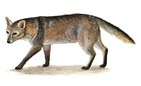
Generally, the crab-eating fox resembles the size and shape of most foxes. The coat is gray-brown on dorsally, with the face, ears, and legs reddish. The throat and underside of C. thous is white. The tips of the ears, tail, and legs are black. C. thous has short, robust legs. The head and body length averages 643 mm and the average tail length is 285 mm (Berta, 1982). These foxes weigh between five and eight kg.
- Other Physical Features
- endothermic
- homoiothermic
- bilateral symmetry
-
- Range mass
- 5 to 8 kg
- 11.01 to 17.62 lb
-
- Average length
- 643 mm
- 25.31 in
-
- Average basal metabolic rate
- 8.502 W
- AnAge
Development
See Reproduction.
Reproduction
Captive crab-eating foxes are monogamous and often breed twice per year in intervals of 7 to 8 months with a possible peak in births during January or February (Berta, 1982).
- Mating System
- monogamous
Breeding in C. thous takes place throughout the year, but peaks November or December (Canid Specialist Group, 1998). The gestation period of C. thous averages 56 days, leading to a peak of births in January and February (Nowak, 1999). Females produce between 3 and 6 pups per litter (Medel, 1988). Captive females have been known to reproduce twice annually, although information for wild crab-eting foxes is not available. At birth, C. thous pups weigh between 120 and 160 grams. They are born without teeth, and their eyes and ears closed (Berta, 1982). The eyes of the newborns open at 14 days, and they start digesting solid food at 30 days. Pups are weaned at 90 days (Nowak, 1999). The pups' coats are charcoal grey with a yellowish-brown patch on the lower abdomen. Twenty days after birth the pelage starts to change, and by the 35th day pups show adult pelage (Berta, 1982). Sexual maturity is reached by the first year. Raised leg urination (in both sexes) is indicative of sexual maturity in C. thous (Berta,1982; Medel, 1988).
- Key Reproductive Features
- iteroparous
- year-round breeding
- gonochoric/gonochoristic/dioecious (sexes separate)
- sexual
- fertilization
- viviparous
-
- Breeding season
- Peak breeding occurs in November and December.
-
- Range number of offspring
- 3 to 6
-
- Average number of offspring
- 4
-
- Average number of offspring
- 4
- AnAge
-
- Range gestation period
- 52 to 59 days
-
- Average gestation period
- 56 days
-
- Average weaning age
- 90 days
-
- Average age at sexual or reproductive maturity (female)
- 9 months
-
- Average age at sexual or reproductive maturity (female)
Sex: female - 274 days
- AnAge
- Average age at sexual or reproductive maturity (female)
-
- Average age at sexual or reproductive maturity (male)
- 9 months
-
- Average age at sexual or reproductive maturity (male)
Sex: male - 274 days
- AnAge
- Average age at sexual or reproductive maturity (male)
The female nurses the young for about 90 days. When solid food is ingested (around 30 days) both parents bring the young food. Both parents guard the young (Nowak, 1999).
- Parental Investment
- altricial
- male parental care
- female parental care
Lifespan/Longevity
In captivity the crab-eating fox has been known to live up to eleven years six months (Nowak, 1999).
-
- Range lifespan
Status: captivity - 11 (high) years
- Range lifespan
-
- Average lifespan
Status: captivity - 11.5 years
- Max Planck Institute for Demographic Research
- Average lifespan
Behavior
The crab-eating fox is nocturnal and lives in monogamous pairs (Eisenberg, 1999). They travel in pairs but hunt individually (Berta, 1982). Their home range varies between 0.6 to 0.9 km2 (Eisenberg, 1999). During the dry season, they tend to be more territorial than during the wet season, however overlap of territories is common (Nowak, 1995).
- Key Behaviors
- nocturnal
- crepuscular
- motile
- sedentary
- territorial
- social
Communication and Perception
Food Habits
The crab-eating fox is omnivorous. In one study their diet included 25.3% small mammals, 24.1% reptiles, 0.6% marsupials, 0.6% rabbits, 10.3% birds, 35.1% amphibians, and 5.2% fish (Medel, 1988). However, in other studies (see Berta, 1982) the porportion of animals consumed is different, suggesting an opportunistic feeding behavior, and they may shift their food habits seasonally. During the wet season in the low llanos, crabs and other crustaceans are consumed, whereas during the dry season their diet contained more insects (Berta, 1982).
- Primary Diet
-
carnivore
- eats terrestrial vertebrates
- insectivore
- eats non-insect arthropods
- Animal Foods
- birds
- mammals
- amphibians
- reptiles
- fish
- insects
- terrestrial non-insect arthropods
- aquatic crustaceans
Predation
Predation upon this species has not been reported.
Ecosystem Roles
Because of its role as a predator, C. thous may help to control populations of small mammals, insects, fish, and crabs.
Economic Importance for Humans: Positive
Although the pelt is worth little, the crab-eating fox is hunted intensively (Berta, 1982).
Economic Importance for Humans: Negative
There is little evidence that C. thous impacts the local livestock, however the animal is often shot by local farmers and ranchers (Canid Specialist Group, 1995).
Conservation Status
C. thous is listed in CITES Appendix II (CITES, 2000), but the Argentine Wildlife board has declared the crab-eating fox out of danger (Canid Specialist Group, 1998).
-
- IUCN Red List
-
Least Concern
More information
-
- IUCN Red List
-
Least Concern
More information
-
- CITES
- Appendix II
Other Comments
C. thous was formerly known as Dusicyon thous. C. thous is a monotypic species but formerly the subgenera Atelocynus and Speothos were included in Cerdocyon.
Cerdocyon thous is derived from three Greek words kerdo (fox), cyon (dog) and thoos (jackel). The word 'zorro' is spanish for fox. Other common names include Zorro del Monte, Azara's Fox and Zorro Perro (Berta,1982; Canid Specialist Group, 1998).
Contributors
Amanda Hover (author), University of Wisconsin-Stevens Point, Chris Yahnke (editor), University of Wisconsin-Stevens Point.
Glossary
- Neotropical
-
living in the southern part of the New World. In other words, Central and South America.

- altricial
-
young are born in a relatively underdeveloped state; they are unable to feed or care for themselves or locomote independently for a period of time after birth/hatching. In birds, naked and helpless after hatching.
- bilateral symmetry
-
having body symmetry such that the animal can be divided in one plane into two mirror-image halves. Animals with bilateral symmetry have dorsal and ventral sides, as well as anterior and posterior ends. Synapomorphy of the Bilateria.
- carnivore
-
an animal that mainly eats meat
- chemical
-
uses smells or other chemicals to communicate
- crepuscular
-
active at dawn and dusk
- endothermic
-
animals that use metabolically generated heat to regulate body temperature independently of ambient temperature. Endothermy is a synapomorphy of the Mammalia, although it may have arisen in a (now extinct) synapsid ancestor; the fossil record does not distinguish these possibilities. Convergent in birds.
- female parental care
-
parental care is carried out by females
- fertilization
-
union of egg and spermatozoan
- forest
-
forest biomes are dominated by trees, otherwise forest biomes can vary widely in amount of precipitation and seasonality.
- insectivore
-
An animal that eats mainly insects or spiders.
- internal fertilization
-
fertilization takes place within the female's body
- iteroparous
-
offspring are produced in more than one group (litters, clutches, etc.) and across multiple seasons (or other periods hospitable to reproduction). Iteroparous animals must, by definition, survive over multiple seasons (or periodic condition changes).
- male parental care
-
parental care is carried out by males
- monogamous
-
Having one mate at a time.
- motile
-
having the capacity to move from one place to another.
- native range
-
the area in which the animal is naturally found, the region in which it is endemic.
- nocturnal
-
active during the night
- sedentary
-
remains in the same area
- sexual
-
reproduction that includes combining the genetic contribution of two individuals, a male and a female
- social
-
associates with others of its species; forms social groups.
- tactile
-
uses touch to communicate
- territorial
-
defends an area within the home range, occupied by a single animals or group of animals of the same species and held through overt defense, display, or advertisement
- tropical
-
the region of the earth that surrounds the equator, from 23.5 degrees north to 23.5 degrees south.
- viviparous
-
reproduction in which fertilization and development take place within the female body and the developing embryo derives nourishment from the female.
- year-round breeding
-
breeding takes place throughout the year
References
Berta, A. 1982. *Cerdocyon thous*. Mammalian Species, No: 186: 1-4.
CITES, 2000. "Appendices I and II" (On-line). Accessed October 24, 2001 at http://www.cites.org/eng/append/appendice12.shtml.
Canid Specialist Group, 1998. "Crab-eating Zorro (*Cerdocyon thous*)" (On-line). Accessed August 27, 2001 at http://www.canids.org/SPPACCTS/cthous.htm.
Eisenberg, J., K. Redford. 1999. Mammals of the Neotropics: the Central Neotropics. Volume 3.. Chicago, IL: University of Chicago Press.
Medel, R., F. Jaksic. 1988. Ecología de los c·nidos sudamericanos: una revisiόn. Revista Chilena de Historia Natural, 61: 67-79.
Nowak, R. 1999. Walker's Mammals of the World, Sixth Edition. Baltimore and London: John Hopkins University Press.
Nowak, R. 1995. "Crab-eating Fox" (On-line). Accessed October 24, 2001 at http://www.press.jhu.edu/books/walker/carnivora.canidae.cerdocyon.html.