Cerastes cerastesDesert Horned Viper
Geographic Range
Sahara horned vipers are among the most abundant and easily distinguishable of the venomous snakes of the North African and Middle Eastern deserts. Cerastes cerastes is generally distributed all across North Africa, including southwestern Arabia and southwestern Israel. Common in the Sahara desert, it is most frequently found between Egypt and Morocco. Its range extends to southward to northern Mali, Niger, northern Chad, Sudan, and Mauritania.
Although records are rare in the southern Saharan borderlands, this snake has been reported within the Sahel, the sub-steppe region of the Sahara. Interestingly, C. cerastes is also known to inhabit the deserts of the eastern Sinai, coexisting with the Arabian horned viper, Cerastes gasperettii. (Branch and Spawls, 1995; Cox, et al., 2006; Johann, 1973; McGinley, 2007; Morain and Young, 2003; Schneemann, et al., 2004)
- Biogeographic Regions
- palearctic
- ethiopian
Habitat
Found throughout the Sahara in Northern Africa, C. cerastes inhabits a variety of habitats within the desert, including rock hills, sandy deserts, and wadis. Members of this species can sometimes be found in dunes, and are rarely found on rock pavement and gravel plains.
It has been determined that there is a strong correlation between microclimate and the general distribution of this species. Saharan horned vipers generally prefer cooler temperatures, with annual averages of 20°C or lower, and are usually found in altitudes of up to 1500m. Even humidity is important when considering the locality of these snakes. Temperatures must be high enough for the snake to bask and obtain heat, and humid enough to retain a maximum amount of water present in the body, as the only source of water is from prey. ("Cerastes cerastes (Desert Horned Viper)", 2004; Johann, 1973; Mermod, 1970; Norris, 2000)
- Habitat Regions
- temperate
- tropical
- terrestrial
- Terrestrial Biomes
- desert or dune
-
- Range elevation
- 1500 (high) m
- 4921.26 (high) ft
Physical Description
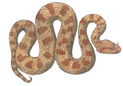
Sahara horned vipers are amongst the most distinct of the North African desert snakes. Compared to most snakes in the region, this species is short in length, averaging between 30 and 60 cm. Hatchlings are usually between 12 and 15 cm. Although females are larger, both sexes share the same general body structure and color patterns. The head is somewhat flat, broad, and triangular, with eyes on the side of the head, and the neck is thin.
Covered in approximately 25 to 35 rows of heavily keeled scales, C. cerastes is characterized by the presence of supraorbital “horns”, which consist of a single scale above each eye, from which a dark line extends towards the back of snake. This feature is what generally distinguishes Sahara horned vipers from other species of the genus Cerastes, as Cerastes gasperettii has horns that consist of multiple scales, and Cerastes vipera has its eyes on the top of the head. Prominent brow ridges typically ensue the lack or reduction of these horns. (Blanc, 1986; Branch and Spawls, 1995; Mermod, 1970)
The body is broad and appears flat, with a short tail which may have a black tip. This species is brownish-yellow and gray in color, perfectly blending into the sandy environment in which it lives. Dorsally, it also has rectangular brown patches that are darker in color than the rest of the body. (Disi, 1983; George, 2002)
- Other Physical Features
- heterothermic
- venomous
- Sexual Dimorphism
- sexes alike
- female larger
-
- Range length
- 30 to 85 cm
- 11.81 to 33.46 in
-
- Average length
- 30 to 60 cm
- in
Development
As an oviparous species, Cerastes cerastes offspring development occurs outside of the mother's body, in the fertilized eggs she lays. An increase in oxygen consumption allows the snake to experience an exponential growth pattern throughout embryonic development, and normal respiration rates are assumed after hatching. (Cox, et al., 2006; George, 2002; Ludwig, et al., 2003)
Reproduction
Information regarding the mating systems of C. cerastes is data deficient. However, it has been observed that this species typically breeds during the first few weeks of April. In addition, it is assumed that members of the opposite sex locate and attract each other through the use of pheromones. (George, 2002; Ludwig, et al., 2003)
Copulation is generally observed during the first week of April and always occurs while buried under the sand. It is unknown whether these snakes breed annually. In a case of two captive individuals, copulation lasted for 4 days. Cerastes cerastes generally oviposits anywhere from 8 to 23 eggs, usually under rocks or in abandoned burrows of reptiles and mammals. The young hatch after a 50 to 80 day incubation period. Juvenile Cerastes cerastes reach reproductive maturity at 2 years of age. (Brodie Jr. and Campbell, 1992; George, 2002; Ludwig, et al., 2003)
- Key Reproductive Features
- iteroparous
- seasonal breeding
- sexual
- fertilization
- oviparous
-
- Breeding interval
- The breeding interval for Cerastes cerastes is unknown.
-
- Breeding season
- Sahara horned vipers mate between April and June and eggs hatch from June to August.
-
- Range number of offspring
- 8 to 23
-
- Range gestation period
- 50 to 80 days
-
- Average age at sexual or reproductive maturity (female)
- 2 years
-
- Average age at sexual or reproductive maturity (male)
- 2 years
There is no information currently available concerning the parental investment of Cerastes cerastes.
Lifespan/Longevity
Although very little is known concerning the lifespan of individuals in the wild, specimens in captivity have been observed to survive for up to 18 years. (Branch and Spawls, 1995; Ludwig, et al., 2003)
-
- Range lifespan
Status: captivity - 14 to 18 years
- Range lifespan
Behavior
Consistent with numerous taxa of the Squamata order, Cerastes cerastes exhibits a great deal of fossorial behavior. Beginning at the posterior end, the snake extends its body anteriorly into the sand, usually until only its eyes and nostrils are exposed. During the day, it may hide in burrows or holes made by other animals, under wood or rocks, or even in bushes. It is most often found buried or partially buried in soft sand, avoiding the scorching heat as well as using its camouflage to capture potential prey. Sahara horned vipers are generally even-tempered snakes, but they are capable of administering toxic venom if threatened. When disturbed, the snake produces a hissing and crackling sound from the shaking and rubbing of its coils, and does so as a warning before striking.
Sidewinding is the primary method of locomotion for C. cerastes and the majority of desert snakes. This type of movement allows the snake to move quickly across the desert sands by lifting a loop of the body and moving it forward, while the rest of the body follows the moving loop. This also assists in preventing the snake from overheating, as minimum contact between the belly and the ground is maintained throughout the movement.
Hibernation occurs from January to February, but is interrupted by warm days throughout the winter days. By late March, activity increases, and foraging mainly occurs at night. (Cox, et al., 2006; Ludwig, et al., 2003; Mermod, 1970; Schneemann, et al., 2004)
- Key Behaviors
- terricolous
- fossorial
- nocturnal
- sedentary
- hibernation
- solitary
Home Range
There is currently no information available regarding the home range of Cerastes cerastes. (Branch and Spawls, 1995)
Communication and Perception
As specialized semi-fossorial snakes, all members of the genus Cerastes exhibit predatory launch strikes from partially buried positions in the Saharan sands. As such, the majority of the communication and perception techniques demonstrated by these snakes incorporate multiple environmental stimuli in order to enhance prey localization and acquisition. Through multiple studies and experiments, it has been found that foraging by vibration detection is particularly significant in C. cerastes, as well as other members of the genus. Additionally, visual capabilities are pertinent in strike accuracy and distance, although the snake is still quite capable of capturing prey with hindered vision. Interestingly, prey capture behavior does not seem to be limited by olfactory senses, and in contrast to common belief, chemosensory reliance in Cerastes during foraging is nearly negligible, as visual stimuli act as primary determinants of prey apprehension. (McGinley, 2007; Morain and Young, 2002; Morain and Young, 2003)
When communicating with other members of its own species, Sahara horned vipers rely mostly upon chemical signals in the form of pheromones. This is used particularly during the mating season, as it acts to locate members of the opposite sex. Also, C. cerastes makes use of vibrational stimuli and the ability to sense heat from other organisms in the environment from its pit organs in order to locate prey. Located just behind the nostrils, the pit organs in these snakes allow them to detect warm-blooded animals, even in the dark. (Cox, et al., 2006; Morain and Young, 2002; Morain and Young, 2003)
- Other Communication Modes
- pheromones
- Perception Channels
- visual
- infrared/heat
- tactile
- acoustic
- vibrations
- chemical
Food Habits
The diet of this carnivorous species consists primarily of small rodents, geckos, birds, and a variety of lizards. In captivity, a full grown specimen was observed to feed on weaver finches (Passer domesticus niloticus), lacertids (Mesalina olivieri), and dune geckos (Stenodactylus petrii). These vipers are also known to eat jerboas (Jaculus jaculus), yellow wagtails (Motacilla flava thunbergi), and chiffchaffs (Phylloscopus collybita). Cerastes cerastes has been known to travel long distances at night in search of prey. ("Cerastes cerastes (Desert Horned Viper)", 2004; George, 2002; Ludwig, et al., 2003)
- Primary Diet
-
carnivore
- eats terrestrial vertebrates
- Animal Foods
- birds
- mammals
- reptiles
Predation
Sahara horned vipers are known to have only a few natural enemies, including honey badgers, monitor lizards, and a variety of wild and feral cat species. The snakes' colors provide optimum camouflage, working in their favor as both predators and prey. In addition, although C. cerastes burrows in order to stay cool during the day, as well as to attack unsuspecting prey, this behavior may also help hide it from potential predators. (Brodie Jr. and Campbell, 1992; Cox, et al., 2006; Johann, 1973)
- Anti-predator Adaptations
- cryptic
-
- Known Predators
-
- Honey badgers (Mellivora capensis)
- Monitor lizards (Varanus griseus)
Ecosystem Roles
This species is a particularly successful predator throughout the Sahara. With only a few known predators, it can be inferred that C. cerastes acts to limit the population sizes of the prey upon which it feeds. (Disi, 1983; Ludwig, et al., 2003)
Economic Importance for Humans: Positive
As a very successful predator across the Sahara, C. cerastes acts to control populations of rodents that disturb livestock and other food sources of the native people of the region. In some areas, local people consider the snake to be of no particular danger, and the species is even tolerated around some villages. In contrast, other regions fear the snake, and believe it to have powers and even that it is capable of flying. Some native snake charmers use C. cerastes because of their horns, and large numbers of the species have been observed for sale at tourist resorts.
In addition, the venom derived from Sahara horned vipers provides a great deal of information concerning certain enzymes and their effects on reptilian and mammalian biochemical processes, as well as assist in the production of antivenins that are used for a variety of African snake species. (Blanc, 1986; Ludwig, et al., 2003; O'Shea, 2008)
- Positive Impacts
- source of medicine or drug
- research and education
Economic Importance for Humans: Negative
A venomous snake, Cerastes cerastes is capable of inflicting damage to its prey, but also bites when threatened. Common amongst all three species of Cerastes, the venom is cytotoxic, affecting the walls and contents of cells, yet is not very toxic when compared to most other snakes in the region.
Despite the widespread distribution of Sahara horned vipers, their relatively hostile habitats result in few humans bitten, and therefore little statistical data is available concerning C. cerastes bites. However, venomous bites have been known to cause swelling, nausea, hemorrhaging, vomiting, necrosis, and hematuria. Bites should be treated immediately with elevation, analgesics, and antibiotic cover. For more serious bites, supply of an appropriate antivenin is required. (Branch and Spawls, 1995; Ludwig, et al., 2003; Schneemann, et al., 2004)
- Negative Impacts
-
injures humans
- bites or stings
- venomous
Conservation Status
According to the International Union for Conservation of Nature (IUCN) Center for Mediterranean Cooperation, Cerastes cerastes is considered a species of “Least Concern” in terms of its conservation status. In fact, all three species of Cerastes are not of particular concern in the Mediterranean Basin.
A region relatively rich in biodiversity, the Mediterranean Basin is regarded as a biodiversity hotspot due to the abundance of threatened plant endemism that occurs. The primary threat to reptilian populations is habitat loss and degradation, mainly due to human activities. Pollution, the introduction of alien species, and general human disturbance are among the largest impacts to these populations. It is important to note that snakes are generally affected to the highest degree, however, only a few are actually considered threatened. (Cox, et al., 2006; Johann, 1973; McGinley, 2007; Werner and Sivan, 1992)
-
- IUCN Red List
- Least Concern
-
- CITES
- No special status
Contributors
Issac Anderson (author), University of Michigan-Ann Arbor, Phil Myers (editor), University of Michigan-Ann Arbor, Rachelle Sterling (editor), Special Projects.
Glossary
- Ethiopian
-
living in sub-Saharan Africa (south of 30 degrees north) and Madagascar.

- Palearctic
-
living in the northern part of the Old World. In otherwords, Europe and Asia and northern Africa.
- acoustic
-
uses sound to communicate
- carnivore
-
an animal that mainly eats meat
- chemical
-
uses smells or other chemicals to communicate
- cryptic
-
having markings, coloration, shapes, or other features that cause an animal to be camouflaged in its natural environment; being difficult to see or otherwise detect.
- desert or dunes
-
in deserts low (less than 30 cm per year) and unpredictable rainfall results in landscapes dominated by plants and animals adapted to aridity. Vegetation is typically sparse, though spectacular blooms may occur following rain. Deserts can be cold or warm and daily temperates typically fluctuate. In dune areas vegetation is also sparse and conditions are dry. This is because sand does not hold water well so little is available to plants. In dunes near seas and oceans this is compounded by the influence of salt in the air and soil. Salt limits the ability of plants to take up water through their roots.
- drug
-
a substance used for the diagnosis, cure, mitigation, treatment, or prevention of disease
- fertilization
-
union of egg and spermatozoan
- fossorial
-
Referring to a burrowing life-style or behavior, specialized for digging or burrowing.
- heterothermic
-
having a body temperature that fluctuates with that of the immediate environment; having no mechanism or a poorly developed mechanism for regulating internal body temperature.
- hibernation
-
the state that some animals enter during winter in which normal physiological processes are significantly reduced, thus lowering the animal's energy requirements. The act or condition of passing winter in a torpid or resting state, typically involving the abandonment of homoiothermy in mammals.
- infrared/heat
-
(as keyword in perception channel section) This animal has a special ability to detect heat from other organisms in its environment.
- iteroparous
-
offspring are produced in more than one group (litters, clutches, etc.) and across multiple seasons (or other periods hospitable to reproduction). Iteroparous animals must, by definition, survive over multiple seasons (or periodic condition changes).
- native range
-
the area in which the animal is naturally found, the region in which it is endemic.
- nocturnal
-
active during the night
- oviparous
-
reproduction in which eggs are released by the female; development of offspring occurs outside the mother's body.
- pheromones
-
chemicals released into air or water that are detected by and responded to by other animals of the same species
- seasonal breeding
-
breeding is confined to a particular season
- sedentary
-
remains in the same area
- sexual
-
reproduction that includes combining the genetic contribution of two individuals, a male and a female
- solitary
-
lives alone
- tactile
-
uses touch to communicate
- temperate
-
that region of the Earth between 23.5 degrees North and 60 degrees North (between the Tropic of Cancer and the Arctic Circle) and between 23.5 degrees South and 60 degrees South (between the Tropic of Capricorn and the Antarctic Circle).
- terrestrial
-
Living on the ground.
- tropical
-
the region of the earth that surrounds the equator, from 23.5 degrees north to 23.5 degrees south.
- venomous
-
an animal which has an organ capable of injecting a poisonous substance into a wound (for example, scorpions, jellyfish, and rattlesnakes).
- vibrations
-
movements of a hard surface that are produced by animals as signals to others
- visual
-
uses sight to communicate
References
2004. "Cerastes cerastes (Desert Horned Viper)" (On-line). Accessed March 07, 2010 at http://zipcodezoo.com/Animals/C/Cerastes_cerastes/#Biology.
Blanc, C. 1986. The reptile population of the extreme south of Tunisia. Amphibia-Reptilia, 7/4: 385-389.
Branch, B., S. Spawls. 1995. The Dangerous Snakes of Africa. United Kingdom: Blandford.
Brodie Jr., E., J. Campbell. 1992. Biology of the Pitvipers. Tyler, Texas, USA: Selva.
Cox, N., J. Chanson, S. Stuart. 2006. The Status and Distribution of the Mediterranean Basin. Gland, Switzerland and Cambridge, UK: The World Conservation Union (IUCN). Accessed March 14, 2010 at http://data.iucn.org/dbtw-wpd/edocs/2006-027.pdf.
Disi, A. 1983. Herpetology of Jordan 1. Venomous Snakes. Dirasat Natural Sciences (Amman), 10/2: 167-180.
George, L. 2002. Vipers. Mankato, Minnesota: Capstone Press.
Johann, H. 1973. A location of origin for Cerastes- cerastes in northern Tunisia Serpentes Viperidae. Salamandra, 9/3-4: 160.
Ludwig, D., D. Mallow, G. Nilson. 2003. True Vipers. Malabar, Florida, USA: Krieger Publishing Company.
McGinley, M. 2007. "Status and distribution of reptiles and amphibians of the Mediterranean Basin" (On-line). Encyclopedia of Earth. Accessed March 14, 2010 at http://www.eoearth.org/article/Status_and_distribution_of_reptiles_and_amphibians_of_the_Mediterranean_Basin.
Mermod, C. 1970. Living area and displacement activity of Cerastes-vipera and Cerastes-cerastes Reptilia Viperidae. Revue Suisse de Zoologie, 77/3: 555-562.
Morain, M., B. Young. 2002. The use of ground-borne vibrations for prey localization in the Saharan sand vipers (Cerastes). The Joural of Experimental Biology, 205/5: 661-665. Accessed February 20, 2010 at http://jeb.biologists.org/cgi/content/abstract/205/5/661.
Morain, M., B. Young. 2003. Vertical Burrowing in the Saharan Sand Vipers (Cerastes). Copeia, 2003/1: 131-137. Accessed February 20, 2010 at http://www.jstor.org/sici?origin=sfx%3Asfx&sici=0045-8511%282003%291%3C131%3AVBITSS%3E2.0.CO%3B2-F&cookieSet=1.
Norris, S. 2000. "Desert Horned Viper" (On-line). Accessed March 07, 2010 at http://www.whozoo.org/Intro2000/sabrinor/SDNdeserthornedviper.htm.
O'Shea, M. 2008. Venomous Snakes of the World. United Kingdom: New Holland Publishers.
Schneemann, M., R. Cathomas, S. Laidlaw, A. El Nahas, R. Theakston, D. Warrell. 2004. Life-threatening envenoming by the Saharan horned viper (Cerastes cerastes) causing micro-angiopathic haemolysis, coagulopathy, and acute renal failure: clinical cases and review. QJM, 97/11: 717-727. Accessed February 21, 2010 at http://qjmed.oxfordjournals.org/cgi/content/full/97/11/717.
Werner, Y., N. Sivan. 1992. Systematics and zoogeography of Cerastes (Ophidia: Viperidae) in the Levant: 2. Taxonomy, ecology, and zoogeography. Snake, 24/1: 34-49.