Cardiocranius paradoxusfive-toed pygmy jerboa
Geographic Range
Five-toed pygmy jerboas, Cardiocranius paradoxus, are found only in a few areas in Asia. In Russia they are found in the Ubsu-Nur Depression of the Tuva Autonomous Region in the extreme south-central part of the country. In Kazakhstan, their range is restricted to a small area north of Lake Balkhash, where the species was first discovered. They are also found throughout western and southern Mongolia, as well as in the Nan Shan Mountains of northern China. ("Five-toed Dwarf Jerboa", 1999; Gromov and Eszhanov, 2004; Gromov, 2002)
- Biogeographic Regions
- palearctic
Habitat
Five-toed pygmy jerboas are especially adapted to rocky deserts. These animals prefer to have dunes or outcroppings with ample vegetative cover within their home ranges. The protective shrubbery offers a safe place under which to burrow. ("Five-toed Dwarf Jerboa", 1999; Gromov, 2002)
- Habitat Regions
- temperate
- terrestrial
- Terrestrial Biomes
- desert or dune
Physical Description
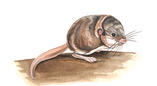
Cardiocranius paradoxus generally reaches a body length of 50 to 75 mm, with the tail extending a further 70 to 78 mm. These small jerboas are grayish buff with white underbellies. The tail is thinly haired and is light brown above and white below. Although rather slim at the base, the tail quickly thickens before coming to a tapering point. At the end of the tail is a tuft of hair. ("Five-toed Dwarf Jerboa", 1999)
In most jerboas, the three metatarsals near the center of each hind foot fuse to form a cannon bone, thus there are a total of three toes on each hind foot. Instead, C. paradoxus has five individual toes. The two outside toes (digits 1 and 5) are rather small in comparison to the three central toes, but they are present nonetheless and give this species its common name. The hind foot exhibits a patch of bristly hairs on the sole, which help five-toed pygmy jerboas to obtain better traction on loose sand. ("Five-toed Dwarf Jerboa", 1999)
The skull of these small jerboas is heart-shaped, which explains the origin of the generic name, Cardiocranius. Although the external ears are extremely small, the auditory bullae are greatly inflated, allowing C. paradoxus to hear quite well and sense low frequency vibrations. Five-toed pygmy jerboas have large upper incisors that are grooved on the front surface. ("Five-toed Dwarf Jerboa", 1999)
- Other Physical Features
- endothermic
- bilateral symmetry
- Sexual Dimorphism
- sexes alike
-
- Range length
- 50 to 75 mm
- 1.97 to 2.95 in
Reproduction
To date, nothing has been published concerning the mating system of five-toed pygmy jerboas. Their close relatives, four-toed jerboas (Allactaga tetradactyla), might give some hints as to the mating system for this species. During the breeding months, a male A. tetradactyla will playfully chase a female until she briefly stops and allows him to copulate with her.
Individuals in reproductive condition have been discovered in Kazakhstan in the month of July, but little else is known about the reproductive behavior of this species. This is most likely due to the fact that Cardiocranius paradoxus is a rare species, living in isolated areas, and difficult to study. A close relative that might offer insight is Allactaga tetradactyla. In the case of A. tetradactyla, the breeding season is quite long, with a peak during the summer months. Over the course of the year, these jerboas give birth to three litters of 3 to 5 young per litter. The gestation period for A. tetradactyla is 25 to 42 days and the young reach sexual maturity just after one year of age. ("Five-toed Dwarf Jerboa", 1999)
- Key Reproductive Features
- iteroparous
- seasonal breeding
- gonochoric/gonochoristic/dioecious (sexes separate)
- sexual
- viviparous
Female five-toed pygmy jerboas have eight teats, as do most jerboas, and nurse their young as all mammals do. Other than this, little is known about the parental investment of Cardiocranius paradoxus. In a close relative, Allacta elater, parental investment consists of the mother caring for her young for several months, protecting and teaching them until they are old enough to fend for themselves. ("Five-toed Dwarf Jerboa", 1999)
- Parental Investment
- altricial
-
pre-fertilization
- provisioning
-
protecting
- female
-
pre-hatching/birth
-
provisioning
- female
-
protecting
- female
-
provisioning
-
pre-weaning/fledging
-
provisioning
- female
-
provisioning
-
pre-independence
-
protecting
- female
-
protecting
Lifespan/Longevity
The lifespan of Cardiocranius paradoxus is currently not known and further data are needed on the subject. A close relative, Jaculus jaculus, is known to live for up to 4 years in the wild and up to 6 years in captivity.
Behavior
Five-toed pygmy jerboas are strictly nocturnal, preferring to be most active mainly from 2200 to 0400 hours (10:00pm to 4:00am). During this time, an individual will move almost non-stop around its home range. Observations show that roughly 90% of the active period is devoted to exploratory activity, while the rest of the time is used for feeding, brief periods of rest (about 2 to 5 minutes at a time), and burrowing. ("Five-toed Dwarf Jerboa", 1999; Gromov and Eszhanov, 2004; Gromov, 2002)
Five-toed pygmy jerboas move by small hops, although crawling is occasionally observed. When a jerboa moves, it never moves in a straight line, but rather changes directions constantly so as to appear to move in circles. When startled, an individual might jump as high as 20 to 30 cm straight up into the air. (Gromov and Eszhanov, 2004; Gromov, 2002)
Five-toed pygmy jerboas may dig their own burrows or utilize the abandoned burrows of other animals. When digging its own burrow, an individual uses its hind legs to rake and kick the soil. A burrow is usually dug under a bush that offers cover and the entrance is often hidden by a pile of dry grass. Burrows have been observed to be roughly 25 to 30 cm deep with a central nesting chamber about 10 to 11 cm in diameter. Burrows are used as a safe place to rest, hibernate, and rear young, although further studies should be pursued for more details on burrow use. (Gromov and Eszhanov, 2004; Gromov, 2002)
- Key Behaviors
- terricolous
- saltatorial
- nocturnal
- motile
- hibernation
- solitary
-
- Average territory size
- 14300 m^2
Home Range
Five-toed pygmy jerboas generally have a home range of about 14,300 squared meters. Observations have shown that individuals will move throughout the entire home range during foraging, but will spend a majority of the time in one or two areas within the range. Jerboas have a number of burrows scattered around the territory so that a safe haven is never too far off. (Gromov and Eszhanov, 2004; Gromov, 2002)
Communication and Perception
Like other jerboas, ive-toed pygmy jerboas have a keen sense of hearing, smell, and vision. The greatly inflated auditory bullae allow five-toed pygmy jerboas to sense vibrations produced by low frequency sounds, as well as aid in their sensitive hearing. As is true for most rodents, this species likely communicates largely using olfactory cues. ("Five-toed Dwarf Jerboa", 1999)
- Perception Channels
- visual
- tactile
- acoustic
- vibrations
- chemical
Food Habits
These small rodents are strictly herbivorous. The diet of Cardiocranius paradoxus mainly consists of seeds and leaves of the grasses and low-growing vegetation found in its habitat. This species is also known to eat the occasional flower. Five-toed pygmy jerboas eat only the juiciest parts of the leaves, although it has been observed that they will also nibble on dead grass. Seeds are collected from the plants themselves, as well as from the ground. (Gromov and Eszhanov, 2004; Gromov, 2002)
- Plant Foods
- leaves
- seeds, grains, and nuts
- flowers
Predation
Predators of Cardiocranius paradoxus include common foxes (Vulpes vulpes), Corsac foxes (V. corsac), Eversmann's polecats (Mustella eversmanni), long-eared hedgehogs (Erinaceus auritus), short-eared owls (Asio flammeus), and little owls (Athene noctua). When faced with a predator, these pygmy jerboas hop rapidly (and in a zig-zag manner) for the cover of a shrub or burrow. (Gromov and Eszhanov, 2004)
- Anti-predator Adaptations
- cryptic
-
- Known Predators
-
- common foxes (Vulpes vulpes)
- Corsac foxes (Vulpes corsac)
- Eversmann's polecats (Mustella eversmanni)
- long-eared hedgehogs (Erinaceus auritus)
- short-eared owls (Asio flammeus)
- little owls (Athene noctua)
Ecosystem Roles
The largest role that Cardiocranius paradoxus plays in the ecosystem is as prey for the animals that prey upon it. They are also important predators on seeds in the ecosystems they inhabit. (Gromov and Eszhanov, 2004)
Economic Importance for Humans: Positive
Five-toed pygmy jerboas have no known positive economic importance for humans aside from their role as members of healthy, desert ecosystems.
Economic Importance for Humans: Negative
Cardiocranius paradoxus has no known negative economic importance for humans.
Conservation Status
Five-toed pygmy jerboas are widely regarded as vulnerable and rare. They are especially rare in China. The causes of the decline being observed in five-toed pygmy jerboa populations ranges from habitat destruction to predation and interspecific competition. Climatic changes in their usually dry desert habitats are causing increased moisture levels, which in turn lead to rapid plant growth. This eliminates some of the rocky desert habitat that these jerboas require. Human expansion is also degrading this limited habitat type. Increased predation is seriously decimating jerboa populations in Kazakhstan. Interspecific competition with other rodents for food and habitat is also taking its toll in the Russian populations. ("Five-toed Dwarf Jerboa", 1999; Gromov and Eszhanov, 2004; Gromov, 2002)
-
- IUCN Red List
-
Data Deficient
More information
-
- IUCN Red List
-
Data Deficient
More information
-
- US Federal List
- No special status
-
- CITES
- No special status
-
- State of Michigan List
- No special status
Contributors
Tanya Dewey (editor), Animal Diversity Web.
Patrick Sherman (author), Michigan State University, Barbara Lundrigan (editor, instructor), Michigan State University.
Glossary
- Palearctic
-
living in the northern part of the Old World. In otherwords, Europe and Asia and northern Africa.

- acoustic
-
uses sound to communicate
- altricial
-
young are born in a relatively underdeveloped state; they are unable to feed or care for themselves or locomote independently for a period of time after birth/hatching. In birds, naked and helpless after hatching.
- bilateral symmetry
-
having body symmetry such that the animal can be divided in one plane into two mirror-image halves. Animals with bilateral symmetry have dorsal and ventral sides, as well as anterior and posterior ends. Synapomorphy of the Bilateria.
- chemical
-
uses smells or other chemicals to communicate
- cryptic
-
having markings, coloration, shapes, or other features that cause an animal to be camouflaged in its natural environment; being difficult to see or otherwise detect.
- desert or dunes
-
in deserts low (less than 30 cm per year) and unpredictable rainfall results in landscapes dominated by plants and animals adapted to aridity. Vegetation is typically sparse, though spectacular blooms may occur following rain. Deserts can be cold or warm and daily temperates typically fluctuate. In dune areas vegetation is also sparse and conditions are dry. This is because sand does not hold water well so little is available to plants. In dunes near seas and oceans this is compounded by the influence of salt in the air and soil. Salt limits the ability of plants to take up water through their roots.
- endothermic
-
animals that use metabolically generated heat to regulate body temperature independently of ambient temperature. Endothermy is a synapomorphy of the Mammalia, although it may have arisen in a (now extinct) synapsid ancestor; the fossil record does not distinguish these possibilities. Convergent in birds.
- folivore
-
an animal that mainly eats leaves.
- granivore
-
an animal that mainly eats seeds
- herbivore
-
An animal that eats mainly plants or parts of plants.
- hibernation
-
the state that some animals enter during winter in which normal physiological processes are significantly reduced, thus lowering the animal's energy requirements. The act or condition of passing winter in a torpid or resting state, typically involving the abandonment of homoiothermy in mammals.
- iteroparous
-
offspring are produced in more than one group (litters, clutches, etc.) and across multiple seasons (or other periods hospitable to reproduction). Iteroparous animals must, by definition, survive over multiple seasons (or periodic condition changes).
- motile
-
having the capacity to move from one place to another.
- native range
-
the area in which the animal is naturally found, the region in which it is endemic.
- nocturnal
-
active during the night
- saltatorial
-
specialized for leaping or bounding locomotion; jumps or hops.
- seasonal breeding
-
breeding is confined to a particular season
- sexual
-
reproduction that includes combining the genetic contribution of two individuals, a male and a female
- solitary
-
lives alone
- tactile
-
uses touch to communicate
- temperate
-
that region of the Earth between 23.5 degrees North and 60 degrees North (between the Tropic of Cancer and the Arctic Circle) and between 23.5 degrees South and 60 degrees South (between the Tropic of Capricorn and the Antarctic Circle).
- terrestrial
-
Living on the ground.
- vibrations
-
movements of a hard surface that are produced by animals as signals to others
- visual
-
uses sight to communicate
- viviparous
-
reproduction in which fertilization and development take place within the female body and the developing embryo derives nourishment from the female.
References
1999. Five-toed Dwarf Jerboa. Pp. 1333-1334 in R Nowak, ed. Walker's Mammals of the World, Vol. 2, 6th Edition. Baltimore, Maryland: The Johns Hopkins University Press.
Gromov, V. 2002. On the Biology of Five-toed Pigmy Jerboa (Cardiocranius paradoxus Satunin, 1902) in the Ubsu-Nuur Depression. Russian Journal of Ecology, 33: 232-236.
Gromov, V., B. Eszhanov. 2004. On the Biology of the Five-Toed Pygmy Jerboa (CARDIOCRANIUS PARADOXUS Satunin, 1902) in Kazakhstan: New Data. Russian Journal of Ecology, 35: 55-57.