Carcharias taurusDogfish shark(Also: Ground shark; Sand Tiger)
Geographic Range
Grey nurse sharks, also called sand tiger sharks, can be found in the Atlantic, Indian, and Pacific Oceans in temperate and tropical waters. They are found in warm seas, except for the eastern Pacific. They occur from the Gulf of Maine to Argentina in the western Atlantic, the coast of Europe to north Africa in the eastern Atlantic, in the Mediterranean sea, from Australia to Japan in the west Pacific, and off the coasts of South Africa. (Budker, 1971; Carrier, et al., 2004; Cooper, 2006; Gilbert, et al., 1967)
- Biogeographic Regions
- indian ocean
- atlantic ocean
- pacific ocean
- mediterranean sea
Habitat
Grey nurse sharks are found in temperate and tropical waters. They are typically found in shallow waters, such as shallow bays, surf zones, and near coral or rocky reefs. They have been sighted in waters as deep as 191 meters, but will most likely be seen in the surf zone to a depth of 60 meters. They are usually found near the bottom of the water column. (Cooper, 2006; Leneaweaver III and Backus, 1970)
- Habitat Regions
- temperate
- tropical
- saltwater or marine
- Other Habitat Features
- estuarine
-
- Range depth
- 2 to 191 m
- 6.56 to 626.64 ft
-
- Average depth
- 60 meters m
- ft
Physical Description
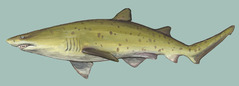
The dorsal side of grey nurse sharks is grey, the underside is a dirty white color. These are stout-bodied sharks with metallic brown or reddish colored spots on the sides. When a grey nurse shark pup is born it is typically between 115 and 150 cm. As they mature, grey nurse sharks can reach 5.5 meters, but an average size is 3.6 meters. Females are generally larger than males. Average weight is from 95 to 110 kg. A distinguishing characteristic of grey nurse sharks is that the anal fin and both dorsal fins are the same size. The tail is heterocercal, with a long, upper lobe and a shorter, lower lobe. These different lobes allow for great movement. The mouth bears razor like teeth and is long and slender, with pointed snout. Their elongated teeth are visible even when the mouth is closed, giving these sharks a menacing appearance. This has led many to believe that these are dangerous sharks, a reputation they don't deserve. ("Abyss Scuba Diving", 2005; "Sensory Biology of Sharks, Skates, and Rays", 1979; Bennett and Bansemer, 2004; Department of the Environment and Heritage, Australia, 1999; Hamlett, 1999)
- Other Physical Features
- ectothermic
- heterothermic
- bilateral symmetry
- Sexual Dimorphism
- female larger
-
- Range mass
- 50 to 300 kg
- 110.13 to 660.79 lb
-
- Average mass
- 95-110 kg
- lb
-
- Range length
- 6 (high) m
- 19.69 (high) ft
-
- Average length
- 3.6 m
- 11.81 ft
-
- Range basal metabolic rate
- <190 to 311 cm3.O2/g/hr
-
- Average basal metabolic rate
- 239 cm3.O2/g/hr
Development
It takes a grey nurse shark pup between 6-9 months to develop in the uterus of a female. Young nurse sharks develop a jaw and teeth very early their development and some eat their siblings while still developing within their mother, a phenomenon known as intra-uterine cannibalism. It is uncertain how long it takes grey nurse sharks to reach maturity, but maturity is estimated at between 5 and 13 years. Sharks continue to grow throughout their lives. ("Abyss Scuba Diving", 2005; "Shark Conservation", 2004; Department of the Environment and Heritage, Australia, 1999; Gilbert, et al., 1967)
- Development - Life Cycle
- indeterminate growth
Reproduction
Males outnumber females by a 2:1 ratio and multiple males will copulate with a single female. A dominance hierarchy has only been observed in captivity, with the oldest males copulating first. (Hamlett, 1999)
- Mating System
- polygynandrous (promiscuous)
Mating occurs in November and October. The gestation period will take anywhere from six to nine months. Females give birth in early spring near coastal, rocky reefs. Caves inhabited by these sharks are also used as breeding grounds and, if disrupted, their breeding may be interrupted. Female sharks bear young once every two years, with a maximum of two shark pups at birth, one from each uterus. Grey nurse sharks are ovoviviparous which means that eggs develop inside of the female in each uterus. Young hatch from the eggs and are retained in the uteri until they are fully developed. Females have hundreds of eggs inside the uterus. When an egg is fertilized the shark pup begins to grow and, at 55 mm, develops a jaw and teeth. This shark then eats the other developing embryos during its 6 to 9 month gestation (intra-uterine cannibalism). ("Sensory Biology of Sharks, Skates, and Rays", 1979; Carrier, et al., 2004)
Males mature at a length of 1.95 meters, or 4-5 years in age, and females mature at 2.2 meters, or 6 years in age. (Cooper, 2006)
- Key Reproductive Features
- iteroparous
- seasonal breeding
- gonochoric/gonochoristic/dioecious (sexes separate)
- sexual
- fertilization
- ovoviviparous
-
- Breeding interval
- Grey nurse sharks bear young once every two years.
-
- Breeding season
- Shark pups are usually born in early spring (March and April).
-
- Range number of offspring
- 1 to 2
-
- Average number of offspring
- 1
-
- Range gestation period
- 6 to 9 months
-
- Range age at sexual or reproductive maturity (female)
- 5 to 13 years
-
- Average age at sexual or reproductive maturity (female)
- 7-8 years
-
- Range age at sexual or reproductive maturity (male)
- 5 to 13 years
-
- Average age at sexual or reproductive maturity (male)
- 7-8 years
A pup will be born approximately 115-150 cm in length. This shark is able to fend for itself and live without parental care. Intra-uterine cannibalism ensures plenty of energy to the developing pup, resulting in a well-fed and well-developed offspring. ("Sensory Biology of Sharks, Skates, and Rays", 1979; Carrier, et al., 2004; Hamlett, 1999)
- Parental Investment
- no parental involvement
-
pre-fertilization
- provisioning
-
protecting
- female
-
pre-hatching/birth
-
provisioning
- female
-
protecting
- female
-
provisioning
Lifespan/Longevity
Little is known about the lifespan of ocean dwelling grey nurse sharks, however those held in captivity live to an average age of thirteen to sixteen years. It is believed that those in the wild live longer still. (Carrier, et al., 2004)
-
- Range lifespan
Status: wild - 35 (high) years
- Range lifespan
-
- Range lifespan
Status: captivity - 16 (high) years
- Range lifespan
Behavior
Grey nurse sharks may travel in groups of twenty or fewer but most often occur alone. Group travel may improve mating success, feeding, and survival. Grey nurse shark are most active at night. During the day they stay near caves, cliffs, and drop-offs. Metabolic rates during the day (~200cm3/O2/hr) are much lower than at night (~325cm3/O2/hr). These are not aggressive sharks, but divers are warned not to intrude into their caves, or bother them. Grey nurse sharks gulp air and hold it in their stomachs to maintain neutral buoyancy. Because their bodies are dense, they tend to fall to the bottom, by retaining air in their stomachs, they are able to remain motionless in the water column. ("Sensory Biology of Sharks, Skates, and Rays", 1979; Carrier, et al., 2004; Gilbert, et al., 1967; Leneaweaver III and Backus, 1970)
Grey nurse shark populations in the northern and southern extremes of their range may make seasonal migrations to warm waters (towards the poles in summer and towards the equator in winter). (Carpenter, 2006)
Home Range
There is no information on home ranges in these sharks.
Communication and Perception
Communication among grey nurse sharks is not well understood. Sharks in general are sensitive to electrical and chemical cues. (Hamlett, 1999)
Grey nurse sharks, and other species of sharks, have pores on their ventral surface. These pores are instrumental in detecting electrical fields, which help them to detect and locate prey and may help in navigating using the earth's magnetic field.
Food Habits
Grey nurse sharks have a range of prey, including bony fish, rays, lobsters, crabs, squid, and other small sharks. Grey nurse sharks sometimes hunt cooperatively, chasing fish into small groups and then attacking them. Grey nurse sharks, like other sharks, have been known to attack at random during feeding frenzies, where a large number of prey is found together. In feeding frenzies sharks rely heavily on their electroreceptors, attacking everything in close vicinity. (Carrier, et al., 2004)
- Animal Foods
- fish
- mollusks
- aquatic crustaceans
Predation
The only know predators of adult grey nurse sharks are humans. Human hunting has caused population declines, both as a result of shark fishing and persecution because their fierce appearance has caused them to be mistaken for other, more dangerous, species of sharks. They are also accidentally caught in commercial fishing nets. Young sharks are eaten by other sharks. ("Abyss Scuba Diving", 2005; "Shark Conservation", 2004; Budker, 1971; Department of the Environment and Heritage, Australia, 1999)
-
- Known Predators
-
- humans (Homo sapiens)
- other sharks (Chondrichthyes)
Ecosystem Roles
Grey nurse sharks help to regulate prey populations. Different species of lampreys (Petromyzontidae) prey on these sharks in a parasitic relationship, whereby the lamprey attaches to the shark, and extracts blood and other nutrients through a wound. These sharks also have mutualistic relationships with pilotfish (Naucrates ductor), which clean their gills and, in exchange, get to eat the scraps of food left behind in the gills. ("Abyss Scuba Diving", 2005; Department of the Environment and Heritage, Australia, 1999; Leneaweaver III and Backus, 1970)
- pilotfish (Naucrates ductor)
- lampreys (Petromyzontidae)
Economic Importance for Humans: Positive
Shark teeth are lost frequently and are prized gifts in many regions of the world. Shark is a delicacy that is eaten in many areas. ("Conservation on International Trade in Endangeren Species of wild flora and fauna", 2005; Department of the Environment and Heritage, Australia, 1999)
- Positive Impacts
- food
- body parts are source of valuable material
- ecotourism
- research and education
Economic Importance for Humans: Negative
Grey nurse sharks are known for their fierce appearance and have gained an undeserved reputation as a man-eater in Australia. These sharks are not generally aggressive, but have been known to bite. Their bites can inflict serious damage because of their size and their dangerous teeth. They are sometimes tangled in fishing nets. (Cooper, 2006)
- Negative Impacts
-
injures humans
- bites or stings
Conservation Status
Grey nurse sharks were the first shark species to be protected by law. Grey nurse sharks are cited as being critically endangered in the Commonwealth Legislation (Australia). They are also considered endangered in New South Wales. The Queensland Government is hoping to provide a listing in the Nature Conservation Act of 1992 which will give these sharks additional protection. The National Marine Fisheries service in the United States prohibits hunting of these sharks. The IUCN lists grey nurse sharks as a vulnerable species on the red list (last evaluated in 2000). CITES does not have a listing for them, and is the most recently updated (2005). The fact that these sharks live in shallow, accessible waters, have a fierce appearance, and have a low reproductive rate, has contributed to declines in populations. Population declines worldwide are estimated at 20% in the last 10 years. ("Abyss Scuba Diving", 2005; "Conservation on International Trade in Endangeren Species of wild flora and fauna", 2005; "IUCN Red List of Endangered Species", 2005; "Sensory Biology of Sharks, Skates, and Rays", 1979; Cooper, 2006)
-
- IUCN Red List
-
Critically Endangered
More information
-
- IUCN Red List
-
Critically Endangered
More information
-
- US Federal List
- No special status
-
- CITES
- No special status
Contributors
Tanya Dewey (editor), Animal Diversity Web.
Gary Gerlach (author), Kalamazoo College, Ann Fraser (editor, instructor), Kalamazoo College.
Glossary
- Atlantic Ocean
-
the body of water between Africa, Europe, the southern ocean (above 60 degrees south latitude), and the western hemisphere. It is the second largest ocean in the world after the Pacific Ocean.

- Pacific Ocean
-
body of water between the southern ocean (above 60 degrees south latitude), Australia, Asia, and the western hemisphere. This is the world's largest ocean, covering about 28% of the world's surface.
- bilateral symmetry
-
having body symmetry such that the animal can be divided in one plane into two mirror-image halves. Animals with bilateral symmetry have dorsal and ventral sides, as well as anterior and posterior ends. Synapomorphy of the Bilateria.
- carnivore
-
an animal that mainly eats meat
- chemical
-
uses smells or other chemicals to communicate
- coastal
-
the nearshore aquatic habitats near a coast, or shoreline.
- ecotourism
-
humans benefit economically by promoting tourism that focuses on the appreciation of natural areas or animals. Ecotourism implies that there are existing programs that profit from the appreciation of natural areas or animals.
- ectothermic
-
animals which must use heat acquired from the environment and behavioral adaptations to regulate body temperature
- electric
-
uses electric signals to communicate
- estuarine
-
an area where a freshwater river meets the ocean and tidal influences result in fluctuations in salinity.
- fertilization
-
union of egg and spermatozoan
- food
-
A substance that provides both nutrients and energy to a living thing.
- heterothermic
-
having a body temperature that fluctuates with that of the immediate environment; having no mechanism or a poorly developed mechanism for regulating internal body temperature.
- indeterminate growth
-
Animals with indeterminate growth continue to grow throughout their lives.
- internal fertilization
-
fertilization takes place within the female's body
- iteroparous
-
offspring are produced in more than one group (litters, clutches, etc.) and across multiple seasons (or other periods hospitable to reproduction). Iteroparous animals must, by definition, survive over multiple seasons (or periodic condition changes).
- migratory
-
makes seasonal movements between breeding and wintering grounds
- motile
-
having the capacity to move from one place to another.
- natatorial
-
specialized for swimming
- native range
-
the area in which the animal is naturally found, the region in which it is endemic.
- nocturnal
-
active during the night
- ovoviviparous
-
reproduction in which eggs develop within the maternal body without additional nourishment from the parent and hatch within the parent or immediately after laying.
- piscivore
-
an animal that mainly eats fish
- polygynandrous
-
the kind of polygamy in which a female pairs with several males, each of which also pairs with several different females.
- reef
-
structure produced by the calcium carbonate skeletons of coral polyps (Class Anthozoa). Coral reefs are found in warm, shallow oceans with low nutrient availability. They form the basis for rich communities of other invertebrates, plants, fish, and protists. The polyps live only on the reef surface. Because they depend on symbiotic photosynthetic algae, zooxanthellae, they cannot live where light does not penetrate.
- saltwater or marine
-
mainly lives in oceans, seas, or other bodies of salt water.
- seasonal breeding
-
breeding is confined to a particular season
- sedentary
-
remains in the same area
- sexual
-
reproduction that includes combining the genetic contribution of two individuals, a male and a female
- social
-
associates with others of its species; forms social groups.
- solitary
-
lives alone
- tactile
-
uses touch to communicate
- temperate
-
that region of the Earth between 23.5 degrees North and 60 degrees North (between the Tropic of Cancer and the Arctic Circle) and between 23.5 degrees South and 60 degrees South (between the Tropic of Capricorn and the Antarctic Circle).
- tropical
-
the region of the earth that surrounds the equator, from 23.5 degrees north to 23.5 degrees south.
- visual
-
uses sight to communicate
References
2005. "Abyss Scuba Diving" (On-line). Accessed October 05, 2005 at http://teachit.acreekps.vic.edu.au/animals/greynurseshark.htm.
2005. "Conservation on International Trade in Endangeren Species of wild flora and fauna" (On-line). Accessed November 19, 2005 at http://www.cites.org/.
2005. "IUCN Red List of Endangered Species" (On-line). Accessed November 19, 2005 at http://www.redlist.org/search/details.php?species=3854.
Office of Naval Research. Sensory Biology of Sharks, Skates, and Rays. N00014-76-C-0943. Arlington, Va: U.S. Government. 1979.
2004. "Shark Conservation" (On-line). Accessed October 05, 2030 at http://www.deh.gov.au/coasts/species/sharks/greynurse/.
Bennett, M., C. Bansemer. 2004. "Investigation of grey nurse sharks in Queensland to fulfill action under the recovery plan for grey nurse sharks in Australia regarding impact of divers, and establishment of a photographic database" (On-line pdf). Investigation of grey nurse sharks in Queensland to fulfill action under the recovery plan for grey nurse sharks in Australia regarding impact of divers, and establishment of a photographic database. Accessed November 14, 2005 at http://gov.au/coasts/publications/pubs/grey-nurse-shark-project.pdf.
Budker, P. 1971. The Life of Sharks. New York: Columbia University Press.
Carpenter, K. 2006. "Carcharias taurus: Sand tiger shark" (On-line). Fishbase. Accessed April 21, 2006 at http://www.fishbase.org/Summary/speciesSummary.php?ID=747&genusname=Carcharias&speciesname=taurus.
Carrier, J., J. Musick, M. Helithaus. 2004. Biology of Sharks and Their Relatives. Boca Raton, London, New York, Washington, D.C.: CRC Press.
Cooper, P. 2006. "Sandtiger shark" (On-line). Ichthyology at the Florida Museum of Natural History: Biological Profiles. Accessed April 18, 2006 at http://www.flmnh.ufl.edu/fish/Gallery/Descript/Sandtiger/Sandtiger.html.
Department of the Environment and Heritage, Australia, 1999. "Nurse Sharks" (On-line). Department of the Environment and Heritage, Australia. Accessed October 06, 2006 at http://www.deh.gov.au/coasts/species/sharks/greynurse/.
Gilbert, P., R. Matheson, D. Rall. 1967. Sharks, Skates, and Rays. Baltimore, Maryland: John Hopkins Press in cooperation with the American Institute of Biological Sciences.
Hamlett, W. 1999. Sharks, Skates, and Rays. Baltimore, Maryland: John Hopkins Press.
Leneaweaver III, H., R. Backus. 1970. Natural History of Sharks. United States of America (philidelphia and New York): J.B. Lippincott Company.