Camelus dromedariusdromedary




Geographic Range
Dromedary camels occupy arid regions of the Middle East through northern India and arid regions in Africa, most notably, the Sahara Desert. They have also been introduced to arid regions of central Australia where some of the only feral populations now persist (Nowak 1991). The original range of their wild ancestors was probably south Asia and the Arabian peninsula.
- Biogeographic Regions
- palearctic
- ethiopian
- australian
Habitat
Dromedary camels prefer desert conditions characterized by a long dry season and a short rainy season. Introduction of dromedary camels into other climates has proven unsuccessful as they are sensitive to cold and humidity (Nowak 1991).
- Habitat Regions
- temperate
- terrestrial
- Terrestrial Biomes
- desert or dune
- savanna or grassland
Physical Description
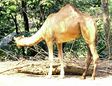
Dromedary camels are characterized by a long-curved neck, deep-narrow chest, and a single hump. The hump is composed of fat bound together by fibrous tissue, acting as food storage in times of need. The size of the hump varies with the nutritional status of the camel, becoming smaller and leaning to one side during times of starvation. The lips of dromedary camels are thickened to allow consumption of coarse, thorny plants. Dromedaries are typically caramel brown or sandy brown in color, however, coloration can range from almost black to nearly white. Hair length is longer on the throat, shoulder, and hump areas. The feet of dromedaries are pad-shaped and adapted for traveling on sand. They can be easily injured on sharp stones and are unsuitable for slippery or muddy conditions. Male dromedaries, in comparison to females, are about 10% heavier, weighing 400-600 kg, and are about 10 cm taller at shoulder height, measuring 1.8-2.0 m. Additionally, male dromedaries have an inflatable soft palate which is used to attract females. Dromedary camels have a total of 34 teeth, with a dental formula of 1/3; 1/1; 3/2; 3/3. (Kohler-Rollefson 1991)
Dromedary camels have remarkable adaptations for their desert lifestyle. Their eyes are protected from blowing sand and dust by a double row of eyelashes. Additionally, at the onset of a sandstorm, these camels have the ability to close their nostrils to prevent sand from entering (Phoenix Zoo 1995). Dromedary camels are able to conserve water in a variety of ways. Water is conserved by the camel's ability to fluctuate its body temperature throughout the day from 34 degrees Celsius to 41.7 degrees Celsius. This fluctuation in body temperature allows the camel to conserve water by not sweating as the external temperature rises. Groups of camels also avoid excess heat from the environment by pressing against each other. Dromedary camels can tolerate greater that 30% water loss, a condition which is lethal for most other mammals at 15%. Water is expended primarily from interstitial and intracellular bodily fluids. Furthermore, dromedary camels can rehydrate quickly, being capable of drinking 100 L of water in just 10 minutes, a feat which would be lethal to any other mammals. (Schmidt-Nielsen 1979, Schmidt-Nielsen et al 1956)
- Other Physical Features
- endothermic
- heterothermic
- bilateral symmetry
- Sexual Dimorphism
- male larger
- sexes shaped differently
-
- Range mass
- 300 to 690 kg
- 660.79 to 1519.82 lb
-
- Average basal metabolic rate
- 224.779 W
- AnAge
Reproduction
During competition for females, males threaten each other by making low noises with the fleshy fold of their mouths, stand as tall as possible, and repeat a series of head movements including lowering, lifting, and bending their necks backwards. Upon confrontation, fighting males attempt to bring their opponent to the ground by biting at his legs and taking the opponent's head in between his jaws. Copulation time ranges from 7-35 minutes, averaging 11-15 minutes.
- Mating System
- polygynous
Females reach sexual maturity around age 3 and mate around age 4 or 5. Males begin to rut by age 3, but do not reach full sexual maturity until age 6. Typically, males and females are seasonal breeders. Breeding occurs in winter and overlaps with the rainy season; both vary in respect to the camel's geographic range. The onset of the breeding season is believed to be cued by nutritional status of the camel and the daylength. The gestation period typically lasts for a period of 15 months, followed by the birth of a single calf.
- Key Reproductive Features
- iteroparous
- seasonal breeding
- gonochoric/gonochoristic/dioecious (sexes separate)
- sexual
- fertilization
- viviparous
-
- Breeding interval
- Female camels give birth to young once every two years.
-
- Breeding season
- Breeding occurs during the winter, or rainy season.
-
- Range number of offspring
- 1 to 2
-
- Average number of offspring
- 1
-
- Average number of offspring
- 1
- AnAge
-
- Range gestation period
- 370 to 440 days
-
- Range time to independence
- 12 to 24 months
-
- Average age at sexual or reproductive maturity (female)
- 3 years
-
- Average age at sexual or reproductive maturity (female)
Sex: female - 1095 days
- AnAge
- Average age at sexual or reproductive maturity (female)
-
- Average age at sexual or reproductive maturity (male)
- 6 years
-
- Average age at sexual or reproductive maturity (male)
Sex: male - 2191 days
- AnAge
- Average age at sexual or reproductive maturity (male)
Calves can move freely by the end of their first day. Maternal care, including lactation, generally lasts for 1 to 2 years. Calves typically experience a growth rate of .19-.31 kg/day for the first year. (Gauthier-Pilthers and Dagg 1981, Kohler-Rollefson 1991)
- Parental Investment
- precocial
- female parental care
Lifespan/Longevity
Dromedary camels have a lifespan of about 40-50 years (Busch Gardens 1996).
-
- Range lifespan
Status: captivity - 50 (high) years
- Range lifespan
-
- Typical lifespan
Status: captivity - 40 to 50 years
- Typical lifespan
-
- Average lifespan
Status: wild - 40.0 years
- Max Planck Institute for Demographic Research
- Average lifespan
Behavior
With the exception of rutting males, dromedary camels display little aggressive behavior. Confrontations among dromedary camels include pushing each other with their whole body or lowered head and neck; snapping at each other without biting; and occasionally vomiting cud when they are hurt or excited. Dromedary camels usually form groups of 2 to 20 individuals. The basic social unit is the family, consisting of one male, and one to several females, subadults, and young. The male within the family unit prevents contact between female camels within the family and stray males by either standing or walking in between them, or by driving the stray males away. The male is the dominant member of the family group and directs the family from the rear while the females take turns leading. Dromedaries tend to travel by walking single file. Dromedary camels find comfort in scratching parts of their body with their front or hind legs, or with their lower incisors. They are also often observed rubbing against trees. Additionally, they seem to like to roll in sand (Gauthier-Pilthers and Dagg 1981, Kohler-Rollefson 1991).
Communication and Perception
Food Habits
Dromedary camels are herbivorous. They eat primarily thorny plants, dry grasses and saltbush; however, they will eat most anything that grows in the desert (Oakland Zoo 1993). Dromedaries primarily browse, with shrubs and forbs composing up to 70% of their diet. About 8-12 hours/day is spent grazing with equal amounts spent ruminating (Kohler-Rollefson 1991). When foraging, camels tend to spread over large areas and select only a few leaves from each plant. This type of feeding behavior reduces the stress on the plant communities and eases competition with other arid region herbivores (Busch Gardens 1996). For the camels, this kind of foraging may reduce their intake of any particular plant toxin by foraging on the widest variety of foliage. Additionally, dromedaries need 6 to 8 times as much salt as other animals for absorption and storage of water. Consequently, 1/3 of their food intake must be halophytic plants. Dromedaries browse up to a height of 3.5 m, breaking off branches or stripping off the leaves in one movement. While browsing, they use their lips to grasp the food, then chew each bite 40-50 times. The mouth is kept open while chewing thorny food (Kohler-Rollefson 1991).
- Plant Foods
- leaves
Economic Importance for Humans: Positive
Dromedary camels are used as beasts of burden by humans and also provide humans with milk, meat, wool, leather, and fuel from dried manure. Through these services, dromedary camels have enabled humans to inhabit extremely arid regions. Dromedary husbandry is increasing today, and is being recognized as an ecologically-sound method of producing protein rich food in arid areas (Phoenix Zoo 1995).
- Positive Impacts
- food
- body parts are source of valuable material
Economic Importance for Humans: Negative
Dromedary camels may, by virtue of their size, hurt humans, but with appropriate husbandry this is unlikely to occur.
Conservation Status
Since dromedary camels are domesticated they have no special conservation status (Busch Gardens 1996).
-
- IUCN Red List
- No special status
-
- US Federal List
- No special status
-
- CITES
- No special status
Other Comments
Dromedary camels are no longer considered wild animals. Dromedary camels are semi-domesticated animals, freely ranging, but under herdsman control. In fact, dromedary camels have been "extinct" from the wild for the past 2000 years. The earliest evidence for dromedary domestication dates to about 4,000 years ago on a small island off the Abu Dhabi coast. Northern Arabian tribes began to use dromedary camels as riding animals around 3,100 years ago (Kohler-Rollefson 1991). The only surviving feral herds of dromedary camels are those found in Australia. Introduced, feral dromedary camels were also found in the southwestern United States until about 1905.
Contributors
Robert Naumann (author), University of Michigan-Ann Arbor.
Glossary
- Australian
-
Living in Australia, New Zealand, Tasmania, New Guinea and associated islands.

- Ethiopian
-
living in sub-Saharan Africa (south of 30 degrees north) and Madagascar.
- Palearctic
-
living in the northern part of the Old World. In otherwords, Europe and Asia and northern Africa.
- bilateral symmetry
-
having body symmetry such that the animal can be divided in one plane into two mirror-image halves. Animals with bilateral symmetry have dorsal and ventral sides, as well as anterior and posterior ends. Synapomorphy of the Bilateria.
- chemical
-
uses smells or other chemicals to communicate
- desert or dunes
-
in deserts low (less than 30 cm per year) and unpredictable rainfall results in landscapes dominated by plants and animals adapted to aridity. Vegetation is typically sparse, though spectacular blooms may occur following rain. Deserts can be cold or warm and daily temperates typically fluctuate. In dune areas vegetation is also sparse and conditions are dry. This is because sand does not hold water well so little is available to plants. In dunes near seas and oceans this is compounded by the influence of salt in the air and soil. Salt limits the ability of plants to take up water through their roots.
- diurnal
-
- active during the day, 2. lasting for one day.
- endothermic
-
animals that use metabolically generated heat to regulate body temperature independently of ambient temperature. Endothermy is a synapomorphy of the Mammalia, although it may have arisen in a (now extinct) synapsid ancestor; the fossil record does not distinguish these possibilities. Convergent in birds.
- female parental care
-
parental care is carried out by females
- fertilization
-
union of egg and spermatozoan
- folivore
-
an animal that mainly eats leaves.
- food
-
A substance that provides both nutrients and energy to a living thing.
- herbivore
-
An animal that eats mainly plants or parts of plants.
- heterothermic
-
having a body temperature that fluctuates with that of the immediate environment; having no mechanism or a poorly developed mechanism for regulating internal body temperature.
- internal fertilization
-
fertilization takes place within the female's body
- introduced
-
referring to animal species that have been transported to and established populations in regions outside of their natural range, usually through human action.
- iteroparous
-
offspring are produced in more than one group (litters, clutches, etc.) and across multiple seasons (or other periods hospitable to reproduction). Iteroparous animals must, by definition, survive over multiple seasons (or periodic condition changes).
- motile
-
having the capacity to move from one place to another.
- native range
-
the area in which the animal is naturally found, the region in which it is endemic.
- nomadic
-
generally wanders from place to place, usually within a well-defined range.
- polygynous
-
having more than one female as a mate at one time
- seasonal breeding
-
breeding is confined to a particular season
- sexual
-
reproduction that includes combining the genetic contribution of two individuals, a male and a female
- social
-
associates with others of its species; forms social groups.
- tactile
-
uses touch to communicate
- temperate
-
that region of the Earth between 23.5 degrees North and 60 degrees North (between the Tropic of Cancer and the Arctic Circle) and between 23.5 degrees South and 60 degrees South (between the Tropic of Capricorn and the Antarctic Circle).
- terrestrial
-
Living on the ground.
- tropical savanna and grassland
-
A terrestrial biome. Savannas are grasslands with scattered individual trees that do not form a closed canopy. Extensive savannas are found in parts of subtropical and tropical Africa and South America, and in Australia.
- savanna
-
A grassland with scattered trees or scattered clumps of trees, a type of community intermediate between grassland and forest. See also Tropical savanna and grassland biome.
- temperate grassland
-
A terrestrial biome found in temperate latitudes (>23.5° N or S latitude). Vegetation is made up mostly of grasses, the height and species diversity of which depend largely on the amount of moisture available. Fire and grazing are important in the long-term maintenance of grasslands.
- viviparous
-
reproduction in which fertilization and development take place within the female body and the developing embryo derives nourishment from the female.
- young precocial
-
young are relatively well-developed when born
References
Busch Gardens. 1996. Animal Bytes: Dromedary Camel. http://crusher.bev.net/education/seaworld/animal_bytes/dromedary_camelab.html.
Gauthier-Pilthers H. and A. Dagg. 1981. The camel, its evolution, ecology, behavior and relationship to man. Chicago: University of Chicago Press.
Kohler-Rollefson. 1991. Camelus dromedarius. In: Mammalian Species. No. 375.
Nowak, R.M. (ed). 1991. Walker's Mammals of the World. Vol II. Baltimore: John Hopkins University Press.
Oakland Zoo. 1997. Dromedary Camel. http://www.oaklandzoo.org/oz/zoo/atoz/azcamel.html.
Phenoix Zoo. 1995. Dromedary Camel (Arabian Camel) http://aztec.inre.asu.edu/phxzoo/camel_dr.html.
Schmidt-Nielsen, K. 1979. Desert Animals, Physiological Problems of Heat and Water. New York: Dover Publications Inc.
Schmidt-Nielsen, B. K. Schmidt-Nielsen, T.R. Houpt and S.A. Jarnum. 1956. Water balance of the camel. American Journal of physiology. 185: 185-194.