Calomyscus bailwardimouse-like hamster
Geographic Range
Calomyscus bailwardi is found in the Paleartic regions of Iran, Afghanistan, Pakistan, Caucasus, and southern Russia. ("Walker's Mammals of the World", 1991)
- Biogeographic Regions
- palearctic
Habitat
Calomyscus bailwardi favors mountain steppe regions between 400 and 3,500 meters, and is typically absent from low valleys. It is commonly found in forests at intermediate latitudes under evergreens as well as on barren hills. It favors crevices between stone walls and embankments in small fields and terraced cultivation. In these crevices nests made of woven grass, wool, and other various soft materials have been found. ("Walker's Mammals of the World", 1991; Grzimek, 2004; Roberts, 1997)
- Habitat Regions
- temperate
- terrestrial
- Other Habitat Features
- agricultural
-
- Range elevation
- 400 to 3500 m
- 1312.34 to 11482.94 ft
Physical Description
Mouselike hamsters were once grouped with the New World Peromyscus, due to their appearance, though they are now grouped with the Old World hamsters. The single morphological feature that distinguishes Calomyscus from Peromyscus is that the genus Calomyscus has four-rooted molar teeth.
Mouselike hamsters have a jaw in which the angular process on the mandible is in line with the rest of the jaw. This sciurognathous jaw is characteristic of the family Muridae. The zygomatic plate is broad and tilted upward. The infraorbital foramen is relatively large and is in the shape of a V, wider dorsally than ventrally. The large size of the infraorbital foramen allows a slip of the masseter muscle to pass through it. The auditory bullae are large and the pterygoid extends to the bullae. The dental formula is 1/1 0/0 0/0 3/3 = 16. The upper incisors have a smooth anterior surface and are covered in yellowish-brown enamel. All of the cheek teeth lack closed ridges of dentine and show only traces of cusps.
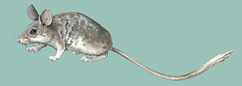
Mouselike hamsters weigh only 15 to 30 grams, on average weighing 20.4 g. There is no sexual dimorphism. Females have six mammae. Their bodies measure 61 to 98 mm, while their tails add an additional 72 to 102 mm, making the tail longer than both the head and body. The vibrissae are up to 21 mm long. The ears are very round and 17 to 20 mm long. The ears are devoid of hair and are pinkish-grey to slate gray in color. Their fur is very soft, fine, plumbeous at the base, and long, and ranges from a light pink-brown to a gray-brown color on the upper part of the body, and their underside, hands, and feet are white. The dividing line between the back and the belly is very well defined. There is no white patch behind the ear or eye, as in some other members of the Muridae. The tail is covered with short brown hairs and ends with a small tassel of hair. Calomyscus bailwardi lacks cheek pouches. The muzzle is sharp and pointed. The hind leg is elongated in comparison to the forelimb. The hindfeet have five digits each, and the forefeet each have five digits with a vestigial clawless thumb. The claws are delicate and small. ("Walker's Mammals of the World", 1991; Grzimek, 2004; Lawlor, 1979; Peshev, 1989; Roberts, 1997; Schlitter and Setzer, 1973)
- Other Physical Features
- endothermic
- homoiothermic
- bilateral symmetry
- Sexual Dimorphism
- sexes alike
-
- Range mass
- 15 to 30 g
- 0.53 to 1.06 oz
-
- Average mass
- 20.4 g
- 0.72 oz
-
- Range length
- 133 to 200 mm
- 5.24 to 7.87 in
Reproduction
Not much is known of the mating systems of mouselike hamsters. They are not thought to be highly social mammals, though they have occasionally been known to share shelter sites in the wild, and they huddle together in captivity. ("Walker's Mammals of the World", 1991; Grzimek, 2004)
The breeding season of C. bailwardi is long, with the peak breeding time ranging from late March to early June. However, the breeding period can vary regionally, depending on food availability. Females have been known to produce up to two litters during this time span. Each litter produces 1 to 5 young. The sex ratio in newborns is equal. Young are weaned no earlier than 4 weeks. Female C. bailwardi have 6 mammae to feed their young.
The highest recorded number of births to a single female was recorded in captivity as 15 litters in 2.25 years, with a total of 41 young produced. In the wild, the typical female is sexually and reproductively active until the 3rd year of life. (Volf and Volf, 2003; "Walker's Mammals of the World", 1991; Grzimek, 2004; Volf and Volf, 2003)
- Key Reproductive Features
- iteroparous
- seasonal breeding
- gonochoric/gonochoristic/dioecious (sexes separate)
- sexual
- fertilization
- viviparous
-
- Breeding interval
- Mouselike hamsters produce two litters per year, during 1 breeding period that takes place in late spring to mid-summer
-
- Breeding season
- The breeding season is from late spring to mid-summer, typically from late March to early June.
-
- Range number of offspring
- 1 to 5
-
- Average number of offspring
- 2.8
-
- Average number of offspring
- 3.3
- AnAge
-
- Range gestation period
- 3 to 5 weeks
-
- Range weaning age
- 4 (low) weeks
-
- Range time to independence
- 4 to 8 months
-
- Average age at sexual or reproductive maturity (female)
- 4 months
-
- Average age at sexual or reproductive maturity (male)
- 5 months
The young of C. bailwardi are hairless and are helpless for the first 13 days of their lives, until they can open their eyes for the first time. Around this same time, gray fur can be seen, though the young will not have the same coloring or size as adults until they are 4 to 8 months old. This is a relatively long period of growth and development for members of the family Muridae.
Young achieve a doubling in weight by the 8th day. Weaning occurs no earlier than the 4th week of life, and growth typically finishes around the 4th month of life when the mouselike hamster reaches an eight- to ninefold body weight in comparison to the birthweight, though growth can continue for up to 8 months.
In one instance, cannibalism was observed. A captive female C. bailwardi ate its young. ("Walker's Mammals of the World", 1991; Grzimek, 2004; Roberts, 1997; Volf and Volf, 2003)
- Parental Investment
- altricial
- female parental care
-
pre-hatching/birth
-
provisioning
- female
-
protecting
- female
-
provisioning
-
pre-weaning/fledging
-
provisioning
- female
-
protecting
- female
-
provisioning
-
pre-independence
-
provisioning
- female
-
protecting
- female
-
provisioning
- post-independence association with parents
Lifespan/Longevity
Captive C. bailwardi typically live for around 4 years. The longest recorded life of C. bailwardi is 9 years, 3 months, and 18 days, which occurred in captivity. The only studies done on C. bailwardi have been in captivity, so the lifespan in the wild is not known. (Volf and Volf, 2003)
-
- Average lifespan
Status: captivity - 9.75 years
- Average lifespan
-
- Average lifespan
Status: captivity - 4 years
- Average lifespan
-
- Average lifespan
Status: captivity - 9.4 years
- AnAge
- Average lifespan
Behavior
Mouselike hamsters are not highly social mammals, though they can sometimes be found sharing shelters in the wild and huddling together in captivity.
They are very agile and are able to jump amongst the tumbled boulders that typically constitute their home. They are also very good climbers. They are nervous in disposition, and timid.
They are nocturnal during the summer, though they become active by day as well during the autumn and winter, extending the hours of activity into the dusk and dawn hours. As far as it is currently known, mouselike hamsters do not hibernate, and they remain active throughout the entire year. ("Walker's Mammals of the World", 1991; Grzimek, 2004; Roberts, 1997)
- Key Behaviors
- terricolous
- diurnal
- nocturnal
- crepuscular
- motile
- solitary
Communication and Perception
No information is available on communication or perception channels of C. bailwardi.
Food Habits
Mouselike hamsters are partly granivorous as well as herbivorous, eating seeds, grasses, flowers, and leaves. Like many other members of Muridae, C. bailwardi brings back food to its home, though it cannot carry large quantities due to its lack of cheek pouches. It conceals the caches of food under stones in its burrow. These caches are most likely utilized during the winter months when the climate is harsh. Captive mouselike hamsters ate chopped vegetables and millet seeds, and they drank water, which is rarely available to them in the wild. ("Walker's Mammals of the World", 1991; Grzimek, 2004)
- Plant Foods
- leaves
- seeds, grains, and nuts
- flowers
- Foraging Behavior
- stores or caches food
Predation
The small size and lack of defenses allows mouselike hamsters to be very susceptible to predation. The most common predators of mouselike hamsters are owls, martens, polecats, and snakes. (Roberts, 1997)
-
- Known Predators
-
- pallid scops owls (Otus brucei)
- marbled polecats (Vormela peregusna)
- stone martens (Martes foina)
- levantine vipers (Macrovipera lebetina obtusa)
- rat snakes (Sphalerosophis atriceps)
Ecosystem Roles
Mouselike hamsters are part of the food chain and are preyed on by local wildlife, depending on the region in which they are being observed.
Cases have been documented in which mouselike hamsters were found living in the burrows of Meriones persicus. Since C. bailwardi is not a good burrower, it is thought that they moved into burrows that were already vacated.
Mouselike hamsters are seed predators and dispersers. If they do not consume all of the seeds that they store for use during the winter, the seeds can sprout the following spring. (Grzimek, 2004; Roberts, 1997)
- Ecosystem Impact
- disperses seeds
Economic Importance for Humans: Positive
Mouselike hamsters have been used in Russia for various tests in labs and are sold as pets in many pet stores. They also have been imported by the United Kingdom for exhibits in zoos. (Acorn Web, 2000)
- Positive Impacts
- pet trade
- research and education
Economic Importance for Humans: Negative
In areas where mouselike hamsters are abundant, they may behave as agricultural pests and harbor diseases to which humans are susceptible. (Grzimek, 2004)
- Negative Impacts
-
injures humans
- carries human disease
- crop pest
Conservation Status
There is very little information on the status of C. bailwardi.
-
- IUCN Red List
-
Least Concern
More information
-
- IUCN Red List
-
Least Concern
More information
Other Comments
During a study in which three populations of C. bailwardi were observed, considerable differences were noticed between the populations. New subspecies of C. bailwardi have thus been proposed, those being C. b. tsolovi and C. b. mustersi. These subspecies are thought to be synonymous with C. grandis. The subspecies C. b. elburzensis and C. b. mystax are regarded to be synonymous with C. hotsony.
The IUCN website lists the species of C. bailwardi as four different species, C. hotsoni, C. mystax, C. tsolovi, and C. urartensis. ("IUCN Red List", 2000; Peshev, 1991)
Contributors
Matthew Wund (editor), University of Michigan-Ann Arbor.
Tracie Goodness (author), University of Michigan-Ann Arbor, Phil Myers (editor, instructor), Museum of Zoology, University of Michigan-Ann Arbor.
Glossary
- Palearctic
-
living in the northern part of the Old World. In otherwords, Europe and Asia and northern Africa.

- acoustic
-
uses sound to communicate
- agricultural
-
living in landscapes dominated by human agriculture.
- altricial
-
young are born in a relatively underdeveloped state; they are unable to feed or care for themselves or locomote independently for a period of time after birth/hatching. In birds, naked and helpless after hatching.
- bilateral symmetry
-
having body symmetry such that the animal can be divided in one plane into two mirror-image halves. Animals with bilateral symmetry have dorsal and ventral sides, as well as anterior and posterior ends. Synapomorphy of the Bilateria.
- chemical
-
uses smells or other chemicals to communicate
- crepuscular
-
active at dawn and dusk
- diurnal
-
- active during the day, 2. lasting for one day.
- endothermic
-
animals that use metabolically generated heat to regulate body temperature independently of ambient temperature. Endothermy is a synapomorphy of the Mammalia, although it may have arisen in a (now extinct) synapsid ancestor; the fossil record does not distinguish these possibilities. Convergent in birds.
- female parental care
-
parental care is carried out by females
- fertilization
-
union of egg and spermatozoan
- folivore
-
an animal that mainly eats leaves.
- forest
-
forest biomes are dominated by trees, otherwise forest biomes can vary widely in amount of precipitation and seasonality.
- granivore
-
an animal that mainly eats seeds
- herbivore
-
An animal that eats mainly plants or parts of plants.
- iteroparous
-
offspring are produced in more than one group (litters, clutches, etc.) and across multiple seasons (or other periods hospitable to reproduction). Iteroparous animals must, by definition, survive over multiple seasons (or periodic condition changes).
- motile
-
having the capacity to move from one place to another.
- mountains
-
This terrestrial biome includes summits of high mountains, either without vegetation or covered by low, tundra-like vegetation.
- native range
-
the area in which the animal is naturally found, the region in which it is endemic.
- nocturnal
-
active during the night
- pet trade
-
the business of buying and selling animals for people to keep in their homes as pets.
- seasonal breeding
-
breeding is confined to a particular season
- sexual
-
reproduction that includes combining the genetic contribution of two individuals, a male and a female
- solitary
-
lives alone
- stores or caches food
-
places a food item in a special place to be eaten later. Also called "hoarding"
- tactile
-
uses touch to communicate
- temperate
-
that region of the Earth between 23.5 degrees North and 60 degrees North (between the Tropic of Cancer and the Arctic Circle) and between 23.5 degrees South and 60 degrees South (between the Tropic of Capricorn and the Antarctic Circle).
- terrestrial
-
Living on the ground.
- visual
-
uses sight to communicate
- viviparous
-
reproduction in which fertilization and development take place within the female body and the developing embryo derives nourishment from the female.
References
1991. Walker's Mammals of the World. Baltimore, USA and London, England: John Hopkins University Press.
2000. "IUCN Red List" (On-line). Accessed February 24, 2004 at http://www.redlist.org.
Acorn Web, 2000. "About Hamsters; Calomyscus bailwardi" (On-line). Accessed February 24, 2004 at http://www.petwebsite.com/mouse.htm.
Ahmad, M., S. Ghalib. 1975. A checklist of mammals of Pakistan. Records Zoological Survey of Pakistan, 7 (1-2): 1-34.
De Roguin, L. 1988. Notes on mammals from Iranian Baluchistan. Revue Suisse de Zoologie, 95(2): 596-606.
Grzimek, B. 2004. Species Accounts; Mouse-like hamster. Pp. 288 in D Kleiman, V Geist, M McDade, eds. Calomyscus bailwardi, Vol. 16, 2 Edition. Detroit: Gale.
Lawlor, T. 1979. Handbook to the Orders and Families of Living Mammals. Eureka, California: Mad River Press.
Morshed, S., J. Patton. 2002. New records of mammals from Iran with systematic comments on hedgehogs (Erinaceidae) and mouse-like hamsters (Calomyscus, Muridae). Zoology in the Middle East, 26: 49-58.
Peshev, D. 1991. On the systematic position of the mouse-like hamster Calomyscus bailwardi Thomas, 1905 (Cricetidae, Rodentia) from the near-east and middle Asia. Mammalia, 55: 107-112.
Peshev, D. 1989. The mouse-like hamster Calomyscus bailwardi new record thomas 1905 a new mammal for the Syrian fauna and the Arab Penninsula. Mammalia, 53(1): 109-112.
Roberts, T. 1997. The Mammals of Pakistan. Karachi ; New York: Oxford University Press.
Schlitter, D., H. Setzer. 1973. New rodents (Mammalia: Cricetidae, Muridae) from Iran and Pakistan. Proceedings of the Biological Society of Washington, 86(14): 163-173.
Volf, J., P. Volf. 2003. The Mouselike Hamster (Calomyscus bailwardi Thomas, 1905) and his breeding in captivity. Zoologische Garten, 73(3): 147-157.