Callosciurus prevostiiPrevost's squirrel
Geographic Range
Callosciurus prevostii is found in Southeast Asian countries such as Thailand, Indonesia, Malaysia, and many small islands of the East Indies (Oakland Zoo, 2001). The northern limit of this squirrel's range is in southern Thailand (Heaney, 1978).
- Other Geographic Terms
- island endemic
Habitat
The habitat of Prevost's squirrels varies within its range. In northern Borneo they have been found in smaller trees of the middle story in primary and old logged forests. In western Malaysia they have been found feeding on the fruit of fig trees in the upper story (Heaney, 1978). They will either nest in tree hollows or make nests of leaves and twigs (Oakland Zoo, 2001).
- Habitat Regions
- tropical
- Terrestrial Biomes
- rainforest
Physical Description
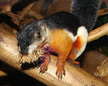
Generally, these squirrels are black on top and chestnut underneath, with a white stripe between the black and chestnut. Many subspecies have a prominent shoulder patch, which can be black, grey, red, white, or a mixture of those colors (Heaney ,1978). The coloration of the pelage varies over the species range. C. prevostii fur is usually thick but not soft (Oakland Zoo, 2001).
- Other Physical Features
- endothermic
- bilateral symmetry
-
- Average mass
- 0.5 kg
- 1.10 lb
-
- Average mass
- 400 g
- 14.10 oz
- AnAge
Development
See Reproduction.
Reproduction
The mating system and behavior of these squirrels has not been reported.
Although the breeding season is year-round, it peaks between June and August. The gestation period is about 40 days. In captivity females have one to four young (Oakland Zoo, 2001). The pregnancy rate in central Malaysia has been broadly related to the amount of rainfall (Wang, 1964). Neonates weigh around 16 grams (Nowak, 1999).
- Key Reproductive Features
- iteroparous
- year-round breeding
- gonochoric/gonochoristic/dioecious (sexes separate)
- sexual
- viviparous
-
- Breeding season
- These squirrels breed year round, but experience a peak in breeding during June and August.
-
- Range number of offspring
- 1 to 4
-
- Average number of offspring
- 1.8
- AnAge
-
- Average gestation period
- 40 days
-
- Average gestation period
- 48 days
- AnAge
Reports on parental care in C. prevostii are not available. However, like all mammals, the female does provide the young with milk. Squirrels of the genus Callosciurus construct nests in tree hollows, or from leaves and twigs. The female therefore provides her growing offspring with a home also. As with other members of the genus, the young are probably altricial, and weigh only 16 grams when born. (Nowak, 1999)
- Parental Investment
- altricial
Lifespan/Longevity
The lifespan of this species is not known. However, Callosciurus erythraeus lived 17 years in captivity. (Nowak, 1999)
-
- Average lifespan
Status: captivity - 21.1 years
- AnAge
- Average lifespan
Behavior
These squirrels are active during the day but mainly at dusk and dawn. They can be seen in groups while feeding in fig trees (Oakland Zoo, 2001). It is believed that the adults give seeds to juveniles since the juveniles are never seen foraging. It is also believed that they cache food after one was observed trying to wedge a ripe fruit into a crack in a tree branch (Becker et al., 1985).
- Key Behaviors
- crepuscular
- motile
- social
Communication and Perception
Food Habits
The food habits of C. prevostii vary throughout the species range. These squirrels primarily eat coconut, rubber seeds (among other varieties), oil palm fruit, and other soft fruits such as figs. They also eat eggs, buds, flowers, other vegetable matter, and insects, including ants, termites, and beetle larvae, although this is not the main staple of their diet (Heaney, 1978; Nowak, 1999).
- Animal Foods
- insects
- Plant Foods
- leaves
- seeds, grains, and nuts
- fruit
- flowers
Predation
A yellow-throated marten was seen pursuing Prevost's squirrel, and a creasted serpent eagle was seen carrying one. These are the only noted observations of predation on the species, and not much is known about their predators (Becker et al., 1985). Although anti-predator behavior for this species has not been reported, a related species, Callosciurus caniceps is known to have an alarm call (Nowak, 1999).
-
- Known Predators
-
- yellow-throated martens (Martes flavigula)
- crested serpent-eagles (Spilornis cheela)
Ecosystem Roles
Prevost's squirrels drop the seeds of some species after eating the flesh from the fruit. Squirrels disperse these seeds by carrying them away from the parent tree. Seeds carried away in such a manner may have a lower risk of being eaten compared to ones that are found beneath the parent tree (Becker et al., 1985).
- Ecosystem Impact
- disperses seeds
Economic Importance for Humans: Positive
No positive interactions between humans and C. prevostii have been reported.
Economic Importance for Humans: Negative
Where their habitat has been converted to agriculture, these squirrels grow fond of oil palm nuts. This brings them into conflict with plantation owners (Heany, 1978).
- Negative Impacts
- crop pest
Conservation Status
Currently Prevost's squirrels are not threatened. However, habitat destruction and the pet trade may affect their numbers (Oakland Zoo, 2001). Many of the natural habitats in which they live have a vulnerable or a critical/endangered status, such as the Peninsular Malaysian rain forests and the Sumatran lowland rain forests (National Geographic, 2001).
-
- IUCN Red List
-
Least Concern
More information
-
- IUCN Red List
-
Least Concern
More information
-
- CITES
- No special status
Other Comments
Prevost's squirrel is also known as the Tri-colored, Ornamental, or Beautiful squirrel (Oakland Zoo, 2001).
Contributors
Heidi Hoffman (author), University of Wisconsin-Stevens Point, Chris Yahnke (editor), University of Wisconsin-Stevens Point.
Glossary
- altricial
-
young are born in a relatively underdeveloped state; they are unable to feed or care for themselves or locomote independently for a period of time after birth/hatching. In birds, naked and helpless after hatching.
- bilateral symmetry
-
having body symmetry such that the animal can be divided in one plane into two mirror-image halves. Animals with bilateral symmetry have dorsal and ventral sides, as well as anterior and posterior ends. Synapomorphy of the Bilateria.
- chemical
-
uses smells or other chemicals to communicate
- crepuscular
-
active at dawn and dusk
- endothermic
-
animals that use metabolically generated heat to regulate body temperature independently of ambient temperature. Endothermy is a synapomorphy of the Mammalia, although it may have arisen in a (now extinct) synapsid ancestor; the fossil record does not distinguish these possibilities. Convergent in birds.
- frugivore
-
an animal that mainly eats fruit
- granivore
-
an animal that mainly eats seeds
- herbivore
-
An animal that eats mainly plants or parts of plants.
- island endemic
-
animals that live only on an island or set of islands.
- iteroparous
-
offspring are produced in more than one group (litters, clutches, etc.) and across multiple seasons (or other periods hospitable to reproduction). Iteroparous animals must, by definition, survive over multiple seasons (or periodic condition changes).
- motile
-
having the capacity to move from one place to another.
- native range
-
the area in which the animal is naturally found, the region in which it is endemic.
- oriental
-
found in the oriental region of the world. In other words, India and southeast Asia.

- rainforest
-
rainforests, both temperate and tropical, are dominated by trees often forming a closed canopy with little light reaching the ground. Epiphytes and climbing plants are also abundant. Precipitation is typically not limiting, but may be somewhat seasonal.
- sexual
-
reproduction that includes combining the genetic contribution of two individuals, a male and a female
- social
-
associates with others of its species; forms social groups.
- tactile
-
uses touch to communicate
- tropical
-
the region of the earth that surrounds the equator, from 23.5 degrees north to 23.5 degrees south.
- viviparous
-
reproduction in which fertilization and development take place within the female body and the developing embryo derives nourishment from the female.
- year-round breeding
-
breeding takes place throughout the year
References
"National Geographic" (On-line). Accessed December 3, 2001 at http://www.nationalgeographic.com/wildworld/profiles/terrestrial_im.html.
Becker, P., M. Leighton, J. Payne. 1985. Why Tropical Squirrels Carry Seeds Out of Source Crowns. Journal of Tropical Ecology, 1(2): 183-186.
Heaney, L. 1978. Island Area and Body Size of Insular Mammals: Evidence from the Tri-Colored Squirrel (Calloscuirus prevosti) of Southeast Asia. Evolution, 32(1): 29-44.
Medway, L. 1964. The Fauna. Pp. 63 in W Gungwu, ed. Malaysia: A Survey. London: Pall Mall Press Limited.
Nowak, R. 1999. Walker's Mammals of the World, Sixth Edition. Baltimore and London: John Hopkins University Press.
Oakland Zoo, "Animals A-Z: Prevost's Squirrel" (On-line). Accessed December 3, 2001 at http://www.oaklandzoo.org/atoz/azpresquirrel.html.