Callosciurus erythraeusPallas's squirrel



Geographic Range
Red-bellied squirrels naturally inhabit southern China, Malaya, and the lowlands and mountains of Taiwan. In 1935, 40 individuals were removed from Taiwan and introduced on the island of Izuoshima, about 100 km south of Tokyo, Japan. Later, 100 squirrels were taken from the Izuoshima population and moved 400 km west to Tomogashima Island. (Setoguchi 1990)
- Biogeographic Regions
- oriental
Habitat
The habitat has a mean temperature of 15.8 degrees Celsius and mean rainfall of 1,455 mm. Vegetation consists of warm-temperate evergreen trees and woody plants with a high occurrence of fruiting vegetation such as the camellia and bayberry.
- Habitat Regions
- temperate
- terrestrial
- Terrestrial Biomes
- forest
- rainforest
Physical Description
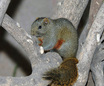
Callosciurus erythraeus are medium in size with adults reaching a total head and body length of up to 200 mm. They have strong claws on their fingers and toes, excellent for digging holes to cache a supply of nuts. The ankles have extreme rotational capability and the claws, which they sink into the bark of a tree branch or trunk as they run, ensure them a firm grip as they chase nimbly through the trees. With large, protruding eyes, red-bellied squirrels have sharp vision and can distinguish vertical objects particularly well -- a useful ability for an animal that spends much of its time in trees leaping from branch to branch. Because of eye location, they are able to see behind, overhead and underneath without turning their heads, giving them the ability to survey the area for any signs of danger. The eyes also contain cones within the retina, allowing Callosciurus erythraeus to see the bright colors of its surroundings. (NatZoo 1992)
- Other Physical Features
- endothermic
- homoiothermic
- bilateral symmetry
- Sexual Dimorphism
- sexes alike
-
- Average mass
- 272 g
- 9.59 oz
- AnAge
Reproduction
Red-bellied squirrels are sexually promiscuous. On the female's day of estrus, several males gather around her and begin vocalizing. These vocalizations are the beginning of mating bouts in which the males spar with one another to win the right to mate. The winner of the bout will often guard his mate for a short period of time, trying to ensure that he is the true fertilizer of the female's eggs. But if the number of challenging males gets to be too much, the "guard" usually leaves and she may mate (and usually does) with another individual.
- Mating System
- polygynandrous (promiscuous)
The female first scouts and then builds a nest in a suitable and relatively protected site. This behavior peaks in spring and autumn in accordance with the breeding seasons. In that nest, the female gives birth usually to several young.
(Setoguchi 1991)
- Key Reproductive Features
- iteroparous
- seasonal breeding
- gonochoric/gonochoristic/dioecious (sexes separate)
- sexual
- fertilization
- oviparous
Young are cared for and nursed by females in the nest until they reach independence.
- Parental Investment
- altricial
- female parental care
Lifespan/Longevity
-
- Average lifespan
Status: captivity - 16.1 years
- Max Planck Institute for Demographic Research
- Average lifespan
Behavior
Home ranges of adults overlap, with the extent of overlap being less among females then males. When these squirrels do encounter each other, a chase may ensue until the possible "intruder" is moved off the territory, or the territory owner may show indifference and continue normal activity. A fixed dominant hierarchy does exist especially at locations of common feeding and includes both sexes. It appears to be correlated with age. (Tamura et al. 1988)
- Key Behaviors
- arboreal
- diurnal
- motile
- sedentary
- territorial
- dominance hierarchies
Communication and Perception
Food Habits
Similar to all tree squirrels, red-bellied squirrels rely heavily on a diet consisting of leaves, fruit, seeds, insects, nuts, acorns, and cones. These squirrels feed mainly in the trees, but do spend some time feeding on the surface. Clearly they rely most heavily on arboreal foods and procure most foodstuffs while keeping their place among the branches. Red-bellied squirrels are well adapted in that they rotate their dietary consumption based on the seasonal availability of the item. In winter, they consume primarily Camellia tree flowers, which bloom from October to June. Later the diet switches toward the greatest period of leaf consumption from April to May. In June their palate is suffused with the luscious fruits that are now abundant. And as fall comes around, red-bellied squirrels busy their jaws with the nutritiously profitable food source of ants that are still active above ground as opposed to the usual hoarding behavior. (Setoguchi 1990)
- Animal Foods
- insects
- Plant Foods
- leaves
- seeds, grains, and nuts
- fruit
- Foraging Behavior
- stores or caches food
Ecosystem Roles
Red-bellied squirrels are important as seed dispersers of tree species.
- Ecosystem Impact
- disperses seeds
Economic Importance for Humans: Positive
Red-bellied squirrels are valuable for their ecosystem roles, particularly as seed dispersers.
Economic Importance for Humans: Negative
The small negative effects of red-bellied squirrels lies primarily in their habit of gnawing on tree bark, sometimes killing the tree. Also their consumption of oil palm nuts has brought them into conflict with plantation owners who now hunt them as pests. (NatZoo 1992)
- Negative Impacts
- crop pest
Conservation Status
There is no threat to this species as they have been widely introduced from their ancestral home ranges to new localities such as Tomogashima Island. Numbers there have increased profoundly and these squirrels had colonized the whole island by 1959, only 5 years after being first introduced.
-
- IUCN Red List
-
Least Concern
More information
Contributors
Debra L. Rodriguez (author), University of Michigan-Ann Arbor.
Glossary
- altricial
-
young are born in a relatively underdeveloped state; they are unable to feed or care for themselves or locomote independently for a period of time after birth/hatching. In birds, naked and helpless after hatching.
- arboreal
-
Referring to an animal that lives in trees; tree-climbing.
- bilateral symmetry
-
having body symmetry such that the animal can be divided in one plane into two mirror-image halves. Animals with bilateral symmetry have dorsal and ventral sides, as well as anterior and posterior ends. Synapomorphy of the Bilateria.
- chemical
-
uses smells or other chemicals to communicate
- diurnal
-
- active during the day, 2. lasting for one day.
- dominance hierarchies
-
ranking system or pecking order among members of a long-term social group, where dominance status affects access to resources or mates
- endothermic
-
animals that use metabolically generated heat to regulate body temperature independently of ambient temperature. Endothermy is a synapomorphy of the Mammalia, although it may have arisen in a (now extinct) synapsid ancestor; the fossil record does not distinguish these possibilities. Convergent in birds.
- female parental care
-
parental care is carried out by females
- fertilization
-
union of egg and spermatozoan
- forest
-
forest biomes are dominated by trees, otherwise forest biomes can vary widely in amount of precipitation and seasonality.
- frugivore
-
an animal that mainly eats fruit
- granivore
-
an animal that mainly eats seeds
- herbivore
-
An animal that eats mainly plants or parts of plants.
- internal fertilization
-
fertilization takes place within the female's body
- introduced
-
referring to animal species that have been transported to and established populations in regions outside of their natural range, usually through human action.
- iteroparous
-
offspring are produced in more than one group (litters, clutches, etc.) and across multiple seasons (or other periods hospitable to reproduction). Iteroparous animals must, by definition, survive over multiple seasons (or periodic condition changes).
- motile
-
having the capacity to move from one place to another.
- native range
-
the area in which the animal is naturally found, the region in which it is endemic.
- oriental
-
found in the oriental region of the world. In other words, India and southeast Asia.

- oviparous
-
reproduction in which eggs are released by the female; development of offspring occurs outside the mother's body.
- polygynandrous
-
the kind of polygamy in which a female pairs with several males, each of which also pairs with several different females.
- rainforest
-
rainforests, both temperate and tropical, are dominated by trees often forming a closed canopy with little light reaching the ground. Epiphytes and climbing plants are also abundant. Precipitation is typically not limiting, but may be somewhat seasonal.
- seasonal breeding
-
breeding is confined to a particular season
- sedentary
-
remains in the same area
- sexual
-
reproduction that includes combining the genetic contribution of two individuals, a male and a female
- stores or caches food
-
places a food item in a special place to be eaten later. Also called "hoarding"
- tactile
-
uses touch to communicate
- temperate
-
that region of the Earth between 23.5 degrees North and 60 degrees North (between the Tropic of Cancer and the Arctic Circle) and between 23.5 degrees South and 60 degrees South (between the Tropic of Capricorn and the Antarctic Circle).
- terrestrial
-
Living on the ground.
- territorial
-
defends an area within the home range, occupied by a single animals or group of animals of the same species and held through overt defense, display, or advertisement
References
NatZoo (http://www.si.edu/natzoo/zooview/animals/squirrel.htm) 1992.
Setoguchi, Mieko. 1990. Food habits of red-bellied tree squirrels on a small island in Japan. Journal of Mammalogy. Vol. 71(4). pp 570-578.
Setoguchi, Mieko. 1991. Nest-site selection and nest-building behavior of red-bellied tree squirrels on Tomogashima Island, Japan. Journal of Mammalogy. Vol. 72(1). pp163-170.
Tamura, Noriko, Fumio Hayashi, and Kazuyoshi Miyashita. 1988. Dominance hierarchy and mating behavior of the Formosan squirrel Callosciurus erythraeus thaiwanensis. Journal of Mammalogy. Vol. 69(2). pp 320-331.