Callipepla gambeliiGambel's quail



Geographic Range
Gambel's quail are found almost exclusively in the southwestern United States, mainly in Arizona. Their range extends into Mexico, east to parts of Texas, west to California and a small part of southern Utah, Nevada and Colorado. A few quail were introduced to Hawaii in 1928, 1958 and 1960, and a few remain there today.
- Biogeographic Regions
- nearctic
- oceanic islands
Habitat
Gambel's Quail live in warm deserts with brushy and thorny vegetation. These birds also survive well in cultivated communities and prefer mesquite lined river valleys and drainages near these lands. Desert mountain foothills, mesquite springs, plains with diverse vegetation and any area of the desert receiving slightly more rainfall than surrounding parts, are all home to good populations of Gambel's quail. These quail are non-migratory and annual movements of the covey are less than 2 kilometers. Gambel's quail prefer to roost in dense shrubs or trees at night. Shade from various types of desert vegetation is also very helpful. Dense cover provides shelter from predators. Common plants found in the quails' habitat include: desert hackberry, mesquites, little leaf sumac, desert thorns, catclaw acacia, scrub oak, and various other types of desert shrubbery (Brown 1998).
- Habitat Regions
- temperate
- terrestrial
- Terrestrial Biomes
- desert or dune
- chaparral
- scrub forest
Physical Description
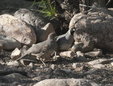
Like other quails, Gambel's quail have a chunky round body with a plume on the head. Mature birds average eleven inches long and weigh from 160 to 200 grams (Brown 1998). Males have a dark and thick plume, a black face and neck and also a black patch on the breast. Females have more dull and thin plumes and lack these black markings. Mature males have much more striking plumage than females. This quail has chestnut sides, olive wings and various white and cream-colored markings (Brown 1998). Some variation in plumage occurs across its range; mainly birds being darker and more vividly colored in areas with more rainfall. Gambel's quail are known to hybridize with California and Scaled quails, but this is not very common (Brown 1998).
- Other Physical Features
- endothermic
- homoiothermic
- bilateral symmetry
- Sexual Dimorphism
- male more colorful
- ornamentation
-
- Range mass
- 160 to 200 g
- 5.64 to 7.05 oz
-
- Average basal metabolic rate
- 0.755 W
- AnAge
Reproduction
Gambel's quail are considered monogamous, but sometimes a mature female will leave young with the male and seek another brood with a new father. In order to entice females, males offer small bits of food during feeding. Studies have shown that the rate of this process, called "tidbitting," is the basis for a females' selection of a mate (Brown 1998). (Brown, et al., 1998)
- Mating System
- monogamous
Female quail select nest sites usually on the ground. Preferably the nest is hidden under a shrub, rock, or protected site. Sometimes these quail may build in a tree two to ten meters off the ground if a suitable platform is available. The nest itself is bowl shaped, about four centimeters deep and thirteen to eighteen centimeters wide. Small twigs, grass stems, leaves and feathers line the nest. The eggs are dull white and are smooth, often containing brown spots. Average clutch size is ten to twelve eggs. During dryer years clutches tend to be smaller.
- Key Reproductive Features
- iteroparous
- seasonal breeding
- gonochoric/gonochoristic/dioecious (sexes separate)
- sexual
- fertilization
- oviparous
-
- Breeding interval
- Breeding occurs once yearly.
-
- Average eggs per season
- 10 to 12
-
- Average eggs per season
- 11
- AnAge
-
- Range time to hatching
- 22 to 23 days
-
- Average age at sexual or reproductive maturity (female)
- 1 years
-
- Average age at sexual or reproductive maturity (male)
- 1 years
Females generally incubate the eggs for twenty-one to twenty-three days. Males will attempt incubation if the female dies or is unavailable. Both parents care for young, and if one parent dies the brood can be successfully raised by the remaining parent (Brown 1998). Young quail are capable of running around and feeding soon after hatching.
- Parental Investment
- precocial
- male parental care
- female parental care
Lifespan/Longevity
-
- Average lifespan
Sex: male
Status: wild - 7.4 years
- Max Planck Institute for Demographic Research
- Average lifespan
Behavior
Gambel's quail are fast runners and only fly to escape danger, cross obstacles like roads, or fly to a roost at night. They are not fast in flight and prefer to remain on the ground if possible. The birds are not territorial and population density depends on brood productivity, which varies depending on yearly climate. A typical covey usually consists of an adult pair and up to sixteen young. Each covey has a specific home range, but does not defend this area and coveys commonly travel and feed in each other's home ranges (Brown 1998).
Communication and Perception
Food Habits
Ninety percent of the Gambel's Quail diet comes from plants. Various types of seeds and leaves are eaten throughout the year. During certain times of year fruits and berries from cacti are eaten. A few insects are eaten during the nesting season in spring and early summer. The quails feed in groups while slowly traveling along the ground. Typically a covey feeds twice a day, morning and afternoon. Communication between group members is kept with calls. The birds typically rest in a shady area during the hottest parts of the day. During cooler weather, the birds may feed and remain active for longer time periods. The quail has little if any free water requirements, but does prefer to live near and will frequent a water source if one is available (Brown 1998).
- Animal Foods
- insects
- Plant Foods
- leaves
- seeds, grains, and nuts
- fruit
Predation
These quail prefer to remain motionless and rely on camouflage to avoid predators, especially if hidden by vegetation. They are preyed on by a wide diversity of small to medium avian, mammalian, and saurian predators including snakes, raptors, foxes, bobcats, and coyote.
- Anti-predator Adaptations
- cryptic
Economic Importance for Humans: Positive
This is a game bird, so presumably people eat them.
- Positive Impacts
- food
Conservation Status
Currently, there is no significant conservation effort to aide the Gamble's quail, but the bird is doing very well. Habitat degradation from urbanization and cattle grazing are possible threats to the bird. The Gambel's quail is an extremely popular game bird and there are few hunting restrictions. The season is long and the daily bag limit is fifteen birds. Hunters harvested an estimated 1,200,000 quail in 1994 and 1995. Current research shows however, that the main factor affecting the population size is variations in annual environmental conditions, mainly temperature and rainfall.
-
- IUCN Red List
-
Least Concern
More information
Other Comments
Factors Affecting Quail Numbers
The Gambel's Quail has few predators. Bobcats, birds of prey and human hunters do take a substantial number of birds, but the main effect on the quails' population is the weather (Brown 1998). Temperature and rainfall are two key factors limiting the quails' reproductive success. Above average temperatures and below average rainfall usually leads to severe decline of the Gambel's Quail population. A year of high rainfall and below average temperatures causes a large increase in brood success and rapid population growth. These environmental factors greatly affect plant growth, which the birds feed upon, which in turn affects the birds' reproductive success (Heffelinger 1999). Studies have shown that the Gambel's Quail is susceptible to a hepatitus virus that may be comparable to a viral disease that the Bobwhite quail suffers from. Wild Gambel's quail have not been found with this disease however (Bradely 1994).
Contributors
Matthew Thomson (author), University of Michigan-Ann Arbor, Terry Root (editor), University of Michigan-Ann Arbor.
Glossary
- Nearctic
-
living in the Nearctic biogeographic province, the northern part of the New World. This includes Greenland, the Canadian Arctic islands, and all of the North American as far south as the highlands of central Mexico.

- acoustic
-
uses sound to communicate
- bilateral symmetry
-
having body symmetry such that the animal can be divided in one plane into two mirror-image halves. Animals with bilateral symmetry have dorsal and ventral sides, as well as anterior and posterior ends. Synapomorphy of the Bilateria.
- chaparral
-
Found in coastal areas between 30 and 40 degrees latitude, in areas with a Mediterranean climate. Vegetation is dominated by stands of dense, spiny shrubs with tough (hard or waxy) evergreen leaves. May be maintained by periodic fire. In South America it includes the scrub ecotone between forest and paramo.
- chemical
-
uses smells or other chemicals to communicate
- cryptic
-
having markings, coloration, shapes, or other features that cause an animal to be camouflaged in its natural environment; being difficult to see or otherwise detect.
- desert or dunes
-
in deserts low (less than 30 cm per year) and unpredictable rainfall results in landscapes dominated by plants and animals adapted to aridity. Vegetation is typically sparse, though spectacular blooms may occur following rain. Deserts can be cold or warm and daily temperates typically fluctuate. In dune areas vegetation is also sparse and conditions are dry. This is because sand does not hold water well so little is available to plants. In dunes near seas and oceans this is compounded by the influence of salt in the air and soil. Salt limits the ability of plants to take up water through their roots.
- diurnal
-
- active during the day, 2. lasting for one day.
- endothermic
-
animals that use metabolically generated heat to regulate body temperature independently of ambient temperature. Endothermy is a synapomorphy of the Mammalia, although it may have arisen in a (now extinct) synapsid ancestor; the fossil record does not distinguish these possibilities. Convergent in birds.
- female parental care
-
parental care is carried out by females
- fertilization
-
union of egg and spermatozoan
- food
-
A substance that provides both nutrients and energy to a living thing.
- granivore
-
an animal that mainly eats seeds
- herbivore
-
An animal that eats mainly plants or parts of plants.
- internal fertilization
-
fertilization takes place within the female's body
- introduced
-
referring to animal species that have been transported to and established populations in regions outside of their natural range, usually through human action.
- iteroparous
-
offspring are produced in more than one group (litters, clutches, etc.) and across multiple seasons (or other periods hospitable to reproduction). Iteroparous animals must, by definition, survive over multiple seasons (or periodic condition changes).
- male parental care
-
parental care is carried out by males
- monogamous
-
Having one mate at a time.
- motile
-
having the capacity to move from one place to another.
- native range
-
the area in which the animal is naturally found, the region in which it is endemic.
- oceanic islands
-
islands that are not part of continental shelf areas, they are not, and have never been, connected to a continental land mass, most typically these are volcanic islands.
- oviparous
-
reproduction in which eggs are released by the female; development of offspring occurs outside the mother's body.
- scrub forest
-
scrub forests develop in areas that experience dry seasons.
- seasonal breeding
-
breeding is confined to a particular season
- sedentary
-
remains in the same area
- sexual
-
reproduction that includes combining the genetic contribution of two individuals, a male and a female
- sexual ornamentation
-
one of the sexes (usually males) has special physical structures used in courting the other sex or fighting the same sex. For example: antlers, elongated tails, special spurs.
- social
-
associates with others of its species; forms social groups.
- tactile
-
uses touch to communicate
- temperate
-
that region of the Earth between 23.5 degrees North and 60 degrees North (between the Tropic of Cancer and the Arctic Circle) and between 23.5 degrees South and 60 degrees South (between the Tropic of Capricorn and the Antarctic Circle).
- terrestrial
-
Living on the ground.
- visual
-
uses sight to communicate
- young precocial
-
young are relatively well-developed when born
References
Bradely, G., R. M.R., N. T.H., L. F., B. E.J.. 1994. Inclusion of Body Hepatitis in Gambel's Quail: *Calliepepla gambelii*. Journal of Wildlife Diseases, 30: 281-284.
Brown, D., J. Hagelin, M. Taylor, J. Galloway. 1998. Gambel's Quail: *Callipepla gambellii*. The Birds of North America, 321: 1-24.
Heffelinger, J., F. Guthery, R. Olding, C. Cochran, C. McMullen. January 1999. Influence of the precipitation, timing, and summer temperatures on reproduction of Gambel's Quail. Journal of Wildlife Management, 63: 154-161.