Buteo swainsoniSwainson's hawk

Geographic Range
The Swainson's Hawk, -Buteo swainsoni-, spends most of the year in the western United States extending into southwest Canada and south to west Texas. In the winter months, these birds migrate over Central America to the La Pampas region of Argentina (Brown 1996, TPWD 1997).
- Biogeographic Regions
- nearctic
- neotropical
Habitat
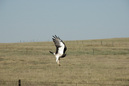
This hawk prefers open grasslands and desert-like habitats. It is common to see this hawk perched on a fence post in a prairie or open range. The Swainson's Hawk also inhabits agricultural areas, and is known to follow farmer's tractors in search of insect or rodent prey (Brown 1996, AID 1997).
- Terrestrial Biomes
- desert or dune
- savanna or grassland
- chaparral
Physical Description
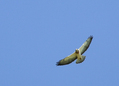
This hawk's most unique feature is its variation in color. The light color morph includes white patches on the forehead, the throat and the belly. The rest of the body is a dark brown. The dark color morph, which is the less common type, includes an entirely dark brown body with only a white patch under the tail. Other variations between these two distinct extremes have been observed. These hawks vary in length from 19 to 22 inches, and have a wingspan of 47 to 57 inches. An average weight for a male is 1.8 pounds, while the average for the female is almost 2.5 pounds. This bird is commonly confused with a Red-tailed hawk, but the Swainson's Hawk has a longer wingspan, more variation in color, and flies in a slight dihedral pattern (Brown 1996, AID 1997).
- Other Physical Features
- endothermic
- bilateral symmetry
-
- Average mass
- 980.64 g
- 34.56 oz
- AnAge
Reproduction
The Swainson's Hawk starts the breeding season by building nests in March and April. The nest are usually found in trees, shrubs, on the ground, or on top of utility poles. These hawks are mostly mongamous, so a breeding pair may return to a previous nesting site. These birds become highly territorial towards their nest and their mate during this time of the year. When the nest is complete, the female lays 2 to 4 whitish-colored eggs with brown flecks. The male usually helps the female with the incubation, which lasts for about 30 days. The young hatch between March and July, and stay in the nest for another 30 days. While most juveniles migrate the following winter with their parents, there are some groups that do not migrate their first winter (Brown 1996, TPWD 1997).
- Key Reproductive Features
- iteroparous
- gonochoric/gonochoristic/dioecious (sexes separate)
- sexual
- oviparous
Lifespan/Longevity
-
- Range lifespan
Status: wild - 19.5 (high) years
- Range lifespan
-
- Average lifespan
Status: wild - 235 months
- Bird Banding Laboratory
- Average lifespan
Behavior
During the mating season, the Swainson's Hawk stays with its mate, and is highly territorial toward all other hawks. For the rest of the year, this hawk can live peacefully among other Swainson's Hawks and other birds in general. These birds are also known to form flocks of up to 100 during migration and the winter months, and communal roosts of thousands of these hawks have been documented in Argentina (Brown 1996, TPWD 1997, Line 1996).
- Key Behaviors
- flies
- motile
Communication and Perception
Food Habits
The Swainson's Hawk is somewhat of a generalist, and eats whatever it can find. During its time in North America, its diet consists of insects, small mammals and birds, and occasional reptiles and amphibians. When these birds migrate to the Argentina area, they feed mainly on insects like grasshoppers and crickets (Brown 1996, TPWD 1997).
Economic Importance for Humans: Positive
The Swainson's Hawk is of special importance to farmers, both in North and South America. Some Swainson's Hawks will live entirely on insects and rodents that it catches in crop fields, thus alleviating some crop destruction for farmers. This species is also important to scientists as they can study the ecological details of its massive migration of over 5,000 miles (Brown 1996, AID 1997, Line 1996).
Conservation Status
This species of hawk is on the list of Federal Species of Concern, and is also considered threatened by the state of California. The primary cause of this concern is the massive killing of more than 20,000 Swainson's Hawks by pesticides used in the Argentina agricultural areas. In order to help these hawks recover, the use of deadly pesticides by Argentinian farmers must be stopped. Although the farmers are in support of saving the birds, this recovery effort is proving to be a daunting task (Brown 1996, Line 1996).
-
- IUCN Red List
-
Least Concern
More information
-
- IUCN Red List
-
Least Concern
More information
-
- US Migratory Bird Act
- Protected
-
- US Federal List
- No special status
-
- CITES
- Appendix II
-
- State of Michigan List
- No special status
Contributors
Kara Stabler (author), Southwestern University, Stephanie Fabritius (editor), Southwestern University.
Glossary
- Nearctic
-
living in the Nearctic biogeographic province, the northern part of the New World. This includes Greenland, the Canadian Arctic islands, and all of the North American as far south as the highlands of central Mexico.

- Neotropical
-
living in the southern part of the New World. In other words, Central and South America.
- acoustic
-
uses sound to communicate
- bilateral symmetry
-
having body symmetry such that the animal can be divided in one plane into two mirror-image halves. Animals with bilateral symmetry have dorsal and ventral sides, as well as anterior and posterior ends. Synapomorphy of the Bilateria.
- chaparral
-
Found in coastal areas between 30 and 40 degrees latitude, in areas with a Mediterranean climate. Vegetation is dominated by stands of dense, spiny shrubs with tough (hard or waxy) evergreen leaves. May be maintained by periodic fire. In South America it includes the scrub ecotone between forest and paramo.
- chemical
-
uses smells or other chemicals to communicate
- desert or dunes
-
in deserts low (less than 30 cm per year) and unpredictable rainfall results in landscapes dominated by plants and animals adapted to aridity. Vegetation is typically sparse, though spectacular blooms may occur following rain. Deserts can be cold or warm and daily temperates typically fluctuate. In dune areas vegetation is also sparse and conditions are dry. This is because sand does not hold water well so little is available to plants. In dunes near seas and oceans this is compounded by the influence of salt in the air and soil. Salt limits the ability of plants to take up water through their roots.
- endothermic
-
animals that use metabolically generated heat to regulate body temperature independently of ambient temperature. Endothermy is a synapomorphy of the Mammalia, although it may have arisen in a (now extinct) synapsid ancestor; the fossil record does not distinguish these possibilities. Convergent in birds.
- iteroparous
-
offspring are produced in more than one group (litters, clutches, etc.) and across multiple seasons (or other periods hospitable to reproduction). Iteroparous animals must, by definition, survive over multiple seasons (or periodic condition changes).
- motile
-
having the capacity to move from one place to another.
- native range
-
the area in which the animal is naturally found, the region in which it is endemic.
- oviparous
-
reproduction in which eggs are released by the female; development of offspring occurs outside the mother's body.
- sexual
-
reproduction that includes combining the genetic contribution of two individuals, a male and a female
- tactile
-
uses touch to communicate
- tropical savanna and grassland
-
A terrestrial biome. Savannas are grasslands with scattered individual trees that do not form a closed canopy. Extensive savannas are found in parts of subtropical and tropical Africa and South America, and in Australia.
- savanna
-
A grassland with scattered trees or scattered clumps of trees, a type of community intermediate between grassland and forest. See also Tropical savanna and grassland biome.
- temperate grassland
-
A terrestrial biome found in temperate latitudes (>23.5° N or S latitude). Vegetation is made up mostly of grasses, the height and species diversity of which depend largely on the amount of moisture available. Fire and grazing are important in the long-term maintenance of grasslands.
- visual
-
uses sight to communicate
References
Active Integrated Design (AID), 1997. "Swainson's Hawk" (On-line). Accessed November 30,1999 at http://www.ai-design.com/stargig/raptor/global/content/report/SwainsonsHawk.html.
Brown, N. 1996. "Swainson's hawk profile" (On-line). Accessed November 29, 1999 at http://arnica.csustan.edu/esrpp/swainson.htm.
Line, L. 1996. Lethal Migration. Audubon, Sept/Oct: 50.
Texas Parks and Wildlife Department (TPWD), 1997. "Swainson's Hawk" (On-line). Accessed November 30,1999 at http://www.tpwd.state.tx.us/nature/wild/birds/swainson.htm.