Bufonidaebufonidés, Bufonids, crapauds, Toads


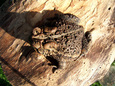
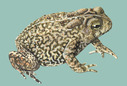
Toads are best known for their thick, warty skins.
Over 350 extant species in approximately 26 genera are recognized in this family of anurans. More than half of bufonids are members of a single genus, Bufo. Toads are cosmopolitan in distribution, found throughout both temperate and tropical regions, except east of Wallace's Line (Australopapuan region), Madagascar, and Oceania.
Bufonids are unique among anurans in having a Bidder's organ, a rudimentary ovary that develops at the anterior end of the larval testes of males. Its persistence in adult males is considered by many to be paedomorphic. Toads are further diagnosed by an absence of teeth which, though known in some other frogs, appears to have evolved separately in those lineages. Prominent skin glands, especially the parotid glands located on the posterodorsal region of the head, are characteristic of many (though not all) bufonids, and contribute to the "toad gestalt" that many people can identify. Most toads have dull coloration. Bufonid skin toxins are typically peptides, although tetrodotoxin is found in the aposematically colored genus Atelopus, and lipophilic alkaloids like those found in the dendrobatids have been identified in the bufonid Melanophryniscus. Skulls are heavily ossified, and in many species the skin is co-ossified with the skull. Toads range in size from 20 mm to 250 mm long.
Most toads are terrestrial, although some live partially in streams, and a few are arboreal. Axillary amplexus typically results in long strings of eggs being laid in ponds or streams, which hatch into type IV tadpoles. Some bufonids lay eggs on leaves above water, and a few species have tadpoles that live in torrential streams and have suckers on their bellies, which they use to attach themselves to the substrate. Reproductive modes span the range of known anuran modes. Oviparity with free-swimming larvae is the most common (and primitive), but direct terrestrial development and viviparity (with attendant internal fertilization) are known in toads as well.
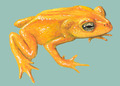
Because of their warty appearance and poisonous nature, humans do not tend to eat toads. In multiple failed attempts to control insect pests, Rhinella marina has been introduced into several regions in which bufonids are not native, including Australia and Papua New Guinea. Marine, or cane toads are generally considered pests in these areas, as they have voracious appetites, and do not restrict themselves to eating unwanted insects. Incilius periglenes, the golden toad, is a brightly colored cloud-forest dwelling animal from Costa Rica that may now be extinct, and has attracted much attention from conservationists as a result of its decline and apparent disappearance.
Until recently, Bufonidae was split into Bufonidae and Atelopodidae. The presence of a Bidder's organ prompted the move to a single family, Bufonidae, with the exception of Brachycephalus (Bidder's organ absent), now placed in Brachycephalidae. Bufonids are unambiguously placed in the Neobatrachia, but relationships among the families of these "advanced" frogs is controversial. Most authors identify a superfamily, alternately called Bufonoidea or Hyloidea, which includes all the neobatrachians that are not Ranoids or Microhyloids. The group Bufonoidea is thus sketchy at best. Furthermore, relationships among the bufonoids are not resolved.
Fossil toads are known from the upper Paleocene of South America, and from upper Tertiary and Quaternary deposits of North America, South America, Europe and Africa. Twenty species are known solely from fossils.
Cannatella, D., and A. Graybeal. 1996. Bufonidae: Tree of Life. (Website.) http://tolweb.org/tree?group=Bufonidae&contgroup=Neobatrachia
Cogger, H. G., and R. G. Zweifel, editors. 1998. Encyclopedia of Reptiles and Amphibians, 2nd edition. Academic Press, San Diego.
Duellman, W. E., and L. Trueb. 1986. Biology of Amphibians. Johns Hopkins University Press, Baltimore, MD.
Pough, F. H., R. M. Andrews, J. E. Cadle, M. L. Crump, A. H. Savitzky, and K. D. Wells. 1998. Herpetology. Prentice-Hall, Inc., Upper Saddle River, NJ.
Zug, G. R. 1993. Herpetology: an introductory biology of amphibians and reptiles. Academic Press, San Diego.
Contributors
Heather Heying (author).
Glossary
- bilateral symmetry
-
having body symmetry such that the animal can be divided in one plane into two mirror-image halves. Animals with bilateral symmetry have dorsal and ventral sides, as well as anterior and posterior ends. Synapomorphy of the Bilateria.
- ectothermic
-
animals which must use heat acquired from the environment and behavioral adaptations to regulate body temperature
- metamorphosis
-
A large change in the shape or structure of an animal that happens as the animal grows. In insects, "incomplete metamorphosis" is when young animals are similar to adults and change gradually into the adult form, and "complete metamorphosis" is when there is a profound change between larval and adult forms. Butterflies have complete metamorphosis, grasshoppers have incomplete metamorphosis.
- motile
-
having the capacity to move from one place to another.