Blarina hylophagaElliot's short-tailed shrew
Geographic Range
Blarina hylophaga ranges from southern Nebraska and Iowa to southern Texas; east to Missouri and northwestern Arkansas; Oklahoma; extending into Louisiana. (Nowak, 1999)
Habitat
Blarina hylophaga is found in various habitats. The species prefers the damp soils of oak-hickory and other deciduous forests, grasslands, and the banks of rivers and lakes that allow easy burrowing. However, these shrews avoid standing water. They use the trails and burrows excavated by other small mammals in soft soils. In deciduous forests they most frequently are found near old decaying logs and at the bases of rock outcrops. They may burrow extensively under leaf litter, logs, humus of the forest floor, and deeply into the soil, but ground cover is not required. In addition, they may shelter in logs, stumps, or crevices of building foundations. (Hutterer, 1993; Nowak, 1999; Davis and Schmidly, 1994; The University of Kansas, 2001)
- Habitat Regions
- temperate
- terrestrial
- Terrestrial Biomes
- forest
- Other Habitat Features
- riparian
Physical Description
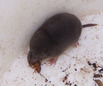
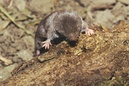
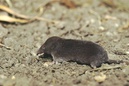
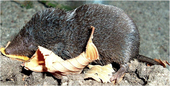
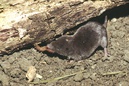
Short-tailed shrews have a head and body length that ranges from 75 to 105 mm, a tail length that is 17 to 30 mm, and a body weight of 15 to 30 grams. Their fur is silvery-gray to black dorsally, and their underside is only slightly paler. The body is robust, with a pointed muzzle that extends beyond the mouth. They have small eyes, ears hidden by the fur, and small front and hind limbs and feet. There is not much sexual dimorphism. Blarina has five unicuspid teeth in the upper jaw. Females have six mammae.
Blarina hylophaga is very similar to Blarina carolinensis. Both are small, slate-gray to brown shrews with short tails and no external ears. However, B. hylophaga has slightly larger cranial measurements, and a noticeably larger fourth premolar. Blarina hylophaga is more gray in color, whereas B. carolinensis is tinged with brown.
In comparison to Blarina brevicauda, B. hylophaga is less robust. In a study done by Russell A. Benedict, the two animals were classified to species by a few characteristics, including hind foot measurement, total length, and weight. Blarina brevicauda were classified as such if having a hind foot measurement greater than or equal to 15.5 mm, a total length greater than 115 mm, and a weight greater than 15 g. On the other hand, B. hylophaga typically weighed less than 20 g, had less than 120 mm in total length, and had a hind foot less than or equal to 15 mm. (Benedict, R.A., Feb. 1999; George, 1999; Nowak, 1999; Davis and Schmidly, 1994; The University of Kansas, 2001)
- Other Physical Features
- endothermic
- bilateral symmetry
- Sexual Dimorphism
- sexes alike
-
- Range mass
- 13 to 16 g
- 0.46 to 0.56 oz
-
- Range length
- 92 to 121 mm
- 3.62 to 4.76 in
-
- Average length
- 90.00 mm
- 3.54 in
Reproduction
Elliot's short-tailed shrews are thought to be polygynandrous, meaning males and females have multiple mates.
- Mating System
- polygynandrous (promiscuous)
Blarina hylophaga is usually solitary, but individuals come together from early spring to early autumn in order to reproduce. The estrous cycle is 2 to 4 days. Gestation averages from 21 to 22 days. Litter size ranges from 4 to 10, with usually 5 or 6 young. The babies are born hairless, pink, and wrinkled. Nests are constructed of leaves, grasses, and plant fibers. They are usually made under logs, in burrows, or even rarely, on top of the ground. Females produce 2 to 3 litters per year. (Nowak, 1999; The University of Kansas, 2001)
- Key Reproductive Features
- iteroparous
- seasonal breeding
- gonochoric/gonochoristic/dioecious (sexes separate)
- sexual
- fertilization
- viviparous
-
- Breeding interval
- Elliot's short-tailed shrews can breed 2 or 3 times per year.
-
- Breeding season
- Breeding takes place from early spring to early autumn.
-
- Range number of offspring
- 4 to 10
-
- Average number of offspring
- 5 or 6
-
- Average number of offspring
- 6.5
- AnAge
-
- Range gestation period
- 21 to 22 days
-
- Range weaning age
- 18 to 20 days
-
- Range age at sexual or reproductive maturity (female)
- 6 to 12 weeks
-
- Range age at sexual or reproductive maturity (male)
- 6 to 12 weeks
Parental care is provided by the females. The young of B. hylophaga leave the nest at 18 to 20 days and are weaned a few days after. Females attain sexual maturity at 6 weeks of age, and males at 12 weeks of age. It is possible for a female shrew born in early spring to breed by late summer or autumn of the same year. Males, most often, do not breed until the spring after their birth. (Nowak, 1999; The University of Kansas, 2001)
- Parental Investment
- altricial
-
pre-fertilization
- provisioning
-
protecting
- female
-
pre-hatching/birth
-
provisioning
- female
-
protecting
- female
-
provisioning
-
pre-weaning/fledging
-
provisioning
- female
-
protecting
- female
-
provisioning
-
pre-independence
-
provisioning
- female
-
protecting
- female
-
provisioning
Lifespan/Longevity
Few wild Blarina individuals survive more than a year. However, captive individuals have survived to 33 months. (Nowak, 1999)
-
- Range lifespan
Status: captivity - 33 (high) months
- Range lifespan
-
- Typical lifespan
Status: wild - 1 (high) years
- Typical lifespan
-
- Average lifespan
Status: captivity - 2.8 years
- AnAge
- Average lifespan
Behavior
Blarina hylophaga does not hibernate, but is active throughout the year. These shrews can be seen by day or night. They are a solitary and territorial species, only coming together to breed. Residents of a territory fight off intruders. Individuals mark their ranges with scent. The skin contains glands, especially on the flanks and anal region in both sexes, that secrete odors repugnant to predators. Their odor may also act as a chemical signal to attract or deter other shrews. As a consequence, you will smell this odor especially during breeding season. Blarina are effective climbers. And although they do not hibernate, in the winter they store reserves of food. (Nowak, 1999; The University of Kansas, 2001)
Home Range
The size of the home range of these shrews is not available.
Communication and Perception
Elliot's short-tailed shrews use scent for communication of reproductive and territorial information. It is likey that tactile cues are important during mating and between a mother and her offspring. They also use echolocation to help navigate underground and to hunt. (Nowak, 1999)
- Other Communication Modes
- pheromones
- scent marks
- Perception Channels
- visual
- tactile
- acoustic
- echolocation
- chemical
Food Habits
Shrews feed primarily on insects. Many other invertebrates, small vertebrates, and some vegetable material, particulary seeds, are also eaten. Insects, arthropods, and earthworms are more frequently eaten. They capture food by searching ground litter, digging superficial burrows in the ground, and using echolocation by high-pitched calls. Blarina hylophaga has specialized teeth from which submaxillary glands secrete poison. This poison immobilizes small animals, making it possible for shrews to kill prey larger than themselves, such as mice, fast and efficiently. (Davis and Schmidly, 1994; The University of Kansas, 2001)
- Primary Diet
- carnivore
- Animal Foods
- mammals
- amphibians
- insects
- terrestrial non-insect arthropods
- terrestrial worms
- Plant Foods
- seeds, grains, and nuts
Predation
The skin of B. hylophaga contains glands that secrete odors repugnant to predators. Carnivorous mammals often capture B. hylophaga, but seldom eat them due to these foul-smelling skin glands. Predators include owls, hawks, snakes, and domestic cats. (The University of Kansas, 2001)
The skin of Elliot's short-tailed shrews contains glands that secrete odors repugnant to predators. Carnivorous mammals often capture these shrews but seldom eat them due to these foul-smelling skin glands. Predators include owls, hawks, snakes, and domestic cats. (The University of Kansas, 2001)
-
- Known Predators
-
- owls (Strigiformes)
- hawks (Accipitridae)
- snakes (Serpentes)
- domestic cats (Felis silvestris)
Ecosystem Roles
Blarina are the most fossorial of American shrews, aiding in soil aeration. They use surface and subsurface runways and burrows of small mammals. They also use leaf litter and decomposing trees to burrow and nest. Blarina serves an important role in controlling the population size of larch sawflies and other destructive insects. (Nowak, 1999; The University of Kansas, 2001)
- Ecosystem Impact
- biodegradation
- soil aeration
Economic Importance for Humans: Positive
Blarina hylophaga serves as a check on larch sawflies and other destructive insects. (Nowak, 1999)
- Positive Impacts
- controls pest population
Economic Importance for Humans: Negative
The venomous saliva of B. hylophaga has negative effects on humans when they are bitten, although the venom is not life-threatening. This shrew may also be a nuisance when sheltering in crevices of building foundations, especially because they produce a foul smell. (Nowak, 1999; Vaughn, T.A. and Czaplewski, N.J., 2000)
- Negative Impacts
-
injures humans
- bites or stings
- venomous
- household pest
Conservation Status
Blarina hylophaga has a Global Heritage and National Heritage status rank of G5 and N5 respectively by the U.S. ESA. Both these rankings describe the species' status as secure, meaning individuals are common, abundant, and widespread in its range. Blarina species have been wiped out by human development and habitat loss, as well as predation by domestic cats. The subspecies B. hylophaga plumbea is known by 7 specimens on the Texas coast at the Aransas Wildlife Refuge, where small groups of B. hylophaga have been recently discovered. (Nowak, 1999)
-
- IUCN Red List
-
Least Concern
More information
-
- IUCN Red List
-
Least Concern
More information
-
- US Federal List
- No special status
-
- CITES
- No special status
Other Comments
Blarina are effective climbers. One B. brevicauda individual was documented to have climbed 1.9 m up a tree. (Nowak, 1999)
Contributors
Tanya Dewey (editor), University of Michigan-Ann Arbor, George Hammond (editor), Animal Diversity Web Staff, Gail McCormick (editor), Animal Diversity Web Staff.
Nancy Shefferly (editor), Animal Diversity Web Staff.
Dana Begnoche (author), University of Michigan-Ann Arbor, Bret Weinstein (editor), University of Michigan-Ann Arbor.
Glossary
- Nearctic
-
living in the Nearctic biogeographic province, the northern part of the New World. This includes Greenland, the Canadian Arctic islands, and all of the North American as far south as the highlands of central Mexico.

- acoustic
-
uses sound to communicate
- altricial
-
young are born in a relatively underdeveloped state; they are unable to feed or care for themselves or locomote independently for a period of time after birth/hatching. In birds, naked and helpless after hatching.
- bilateral symmetry
-
having body symmetry such that the animal can be divided in one plane into two mirror-image halves. Animals with bilateral symmetry have dorsal and ventral sides, as well as anterior and posterior ends. Synapomorphy of the Bilateria.
- biodegradation
-
helps break down and decompose dead plants and/or animals
- carnivore
-
an animal that mainly eats meat
- chemical
-
uses smells or other chemicals to communicate
- echolocation
-
The process by which an animal locates itself with respect to other animals and objects by emitting sound waves and sensing the pattern of the reflected sound waves.
- endothermic
-
animals that use metabolically generated heat to regulate body temperature independently of ambient temperature. Endothermy is a synapomorphy of the Mammalia, although it may have arisen in a (now extinct) synapsid ancestor; the fossil record does not distinguish these possibilities. Convergent in birds.
- fertilization
-
union of egg and spermatozoan
- forest
-
forest biomes are dominated by trees, otherwise forest biomes can vary widely in amount of precipitation and seasonality.
- fossorial
-
Referring to a burrowing life-style or behavior, specialized for digging or burrowing.
- insectivore
-
An animal that eats mainly insects or spiders.
- iteroparous
-
offspring are produced in more than one group (litters, clutches, etc.) and across multiple seasons (or other periods hospitable to reproduction). Iteroparous animals must, by definition, survive over multiple seasons (or periodic condition changes).
- motile
-
having the capacity to move from one place to another.
- native range
-
the area in which the animal is naturally found, the region in which it is endemic.
- nocturnal
-
active during the night
- pheromones
-
chemicals released into air or water that are detected by and responded to by other animals of the same species
- polygynandrous
-
the kind of polygamy in which a female pairs with several males, each of which also pairs with several different females.
- riparian
-
Referring to something living or located adjacent to a waterbody (usually, but not always, a river or stream).
- scent marks
-
communicates by producing scents from special gland(s) and placing them on a surface whether others can smell or taste them
- seasonal breeding
-
breeding is confined to a particular season
- sedentary
-
remains in the same area
- sexual
-
reproduction that includes combining the genetic contribution of two individuals, a male and a female
- soil aeration
-
digs and breaks up soil so air and water can get in
- solitary
-
lives alone
- tactile
-
uses touch to communicate
- temperate
-
that region of the Earth between 23.5 degrees North and 60 degrees North (between the Tropic of Cancer and the Arctic Circle) and between 23.5 degrees South and 60 degrees South (between the Tropic of Capricorn and the Antarctic Circle).
- terrestrial
-
Living on the ground.
- territorial
-
defends an area within the home range, occupied by a single animals or group of animals of the same species and held through overt defense, display, or advertisement
- venomous
-
an animal which has an organ capable of injecting a poisonous substance into a wound (for example, scorpions, jellyfish, and rattlesnakes).
- visual
-
uses sight to communicate
- viviparous
-
reproduction in which fertilization and development take place within the female body and the developing embryo derives nourishment from the female.
References
Benedict, R.A., Feb. 1999. Characteristics of a hybrid zone between two species of short-tailed shrew (Blarina). Journal of Mammology, 80: 135-141.
Braun, J.K., G., Nye, R., Stafira, J.. 2001. "Sam Noble Oklahoma Museum of Natural History" (On-line). Accessed September 30, 2001 at www.omnh.ou.edu/mammalkey/.
Davis, W., D. Schmidly. 1994. "The Mammals of Texas {Online Edition}" (On-line). Accessed September 30, 2001 at www.nsrl.ttu.edu/tmot1/.
George, S. 1999. Elliot's short-tailed shrew, Blarina hylophaga. Pp. 51-52 in D Wilson, S Ruff, eds. The Smithsonian Book of North American Mammals. Washington, DC: Smithsonian Institution Press.
Hutterer, R. 1993. "Smithsonian National Museum of Natural History Mammal Species of the World" (On-line). Accessed October 7, 2001 at nmnhwww.si.edu/cgi-bin/wdb/msw.
Nowak, R. 1999. Walker's Mammals of the World, Sixth Edition. Baltimore and London: The Johns Hopkins University Press.
The University of Kansas, 2001. "University of Kansas Key to Mammal Species in Kansas" (On-line). Accessed September 30, 2001 at www.ukans.edu/~mammals/.
Vaughn, T.A., R., Czaplewski, N.J.. 2000. Mammology. New York: Saunder's College Publishing.