Blarina carolinensissouthern short-tailed shrew
Geographic Range
Southern short-tailed shrews inhabit the southeastern corner of the United States (Wilson and Ruff 1999). Populations can be found as far north as southern Illinois and south-central Virginia and as far south as central Florida (Whitaker and Hamilton 1998). (Whitaker Jr and Hamilton Jr, 1998; Wilson and Ruff, 1999)
Habitat
Southern short-tailed shrews are most commonly found in moist, well-drained habitats containing woody vegetation (Wilson and Ruff 1999). The well-drained soil allows Blarina carolinensis to burrow underground and construct nests.
The nest (located either underground or beneath decomposing logs or stumps) is composed of shredded grass, roots, dry leaves, and other vegetable material (Wilson and Ruff 1999). (Wilson and Ruff, 1999)
- Habitat Regions
- temperate
- terrestrial
- Terrestrial Biomes
- forest
Physical Description
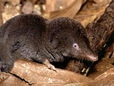
Blarina carolinensis is the smallest species in the genus. Total length ranges from 75 to 105 millimeters. The tail length ranges from 17 to 30 millimeters. The range in weight is 15 to 30 grams (Nowak 1999). The dorsal pelage is slate colored while the ventral pelage is a paler shade of grey. They have small eyes, a long, highly moveable nose, and small ears (Wilson and Ruff 1999).
Species of Blarina exhibit little geographic overlap, so are usually distinguished from one another by where they occur. Blarina species differ in their number of chromosomes as well. Blarina carolinensis has 36-46 chromosomes, while Blarina brevicauda, found in northeastern North America, has 48 to 50 chromosomes, and Blarina hylophaga, found in the central United States, has 52 chromosomes (Wilson and Ruff 1999). (Nowak, 1999; Wilson and Ruff, 1999)
- Other Physical Features
- endothermic
- bilateral symmetry
-
- Range mass
- 15 to 30 g
- 0.53 to 1.06 oz
-
- Range length
- 75 to 105 mm
- 2.95 to 4.13 in
Reproduction
Little is known of mating behavior of southern short-tailed shrews.
Southern short-tailed shrews breed twice a year (Wilson and Ruff 1999). The first period of reproduction is between the months of March and June. A peak in breeding activity is reached during this period in April. The second period is between September and November, with a peak in activity reached during October. Gestation ranges between 21 and 30 days. Litter size is 2 to 6 individuals. Once born, the young weigh about one gram. Females reach sexual maturity at about six weeks of life, while males become sexually mature at around twelve weeks of age (Banfield 1974). (Banfield, 1974; Wilson and Ruff, 1999)
- Key Reproductive Features
- iteroparous
- seasonal breeding
- gonochoric/gonochoristic/dioecious (sexes separate)
- sexual
- viviparous
-
- Breeding interval
- Southern short-tailed shrews breed twice a year.
-
- Breeding season
- March to June and September to November.
-
- Range number of offspring
- 2 to 6
-
- Range gestation period
- 21 to 30 days
-
- Range weaning age
- 18 to 21 days
-
- Range age at sexual or reproductive maturity (female)
- 6 to 12 weeks
-
- Range age at sexual or reproductive maturity (male)
- 6 to 12 weeks
Young are born naked and unable to see (Davis and Schmidly 1997). They are cared for and nursed by their mother in her nest. After 18-20 days of life the young begin to venture from the nest and are weaned shortly after that (Nowak 1999). (Davis and Schmidly, 1997; Nowak, 1999)
- Parental Investment
- altricial
- female parental care
-
pre-hatching/birth
-
provisioning
- female
-
protecting
- female
-
provisioning
-
pre-weaning/fledging
-
provisioning
- female
-
protecting
- female
-
provisioning
Lifespan/Longevity
George et. al (1986) recorded the lifespan of most wild individuals to be no longer than a year. Individuals in captivity have been recorded as living up to 33 months. (George, et al., 1986)
-
- Range lifespan
Status: captivity - 33 (high) months
- Range lifespan
-
- Typical lifespan
Status: wild - 1 (high) years
- Typical lifespan
Behavior
Southern short-tailed shrews are primarily nocturnal. They spend much of their time in burrows and tunnels underground or in leaf litter. They are solitary and maybe territorial. There is some evidence that they are more active immediately after periods of rainfall.
- Key Behaviors
- nocturnal
- motile
- sedentary
- solitary
- territorial
Communication and Perception
Food Habits
Southern short-tailed shrews are primarily carnivorous, though some vegetable matter may be taken (Nowak 1999). Their diet is composed mainly of soil invertebrates. They feed throughout the day but are most active at night and in the early morning and early evening hours (Nowak 1999). Earthworms, centipedes, and berries are examples of this shrew's diet (Davis and Schmidly 1997). (Davis and Schmidly, 1997; Nowak, 1999)
- Primary Diet
-
carnivore
- insectivore
- eats non-insect arthropods
Predation
Southern short-tailed shrews have a variety of predators. Their main predators include hawks and owls, especially barn owls. Coyotes, red fox, and large snakes are also known to prey on southern short-tailed shrews. (Wilson and Ruff, 1999)
-
- Known Predators
-
- owls (Strigiformes)
- hawks (Accipitridae)
- coyotes (Canis latrans)
- red fox (Vulpes vulpes)
- snakes (Serpentes)
Ecosystem Roles
Southern short-tailed shrews are probably one of the most numerous mammalian members of their communities. They represent an important prey base for their predators and influence the composition of invertebrate communities through their own predation.
Economic Importance for Humans: Positive
Southern short-tailed shrews help control insect populations. (Whitaker Jr and Hamilton Jr, 1998)
- Positive Impacts
- controls pest population
Economic Importance for Humans: Negative
Southern short-tailed shrews, like their northern cousins, Blarina brevicauda, may have toxins in their saliva (see Comments below). Bites may result in a painful burning sensation that can last some time.
- Negative Impacts
-
injures humans
- bites or stings
Conservation Status
Southern short-tailed shrews are abundant in suitable habitats throughout their range.
-
- IUCN Red List
-
Least Concern
More information
-
- IUCN Red List
-
Least Concern
More information
-
- US Federal List
- No special status
-
- CITES
- No special status
Other Comments
Blarina carolinensis may produce poison in the submaxillary glands, as does its close relative Blarina brevicauda (Davis and Schmidly 1997). This venom is secreted into the saliva and can be injected into prey through a bite wound. However, B. carolinensis does not seem to prey on vertebrates whereas B. brevicauda does frequently, making it less likely to require the use of venom to subdue prey. The test for venom presence in B. carolinensis has not yet been performed. (Davis and Schmidly, 1997)
Contributors
Tanya Dewey (editor), University of Michigan-Ann Arbor, George Hammond (editor), Animal Diversity Web Staff, Gail McCormick (editor), Animal Diversity Web Staff.
Desirae Foust (author), University of Northern Iowa, Jim Demastes (editor), University of Northern Iowa.
Glossary
- Nearctic
-
living in the Nearctic biogeographic province, the northern part of the New World. This includes Greenland, the Canadian Arctic islands, and all of the North American as far south as the highlands of central Mexico.

- altricial
-
young are born in a relatively underdeveloped state; they are unable to feed or care for themselves or locomote independently for a period of time after birth/hatching. In birds, naked and helpless after hatching.
- bilateral symmetry
-
having body symmetry such that the animal can be divided in one plane into two mirror-image halves. Animals with bilateral symmetry have dorsal and ventral sides, as well as anterior and posterior ends. Synapomorphy of the Bilateria.
- carnivore
-
an animal that mainly eats meat
- chemical
-
uses smells or other chemicals to communicate
- endothermic
-
animals that use metabolically generated heat to regulate body temperature independently of ambient temperature. Endothermy is a synapomorphy of the Mammalia, although it may have arisen in a (now extinct) synapsid ancestor; the fossil record does not distinguish these possibilities. Convergent in birds.
- female parental care
-
parental care is carried out by females
- forest
-
forest biomes are dominated by trees, otherwise forest biomes can vary widely in amount of precipitation and seasonality.
- insectivore
-
An animal that eats mainly insects or spiders.
- iteroparous
-
offspring are produced in more than one group (litters, clutches, etc.) and across multiple seasons (or other periods hospitable to reproduction). Iteroparous animals must, by definition, survive over multiple seasons (or periodic condition changes).
- motile
-
having the capacity to move from one place to another.
- native range
-
the area in which the animal is naturally found, the region in which it is endemic.
- nocturnal
-
active during the night
- seasonal breeding
-
breeding is confined to a particular season
- sedentary
-
remains in the same area
- sexual
-
reproduction that includes combining the genetic contribution of two individuals, a male and a female
- solitary
-
lives alone
- tactile
-
uses touch to communicate
- temperate
-
that region of the Earth between 23.5 degrees North and 60 degrees North (between the Tropic of Cancer and the Arctic Circle) and between 23.5 degrees South and 60 degrees South (between the Tropic of Capricorn and the Antarctic Circle).
- terrestrial
-
Living on the ground.
- territorial
-
defends an area within the home range, occupied by a single animals or group of animals of the same species and held through overt defense, display, or advertisement
- viviparous
-
reproduction in which fertilization and development take place within the female body and the developing embryo derives nourishment from the female.
References
Banfield, A. 1974. The Mammals of Canada. Toronto: University of Toronto Press.
Davis, W., D. Schmidly. 1997. "The Mammals of Texas-Online Edition" (On-line). Accessed November 28, 2001 at http://www.nsrl.ttu.edu/tmot1/blarcaro.htm.
George, S., J. Choate, H. Genoways. 1986. Blarina brevicauda. Mammalian Species, 261: 9.
Nowak, R. 1999. Walker's Mammals of the World, Sixth Edition VII. Baltimore and London: The John's Hopkins University Press.
Whitaker Jr, J., W. Hamilton Jr. 1998. Mammals of the Eastern United States. Ithaca and London: Cornell University Press.
Wilson, D., S. Ruff. 1999. The Smithsonian Book of North American Mammals. Washington and London: Smithsonian Institution Press.