Blarina brevicaudanorthern short-tailed shrew


Geographic Range
Northern short-tailed shrews are only native in the Nearctic region. They inhabit most of east central North America from southern Saskatchewan and Nova Scotia in Canada to central Nebraska and Georgia in the United States.
Habitat
Northern short-tailed shrews are found in nearly all terrestrial habitats. However, their populations are most dense in damp brushy woodlands, bushy bogs and marshes, and weedy and bushy borders of fields. These shrews are also common in cultivated fields, in flower and vegetable gardens, fence rows, and beside country roads. In the winter, they often retreat into barns, cellars and sheds. They need only sufficient vegetation to provide cover. They are slow to rehabit areas of forest burns. Northern short-tailed shrews construct elaborate runways under leaves, dirt, and snow and construct theirnests in tunnels or under logs and rocks.
- Habitat Regions
- temperate
- Terrestrial Biomes
- chaparral
- forest
- scrub forest
Physical Description
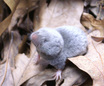
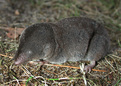
Head and body length is 75-105 mm, tail length is 17-30 mm. Males are slightly larger than females, especially in the skulls. The fur is velvety and soft, and the color almost uniformly slate gray, with the underparts being only slightly paler. Summer pelage is a shade paler than winter.
Blarina brevicauda is a robust-looking shrew, nearly the size of a meadow mouse; the snout is shorter and heavier than that of other shrews, the tail is short, the eyes small, and the ears are almost completely hidden by the fur.
- Other Physical Features
- endothermic
- bilateral symmetry
- Sexual Dimorphism
- male larger
-
- Range mass
- 18.0 to 30.0 g
- 0.63 to 1.06 oz
-
- Average mass
- 21.63 g
- 0.76 oz
-
- Range length
- 75.0 to 105.0 mm
- 2.95 to 4.13 in
-
- Average basal metabolic rate
- 0.344 W
- AnAge
Reproduction
Little information is available regarding the mating systems of northern short-tailed shrews.
Elaborate mating nests, 150 to 250 mm long by approximately 150 mm wide, are built out of shredded grass or leaves and placed in tunnels or under logs and rocks. The breeding season extends from early spring to early fall (March-September), although some scattered reproductive activity may occur throughout the entire year. Females may have up to 3 litters per year, although 2 is more usual. Gestation lasts 21 to 22 days and litter size ranges from 3 to 10 individuals, although 5 to 7 pups is most common. Young short-tailed shrews leave the nest at 18 to 20 days of age and are weaned several days later. Females reach sexual maturity at 6 weeks of age, while males mature at 12 weeks.
- Key Reproductive Features
- iteroparous
- seasonal breeding
- gonochoric/gonochoristic/dioecious (sexes separate)
- sexual
- induced ovulation
- fertilization
- viviparous
-
- Breeding interval
- Female northern short-tailed shrews may have multiple litters throughout the warm months of the year, depending on food availability.
-
- Breeding season
- Short-tailed shrews breed between March and September.
-
- Range number of offspring
- 3 to 10
-
- Average number of offspring
- 6
-
- Average number of offspring
- 6
- AnAge
-
- Range gestation period
- 22 (high) days
-
- Range weaning age
- 20.0 (low) days
-
- Average age at sexual or reproductive maturity (female)
Sex: female - 46 days
- AnAge
- Average age at sexual or reproductive maturity (female)
-
- Average age at sexual or reproductive maturity (male)
Sex: male - 65 days
- AnAge
- Average age at sexual or reproductive maturity (male)
Females care for their young in the nest for 18 to 20 days. After weaning, at 25 days old, young northern short-tailed shrews leave the nest and all parental care ends.
- Parental Investment
- altricial
- female parental care
-
pre-hatching/birth
-
provisioning
- female
-
protecting
- female
-
provisioning
-
pre-weaning/fledging
-
provisioning
- female
-
protecting
- female
-
provisioning
Lifespan/Longevity
Northern short-tailed shrews can live as long as 3 years, but most probably die in their first year or before they reach adulthood.
-
- Range lifespan
Status: wild - 3.0 (high) years
- Range lifespan
-
- Average lifespan
Status: wild - 2.5 years
- Max Planck Institute for Demographic Research
- Average lifespan
Behavior
Short-tailed shrews are active year round, both day and night (although they are more nocturnal than diurnal). These shrews are the most fossorial of American shrews and are effective in tunneling through leaves, plant debris, and snow with their strong paws and cartilaginous snouts. They construct elaborate runways and nests but have also been known to use the tunnels of mice and moles. Although most of their time is spent on or under the ground, short-tailed shrews are also effective climbers and have been observed climbing nearly 2 meters up a tree trunk to obtain suet from a bird feeder.
Blarina brevicauda is not a sociable or gregarious mammal. In captivity, short-tailed shrews have been observed to live together peacefully if enough space is provided, but in the wild, short-tailed shrews are solitary and territorial. Territory size and stability are determined by prey density and tend to overlap slightly between members of opposite sexes during the breeding season. Shrews mark their territories with scent and threaten and physically drive away any intruders.
-
- Average territory size
- 0.025 km^2
Home Range
Home ranges of northern short-tailed shrews can be twice the size of those of other shrews. Their home range is on average 2.5 ha. Although they are solitary and territorial in the wild, home ranges tend to overlap. Territory size and stability are determined by how much prey is available in the area.
Communication and Perception
Northern short-tailed shrews, especially males, exude a musky odor from scent glands on their belly and sides. They may use this to mark their territories with scent, though some researchers think this is unlikely because Northern short-tailed shrews have a poor sense of smell. This musky secretion may instead be used to deter predators because of its foul taste.
Northern short-tailed shrews also have poor vision, perhaps only being able to detect light and dark. They use a form of echolocation, similar to what bats and whales use, to detect and distinguish among objects in the environment. They send out a series of ultrasonic (outside of the human hearing range) clicks and then listen for the returning echoes. By decoding these echoes they can perceive their environment without sight. Similar to other shrews, northern short-tailed shrews also have a highly developed sense of touch, particularly in the snout and vibrissae.
Northern short-tailed shrews utter a variety of sounds (chirps, buzzes, twitters) in their aggressive interactions with other individuals, and a clicking sound is used during courtship.
Food Habits
Short-tailed shrews are voracious eaters and must feed frequently, commonly in the early and late afternoon. It is estimated that they consume and metabolize as much as three times their weight in food per day. The diet of Blarina brevicauda consists mainly of invertebrates, small vertebrates, and plant material. B. brevicauda stores food for winter, including snails and beetles, and in captivity puts nutmeats, sunflower seeds, and other edibles into storage.
The submaxillary salivary glands of Blarina brevicauda produce a toxic material which is effective in subduing its prey. This enables it to prey upon animals much larger than itself, including salamanders, frogs, snakes, mice, birds, and other shrews.
- Primary Diet
-
carnivore
- eats non-insect arthropods
Predation
Northern short-tailed shrews are preyed upon by owls, hawks, snakes, weasels, red fox, coyotes, and occasionally pickerel, trout, and sunfish when they venture near water. Northern short-tailed shrews are aggressive, and they threaten and physically drive away any intruders. They escape predation by remaining hidden in the cover of vegetation or under the soil or snow during foraging expeditions from their nest. They may also make themselves distasteful by exuding a musky odor from glands on their belly and sides. Many mammal predators, such as weasels and foxes, may refuse to eat northern short-tailed shrews because of their foul taste.
-
- Known Predators
-
- owls (Strigiformes)
- snakes (Serpentes)
- hawks (Accipitridae)
- weasels (Mustela)
- red fox (Vulpes vulpes)
- coyotes (Canis latrans)
- pickerel (Esox americanus)
- trout (Salmoninae)
- sunfish (Centrarchidae)
Ecosystem Roles
Northern short-tailed shrews are highly abundant in many of the habitats in which they live. Because of this and the fact that they eat large quantities of invertebrates, they have a profound effect on invertebrate abundance. They are also an important prey species, especially for owls.
Economic Importance for Humans: Positive
Due to its insectivorous nature and ravenous appetite, Blarina brevicauda often serves as an important check on insect crop pests, especially the larch sawfly. It also destroys snails and mice that damage crops and are pests to humans.
- Positive Impacts
- controls pest population
Economic Importance for Humans: Negative
The poison secreted from the submaxillary glands of northern short-tailed shrews can cause pain that lasts for several days in a human who is bitten. However, bites are rare, and usually occur when someone attempts to handle a shrew.
- Negative Impacts
-
injures humans
- bites or stings
Conservation Status
Blarina brevicauda is common through much of its range, especially in the areas surrounding the Great Lakes. As with many small mammals, its populations undergoes frequent fluctuations, the causes and effects of which are not well understood.
-
- IUCN Red List
-
Least Concern
More information
-
- IUCN Red List
-
Least Concern
More information
-
- US Federal List
- No special status
-
- CITES
- No special status
-
- State of Michigan List
- No special status
Contributors
Tanya Dewey (editor), University of Michigan-Ann Arbor, George Hammond (editor), Animal Diversity Web Staff, John Berini (editor), Animal Diversity Web Staff, Gail McCormick (editor), Animal Diversity Web Staff.
Liz Ballenger (author), University of Michigan-Ann Arbor.
Glossary
- Nearctic
-
living in the Nearctic biogeographic province, the northern part of the New World. This includes Greenland, the Canadian Arctic islands, and all of the North American as far south as the highlands of central Mexico.

- acoustic
-
uses sound to communicate
- altricial
-
young are born in a relatively underdeveloped state; they are unable to feed or care for themselves or locomote independently for a period of time after birth/hatching. In birds, naked and helpless after hatching.
- bilateral symmetry
-
having body symmetry such that the animal can be divided in one plane into two mirror-image halves. Animals with bilateral symmetry have dorsal and ventral sides, as well as anterior and posterior ends. Synapomorphy of the Bilateria.
- bog
-
a wetland area rich in accumulated plant material and with acidic soils surrounding a body of open water. Bogs have a flora dominated by sedges, heaths, and sphagnum.
- carnivore
-
an animal that mainly eats meat
- chaparral
-
Found in coastal areas between 30 and 40 degrees latitude, in areas with a Mediterranean climate. Vegetation is dominated by stands of dense, spiny shrubs with tough (hard or waxy) evergreen leaves. May be maintained by periodic fire. In South America it includes the scrub ecotone between forest and paramo.
- chemical
-
uses smells or other chemicals to communicate
- diurnal
-
- active during the day, 2. lasting for one day.
- endothermic
-
animals that use metabolically generated heat to regulate body temperature independently of ambient temperature. Endothermy is a synapomorphy of the Mammalia, although it may have arisen in a (now extinct) synapsid ancestor; the fossil record does not distinguish these possibilities. Convergent in birds.
- female parental care
-
parental care is carried out by females
- fertilization
-
union of egg and spermatozoan
- forest
-
forest biomes are dominated by trees, otherwise forest biomes can vary widely in amount of precipitation and seasonality.
- induced ovulation
-
ovulation is stimulated by the act of copulation (does not occur spontaneously)
- iteroparous
-
offspring are produced in more than one group (litters, clutches, etc.) and across multiple seasons (or other periods hospitable to reproduction). Iteroparous animals must, by definition, survive over multiple seasons (or periodic condition changes).
- marsh
-
marshes are wetland areas often dominated by grasses and reeds.
- motile
-
having the capacity to move from one place to another.
- native range
-
the area in which the animal is naturally found, the region in which it is endemic.
- nocturnal
-
active during the night
- scrub forest
-
scrub forests develop in areas that experience dry seasons.
- seasonal breeding
-
breeding is confined to a particular season
- sedentary
-
remains in the same area
- sexual
-
reproduction that includes combining the genetic contribution of two individuals, a male and a female
- solitary
-
lives alone
- swamp
-
a wetland area that may be permanently or intermittently covered in water, often dominated by woody vegetation.
- tactile
-
uses touch to communicate
- temperate
-
that region of the Earth between 23.5 degrees North and 60 degrees North (between the Tropic of Cancer and the Arctic Circle) and between 23.5 degrees South and 60 degrees South (between the Tropic of Capricorn and the Antarctic Circle).
- territorial
-
defends an area within the home range, occupied by a single animals or group of animals of the same species and held through overt defense, display, or advertisement
- viviparous
-
reproduction in which fertilization and development take place within the female body and the developing embryo derives nourishment from the female.
References
Rue, L.L. 1967. Pictorial guide to the mammals of North America. Thomas Y. Crowell Company, New York. pp. 15-17.
Hamilton, W.J. and J.O. Whitaker, Jr. 1979. Mammals of the Eastern United States. Cornell University Press, Ithaca, NY. pp. 48-51.
Jackson, H.H.T. 1961. Mammals of Wisconsin. The University of Wisconsin Press, Madison, Wisconsin. pp. 42-55.
Nowak, R.M. and J.L Paradiso. 1983. Walker's Mammals of the World. 4th edition. John Hopkins University Press, Baltimore, MD.
"Animal Life Histories Database" (On-line).
Hammerson, G. 2008. "Blarina brevicauda" (On-line). IUCN Red List of Threatened Species Version 2010.4. Accessed March 30, 2011 at http://www.iucnredlist.org/apps/redlist/details/41451/0.