Arapaima gigasArapaima(Also: Giant arapaima)



Geographic Range
Arapaima gigas exclusively inhabits the Amazon River Basin of South America.
(Goulding et al., 1993)
- Biogeographic Regions
- neotropical
Habitat
Within the Amazon basin, A. gigas is found in several different types of habitat, such as the floodplain lakes of this region, the large tributaries of the Amazon river including the Rio Madera and the Rio Machado, and the varzea or forest. The pirarucu inhabits both white water and clear water. Much of the water that comprises the pirarucu's habitat is also oxygen deficient, as it is located in swampy areas of the rainforest.
(Lowe-McConnell, 1987; Goulding, 1980)
- Habitat Regions
- tropical
- freshwater
- Terrestrial Biomes
- rainforest
- Aquatic Biomes
- lakes and ponds
- rivers and streams
- Wetlands
- swamp
Physical Description
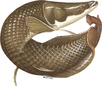
The pirarucu is one of the largest freshwater fishes in the world. At one time, there were many individuals over 3 meters in length that weighed more than 150 kilograms. The scales on a pirarucu this size can reach 6 centimeters in length. However, there are few pirarucu this size, if any, that are living currently. The average size of this species has greatly reduced due to over-fishing, though it is still common to find pirarucu over 2 meters that weigh more than125 kilograms. The pirarucu is usually grey in color with an orange speckling near its posterior end. There are also two symmetrical fins on either side of the body at the posterior end. Interestingly, A. gigas has a bony or toothed tongue, which is the source of the title osteoglossomorph and a distinguishing character of those species in the order Osteoglossiformes.
(Luna and Froese, 2002; Goulding, 1993; Goulding, 1980; Smith, 1981).
- Other Physical Features
- bilateral symmetry
-
- Range mass
- 200 (high) kg
- 440.53 (high) lb
-
- Range length
- 450 (high) cm
- 177.17 (high) in
Development
The female pirarucu is sexually mature at the age of five years old and are typically 160 centimeters in length at this point in their life.
(Queiroz, 1998)
Reproduction
Due to the geographic range that A. gigas inhabits, the animal's life cycle is greatly affected by the seasonal flooding that occurs. Half of the year the pirarucu experiences an abundance of water, which is a benefit to these aquatic organisms; however, the other half of the year the pirarucu experiences drought conditions. The pirarucu has adapted to this great fluctuation in many aspects of it's life, including reproduction. A. gigas lays it's eggs during the months of February, March, and April when the water levels are low. They build a nest approximately 50 cm wide and 15 cm deep, usually in sandy bottomed areas. As the water rises the eggs hatch and the offspring have the flood season to prosper, during the months of May to August. Therefore, the yearly spawning is regulated seasonally. A. gigas is a mouth-brooder.
(Lowe-McConnell 1987; Smith 1981, Luna and Froese, 2002)
- Key Reproductive Features
- iteroparous
- seasonal breeding
- sexual
- fertilization
- oviparous
-
- Breeding season
- In drought season, usually during the months of February-April
A. gigas has been known to guard both the eggs and the offspring themselves. The parental care includes helping to aerate the water for it's offspring, which is a necessity for survival of the offspring in the oxygen-deficient waters of some habitats. Adults have the ability to exude a pheromone from their head to attract offspring and keep them in close proximity.
(Lowe-McConnell, 1987; Luna and Froese, 2000)
- Parental Investment
- male parental care
- female parental care
Behavior
- Key Behaviors
- natatorial
- motile
Communication and Perception
A. gigas communicates with it's offspring by means of attractive pheromones, which keep the offspring near the parents.
(Lowe-McConnell, 1987)
- Communication Channels
- chemical
- Other Communication Modes
- pheromones
Food Habits
A. gigas is a predator that mainly eats other fish. If a bird or some other animal happens to be present, this large predator will also eat that animal. The pirarucu usually finds food near the top of the water because it is an obligate air breather that needs to surface every 10-20 min. However, the pirarucu is also capable of diving.
(Lowe-McConnell, 1987; Goulding, 1980)
Predation
The pirarucu's sheer size and bony armor provide defenses against predators.
-
- Known Predators
-
- humans (Homo sapiens)
- spectacled caimans (Caiman crocodilus)
Economic Importance for Humans: Positive
A. gigas is hunted and utilized in many ways by local human populations. Pirarucu are harpooned or caught in large nets and the meat is said to be delicious. One individual can yield seventy kilograms of meat. In addition, the pirarucu's bony tongue is often used to scrape cylinders of dried guarana, an ingredient in a beverage, and the bony scales are used as nail files. This animal also appears in the pet trade, although to keep a pirarucu correctly requires a large tank and can prove quite difficult.
(Smith, 1981)
Economic Importance for Humans: Negative
There are no known adverse effects towards Homo sapiens.
Conservation Status
In 1976, the SUDEPE (Supertendencia do Desenvolvimento da Pesca) outlawed the killing of a pirarucu from October to March, during the low water season when this animal becomes so visible due to it's sheer size. Also the SUDEPE declared that the pirarucu has to be at least one and a half meters in length before it can be killed.
(Smith, 1981; Goulding, 1980)
-
- IUCN Red List
-
Data Deficient
More information
-
- IUCN Red List
-
Data Deficient
More information
Other Comments
A. gigas was first named by Georges Cuvier in 1817. This animal is often called a living fossil due to it's archaic morphology. This fish has also been extremely successful in the Amazon. However, due to overfishing this animal is in danger of becoming extinct.
Contributors
William Fink (editor), University of Michigan-Ann Arbor.
Lewis Melfi (author), University of Michigan-Ann Arbor.
Glossary
- Neotropical
-
living in the southern part of the New World. In other words, Central and South America.

- bilateral symmetry
-
having body symmetry such that the animal can be divided in one plane into two mirror-image halves. Animals with bilateral symmetry have dorsal and ventral sides, as well as anterior and posterior ends. Synapomorphy of the Bilateria.
- carnivore
-
an animal that mainly eats meat
- chemical
-
uses smells or other chemicals to communicate
- external fertilization
-
fertilization takes place outside the female's body
- female parental care
-
parental care is carried out by females
- fertilization
-
union of egg and spermatozoan
- food
-
A substance that provides both nutrients and energy to a living thing.
- freshwater
-
mainly lives in water that is not salty.
- iteroparous
-
offspring are produced in more than one group (litters, clutches, etc.) and across multiple seasons (or other periods hospitable to reproduction). Iteroparous animals must, by definition, survive over multiple seasons (or periodic condition changes).
- male parental care
-
parental care is carried out by males
- motile
-
having the capacity to move from one place to another.
- natatorial
-
specialized for swimming
- native range
-
the area in which the animal is naturally found, the region in which it is endemic.
- oviparous
-
reproduction in which eggs are released by the female; development of offspring occurs outside the mother's body.
- pet trade
-
the business of buying and selling animals for people to keep in their homes as pets.
- pheromones
-
chemicals released into air or water that are detected by and responded to by other animals of the same species
- piscivore
-
an animal that mainly eats fish
- rainforest
-
rainforests, both temperate and tropical, are dominated by trees often forming a closed canopy with little light reaching the ground. Epiphytes and climbing plants are also abundant. Precipitation is typically not limiting, but may be somewhat seasonal.
- seasonal breeding
-
breeding is confined to a particular season
- sexual
-
reproduction that includes combining the genetic contribution of two individuals, a male and a female
- swamp
-
a wetland area that may be permanently or intermittently covered in water, often dominated by woody vegetation.
- tactile
-
uses touch to communicate
- tropical
-
the region of the earth that surrounds the equator, from 23.5 degrees north to 23.5 degrees south.
References
Goulding, M. 1980. Fishes and the Forest, Explorations in Amazonian Natural History. Berkeley: University of California Press.
Goulding, M., N. Smith, D. Mahar. 1993. Floods of Fortune. New York: Columbia University Press.
Lowe-McConnell, R. 1987. Ecological Studies in Tropical Fish Communities. London: Cambridge University Press.
Luna, S., R. Froese. 13/05/03. "Fishbase.org" (On-line). Accessed 11-2-02 at http://www.fishbase.org/Summary/SpeciesSummary.cfm?ID=2076&genusname=Arapaima&speciesname=gigas.
Queiroz, H. December 1998. Growth and sexual maturation of female pirarucu, *Arapaima gigas*: tools for conservation and management of an Amazonian fish. Journal of Fish Biology, Volume 53, Supplement A: 441-442.
Smith, N. 1981. Man, Fishes, and the Amazon. New York: Columbia University Press.