Anomaluridaescaly-tailed squirrels
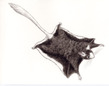
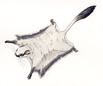
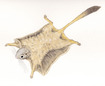
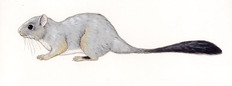
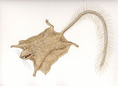
Seven species in 3 genera make up this strange family. Anomalurids are restricted to the forests of central Africa. They are small to moderately large rodents that look very much like squirrels. Resemblances include squirrel-like proportions of the head and body, and a long, furry tail (but differing from squirrels in usually being tufted, and never as bushy as in many sciurids). Even more remarkable, all but one species have gliding membranes very much like those of flying squirrels. And like flying squirrels, these anomalurids are accomplished gliders, leaping from the tops of trees and capable of agile bends and changes of direction.
Externally, anomalurids differ strikingly from squirrels in that the underside of their tails have two rows of pointed, raised scales. These are apparently used to anchor the tail as the animal pushes against the trunk of a tree. Anomalurids also differ from flying squirrels in that the cartilaginous rod that supports the leading edge of the gliding membrane arises from the elbow, rather than the wrist. The ears are larger than typically is the case in squirrels.

The skulls of anomalurids are nothing like those of squirrels. The infraorbital canal is huge and transmits the medial masseter ( hystricomorphous) The zygomatic plate is narrow and nearly horizontal in orientation, very different from the broad and vertical plate of sciurids. Short postorbital processes adorn the frontals. The lower jaws are sciurognathous. The cheekteeth are brachydont and rooted, with 4 or 5 crests; the dental formula is 1/1, 0/0, 1/1, 3/3 = 20.


Most species of anomalurids show considerable variation in their color pattern, but most are brightly colored. The feet bear sharp, curved claws.
Anomalurids are vegetarians, feeding on fruit, bark, flowers, and sometimes insects. They are usually found in pairs, but sometimes in colonies of up to 100 individuals. They often den in hollow trees. The non-gliding anomalurid, Zenkerella, has no trace of the gliding membrane. It possesses scales along the base of its tail, however, and there is little doubt that it belongs to this group.
Anomalurids are known from the early Miocene of Africa. Their relationship to other rodents is not known.
References and literature cited:
Feldhamer, G. A., L. C. Drickamer, S. H. Vessey, and J. F. Merritt. 1999. Mammalogy. Adaptation, Diversity, and Ecology. WCB McGraw-Hill, Boston. xii+563pp.
McLaughlin, C. A. 1984. Protrogomorph, sciuromorph, castorimorph, myomorph (geomyoid, anomaluroid, pedetoid, and ctenodactyloid) rodents. Pp. 267-288 in Anderson, S. and J. K. Jones, Jr. (eds). Orders and Families of Recent Mammals of the World. John Wiley and Sons, N.Y. xii+686 pp.
Paradiso, J. L. 1975. Walker's Mammals of the World, Third Edition. Johns Hopkins University Press, Baltimore.
Savage, R. J. G. and M. R. Long. 1986. Mammal Evolution, an Illustrated Guide. Facts of File Publications, New York. 259 pp.
Vaughan, T. A. 1986. Mammalogy. Third Edition. Saunders College Publishing, Fort Worth. vii+576 pp.
Vaughan, T. A., J. M. Ryan, N. J. Czaplewski. 2000. Mammalogy. Fourth Edition. Saunders College Publishing, Philadelphia. vii+565pp.
Wilson, D. E., and D. M. Reeder. 1993. Mammal Species of the World, A Taxonomic and Geographic Reference. 2nd edition. Smithsonian Institution Press, Washington. xviii+1206 pp.
Glossary
- bilateral symmetry
-
having body symmetry such that the animal can be divided in one plane into two mirror-image halves. Animals with bilateral symmetry have dorsal and ventral sides, as well as anterior and posterior ends. Synapomorphy of the Bilateria.
- chemical
-
uses smells or other chemicals to communicate
- endothermic
-
animals that use metabolically generated heat to regulate body temperature independently of ambient temperature. Endothermy is a synapomorphy of the Mammalia, although it may have arisen in a (now extinct) synapsid ancestor; the fossil record does not distinguish these possibilities. Convergent in birds.
- motile
-
having the capacity to move from one place to another.
- sexual
-
reproduction that includes combining the genetic contribution of two individuals, a male and a female
- tactile
-
uses touch to communicate