Anniella pulchraCalifornia Legless Lizard
Geographic Range
California legless lizards are found in California and Mexico. They are found from western central California (San Joaquin and the coastal regions), through northwestern Baja California, and as far south as Colonia Guerrero, Mexico (Miller 1944; Stebbins 2003). (Miller, 1944; Stebbins, 2003)
Habitat
Unlike most lizards, California legless lizards prefer lower temperatures. In one study it was found that the average temperature of these lizards was between 21 and 28 degrees Celsius. They suggest that being adapted to this lower and wider range of temperatures allows them to remain active in the cooler temperatures of their subterranean environments. They can also remain active in cooler temperatures above ground. have “increased activity in its subterranean environment,” which is in line with observations that they are active on cooler days. (Bury and Balgooyen, 1976; Miller, 1944)
California legless lizards require loose sand for burrowing (sand, loam, or humus), moisture, warmth, and plant cover (Stebbins 2003). As a result, they are most commonly found within 100 km of the coast in dunes which harbor bush lupine (Lupinus arboreus), mock heather (Eriogonum parvilfolium), mock aster (Ericameria ericoides), and other native coastal shrubs (Jennings and Hayes 1994). These shrubs are ideal because they provide plenty of leaf litter, which helps keep temperatures in the sand relatively low and moisture content relatively high on hot days, and have extensive root systems, which attract plenty of insects for prey. (Jennings and Hayes, 1994; Stebbins, 2003)
Additionally, moisture is a key aspect of their environment. Without adequate moisture they cannot shed their skin, which inhibits vision and feeding, causing them to become inactive and even starve to death (Miller 1944). (Miller, 1944)
- Habitat Regions
- temperate
- terrestrial
- Terrestrial Biomes
- desert or dune
- chaparral
- scrub forest
-
- Range elevation
- 0 to 1800 m
- 0.00 to 5905.51 ft
Physical Description
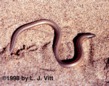
California legless lizards are often mistaken for snakes because of their complete lack of limbs and elongated bodies. However, California legless lizards lack external ear openings and have unreduced eyes with moveable lids (Cogger and Zweifel, 1998). California legless lizards can also use tail autotomy to avoid predation, unlike snakes. Snout to vent length is 90 to 170 mm and total length is around 200 mm. Generally females are slightly larger, males are smaller by up to 10% of female size. Sexes are nearly impossible to distinguish without dissection. (Cogger and Zweifel, 1998; Miller, 1943; Wiens and Slingluff, 2001)
Color varies with subspecies. In the more common Anniella pulchra pulchra, newborn lizards start out as a silvery drab color on their dorsal side and various shades of yellow on the ventral side. Anniella pulchra nigra begin life as silvery on their dorsal side and yellowy on their underside, but change with age. Adults vary in color from brown, to dark brown, to completely black.
Markings include one generally well defined line along the top of the backside and several other lateral sides. Depending of the overall darkness of the specimen, the markings vary in prominence and definition. In the blackest examples, the lines are not noticeable (Miller 1943). (Fusari, 1984; Fusari, 1985; Jennings and Hayes, 1994; Miller, 1943)
- Other Physical Features
- heterothermic
- Sexual Dimorphism
- sexes alike
- female larger
-
- Range mass
- 0.9 to 4.7 g
- 0.03 to 0.17 oz
-
- Range length
- 111 to 228 mm
- 4.37 to 8.98 in
-
- Range basal metabolic rate
- .028 to .116 cm3.O2/g/hr
Development
Aside from size and color, newly born Anniella pulchra are nearly identical to their adult forms. As they grow, their dorsal color usually darkens: slightly in Anniella pulchra pulchra, and more significantly in Anniella pulchra nigra.
Reproduction
Not much is known about mating in California legless lizards.
Little data is available on the reproductive behaviors of California legless lizards. The breeding season is thought to be between the spring months and July and young are commonly born between September and November, suggesting a gestation period of four months. California legless lizards typically mature at two to three years of age for males and females (respectively). Maturation seems to be linked to size: 90 mm snout to vent length in males and 121 mm snout to vent length in females are the sizes at which sexual maturity is reached. Females are ovoviviparous and give live birth to litters of one to four young, most often two (Jenning and Hayes 1994; Miller 1944; Dudek and Associates, Inc. 2000). (Dudek and Associates, Inc, 2000; Jennings and Hayes, 1994; Miller, 1944)
- Key Reproductive Features
- iteroparous
- seasonal breeding
- sexual
- fertilization
- ovoviviparous
-
- Breeding interval
- California legless lizards have been observed to breed biennially, but it is not known if this is true of all populations.
-
- Breeding season
- The breeding season probably occurs between early spring and July.
-
- Range number of offspring
- 1 to 4
-
- Average number of offspring
- 2
-
- Average gestation period
- 4 months
-
- Average age at sexual or reproductive maturity (female)
- 2 years
-
- Average age at sexual or reproductive maturity (male)
- 3 years
As with most species of lizards, there is little to no parental investment in California legless lizards. Young are born live and are immediately independent (Miller 1944). (Miller, 1944)
- Parental Investment
- no parental involvement
-
pre-fertilization
- provisioning
-
protecting
- female
-
pre-hatching/birth
-
provisioning
- female
-
protecting
- female
-
provisioning
Lifespan/Longevity
There exists almost no data on the longevity of California legless lizards in the wild, though one adult specimen is known to have lived for six years in a lab (Jennings and Hayes 1994). (Jennings and Hayes, 1994)
-
- Range lifespan
Status: captivity - 6 (high) years
- Range lifespan
Behavior
Rarely seen above ground, California legless lizards spend most of their time below the surface. Reports indicate that most California legless lizards are found within 2 to 3 inches of the surface, though there have been reports of people finding them at depths of 8 to 12 inches, and sometimes several feet. They can also be found on the soil surface, but almost always under some sort of cover, such as a log, board, or leaf litter (Miller 1994). When placed above the sand or soil, specimens will immediately bury themselves at least slightly. California legless lizards are solitary. (Dudek and Associates, Inc, 2000; Miller, 1944)
Home Range
Though there is a general lack of data in this area, there is one known experiment where 27 lizards were caught, marked, and released in the same area they were caught. Two months later 10 of the marked lizards were found in the same area, all less than 10 m from the initial site of capture. This data lends credence to the presence of a predominately sedentary behavior, though they are likely to move in the event that their microhabitats and resource sources are disturbed (Miller 1944; Dudek and Associates, Inc. 2000). (Dudek and Associates, Inc, 2000; Miller, 1943)
Communication and Perception
Though it is unknown how California legless lizards communicate or interact,there is a fair bit known about how they perceive their environment. They have eyes and are believed to be relatively near-sighted. Though they have no external ear openings, they have a keen sense of mechanical disturbances and can sense vibrations well; individuals almost never feed aboveground, instead preferring to dig under ground and come up directly beneath the prey. Olfactory senses also seem likely as there are recorded instances of California legless lizards sticking their heads above ground while the body is still submerged and licking at the air, as if tasting it (Miller 1944). (Miller, 1944)
- Perception Channels
- visual
- tactile
- vibrations
- chemical
Food Habits
California legless lizards forage in leaf litter for prey. Their primary diet consists of insect larvae, termites, beetles, spiders, and other invertebrates (Dudek and Associates, Inc. 2000; Stebbins 2003). Often they will not eat prey on the surface, but will burrow underground before consuming the prey (Miller 1944). (Dudek and Associates, Inc, 2000; Miller, 1944; Stebbins, 2003)
- Primary Diet
-
carnivore
- insectivore
- eats non-insect arthropods
- Animal Foods
- insects
- terrestrial non-insect arthropods
Predation
California legless lizards avoid most predation by spending most of their time underground. However, when threatened by a predator they are able to lose their tail in order to escape. The tail will regenerate over the course of about one year, but will be much shorter, darker, and more blunt than the original. More than half of all individuals have regrown tails (Miller 1944).
Predators include ringneck snakes (Diadophis punctatus), common kingsnakes (Lampropeltis getula), deer mice (Peromyscus maniculatus), long-tailed weasels (Mustela frenata), domestic cats (Felis sylvestris), California thrashers (Toxostoma redivivum), American robins (Turdus migratorius), and loggerhead shrikes (Lanius ludovicianus) (Jennings and Hayes 1994; Miller 1944). (Jennings and Hayes, 1994; Miller, 1944)
-
- Known Predators
-
- ringneck snakes (Diadophis punctatus)
- common kingsnakes (Lampropeltis getula)
- deer mice (Peromyscus maniculatus)
- long-tailed weasels (Mustela frenata)
- domestic cats (Felis sylvestris)
- California thrashers (Toxostoma redivivum)
- loggerhead shrikes (Lanius ludovicianus)
- American robins (Turdus migratorius)
Ecosystem Roles
Other than their immediate effect on prey and predators, not much is known about the role of Anniella pulchra in the ecosystems they inhabit. It is reported that they are parasitized by a nematode and a cestode (Miller 1944). (Miller, 1944)
Economic Importance for Humans: Positive
California legless lizards provide no known direct benefit to humans, although all species could play important roles in ecosystem stability.
Economic Importance for Humans: Negative
There are no known adverse effects of Anniella pulchra on humans.
Conservation Status
The main threat facing California legless lizards is human habitat disturbance. Harmful activities include the destruction of natural habitat for agriculture, housing developments, sand mining, golf courses, and off-road vehicle activities (Stebbins 2003). Additionally, exotic plant species, such as ice plants (Carpobrotus edulis and Mesembryanthemum crystallinum), Marram grass (Ammophila arenaria), veldt grass (Ehrharta calycina) and eucalyptus trees (Eucalyptus spp.) support much smaller populations of insects and arthropods, which these lizards depend on for food (Jennings and Hayes 1994).
In 1998 to 1999, a moderate-high impact search was done at Moss Landing dune, California, over an area of 1.57 hectares. Previous studies based on lower impact searches would suggest a population of about 170, though researchers found nearly 3600. These results suggest that California legless lizards may be locally abundant (Kuhnz et al. 2005).
Though California legless lizards are listed as a species of special concern in California, they are not protected by federal or international regulations.
In 1998, a rule was proposed to the Department of the Interior Fish and Wildlife Service to list Anniella pulchra nigra as endangered, but it was withdrawn based on the amount of currently protected habitat and conservation efforts to restore native vegetation to dunes colonized by alien vegetation. ("Endangered and Threatened Wildlife and Plants; Withdrawal of Proposed Rule to List the Black Legless Lizard as Endangered", 1998; Dudek and Associates, Inc, 2000; Jennings and Hayes, 1994; Kuhnz, et al., 2005; Stebbins, 2003)
-
- IUCN Red List
-
Least Concern
More information
-
- IUCN Red List
-
Least Concern
More information
-
- US Federal List
- No special status
-
- CITES
- No special status
Other Comments
Recent genetic research has brought up interesting questions about the evolutionary history of California legless lizards. Pearse and Pogson (2000) discovered the subspecies were split into separate northern and southern clades. They believe that the two populations are actually an example of parallel evolution, the darker variation of Anniella pulchra arising independently at least two times (2000). Another study done by Parham and Papenfuss (2008) determined the presence of at least five deep genetic lineages of Anniella pulcrha throughout California. They suggest that some clades are "genetically isolated to the point of being considered species under some concepts" (Parham and Papenfuss 2008, p. 5). These deep genetic variations require more study as they may have important conservation implications. (Parham and Papenfuss, 2008; Pearse and Pogson, 2000)
Contributors
Tanya Dewey (editor), Animal Diversity Web.
Steven Lee (author), University of Maryland, Baltimore County, Kevin Omland (editor, instructor), University of Maryland, Baltimore County.
Glossary
- Nearctic
-
living in the Nearctic biogeographic province, the northern part of the New World. This includes Greenland, the Canadian Arctic islands, and all of the North American as far south as the highlands of central Mexico.

- carnivore
-
an animal that mainly eats meat
- chaparral
-
Found in coastal areas between 30 and 40 degrees latitude, in areas with a Mediterranean climate. Vegetation is dominated by stands of dense, spiny shrubs with tough (hard or waxy) evergreen leaves. May be maintained by periodic fire. In South America it includes the scrub ecotone between forest and paramo.
- chemical
-
uses smells or other chemicals to communicate
- desert or dunes
-
in deserts low (less than 30 cm per year) and unpredictable rainfall results in landscapes dominated by plants and animals adapted to aridity. Vegetation is typically sparse, though spectacular blooms may occur following rain. Deserts can be cold or warm and daily temperates typically fluctuate. In dune areas vegetation is also sparse and conditions are dry. This is because sand does not hold water well so little is available to plants. In dunes near seas and oceans this is compounded by the influence of salt in the air and soil. Salt limits the ability of plants to take up water through their roots.
- fertilization
-
union of egg and spermatozoan
- fossorial
-
Referring to a burrowing life-style or behavior, specialized for digging or burrowing.
- heterothermic
-
having a body temperature that fluctuates with that of the immediate environment; having no mechanism or a poorly developed mechanism for regulating internal body temperature.
- insectivore
-
An animal that eats mainly insects or spiders.
- iteroparous
-
offspring are produced in more than one group (litters, clutches, etc.) and across multiple seasons (or other periods hospitable to reproduction). Iteroparous animals must, by definition, survive over multiple seasons (or periodic condition changes).
- native range
-
the area in which the animal is naturally found, the region in which it is endemic.
- ovoviviparous
-
reproduction in which eggs develop within the maternal body without additional nourishment from the parent and hatch within the parent or immediately after laying.
- scrub forest
-
scrub forests develop in areas that experience dry seasons.
- seasonal breeding
-
breeding is confined to a particular season
- sedentary
-
remains in the same area
- sexual
-
reproduction that includes combining the genetic contribution of two individuals, a male and a female
- solitary
-
lives alone
- tactile
-
uses touch to communicate
- temperate
-
that region of the Earth between 23.5 degrees North and 60 degrees North (between the Tropic of Cancer and the Arctic Circle) and between 23.5 degrees South and 60 degrees South (between the Tropic of Capricorn and the Antarctic Circle).
- terrestrial
-
Living on the ground.
- vibrations
-
movements of a hard surface that are produced by animals as signals to others
- visual
-
uses sight to communicate
References
Department of the Interior Fish and Wildlife Service. Endangered and Threatened Wildlife and Plants; Withdrawal of Proposed Rule to List the Black Legless Lizard as Endangered. FR Doc. 98–21565. Federal Register. 1998. Accessed April 15, 2008 at http://frwebgate.access.gpo.gov/cgi-bin/getdoc.cgi?dbname=1998_register&docid=98-21565-filed.pdf.
Bury, R., T. Balgooyen. 1976. Temperature Selectivity in the Legless Lizard, Anniella pulchra. Copeia, No. 1: 152-155.
Cogger, H., R. Zweifel. 1998. Encyclopedia of Reptiles and Pmphibians. Sydney, Australia: Weldon Owen Pty Limited.
Dudek and Associates, Inc, 2000. "California Legless Lizard" (On-line). Western Riverside County Multiple Species Habitat Conservation Plan. Accessed April 15, 2008 at http://ecoregion.ucr.edu/full.asp?sp_num=38.
Fusari, M. 1985. Drinking of Soil Water by the Califonia Legless Lizard. Copeia, 4: 981-986.
Fusari, M. 1984. Temperature responses of standard, aerobic metabolism by the California Legless Lizard Anniella pulchra. Comp. Biochem. Physiol., Vol 77A, No. 1: 97-101.
Jennings, M., M. Hayes. 1994. Amphibian and Reptile Species of Special Concern in California. California Department of Fish and Game, Special Publication: 1-20. Accessed April 15, 2008 at http://www.dfg.ca.gov/habcon/info/herp_ssc.pdf.
Kuhnz, L., R. Burton, P. Slattery, J. Oakden. 2005. Microhabitats and Populaiton Densities of California Legless Lizards, with Comments of Effectiveness of Various Techniques for Estimating Numbers of Fossorial Reptiles. Journal of Herpetology, Vol 39, No. 3: 395-402. Accessed April 15, 2008 at http://www.bioone.org/archive/0022-1511/39/3/pdf/i0022-1511-39-3-395.pdf.
Miller, C. 1943. An Intergradient Population Connecting Anniella pulchra pulchra and Anniella pulchra nigra. Copeia, No. 1: 2-7.
Miller, C. 1944. Ecological Relations and Adaptations of the Limbless Lizard of the Genus Anniella. Ecological Monographs, Vol 14, No. 3: 271-289. Accessed April 15, 2008 at http://www.jstor.org/stable/1948444.
Parham, J., T. Papenfuss. 2008. High genetic diversity among fossorial lizard populaitons (Anniella pulchra) in a rapidly developing landscape (Central California). Conservation Genetics. Accessed April 15, 2008 at http://www.springerlink.com/content/j27512g20j161x86/fulltext.pdf.
Pearse, D., G. Pogson. 2000. Parallel evolution of the mellanic form of the California Legless Lizard, Anniella pulchra, inferred from mitochondrial DNA sequence variation. Evolution, Vol 53, No. 3: 1041-1046. Accessed April 15, 2008 at http://www.blackwell-synergy.com/doi/pdf/10.1111/j.0014-3820.2000.tb00104.x.
Stebbins, R. 2003. A Field Guide to Western Reptiles and Amphibians. HMCo Field Guides. Accessed April 15, 2008 at http://books.google.com/books?id=9JznHN2VFzkC&printsec=frontcover&dq=stebbins&sig=QeDT7q-JjvkpK5ahT2q9eP2kfbg#PPT188,M1.
Wiens, J., J. Slingluff. 2001. How lizards turn into snakes: a phylogenic analysis of body-form evolution in Anguid lizards. Evolution, 55(11): 2303-2318. Accessed April 15, 2008 at http://www.blackwell-synergy.com/doi/pdf/10.1111/j.0014-3820.2001.tb00744.x.