Anas platyrhynchosmallard



Geographic Range
Mallards can be found almost anywhere in the world. They dominate the Northern Hemisphere, and can be found easly in Oceana, Asia, Africa, South America and many islands
- Biogeographic Regions
- nearctic
- palearctic
- oriental
- ethiopian
- neotropical
- australian
- oceanic islands
Habitat
Most often, they prefer wetlands, where highly productive waters produce large amounts of floating, emergent and submerged vegetation Wetlands also produce a great deal of aquatic invertebrates on which mallards feed.
- Terrestrial Biomes
- taiga
- savanna or grassland
- forest
- rainforest
- scrub forest
- Aquatic Biomes
- lakes and ponds
- rivers and streams
- coastal
Physical Description
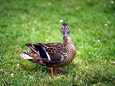
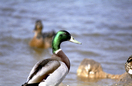
The mallard is undoubtably the most recognized waterfowl in the world. The familiar duck morphology is complemented with a iridesent blue speculum on the wings in both sexes. On the male, the notable characteristics are the green iridesent plumage on the head and neck, and curled black feathers on the tail. The female's plumage is drab brown.
- Other Physical Features
- endothermic
- bilateral symmetry
Reproduction
Most mallard hens breed as yearlings, but they may not have much success; studies show that older hens have much lower duckling mortality than yearlings. Pair bonding starts as early as October and continues through March. Mallard males leave the hen soon after mating occurs. The hen usually lays 9 -13 eggs in a nest on the ground near a body of water. When the ducklings hatch after 26-28 days, the hen leads them to water and does not return to the nest.
- Key Reproductive Features
- iteroparous
- gonochoric/gonochoristic/dioecious (sexes separate)
- sexual
- oviparous
Lifespan/Longevity
-
- Average lifespan
Status: wild - 316 months
- Bird Banding Laboratory
- Average lifespan
Behavior
After the breeding season, mallards form flocks and migrate from northern lattitudes to warmer southern areas. There they wait and feed until the breeding season starts again. Some mallards, however, may choose to stay through the winter in areas where food and shelter are abundant; these mallards make up a resident populations.
The familiar "quack" of ducks is from the female mallard--it is named the "decrescendo call", and can be heard for miles. A female will give the call when she wants to bring other ducks to her, such as her ducklings, and as a result it is also known as the "hail call".
Communication and Perception
Food Habits
Mallards consume a wide variety of foods, including vegetation, insects, worms, gastropods and arthropods, although they are not restricted to these. They also take advantage of human food sources, such as gleaning grain from crops.
Economic Importance for Humans: Positive
An important game species. The money generated by license fees pays for the management of mallard populations and is used to protect important habitats. Also, money spent on hunting equipment is a significant addition to the economy.
Conservation Status
Mallards are the most abundant and widespread of all waterfowl; every year millions are harvested by hunters with little effect on their numbers. The greatest threat to mallards is loss of habitat, but they readily adapt to human disturbances.
-
- IUCN Red List
-
Least Concern
More information
-
- IUCN Red List
-
Least Concern
More information
-
- US Migratory Bird Act
- Protected
-
- US Federal List
- No special status
-
- CITES
- No special status
-
- State of Michigan List
- No special status
Contributors
Dave Rogers (author), University of Michigan-Ann Arbor.
Glossary
- Australian
-
Living in Australia, New Zealand, Tasmania, New Guinea and associated islands.

- Ethiopian
-
living in sub-Saharan Africa (south of 30 degrees north) and Madagascar.
- Nearctic
-
living in the Nearctic biogeographic province, the northern part of the New World. This includes Greenland, the Canadian Arctic islands, and all of the North American as far south as the highlands of central Mexico.
- Neotropical
-
living in the southern part of the New World. In other words, Central and South America.
- Palearctic
-
living in the northern part of the Old World. In otherwords, Europe and Asia and northern Africa.
- acoustic
-
uses sound to communicate
- bilateral symmetry
-
having body symmetry such that the animal can be divided in one plane into two mirror-image halves. Animals with bilateral symmetry have dorsal and ventral sides, as well as anterior and posterior ends. Synapomorphy of the Bilateria.
- chemical
-
uses smells or other chemicals to communicate
- coastal
-
the nearshore aquatic habitats near a coast, or shoreline.
- endothermic
-
animals that use metabolically generated heat to regulate body temperature independently of ambient temperature. Endothermy is a synapomorphy of the Mammalia, although it may have arisen in a (now extinct) synapsid ancestor; the fossil record does not distinguish these possibilities. Convergent in birds.
- forest
-
forest biomes are dominated by trees, otherwise forest biomes can vary widely in amount of precipitation and seasonality.
- iteroparous
-
offspring are produced in more than one group (litters, clutches, etc.) and across multiple seasons (or other periods hospitable to reproduction). Iteroparous animals must, by definition, survive over multiple seasons (or periodic condition changes).
- migratory
-
makes seasonal movements between breeding and wintering grounds
- motile
-
having the capacity to move from one place to another.
- native range
-
the area in which the animal is naturally found, the region in which it is endemic.
- oceanic islands
-
islands that are not part of continental shelf areas, they are not, and have never been, connected to a continental land mass, most typically these are volcanic islands.
- oriental
-
found in the oriental region of the world. In other words, India and southeast Asia.
- oviparous
-
reproduction in which eggs are released by the female; development of offspring occurs outside the mother's body.
- rainforest
-
rainforests, both temperate and tropical, are dominated by trees often forming a closed canopy with little light reaching the ground. Epiphytes and climbing plants are also abundant. Precipitation is typically not limiting, but may be somewhat seasonal.
- scrub forest
-
scrub forests develop in areas that experience dry seasons.
- sexual
-
reproduction that includes combining the genetic contribution of two individuals, a male and a female
- social
-
associates with others of its species; forms social groups.
- tactile
-
uses touch to communicate
- taiga
-
Coniferous or boreal forest, located in a band across northern North America, Europe, and Asia. This terrestrial biome also occurs at high elevations. Long, cold winters and short, wet summers. Few species of trees are present; these are primarily conifers that grow in dense stands with little undergrowth. Some deciduous trees also may be present.
- tropical savanna and grassland
-
A terrestrial biome. Savannas are grasslands with scattered individual trees that do not form a closed canopy. Extensive savannas are found in parts of subtropical and tropical Africa and South America, and in Australia.
- savanna
-
A grassland with scattered trees or scattered clumps of trees, a type of community intermediate between grassland and forest. See also Tropical savanna and grassland biome.
- temperate grassland
-
A terrestrial biome found in temperate latitudes (>23.5° N or S latitude). Vegetation is made up mostly of grasses, the height and species diversity of which depend largely on the amount of moisture available. Fire and grazing are important in the long-term maintenance of grasslands.
- visual
-
uses sight to communicate
References
Todd, Frank S. "Natural History of the Waterfowl". San Diego Natural History Museum.
Ibis Publishing Co. Vista, CA 1996.
Moon, Morgan H. "Waterfowl Ecology and Management". McMillian Publishing. New York,NY 1994.