Alcedo atthiscommon kingfisher
Geographic Range
Alcedo atthis is found throughout Europe and Asia as far east as Japan. They are also found in Africa, south of the Sahara. Common kingfishers are year long residents in their southern habitats, while northern populations travel south during the winter to escape freezing water. Alcedo atthis is the only species of kingfisher in much of its European range. (Tan, 2001; Wikipedia, 2005)
Habitat
Common kingfishers are found on the shores of lakes, ponds, streams, and in wetlands. They have even been known to fish in brackish waters, especially during the winter months, when other bodies of water may be frozen. (Bannerman, 1955; Wikipedia, 2005)
- Habitat Regions
- temperate
- terrestrial
- saltwater or marine
- freshwater
- Aquatic Biomes
- lakes and ponds
- rivers and streams
- coastal
- brackish water
-
- Range elevation
- 0 to 190 m
- 0.00 to 623.36 ft
Physical Description
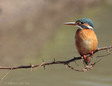
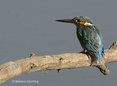
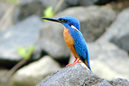
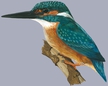
Common kingfishers are reknowned for their iridescent blue plumage. The entire upper portion of the bird: wings, back, and head are completely blue. The underbelly and a small patch underneath the eyes are rich chestnut. The throat and a small part of the side of the neck is bright white. They have small red feet. Their beaks are long, sharp and strong for the purpose of catching and holding prey. Males and females are very similar except for their beaks. A male’s beak is jet black, while the lower half of a female’s beak is chestnut. Juvenile’s are slightly more green and duller than adults. (Human Ageing Genomic Resources, 2005; Tan, 2001; Wikipedia, 2005)
- Other Physical Features
- endothermic
- homoiothermic
- bilateral symmetry
- Sexual Dimorphism
- sexes colored or patterned differently
-
- Range mass
- 26 to 39 g
- 0.92 to 1.37 oz
-
- Average mass
- 34 g
- 1.20 oz
-
- Average length
- 17 cm
- 6.69 in
-
- Range wingspan
- 24 (low) cm
- 9.45 (low) in
-
- Average wingspan
- 26 cm
- 10.24 in
-
- Average basal metabolic rate
- 0.3780 cm3.O2/g/hr
-
- Average basal metabolic rate
- 0.378 W
- AnAge
Reproduction
Mating is the only time that Alcedo atthis individuals are not solitary. At the beginning of the mating season, males will chase females through the trees, producing a loud whistle. Common kingfishers will find a new mate each year. Mating only occurs in the warmer months of the year, starting in April and ending sometimes as late as October. (Bannerman, 1955; Wikipedia, 2005)
- Mating System
- monogamous
In about mid-March nesting begins. The male and female work together to dig a hole into a bank along a water source. Common kingfishers prefer steep banks. The holes are of various depths and are dug into various types of soil. Usually a hole between 15 and 30 cm long is dug, but on occasion some as deep as 1.2 meters have been discovered. They may nest in clay, rock, or sandy ground. Nests also vary in the distance they are above the water, with the distance varying from 0.5 to 37 meters above the water level.
Both parents will raise and feed the young. However, the female will do most of the work. Common kingfishers will brood 2 to 3 clutches a year. These clutches consist usually of 6 or 7 eggs, but there may be as many as 10. (Bannerman, 1955)
- Key Reproductive Features
- iteroparous
- seasonal breeding
- gonochoric/gonochoristic/dioecious (sexes separate)
- sexual
- oviparous
-
- Breeding interval
- Common kingfishers have 2-3 clutches yearly, one in April, another by July, and sometimes, a final clutch in early October.
-
- Breeding season
- Breeding occurs from early April until early October.
-
- Range eggs per season
- 4 to 10
-
- Average eggs per season
- 6
-
- Range time to hatching
- 18 to 21 days
-
- Range fledging age
- 23 to 27 days
Both males and females help to raise the young. For 19-21 days they incubate the eggs. Both will incubate during the day, only the female at night. Both have active roles in brooding and feeding the young, but the female does most of the work. One parent will hunt, then return with a fish exactly the right size for the young, they will also hold it by the tail so that the young can swallow the fish head first. When the young are able, they will eagerly wait at the opening of the burrow to be fed. After 23-27 days the young fledge and emerge from the nest. (Tan, 2001)
- Parental Investment
- altricial
-
pre-fertilization
- provisioning
-
protecting
- female
-
pre-hatching/birth
-
provisioning
- female
-
protecting
- male
- female
-
provisioning
-
pre-weaning/fledging
-
provisioning
- male
- female
-
protecting
- male
- female
-
provisioning
Lifespan/Longevity
Common kingfishers can live for as long as 15 years. The average lifespan is 7 years. However, the first months of development are the most dangerous with only 50% of the young surviving to adulthood. (Bannerman, 1955; Waterscape, 2005)
-
- Range lifespan
Status: wild - 21 (high) years
- Range lifespan
-
- Average lifespan
Status: wild - 7 years
- Average lifespan
-
- Average lifespan
Status: captivity - 21 years
- AnAge
- Average lifespan
Behavior
Common kingfishers are very territorial, as are all kingfishers (Alcedinidae). This is mainly because they must eat around 60% of their body weight each day. They will even defend their area from their mates and offspring. For most of the year individuals are solitary, roosting in heavy cover next to their favorite hunting spot. If another kingfisher enters its territory, both birds will sit on a perch some distance from each other and engage in territorial displays. This usually entails displaying beaks and plumage. Occasional fights also occur, where a bird will grab the other's beak and try to hold them under water. (Bannerman, 1955; Hagemeijer and Blair, 1997; Human Ageing Genomic Resources, 2005; Tan, 2001; Wikipedia, 2005)
The flight of common kingfishers is very fast, which makes their wings look like a blue haze. Common kingfishers can be seen flitting about waterways and wetlands. (Tan, 2001; Wikipedia, 2005)
Home Range
Territory size is highly variable. Size depends on food availability, the quality and availability of nesting sites and individual behavior.
Communication and Perception
Common kingfishers have advanced eyesight, with the ability to polarize light, reducing the reflection of light off of water. They also learn to compensate for refraction, allowing them to catch prey more effectively. Common kingfishers communicate vocally. They are well known for their long, trilling call which sounds like a repetition of “chee”. When mating, a male will whistle loudly to a female and chase her above and through the trees. In a dive for prey, a membrane covers their eyes and they rely solely on touch to know when to snap their jaws shut. (Bannerman, 1955; Tan, 2001)
- Perception Channels
- visual
- polarized light
- tactile
- acoustic
- chemical
Food Habits
Common kingfishers hunt for prey from a perch above the water. Perches may be several centimeters to several meters above the water. When they see potential prey, they dive into the water, grab the prey, and fly back out. Sometimes when a perch is unavailable they will hover above the water to search for prey. After catching a fish, common kingfishers will hold the prey by its tail, and whack it against the perch. This stuns or kills the prey, which is particularly important when eating fish with spines. After consuming a fish it will regurgitate a pellet of indigestible bone.
Common kingfishers eat mostly small fish, making up 60-67% of their diet. They may also eat small arthropods, such as Gammarus fasciatus. Crustacea consist of 5-33% of their diet. Common kingfishers have also been known to eat crabs and other small marine animals during the winter. (Bannerman, 1955; Tan, 2001)
- Animal Foods
- fish
- insects
- aquatic crustaceans
- other marine invertebrates
Predation
Common kingfishers have few natural predators as adults. However, because they are high on the food chain, they are susceptible to the effects of bioaccumulation, the concentration of pollutants as they climb the food chain. Nestlings may be preyed on by snakes and other ground-dwelling predators, but kingfishers are aggressive birds and do defend their young against predators. (Kingfisher wildlife information leaflet, 2005)
Ecosystem Roles
Kingfishers are a good indicator of ecosystem health. Because kingfishers eat small aquatic animals, they are severely effected by toxins in the water. A strong kingfisher population usually means a healthy enviroment. Common kingfishers are important predators on small fish in freshwater habitats throughout their range. (Kingfisher wildlife information leaflet, 2005)
Economic Importance for Humans: Positive
Common kingfishers are important members of ecosystems and good indicators of freshwater community health. (Bannerman, 1955)
- Positive Impacts
- body parts are source of valuable material
Economic Importance for Humans: Negative
Anglers once considered Alcedo atthis a threat to trout populations. However, only 7-28% of the fish that common kingfishers eat are trout fry. Common kingfishers have been known to poach fish farms, but are not numerous enough to cause significant economic losses. (Bannerman, 1955; Bannerman, 1955)
Conservation Status
Common kingfishers are not listed as a concern for many of the top conservation sites. However, common kingfishers do undergo large fluctuations in populations on a yearly basis. This is due mostly to severe cold. In one census, after a severe winter in Belgium there were only 8 pairs, five years later there were 45, but reduced to 25 the following year. (Bannerman, 1955; Hagemeijer and Blair, 1997)
-
- IUCN Red List
-
Least Concern
More information
-
- IUCN Red List
-
Least Concern
More information
-
- US Migratory Bird Act
- No special status
-
- US Federal List
- No special status
-
- CITES
- No special status
Other Comments
The blue and green color that Alcedo atthis is famous for is caused by iridescence rather than pigment. This means that in different lights and from different angles common kingfishers will look a different color.
In Greek mythology, kingfishers were thought to be the Halcyon bird, with the power to control the wind and waves. (Kingfisher wildlife information leaflet, 2005)
Contributors
Tanya Dewey (editor), Animal Diversity Web.
Ryan Gardner (author), Kalamazoo College, Ann Fraser (editor, instructor), Kalamazoo College.
Glossary
- Ethiopian
-
living in sub-Saharan Africa (south of 30 degrees north) and Madagascar.

- Palearctic
-
living in the northern part of the Old World. In otherwords, Europe and Asia and northern Africa.
- acoustic
-
uses sound to communicate
- altricial
-
young are born in a relatively underdeveloped state; they are unable to feed or care for themselves or locomote independently for a period of time after birth/hatching. In birds, naked and helpless after hatching.
- bilateral symmetry
-
having body symmetry such that the animal can be divided in one plane into two mirror-image halves. Animals with bilateral symmetry have dorsal and ventral sides, as well as anterior and posterior ends. Synapomorphy of the Bilateria.
- brackish water
-
areas with salty water, usually in coastal marshes and estuaries.
- carnivore
-
an animal that mainly eats meat
- chemical
-
uses smells or other chemicals to communicate
- coastal
-
the nearshore aquatic habitats near a coast, or shoreline.
- diurnal
-
- active during the day, 2. lasting for one day.
- endothermic
-
animals that use metabolically generated heat to regulate body temperature independently of ambient temperature. Endothermy is a synapomorphy of the Mammalia, although it may have arisen in a (now extinct) synapsid ancestor; the fossil record does not distinguish these possibilities. Convergent in birds.
- estuarine
-
an area where a freshwater river meets the ocean and tidal influences result in fluctuations in salinity.
- freshwater
-
mainly lives in water that is not salty.
- iteroparous
-
offspring are produced in more than one group (litters, clutches, etc.) and across multiple seasons (or other periods hospitable to reproduction). Iteroparous animals must, by definition, survive over multiple seasons (or periodic condition changes).
- migratory
-
makes seasonal movements between breeding and wintering grounds
- monogamous
-
Having one mate at a time.
- motile
-
having the capacity to move from one place to another.
- native range
-
the area in which the animal is naturally found, the region in which it is endemic.
- oriental
-
found in the oriental region of the world. In other words, India and southeast Asia.
- oviparous
-
reproduction in which eggs are released by the female; development of offspring occurs outside the mother's body.
- piscivore
-
an animal that mainly eats fish
- polarized light
-
light waves that are oriented in particular direction. For example, light reflected off of water has waves vibrating horizontally. Some animals, such as bees, can detect which way light is polarized and use that information. People cannot, unless they use special equipment.
- riparian
-
Referring to something living or located adjacent to a waterbody (usually, but not always, a river or stream).
- saltwater or marine
-
mainly lives in oceans, seas, or other bodies of salt water.
- seasonal breeding
-
breeding is confined to a particular season
- sedentary
-
remains in the same area
- sexual
-
reproduction that includes combining the genetic contribution of two individuals, a male and a female
- solitary
-
lives alone
- tactile
-
uses touch to communicate
- temperate
-
that region of the Earth between 23.5 degrees North and 60 degrees North (between the Tropic of Cancer and the Arctic Circle) and between 23.5 degrees South and 60 degrees South (between the Tropic of Capricorn and the Antarctic Circle).
- terrestrial
-
Living on the ground.
- territorial
-
defends an area within the home range, occupied by a single animals or group of animals of the same species and held through overt defense, display, or advertisement
- visual
-
uses sight to communicate
References
Bannerman, D. 1955. The Birds Of The British Isles. Edinburgh: Tweedale Court London: 39a Welbeck Street: Oliver and Boyd LTD..
Hagemeijer, W., M. Blair. 1997. The EBCC Atlas Of European Breeding Birds. 24-28 Oval Road, London NW17DX: T and AD Pyser Ltd..
Human Ageing Genomic Resources, 2005. "AnAge entry for Alcedo atthis (HAGRID 01037)" (On-line). Accessed October 26, 2005 at http://genomics.senescence.info/species/entry.php?species=Alcedo_atthis.
Kingfisher wildlife information leaflet, 2005. "The Royal Society for the Protection of Birds" (On-line). Accessed October 12, 2005 at http://www.rspb.org.uk/birds/guide/k/kingfisher/fishing.asp.
Seago, M. 2005. "Birds of Britain" (On-line). Accessed October 20, 2005 at http://www.birdsofbritain.co.uk/bird-guide/kingfisher.htm.
Seago, M. 2005. "Birds of Britain" (On-line). Accessed October 12, 2005 at http://www.birdsofbritain.co.uk/bird-guide/kingfisher.htm.
Tan, R. 2001. "Mangrove and wetland wildlife at Sungei Buloh Wetlands Reserve" (On-line). Accessed November 03, 2005 at http://www.naturia.per.sg/buloh/birds/Alcedo_atthis.htm.
Waterscape, 2005. "Kingfishers" (On-line). Accessed November 22, 2005 at http://www.waterscape.com/features/wildlife/kingfisher.html.
Wikipedia, 2005. "European Kingfisher" (On-line). Accessed November 09, 2005 at http://en.wikipedia.org/wiki/Alcedo_atthis.